Almost one in three Americans used a wearable device to track health and fitness in 2023, and more than 80% of those users said they'd share the data with a doctor, which tells you this category has already moved far beyond gym gadgets and into the clinical conversation (NIH/NHLBI wearable device trends among U.S. adults). At the same time, the broader patient monitoring devices market is projected at USD 52.60 billion in 2025 and USD 76.11 billion by 2031, with another forecast putting it at USD 118.21 billion by 2033 (MarketsandMarkets patient healthcare monitoring systems and devices market). Those two numbers point to the same reality, health monitoring devices are no longer niche equipment. They're becoming part of everyday triage, chronic-disease follow-up, and home-based decision-making.
That matters because a reading on a screen is only useful if you know what kind of device produced it, how it measured the signal, and whether anyone validated it for the situation you're in. A thermometer, pulse oximeter, smartwatch, and home respiratory monitor can all help flag change, but they don't mean the same thing, and they don't carry the same clinical weight. A viral-surveillance workflow, a home isolation decision, and a hospital discharge plan may all use device data, yet each one needs a different level of trust.

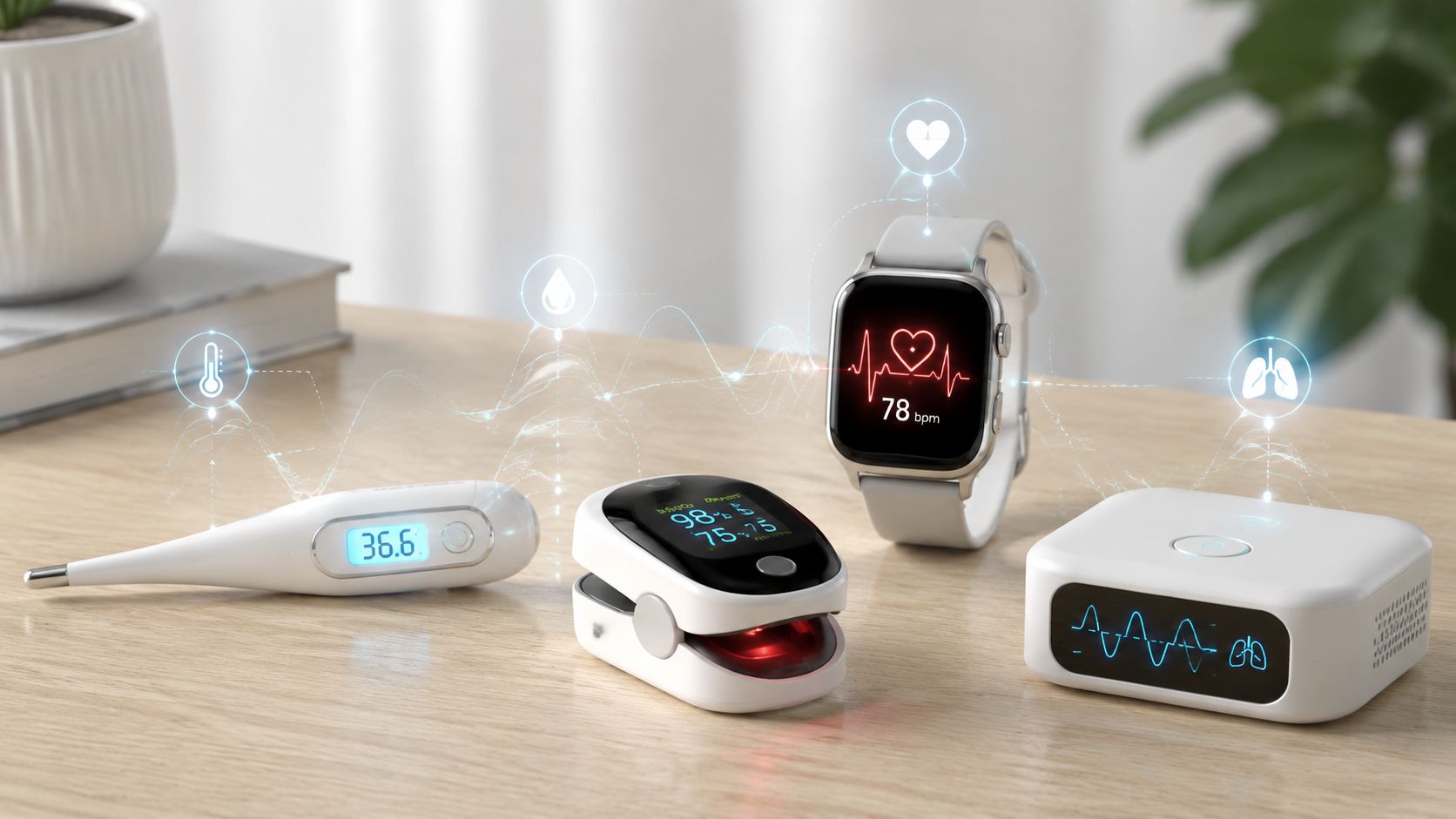
A useful way to read the field is to think in four families. Personal thermometers spot body temperature changes. Pulse oximeters estimate oxygen saturation and pulse. Wearable continuous monitors track signals over time, often through the day and night. Home and remote sensors can add respiration, movement, or multi-parameter tracking when a person isn't sitting in a clinic. If you want a quick consumer-facing overview of options, validated health monitoring tools is one place to compare features without confusing wellness marketing with medical validation.
What Health Monitoring Devices Are and Why They Matter Now
Health monitoring devices are instruments that measure physiological signals repeatedly or continuously outside a one-off clinic visit. Some are designed for consumers, some are regulated medical devices, and some live awkwardly in between, where the hardware is capable but the claims are narrower than the marketing suggests. The distinction matters because the same number can mean “interesting trend,” “needs review,” or “call a clinician now,” depending on the context.
The basic job these devices perform
At the simplest level, they answer questions like, Is the body running hot, is oxygen delivery slipping, is the heart rate drifting, is breathing changing, and is activity dropping off in a way that suggests illness. That's why these tools have value in viral surveillance, patient triage, and chronic-disease follow-up. A fever pattern at home can help a family decide whether to isolate, a low oxygen reading can help a nurse decide whether to escalate care, and a month of heart-rate trends can help a cardiology team see whether a treatment is stabilizing a patient.
A clean way to think about the device market is by workflow, not by brand name. A thermometer gives a spot check. A pulse oximeter adds oxygen saturation and pulse. A wearable monitor fills in the gaps between visits by capturing trends. A remote sensor extends that logic into a connected care pathway, where readings are transmitted and reviewed by a care team. The technology is only half the story, because the rest depends on who checks the data, how fast they respond, and whether the patient understands what the number means.
Practical rule: a device is most useful when the reading leads to a decision, not when it just creates another number on a screen.
Consumer wellness and medical monitoring are not the same thing
Readers get confused. A smartwatch can be excellent for daily awareness and rough trend tracking, but that doesn't make it a medical-grade diagnostic tool. A medical monitor usually has tighter performance targets, clearer instructions for use, and a narrower claim set tied to clinical validation. That's why the line between “wellness” and “medical” isn't bureaucratic trivia, it affects how much confidence you should place in a reading.
The strongest use case is often not self-diagnosis, but triage. In households, clinics, and public-health programs, these devices help people decide whether to watch, wait, test, or seek care. That's also why they sit naturally alongside household testing tools, including viral detection tests, even though the device categories are different.
The Main Categories and How Each One Actually Works
The most useful way to sort health monitoring devices is by the kind of signal they measure. Once you know the sensing method, the output makes much more sense, and so do its limits.
How the sensing works
Infrared thermometry measures heat emitted by the body, which is why ear and forehead thermometers can give a quick spot reading. Pulse oximetry uses red and infrared light absorption to estimate oxygen saturation and pulse. Photoplethysmography, the optical method behind many wearables, watches tiny changes in blood volume under the skin. Biopotential electrodes measure the heart's electrical activity for ECG. Accelerometers detect movement, posture, and sometimes fall events. Pressure and acoustic sensors can support respiratory monitoring by tracking effort or sound patterns.
A smartwatch and a fingertip pulse oximeter may both estimate pulse and oxygenation, but they're engineered differently. The consumer device often optimizes convenience, battery life, and daily use. The medical device is built around validation, repeatability, and clearer clinical interpretation. That's why identical-looking readings don't carry identical meaning.
Health monitoring device families at a glance
| Device family | Signal measured | Typical placement | Typical grade |
|---|---|---|---|
| Digital thermometer | Body temperature | Ear, forehead, mouth, or underarm | Consumer or medical |
| Pulse oximeter | Oxygen saturation, pulse | Finger, toe, or ear | Often medical |
| Wearable monitor | Heart rate, activity, sleep, sometimes ECG or SpO2 | Wrist, chest, adhesive patch, ring | Consumer or medical |
| Respiratory monitor | Breathing rate, airflow, effort, or related signals | Chest, abdomen, bedside, or adhesive sensor | Usually medical |
| Smart home health sensor | Spot-check or ambient health-related measurement | Home setting | Consumer or mixed |
A helpful reference for clinicians and technically minded readers is the CPAP and CHF clinician's guide, which shows how monitoring fits into respiratory and cardiac management rather than standing alone as a device feature.
Where rapid tests fit
Rapid antigen self-tests belong in the same household decision workflow, but they're not health monitors in the vital-sign sense. They detect viral antigens, not temperature, oxygenation, or pulse. That distinction matters because a thermometer can suggest that something is wrong, while a viral test helps identify one possible reason why. Used together, they support a far more informed home decision.
Accuracy, Validation, and the Medical Versus Consumer Gap
The hardest mistake to avoid with health monitoring devices is assuming that all readings are equally trustworthy because they're displayed in the same clean interface. They aren't. A hospital-focused systematic review found a heart-rate bias of -1.1 beats per minute across 55,565 heart-rate pairs, with 95% limits of agreement from -8.8 to 6.5 BPM (JMIR mHealth and UHealth systematic review). That gives you a concrete benchmark for what controlled, clinically monitored measurement can look like.
Why the gap matters in real use
Consumer photoplethysmography devices can be useful, but their limits of agreement are often wider than medical-grade systems, especially when motion, poor fit, skin contact issues, or low signal quality get in the way. In practice, that means a smartwatch may be excellent for spotting a trend and mediocre for making a diagnosis. The number on the screen can still be helpful, but only if you treat it as one data point, not a verdict.
WHO-aligned technical specifications give a clearer picture of what serious monitoring should be able to do. For heart rate, the benchmark is 30 to 250 bpm, with better than ±5 bpm accuracy and 1 bpm resolution. For SpO2, the range is 70 to 99%, with better than ±3% accuracy and 1% resolution. For blood pressure, the range is 30 to 300 mmHg with 1 mmHg gradation. For ECG monitor mode, guidance cites at least 0.5 to 100 Hz bandwidth and a minimum 1 kHz sampling rate (technical specifications document). Those specs matter because narrow bandwidth or under-sampling can distort waveform shape and weaken arrhythmia detection.
A bright green number on a smartwatch is still just an estimate unless the device, the setting, and the validation support that reading.
Consumer, medical, and regulated claims
The practical divide is between medical devices and general wellness products. Medical devices are cleared or regulated for specific clinical uses, while wellness products can talk about fitness, awareness, and non-diagnostic tracking. That doesn't make wellness devices useless. It just means you should read the label as carefully as the screen.

For a closely related example of how specs and use-case expectations intersect, the accuracy of temporal thermometers is a useful internal reference point for understanding why measurement method matters as much as the number itself.
Clinical and Public Health Applications
Health monitoring devices matter most when they change decisions outside the device itself. That's true in a clinic, but it's also true in households, outbreak response, and chronic care programs. The point isn't just to measure more often. The point is to notice change early enough that someone can act.
How device data supports viral surveillance and household triage
Temperature, oxygen saturation, and activity trends all feed into the same broad public-health logic. If a community sees more fever complaints, more low-oxygen readings, or more inactivity patterns consistent with illness, those signals can support situational awareness. They don't diagnose a virus on their own, but they help identify when a household might need testing, isolation, or medical evaluation.
Rapid antigen tests fit into that workflow because they answer a different question. A fever can tell you something is wrong, and a test can help identify whether a viral infection is one plausible cause. The comparison between antigen testing and molecular testing is especially relevant here, so antigen test vs PCR is worth reading alongside any discussion of home monitoring.
Why clinicians like continuous context
Continuous or repeated readings are valuable because many conditions don't announce themselves with a single dramatic measurement. A remote team may care less about one pulse reading and more about whether resting heart rate is drifting over several days, whether oxygen saturation is stable overnight, and whether respiration changes after medication adjustments. That's where wearables and home sensors support triage, not by replacing care, but by showing whether a patient is getting better, worse, or staying flat.
The same hardware also supports chronic-disease management. Patients with cardiovascular, respiratory, or mobility issues can use ongoing data to follow symptoms between visits. In hospital settings, the goal is similar, but the context is tighter and the tolerance for error is lower.
The evidence base shows that not every wearable use case performs equally well. A systematic review and meta-analysis reported pooled sensitivity of 81.9% and specificity of 62.5% for fall detection, with very wide specificity confidence intervals, while a separate meta-analysis cited in the same paper reported 94.80% sensitivity and 96.96% specificity for atrial fibrillation detection (meta-analysis of wearable activity trackers). That contrast is the main lesson. Performance depends on the task.

Why deployment details matter
A device only helps if it stays on the body, keeps transmitting, and survives routine use. Philips' Healthdot shows the trade-offs clearly, because it's a 11.8 g single-use adhesive sensor worn up to 14 days, with data transmission typically every 5 minutes, and protection designed for real-life conditions like shower exposure and drops (Philips Healthdot documentation). That's not just engineering trivia. It's what keeps remote monitoring useful between visits.
For readers thinking about the broader logistics of connected care, an IT asset battery recycling service is a reminder that scaling device fleets also creates disposal, replacement, and sustainability issues that health systems can't ignore.
How to Use These Devices Correctly and Read the Output
A device that's used badly can create more anxiety than insight. The fix is a simple workflow, but every step matters because small errors stack up quickly in home settings.
A practical reading routine
- Position correctly. Make sure the sensor sits where the manufacturer expects it, whether that's a finger, wrist, ear canal, or flat skin surface.
- Ensure clean contact. Wipe the sensor, keep the skin dry when required, and use clean probe covers if the device calls for them.
- Follow timing instructions. Wait after exercise, warm up cold hands, and measure at the same time each day if you're tracking a trend.
- Record context. Note symptoms, fever, activity, medication, and whether the reading was taken at rest or after movement.
- Interpret trends, not single numbers. A stable pattern tells you more than one isolated reading.
- Check signal quality. If the device flags poor contact or motion artifact, treat the reading as uncertain.
- Escalate when the pattern makes sense clinically. Don't wait for perfection if the person looks unwell.
Common mistakes that distort readings
Cold fingers can interfere with pulse oximetry. Nail polish can reduce signal quality on some fingertip sensors. Motion artifacts can make a wearable look more unstable than the patient really is. Dehydration, recent exertion, and poor fit can all nudge heart-rate readings away from the truth.
Practical rule: if the body, the device, and the timing all look wrong, trust the workflow first and the number second.
A low oxygen reading deserves particular caution because it can be a sign of real distress or a faulty measurement. A sudden resting heart-rate shift can also matter, especially when it lines up with fever, shortness of breath, or chest symptoms. Those are the moments when a clinician call makes more sense than self-diagnosis.
For readers who want a deeper explanation of one common tool in this workflow, a pulse oximeter measures is a useful internal reference before relying on home readings.
The Equity Question Most Articles Skip
A lot of device coverage assumes the user has stable internet, enough money for replacement hardware, and the confidence to interpret a dashboard. That's not reality for many households. A 2024 review identified cost of technology, poor internet connectivity, and low health literacy as major barriers to remote patient monitoring and wearables, and a workshop on underserved populations highlighted broadband access, technological literacy, and data integration/interoperability as dominant obstacles (review of barriers to remote patient monitoring and wearables).
Why good validation doesn't guarantee good access
A device can perform well in a clean validation study and still fail in a rural clinic with spotty power, limited Wi-Fi, and patients who don't use the app's default language. That gap isn't a side issue. It's part of whether the technology works in the world. If the data can't be transmitted, understood, or acted on, the sensor might be accurate and still be ineffective.
The equity concern becomes sharper when designers treat low-income or low-literacy communities as an afterthought. Co-design research with low-SES communities found that current wearable design often excludes their needs, even when interest in the devices is real. That's a direct warning against assuming that adoption automatically means inclusion.
What better design needs to address
Affordability is only one piece. Devices also need simple onboarding, offline tolerance, clear alerts, and workflows that don't require constant troubleshooting. If the app depends on a perfect internet connection and the patient depends on the app to see whether a reading is normal, the whole system becomes fragile.
The most honest conclusion is also the most uncomfortable one. Wearables can widen disparities unless they're designed for the people most likely to be left out. That means affordability, language access, usability, and interoperability have to be part of the science, not just the marketing.
Regulatory and Data Privacy Considerations
The rules around health monitoring devices are easier to understand if you separate what the device is allowed to claim from where the data goes. A medical device can be cleared for specific clinical uses. A consumer wellness product can support habits and awareness, but it usually can't make the same diagnostic claims. That distinction affects purchasing decisions, clinician trust, and legal liability.
What to check before sharing data
Before you send wearable data to a clinician or insurer, do four things. First, review app permissions so the device isn't collecting more than you intended. Second, separate clinical uploads from casual activity tracking. Third, check retention settings so you know how long the app keeps your data. Fourth, ask the receiving clinic how it stores and reviews outside data.
Privacy rules also depend on who holds the information. Data stored by a clinician or hospital may fall under HIPAA protections, while data kept in a consumer app often doesn't. That's why the same reading can move through very different legal environments depending on where it lives.
A few labels worth recognizing
If you buy devices from outside the U.S. or travel with them, you may also encounter CE marking in Europe and other regulatory labels tied to the EU AI Act where software-driven functions are involved. Those marks don't eliminate the need to read the fine print, but they do tell you the device is operating under a different regulatory framework.
The practical takeaway is simple. Treat privacy and regulation as part of device quality, not as paperwork after the fact. If a product is sending meaningful health data, you should know who sees it, who stores it, and who can use it.
Where Health Monitoring Devices Are Heading and Your Next Steps
The core picture is clear. Consumer wearables, smart home spot-check tools, clinical-grade monitors, and remote patient monitoring systems all have a place, but they solve different problems. The future is likely to push toward low-connectivity, on-device processing for rural and under-resourced settings, plus tighter integration between wearable streams and clinical decision support.
A simple way to evaluate any new device is to ask four questions. Does it measure the right signal? Has it been validated for the use you care about? Can the person using it operate it correctly? Will anyone act on the data when it changes?
If you're comparing devices for home use, or trying to decide whether a reading is worth attention, return to the basics: signal type, validation, workflow, and equity. Then choose the tool that fits the decision you need to make.
When you're ready to evaluate a thermometer, oximeter, wearable, or remote monitor against real-world use, come back to VirusFAQ.com for the next evidence-based guide, and use it to make your next purchase or care decision with more confidence, not more noise.
Leave a Reply