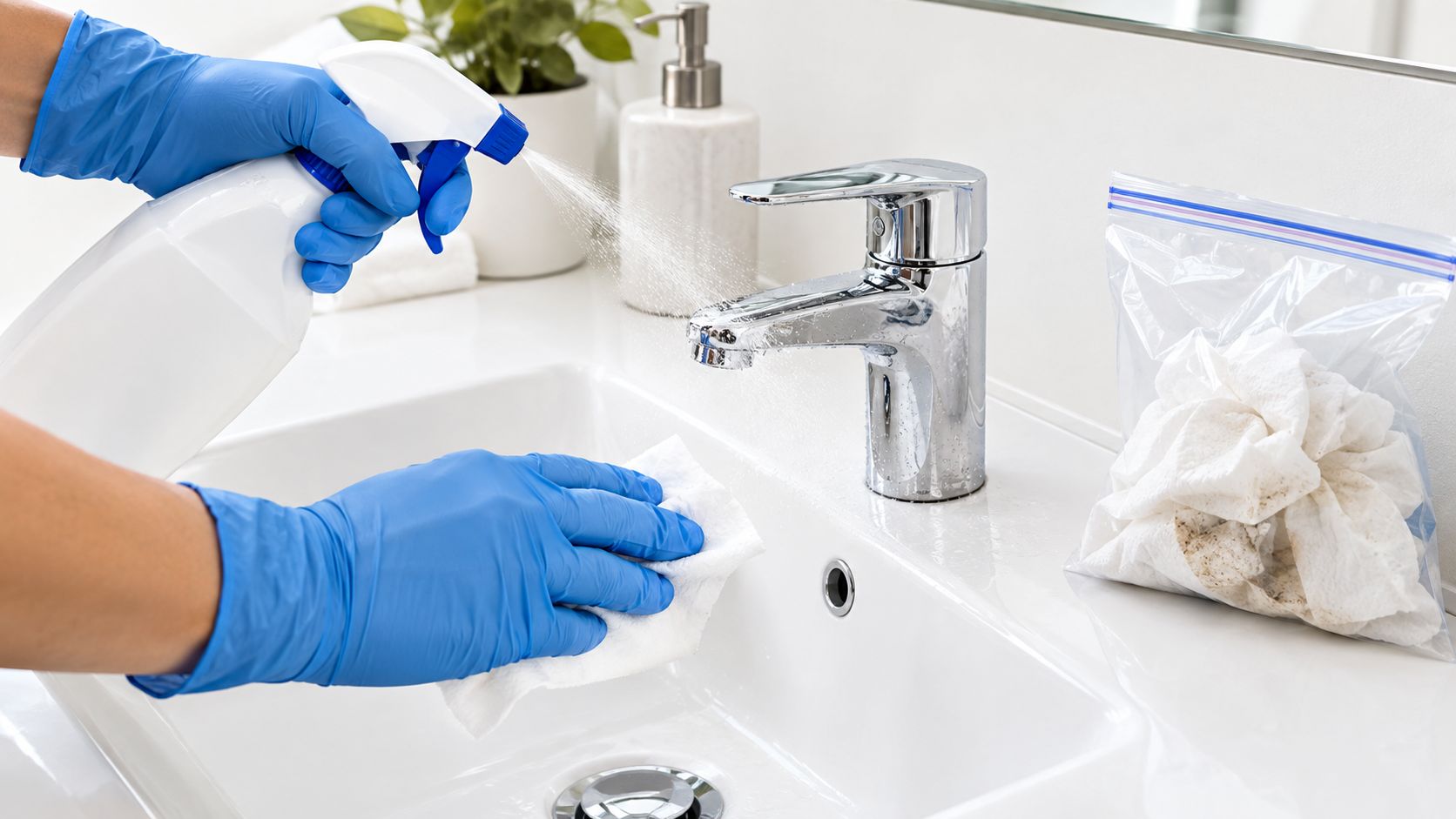
A parent kneels on the bathroom tile at 2 a.m., holding paper towels in one hand while a child retches nearby. The obvious mess is easy to see. The less obvious contamination is harder: the flush handle, faucet, light switch, door knob, towels, toothbrush holder, and any object touched while someone was vomiting.
A stomach-virus cleanup isn't the same as wiping up an ordinary spill. Norovirus can spread through vomit and diarrhea, remain on hard surfaces for days, and resist many everyday cleaning products. The safest approach is a measured process built around physical removal, an appropriate disinfectant, sufficient wet contact time, and cleaning the tools used during the job.
This guide focuses on how to disinfect after stomach virus exposure, including the steps most household guides skip. The current CDC norovirus prevention guidance recommends a chlorine bleach solution at 1,000 to 5,000 ppm, or an EPA-registered product effective against norovirus. The bleach must remain on the surface for at least 5 minutes before the area is cleaned again with soap and hot water.
The First Five Minutes After a Stomach Virus Hits Your Home
The first instinct is usually to grab whatever is closest, perhaps dish soap, a general disinfecting wipe, or a bottle of alcohol-based cleaner. Those products may remove visible grime, but they shouldn't be your only response to a vomiting incident involving suspected norovirus.
Norovirus is a small, non-enveloped virus, and many ordinary disinfectants don't reliably inactivate it. The contaminated area may also be larger than the visible stain. Vomiting can spread particles onto nearby hard surfaces and objects, especially in a bathroom or cramped bedroom.
Start by keeping other people and pets away from the area. Open a window if practical, avoid touching your face, and gather disposable towels, gloves, a trash bag, and a disinfectant that specifically states it works against norovirus. Don't begin scrubbing while someone is still actively vomiting unless you need to prevent immediate contact with the material.
Practical rule: Treat the visible mess as the center of a wider contamination zone. Clean the objects people touched during the incident, not only the tile or floor.
The CDC's measurable standard is important here. Use a bleach solution in the 1,000 to 5,000 ppm range, keep it wet for at least 5 minutes, then clean the surface again with soap and hot water. That contact time is part of the disinfection process, not an optional waiting period.

The next few minutes matter, but the next several hours matter more. A proper cleanup takes time because it involves removing organic material, disinfecting surrounding surfaces, laundering fabrics, and dealing with the mop, cloths, bucket, and clothing used during the response.
Gathering Your Cleanup Kit and Choosing the Right Disinfectant
Set up the full kit before entering the contaminated area. Repeated trips between a bathroom or bedroom and clean storage areas can spread contamination to your gloves, clothing, hands, and nearby surfaces.
Gather disposable nitrile gloves, paper towels, sealable trash bags, and a face covering if splashing or airborne droplets are possible. Wear clothing that can go directly into the wash. Keep separate mop heads and microfiber cloths for this job. Two buckets labeled clean and dirty reduce the chance of dipping a used cloth into fresh disinfectant.
For hard, nonporous surfaces, the CDC recommends a chlorine bleach solution between 1,000 and 5,000 ppm, or an EPA-registered disinfectant effective against norovirus. The EPA's List G database identifies products registered for that pathogen claim. A List G product is not automatically a stronger cleaner. Check its label, EPA registration details, approved surfaces, dilution instructions, and required wet contact time.
Common shopping-list examples include Clorox Hydrogen Peroxide Disinfecting Wipes, Lysol Brand Bleach Mold and Mildew Remover, and Purell Professional Surface Disinfectant. Formulations and registrations can change, so verify the current label instead of relying on the brand name alone. For surfaces that may be damaged by bleach, use a product whose label specifically permits that surface and states effectiveness against norovirus. Do not improvise with an unverified cleaner.
Bleach Dilution Chart for Norovirus Cleanup
| Concentration | Use case | Bleach per gallon | Bleach per quart | Contact time |
|---|---|---|---|---|
| 1,000 ppm | General hard, nonporous surfaces | 5 tablespoons household bleach (6-8.25%) per gallon | 1¼ tablespoons household bleach (6-8.25%) per quart | At least 5 minutes |
| 5,000 ppm | Heavy contamination and visibly soiled areas | 25 tablespoons household bleach (6-8.25%) per gallon | 6¼ tablespoons household bleach (6-8.25%) per quart | At least 5 minutes |
Use 5 tablespoons per gallon for routine hard-surface disinfection and 25 tablespoons per gallon only for heavy, visibly soiled contamination. Both solutions require at least 5 minutes of wet contact time. Confirm your product's label strength before measuring, since household bleach concentrations vary. The bleach-solution guidance for disinfecting provides further dilution instructions.
Never mix bleach with ammonia, acids, toilet-bowl cleaner, or another disinfectant. Prepare the solution fresh when possible. A freshly prepared solution should be used within 24 hours, because chlorine can evaporate and weaken it. If storage is necessary, the CDC says to use a stronger stored solution and replace it within 30 days. The CDC technical guidance on chlorine solutions explains this storage distinction.
Step-by-Step Cleanup From Vomit to Final Rinse
The order matters. Remove visible material first, clean with detergent and water second, and disinfect third. Applying bleach directly over vomit or stool wastes disinfectant on organic material and makes it harder to achieve reliable surface contact.
Start with air and protective equipment
Ventilate the room before you work. Open windows where safe and use an exhaust fan that vents outdoors. Turn off recirculating airflow if it would move contaminated air into other rooms.
Put on gloves and a face covering. Use paper towels or other disposable absorbent material to collect vomit or stool. Place everything directly into a plastic bag, close the bag securely, and keep it away from clean supplies.
Clean outward from the visible mess
Wash the visibly soiled area with detergent and water. Use disposable material for this first pass, and change gloves if they become visibly contaminated. Don't use the same cloth on the floor, toilet, faucet, and door handle.
Apply the stronger bleach solution, or a labeled EPA-registered norovirus disinfectant, to the contaminated hard surface and the surrounding area that may have received splashes or droplets. Keep the surface visibly wet for at least 5 minutes, following the product label if it requires a longer period.
The common reversal is the failure point. Bleach can't do its job well when grime and organic matter are still covering the surface.
Once the primary area is treated, disinfect nearby high-touch points. Include the toilet seat, flush handle, sink faucet, light switch, door knob, cabinet pull, and any shared device or object handled during the incident. Work from cleaner areas toward the bathroom and toilet fixtures so you don't carry contamination back into clean spaces.
Mop the floor last. Begin at the farthest clean point and work toward the exit. Keep the mop head from returning to a cleaned section, and don't carry an uncovered bucket through other rooms.
The Sweet Home Cleaning Service guide is useful for identifying overlooked household touchpoints beyond the obvious spill.
Seal used paper towels, gloves, and disposable materials in an outdoor rubbish container. Reusable cloths and mop heads need their own disinfection process, covered below. Remove gloves without touching the contaminated exterior, then wash your hands thoroughly with soap and water. Handwashing is essential because alcohol sanitizer shouldn't replace soap and water for norovirus control.
For food- or mouth-contact surfaces, follow the disinfectant label and rinse with plain water before reuse when the label or public-health guidance calls for rinsing. Don't return dishes, utensils, or food containers to service just because they look clean.
Laundry, Soft Surfaces, and the Tools You Used to Clean
Soft materials need a slower approach because they can hold contamination in folds, seams, and absorbent fibers. Put on gloves, lift contaminated clothing or bedding carefully, and don't shake it. Shaking can spread material onto nearby surfaces.
Remove solid waste into the toilet where possible, then place the laundry in a bag or directly into the washing machine. Keep it separate from other household loads until washed. Use detergent, the longest suitable cycle, and the warmest temperature the fabric can safely tolerate. Add chlorine bleach only when the care label permits it. An oxygen-based bleach alternative may be appropriate for fabrics that can't tolerate chlorine, but it shouldn't be treated as an automatic substitute for a product specifically labeled for norovirus.
Carpets and upholstery require material-specific care. Cover wet contamination with absorbent disposable material, remove the material carefully, then use a suitable carpet cleaner or upholstery method. Steam treatment may be appropriate for compatible materials, but don't apply heat or moisture to a surface unless the manufacturer permits it.
The tools are part of the contamination zone
A reusable mop head, cloth, scrub brush, or bucket can redistribute virus after the visible spill is gone. Soak compatible reusable tools in a fresh 1,000 to 5,000 ppm bleach solution for at least 5 minutes, then rinse and launder or dry them according to their material and care instructions.
Wash mop heads in a separate hot laundry cycle. High-heat drying adds another protective step when the item can tolerate it. Empty and disinfect buckets, handles, and any reusable brush that touched the contaminated area. Prepare a fresh bleach solution rather than saving a diluted mixture for another cleanup day.
| Item type | Recommended treatment | Temperature or concentration | Contact time |
|---|---|---|---|
| Bedding and clothing | Wash separately with detergent | Warmest fabric-safe setting | Follow the wash-cycle and product directions |
| Bleachable fabric | Add chlorine bleach if the care label allows | CDC norovirus range, 1,000 to 5,000 ppm for applicable surfaces | At least 5 minutes for surface disinfection |
| Non-bleachable fabric | Wash with detergent and use an oxygen-based alternative when suitable | Warmest fabric-safe setting | Follow product directions |
| Mop heads and cloths | Soak or disinfect, then launder separately | Fresh 1,000 to 5,000 ppm solution | At least 5 minutes |
| Buckets and scrub brushes | Clean, then disinfect compatible surfaces | Appropriate labeled disinfectant | Follow the label |
If the volume of laundry is too much to manage safely, a professional service can reduce handling at home. Some households may choose to subscribe to wash and fold for routine laundry after contaminated items have been isolated and handled according to the service's policies. For detergent logistics and household laundry supplies, see this guide to bulk laundry pods.
Electronics require restraint. Don't pour bleach or liquid disinfectant onto phones, remotes, keyboards, or control panels. Remove visible soil with a compatible method, then use a product whose label specifically permits the device's surface and follow its contact-time instructions.
Why Alcohol and Most Wipes Fail Against Norovirus
A wipe can be convenient and still be the wrong tool. Alcohol wipes, hand sanitizer, dish soap, and many general-purpose disinfecting wipes don't reliably kill norovirus, according to the Cleveland Clinic's norovirus cleanup guidance. They may remove residue or reduce contamination, but appearance isn't proof of inactivation.
The reason is structural. Norovirus is non-enveloped, so it doesn't have the lipid outer coating that alcohol-based products commonly disrupt. That makes alcohol an unreliable choice for environmental norovirus disinfection, even when the product feels strong or evaporates quickly.
A generic quat-based wipe also isn't automatically suitable. Look for an EPA registration and a label claim for norovirus or an accepted norovirus surrogate. The EPA List G framework exists so users can distinguish a product registered for this use from a wipe marketed only for ordinary bacteria or general household germs.
Choosing an option for sensitive surfaces
Bleach can discolor fabrics, corrode some metals, damage electronics, and harm certain countertop finishes. Don't force a bleach solution onto a material that the manufacturer says can't tolerate it.
For a sensitive surface, select an EPA-registered product whose label permits that material and states the required contact time. Some accelerated hydrogen peroxide formulations may be suitable, but the label controls. A product with 3% hydrogen peroxide may be discussed for certain sensitive surfaces, yet it still needs full label contact time and material compatibility. Never combine it with bleach or another cleaner.
The practical trade-off is straightforward. Bleach is widely available and supported by CDC guidance for compatible hard surfaces. A List G product may be easier to apply to a particular finish, but it still requires careful label reading, complete wet coverage, and the full contact time.
Ventilation, Timing, and Knowing When the Home Is Safe Again
Cleaning the room removes contamination from surfaces, but household behavior determines whether the virus returns to clean areas. Keep the sick person away from shared spaces as much as practical, use a separate bathroom when possible, and disinfect high-touch fixtures regularly during an active illness.
Continue strict handwashing with soap and water. Hand sanitizer is not a dependable replacement for washing hands after caring for someone with suspected norovirus, using the toilet, changing contaminated laundry, or handling cleanup waste.
People can remain infectious after symptoms improve. A cautious household rule is to keep the person away from food preparation and shared group settings for at least 48 hours after vomiting and diarrhea stop, consistent with public-health advice summarized by BSW Health's stomach-virus guidance. Follow local school, workplace, healthcare, and public-health policies when they are stricter.
Ventilate during cleanup and afterward when possible, but don't direct fans across the contaminated area toward another room. Reopen the kitchen only after food-contact surfaces have been cleaned, disinfected with a compatible labeled product, and rinsed when required. Wash dishes and utensils thoroughly before sharing them again.
A home is ready for normal use when the contamination has been removed, treated surfaces have completed their contact time, reusable tools have been handled, and no visibly soiled areas remain.
Look for practical warning signs rather than relying on smell alone. Lingering visible soil, another household member developing vomiting or diarrhea, or an overlooked towel, handle, or floor section means the response needs another review. People with weakened immune systems, older adults, infants, and young children deserve a lower threshold for medical advice if symptoms or dehydration become concerning.
For more detail on the distinction between airborne spread, droplets, and contaminated surfaces, see whether stomach viruses are airborne.

Quick Reference Checklist and Common Follow-Up Questions
Use this list when you're tired and need the essentials in front of you:
- Protect yourself: Put on gloves, use a face covering when splashing or aerosol exposure is possible, and isolate the room.
- Remove first: Collect vomit or stool with disposable towels and seal the waste.
- Clean before disinfecting: Use detergent and water to remove organic material.
- Use the right chemistry: Choose a CDC-recommended bleach solution in the 1,000 to 5,000 ppm range or an EPA-registered norovirus product.
- Respect contact time: Keep the disinfectant visibly wet for at least 5 minutes.
- Treat the wider zone: Wipe handles, switches, faucets, toilet fixtures, and nearby objects.
- Clean the tools: Disinfect mop heads, cloths, brushes, buckets, and other reusable equipment.
- Wash hands: Use soap and water after removing gloves and finishing cleanup.
How long does norovirus survive on surfaces? It can remain on hard surfaces for days, so clean and disinfect rather than waiting for the area to “air out.”
Is someone still infectious after 48 hours without symptoms? Yes, transmission can still be possible. Keep handwashing and food-safety precautions in place, and follow the isolation guidance above.
When can people share a bathroom? After contaminated surfaces and touchpoints have been cleaned and disinfected, with no visible soil remaining. Continue cleaning frequently while illness is active.
What about kitchen food? Discard visibly contaminated food, clean and disinfect food-contact surfaces with a compatible labeled product, and rinse when required before preparing food again.
Can pets carry it? Keep pets away from vomit, stool, bags, and cleaning chemicals. Don't let an animal track through a contaminated area before it has been cleaned.
For mattresses, bedding, and bedroom fabrics, this practical guide to mattress care for spring cleaning can help you identify soft surfaces that deserve attention after the bathroom is finished.
The critical details are simple but easy to skip: remove organic matter, use a verified norovirus disinfectant, keep it wet long enough, and disinfect the equipment that did the cleaning.
If a stomach-virus incident has just happened, isolate the area, gather gloves and disposable towels, and check the disinfectant label before you start. For additional virus-specific cleanup and prevention guidance, visit VirusFAQ.com and use the relevant norovirus resources alongside current CDC and EPA directions.
Leave a Reply