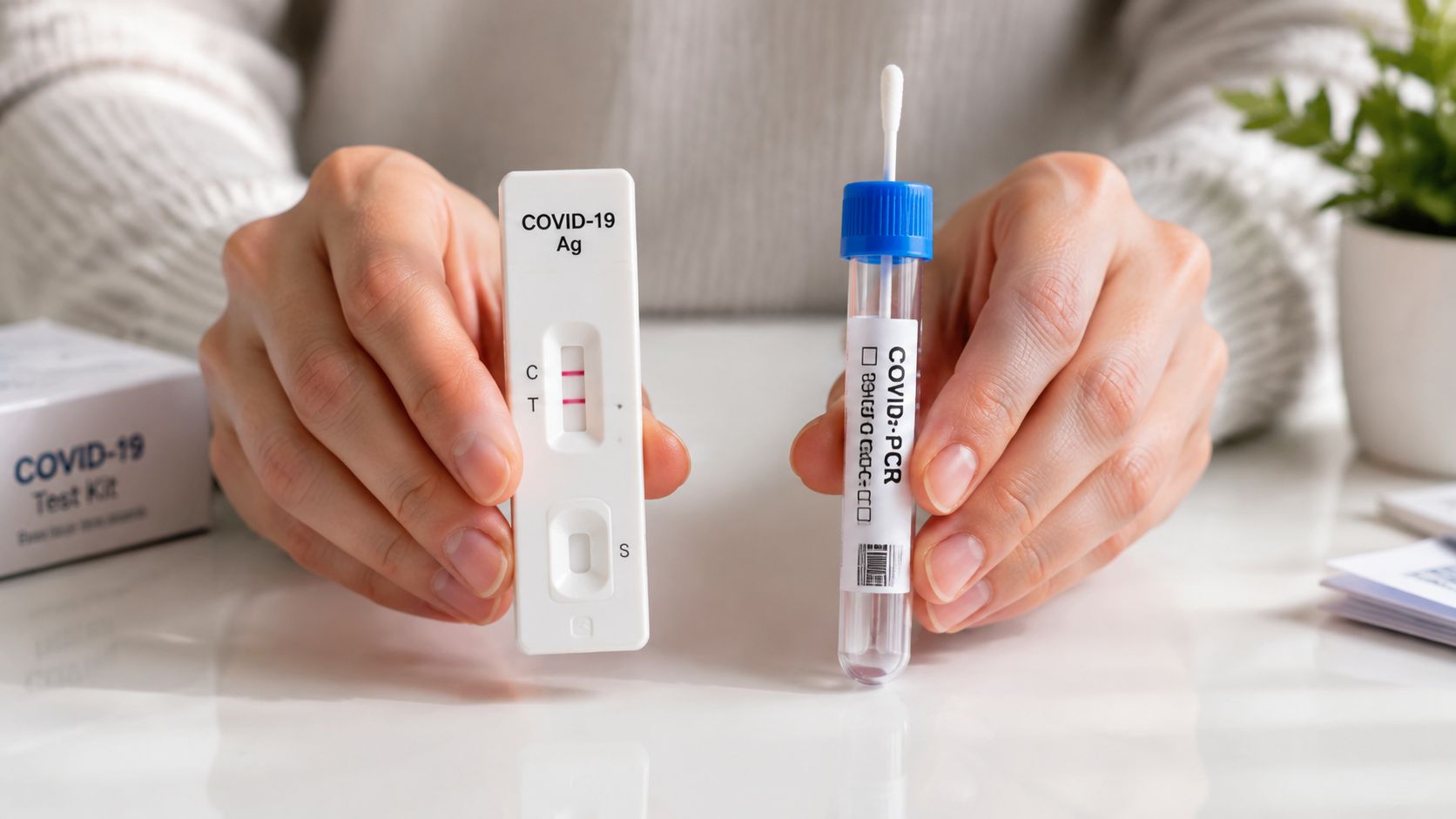
You wake up with a sore throat, a dull headache, and that familiar question. Should you use the rapid test in your bathroom cabinet, or book a PCR?
Often, antigen test vs PCR is framed as a contest about which test is “better.” That's the wrong starting point. These tests answer related but different questions. One is built for speed and day-to-day decisions. The other is built for diagnostic certainty.
That difference matters most when you're trying to decide whether to go to work, visit an older relative, send a child to school, or figure out whether a negative result means you're in the clear. It also matters because “infected” and “infectious right now” are not always the same thing.
Choosing the Right Viral Test
The first decision isn't technical. It's practical. Ask yourself what you need to know today.
If your question is “Do I need the most sensitive test for diagnosis?”, PCR is usually the stronger choice. If your question is “Am I likely contagious enough right now that I should change my plans immediately?”, an antigen test often gives useful real-world information faster.
PAHO/WHO describes the basic tradeoff clearly in its overview of testing methods. PCR detects viral genetic material and typically takes about 4 hours, while antigen tests detect viral proteins and can return results in about 20 to 30 minutes without laboratory infrastructure in the summary provided through this referenced material. That speed is why antigen tests became so common in homes, clinics, schools, and workplaces.
A simple comparison helps early:
| Question | Antigen test | PCR |
|---|---|---|
| What does it detect? | Viral proteins | Viral genetic material |
| How fast is it? | About 20 to 30 minutes | About 4 hours in the cited overview |
| Best for | Rapid screening and quick decisions | Confirming infection with higher sensitivity |
| Main limitation | Misses more infections, especially with lower viral load | Slower and usually needs lab processing |
Many readers get confused because they expect one test to do everything. It won't. A kitchen thermometer and a weather forecast both tell you something about temperature, but they serve different purposes. Viral testing works the same way.
For a broader foundation on test types used in virology, this guide to laboratory diagnosis of viral infections gives useful background.
Practical rule: Choose the test based on the decision you need to make, not on brand loyalty to one method.
How Each Test Detects a Virus
PCR and antigen tests look for different parts of the virus. That one fact explains most of the confusion people have about results.

PCR copies the signal
A PCR test looks for the virus's genetic material. The easiest analogy is a photocopier. If the sample contains even tiny traces of viral RNA, PCR can amplify that material until the machine can detect it.
That's why PCR is called highly sensitive. It doesn't need a lot of virus present in the sample to turn positive. It can pick up small amounts that an antigen test would miss.
Antigen tests look for protein pieces
An antigen test doesn't copy anything. It looks directly for viral proteins. This is comparable to checking whether a visible badge is present on the virus. If enough of that protein is there, the test line appears. If not, the result stays negative.
That direct approach is what makes antigen tests quick and portable. It's also what makes them less sensitive when the amount of virus is low.
A key viral-load pattern appears in a 2023 Scientific Reports analysis of antigen positivity and Ct values. Antigen positivity rose from about 25% at high Ct values around 35, which indicate low viral load, to almost 100% when Ct values were below 20, which indicate high viral load. At a Ct value of about 25, sensitivity was around 80%. In plain language, antigen tests work much better when there is more virus present.
Why timing changes everything
This is where readers often get tripped up. A negative antigen test doesn't always mean “no infection.” It may mean the virus is present, but not yet at a high enough level for that kind of test to detect.
PCR can still detect viral RNA when levels are low, early in infection, or later after the most contagious period has passed. Antigen tests are more tied to how much virus is sitting in the sample at that moment.
If you'd like the lab mechanics behind amplification, primer-driven detection, and related methods, this overview of polymerase chain reaction techniques is the right next read.
Think of PCR as a microphone with an amplifier. Think of an antigen test as listening without amplification.
Key Differences Analyzed Side-by-Side
The most useful way to compare these tests is by decision criteria, not by slogans about “accuracy.”

Comparison table
| Criterion | Antigen test | PCR |
|---|---|---|
| Detection target | Viral proteins | Viral genetic material |
| Turnaround | Fast, often same sitting | Slower, usually processed through a lab |
| Sensitivity pattern | Stronger when viral load is higher | More consistent across low and high viral loads |
| Best practical role | Quick screening and repeated checks | Confirmatory diagnosis |
| Infectiousness insight | Often aligns better with higher viral load states | Better for detecting infection, even at low levels |
Sensitivity is not one fixed number
People often ask, “How accurate is the test?” That sounds straightforward, but performance changes with timing and symptoms.
A longitudinal cohort study published in JAMA Internal Medicine followed 225 people with RT-PCR-confirmed SARS-CoV-2 infection. In that study, antigen test sensitivity peaked at 77% four days after illness onset, but was only 50% during the infectious period when compared with RT-PCR. It was also 18% on days with no symptoms, 56% with any symptoms, and 77% when fever was present. RT-PCR maintained daily positivity of 95%, peaking three days after onset, according to the JAMA Internal Medicine cohort study.
That tells you two things. First, antigen tests are highly context-dependent. Second, symptoms matter. The same test performs very differently in someone with fever than in someone who feels fine.
Specificity and false positives
Rapid antigen tests tend to be strong on specificity. A pooled Omicron analysis found pooled specificity of 1.000 (95% CI: 0.997–1.000) for rapid antigen tests, while overall pooled sensitivity was 0.671 (95% CI: 0.595–0.721) in the cited review. That means a positive antigen result is often useful, but a negative result has to be interpreted more carefully, especially when exposure or symptoms raise suspicion.
Timing after exposure
Timing is where the antigen test vs PCR question becomes real. Early after exposure, viral load may still be low. That's a harder setting for antigen testing. PCR is more likely to detect infection at that stage.
Later in illness, PCR may remain positive because it can detect leftover viral RNA. That can be helpful for diagnosis. It can also be confusing if you're trying to answer the narrower question, “Am I still likely contagious today?”
Speed and accessibility
For daily life, speed changes behavior. A result in minutes can stop someone from attending dinner, getting on a train, or going into an office while they're likely shedding more virus. A result that arrives much later may be diagnostically excellent but less useful for immediate behavior.
A slower, more sensitive test and a faster, less sensitive test don't compete on the same axis. They solve different problems.
When to Choose an Antigen Test
An antigen test makes the most sense when speed matters and you're using the result to guide immediate behavior.
Good fit for same-day decisions
If you wake up with symptoms and need to decide whether to go to work, visit family, or isolate from housemates, an antigen test can help quickly. It's especially practical when symptoms have already started and you need an answer before the day moves on.
Antigen testing also works well when the goal is screening, not definitive exclusion. Schools, households, and workplaces often need a rapid check that identifies many people who are more likely to be contagious right now.
Better for the question of current infectiousness
A major strength of antigen testing is that it often tracks contagiousness more closely than PCR alone. A modeling study found antigen testing may better discriminate actively infectious cases, and a CDC analysis found rapid antigen sensitivity was 80% versus viral culture, as summarized in this analysis of antigen testing and infectiousness.
That doesn't mean antigen tests replace PCR. It means they can be especially useful when the practical question is whether someone is likely to be transmitting virus at that moment.
Serial testing changes the value
One of the biggest mistakes people make is treating an antigen test as a one-time verdict. In real life, repeating the test can make it much more useful.
Use an antigen test when:
- You need a fast answer today. A result in minutes helps you make immediate choices about work, school, travel within your community, or household contact.
- You're doing repeated screening. Serial testing can catch infections that a single early test misses.
- You're checking whether risk to others may be lower. Because antigen positivity often rises with higher viral load, repeated negatives over time can be more informative than one isolated negative result.
For day-to-day behavior, an antigen test is often a decision tool, not a final ruling.
When a PCR Test Is Necessary
PCR is the right choice when you need the most sensitive answer and the stakes of missing infection are higher.
Symptomatic but antigen-negative
This is one of the most common situations. You feel sick, your rapid test is negative, but the symptoms fit a viral infection. That negative antigen result may reflect timing or lower viral load in the sample.
In that situation, PCR is the stronger next step because it can detect viral genetic material at lower levels than an antigen test can.
After a known exposure with no symptoms
Testing too early is a classic source of confusion. Right after exposure, someone may carry virus at levels too low for a rapid test to pick up. If you need confidence after a known exposure, PCR is the better tool.
This is especially important if you live with someone medically vulnerable, work in healthcare, or are about to spend time in a setting where transmission would have larger consequences.
Situations requiring a definitive result
Some environments don't want a quick estimate. They want the most reliable diagnostic answer available. PCR is the usual choice for:
- Clinical evaluation. When a healthcare decision depends on confirming infection.
- Policy or procedural requirements. Some workplaces, care settings, or institutions may require molecular confirmation.
- Conflicting test results. If the story and the rapid test don't match, PCR helps settle the question.
A good way to think about it is this. Antigen tests are often strong for fast triage. PCR is stronger when uncertainty itself is the problem.
Why PCR can still confuse people
PCR's sensitivity is its strength, but it also creates misunderstanding. A PCR-positive result doesn't automatically tell you whether you're at peak infectiousness. It tells you the test found viral genetic material.
That distinction matters most at the tail end of illness. A PCR result may stay positive after the period when an antigen test is more likely to turn negative. For diagnosis, that's useful. For deciding whether you're still highly contagious today, it may be less direct.
How to Interpret Your Test Results
Most testing mistakes happen after the result, not during the swab. People over-trust one negative antigen test, dismiss a faint positive line, or assume every PCR positive means the same level of transmission risk.

Positive antigen result
Treat a visible positive antigen line as a positive result, even if it looks faint. Antigen tests generally have high specificity. In the pooled Omicron analysis, rapid antigen tests had a pooled specificity of 1.000 (95% CI: 0.997–1.000), according to the pooled review on Omicron-era rapid antigen test performance.
A positive result should prompt immediate precautions. Stay home if you can, reduce close contact, and protect others in your household.
Negative antigen result
Caution is warranted. The same pooled analysis found that rapid antigen sensitivity dropped to 0.108 (95% CI: 0.048–0.227) for samples with a CT value greater than 25, which reflects lower viral loads in that review. The paper also notes that clinicians should treat negative antigen results as “presumptive” and confirm with molecular testing if exposure is suspected.
That means a negative rapid test is not a free pass in several common situations:
- You have symptoms. Retest or get a PCR.
- You had a recent close exposure. A single negative result may be too early.
- You're testing before visiting high-risk people. Consider serial antigen testing or use PCR when feasible.
PCR positive and PCR negative
A PCR positive means viral genetic material was detected. That's strong evidence of infection. It does not, by itself, tell you whether you are at the most contagious point.
A PCR negative lowers concern about current infection, but context still matters. If symptoms started very recently or the sample was collected poorly, a healthcare professional may still advise follow-up testing.
Don't interpret the strip in isolation. Interpret the result together with symptoms, exposure, and timing.
For readers who want a broader framework for reading test reports and understanding what different laboratory results can and can't tell you, this guide on how to interpret lab results is a useful companion.
Practical Testing Recommendations
The most practical answer to the antigen test vs PCR question is simple. Use each test for the job it does best.
For most households
If someone wakes up sick, start with an antigen test when you need a quick same-day decision. If that antigen test is negative but symptoms fit infection, don't stop there. Repeat testing or move to PCR if the result will change an important decision.
Recent CDC data found that single daily antigen tests detected 47% of RT-PCR-positive infections, but had 80% sensitivity against viral culture, according to this CDC report on rapid antigen testing and viral culture comparison. That supports a practical takeaway. PCR is stronger for one-time diagnosis. Repeated antigen testing can still be useful when the goal is to identify people who are more likely contagious.

For clinicians, educators, and workplaces
- Clinicians: Use PCR when diagnostic certainty matters most. Use antigen tests as part of real-world contagiousness assessment and repeated screening.
- Schools and employers: Serial antigen testing can support quick operational decisions better than waiting on a single lab-based answer.
- Caregivers and families: Match the test to the question. Fast screening for household spread risk. PCR for confirmation when the consequences of missing infection are larger.
Don't stop at the test result
A positive result should change behavior inside the home, not just outside it. Clean high-touch surfaces such as phones, light switches, faucet handles, fridge doors, and doorknobs. Good disinfecting wipes make that easier because people are more likely to clean thoroughly when the product is quick to use and close at hand.
Testing tells you what risk may be present. Cleaning, ventilation, hand hygiene, and staying home when appropriate help reduce what happens next.
If you want more evidence-based virus guides written for both general readers and science-minded professionals, visit VirusFAQ.com.
Leave a Reply