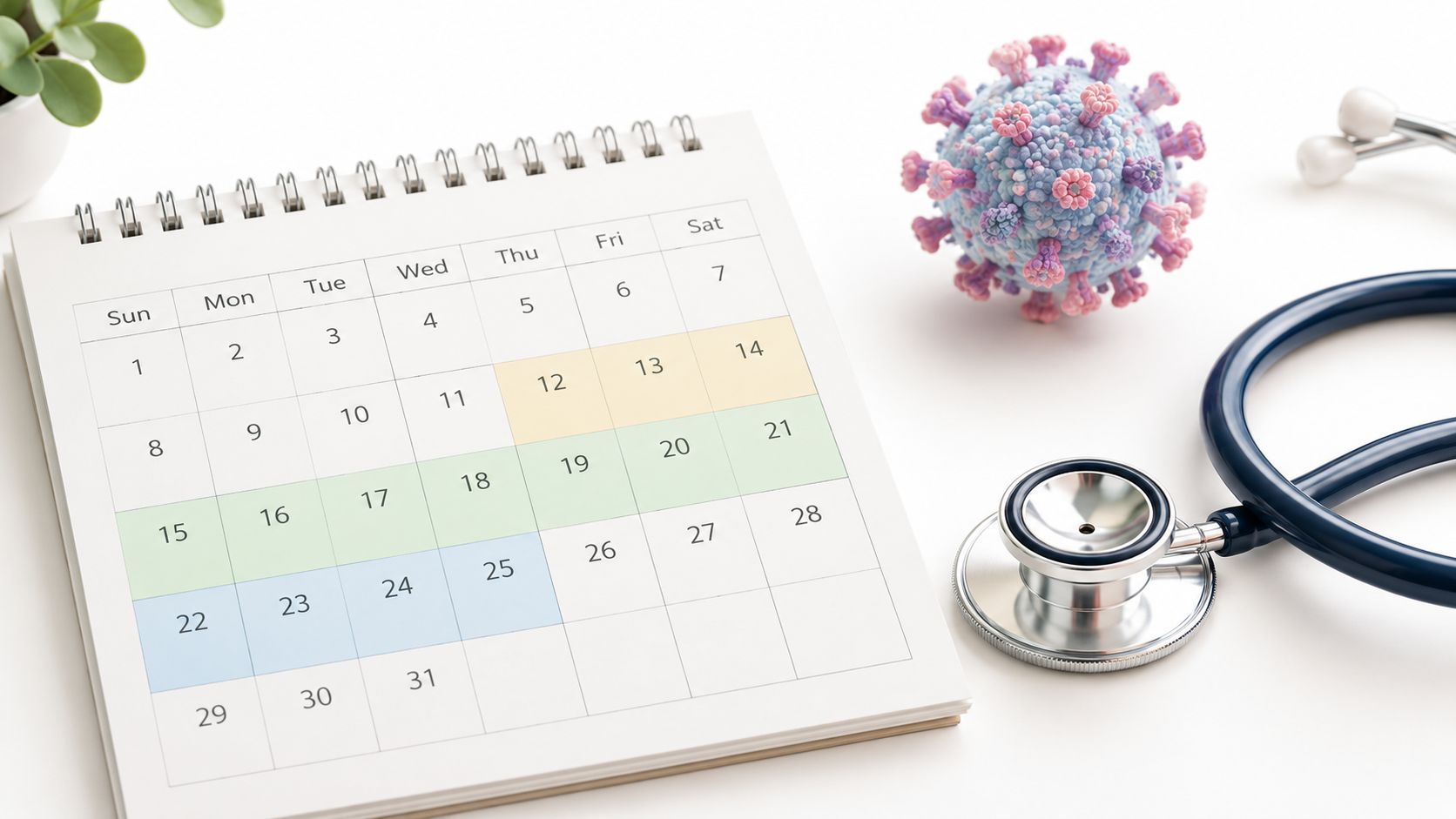
A college student learns that their roommate has mumps. The health center says to watch for symptoms for nearly a month. The familiar answer is that the mumps incubation period averages 16 to 18 days, but the complete range is 12 to 25 days, according to the CDC's mumps guidance. That difference between an average and a full range is what turns an exposure into a waiting game.
The waiting period can feel especially confusing when you feel well after two or three weeks. Your vaccination history, the date of your last close contact, and the number of people sharing your home or living space all affect how public-health officials assess risk. This guide explains what “incubation period mumps” means in practice, why the late end of the window matters, and what to do while you're monitoring yourself.
When a Mumps Exposure Becomes a Waiting Game
The student checks the calendar. The roommate's parotid swelling began today, but the exposure probably happened earlier through shared living space, conversation, or common household routines. The student feels fine, which is reassuring, but feeling fine today doesn't prove that the exposure led to no infection. Mumps can spread before symptoms begin, so the date of contact matters even when nobody recognized illness at the time.
The average incubation period is 16 to 18 days, while the documented full range is 12 to 25 days. In practical terms, someone might develop symptoms around the middle of that window, but public-health monitoring can't stop just because the average date has passed. The late part of the range is why exposed contacts are asked to keep watching for symptoms for the full period.
Why the calendar matters
Write down the last day of close contact with the person who has mumps. If contact continued across several days, public-health staff may need to consider that series of contacts rather than a single exposure date. A roommate, family member, teammate, or classmate may have repeated opportunities for exposure, which makes a personal calendar more useful than a rough guess.
The student should also check whether they have documented evidence of immunity and tell a healthcare provider or local health department about it. Prior vaccination lowers risk, but it doesn't remove the need to monitor after a known exposure. Public-health guidance continues to use the full 12-to-25-day window because mumps transmission can occur before symptoms appear.
Practical rule: Don't treat day 18 as an automatic all-clear. Keep monitoring through day 25 unless a public-health professional gives you different instructions.
This waiting period isn't a reason to panic. It's a defined observation task. Keep the exposure date, symptom notes, vaccination information, and relevant contact details together so you can answer questions quickly if symptoms develop.
What the Incubation Period Actually Measures
A contact tracer may speak with someone who feels completely well, then ask two different questions: when did symptoms begin, and when might that person have become able to spread mumps? Those questions refer to separate stages of infection.
The incubation period runs from the virus entering the body until the first noticeable symptoms. The latent period concerns the time before an infected person can transmit, while the infectious window covers the period when transmission is possible. These stages can overlap, so symptom onset cannot serve as a reliable starting line for infectiousness.
An analogy helps. A relay race has a hidden stretch between the baton exchange and the runner's appearance at the finish. Infection may be progressing during that quiet stretch, even while the person feels normal. The infectious window can begin before symptoms, which is why asking only, “When did you first feel sick?” leaves a gap in contact tracing.
The CDC's overview of mumps incubation and transmission explains why exposed contacts are monitored across the established 12-to-25-day range, rather than cleared after the 16-to-18-day average. It also notes that transmission may occur before symptoms and that some infections are asymptomatic.

Three clocks can run at once
An exposed person may need to track three separate questions:
- When might symptoms begin? The incubation clock answers this.
- When could transmission occur? The infectiousness clock addresses this.
- When can monitoring end? The public-health clock follows the outer end of the incubation range.
For example, a person diagnosed today may have exposed others before feeling ill. One contact may already be far into incubation, while another had a later exposure and has more waiting ahead. Contact tracing therefore records dates, settings, and symptom onset separately instead of treating diagnosis as the only relevant event.
Outbreak teams may also use a rule based on two complete incubation periods without new cases. The longer interval tests whether hidden infections have had enough time to declare themselves, making the tail of the curve operationally important.
For a broader definition, this explanation of the incubation period provides general virology context. Incubation describes symptom timing, not a guarantee that transmission is impossible.
The 12 to 25 Day Mumps Window Explained
The mumps timeline has a familiar center and a clinically important tail. The 16-to-18-day average helps clinicians and exposed people understand when symptoms commonly appear, but the 12-to-25-day range determines how long monitoring must continue. An average summarizes the middle. It doesn't describe every individual case.
You can think about the range in three practical parts. The early window covers days 12 through 15, the typical window centers around days 16 through 18, and the late window extends from days 19 through 25. These groupings help with calendar planning, but they aren't a CDC-published case distribution, and they shouldn't be read as exact shares of infections.
| Window | Days After Exposure | Share of Cases | Public-Health Implication |
|---|---|---|---|
| Early | 12 to 15 | Not specified in the verified guidance | Begin paying close attention to symptoms |
| Typical | 16 to 18 | Not specified in the verified guidance | The average timing falls here, but monitoring continues |
| Late | 19 to 25 | Not specified in the verified guidance | The outer limit explains the full observation period |
Why the tail controls the decision
A person who remains well through day 18 may feel that the risk has passed. That conclusion is premature. The late window is operationally important because public-health officials need a monitoring rule that covers the documented range, not just the date that sounds most typical.
The full range also helps investigators compare exposure dates with symptom onset. In a school, college, household, or workplace, that comparison can help officials determine whether a later case may belong to the same transmission chain or may reflect a separate exposure.
Avoid assigning false precision to the calendar. The verified guidance supports the 12-to-25-day range and the 16-to-18-day average, but it doesn't provide a universal case-by-case prediction based on age, vaccination status, or exposure intensity. Those details may influence an individual risk assessment, yet they don't justify shortening the monitoring period on your own.
How the Infectious Window Overlaps With Incubation
Mumps creates a timing problem because transmission can begin before the classic swelling is obvious. The CDC describes most spread as occurring from 2 days before through 5 days after parotitis begins, according to its mumps public-health strategy. Parotitis means swelling of the salivary glands, especially the parotid glands near the jaw.
That infectious window sits inside the longer incubation envelope. A person may spend days feeling normal, become infectious shortly before swelling, and continue to transmit after symptoms are visible. The person may not know they're ill during the early part of that period, so household members, dorm residents, classmates, and teammates can encounter the virus before anyone recognizes the usual sign.

A side-by-side view
| Timeline | What it means |
|---|---|
| Days 12 to 25 after exposure | The documented mumps incubation range |
| About 2 days before parotitis | Transmission may already be occurring |
| Through 5 days after parotitis begins | The period when most spread is expected |
The timelines answer different questions. The incubation range tells an exposed contact when symptoms might appear. The infectious window tells a case and public-health team when transmission is most likely. Neither timeline can be reduced to the day when jaw swelling becomes noticeable.
That overlap explains why “I felt fine” isn't enough to rule out exposure risk. A person who develops parotitis today may have had close contact with others before recognizing the illness. For a broader comparison of symptom timing and contagiousness across infections, see this guide to how long viruses are contagious.
Isolation, Quarantine, and School Exclusion Rules
Public-health actions follow the calendar, but they also depend on whether someone is a confirmed or suspected case, an exposed contact, or a person with symptoms that need evaluation. A person with mumps should follow public-health instructions for 5 days after parotitis begins, while close contacts should monitor for symptoms through day 25 after exposure, based on CDC guidance.
A school nurse may first ask about the last known contact, the onset of jaw or salivary-gland swelling, vaccination history, and whether the student attended shared activities. A college health center may ask similar questions and coordinate with the local health department. Workplace and childcare decisions can vary under local communicable-disease rules, so families and administrators shouldn't create a shorter schedule based only on the average incubation date.

What close contacts can do
- Record the exposure: Note the last close contact and whether contact continued over several days.
- Monitor symptoms: Watch for jaw or cheek swelling, parotid tenderness, fever, headache, fatigue, or other new symptoms during the full observation period.
- Limit shared items: Don't share cups, utensils, food, or personal items with someone who may be infected.
- Follow local instructions: A health department may issue specific exclusion or monitoring directions for a school, nursery, workplace, or residence.
- Call before arriving: If symptoms develop, contact a clinic first so staff can plan appropriate precautions.
Managers who need to make childcare decisions can also consult this nursery manager illness decision guide for broader sickness-policy context. It shouldn't replace local public-health instructions for a suspected mumps case.
For a practical explanation of exposure decisions, use this guide to when to isolate after exposure. The key distinction is that a confirmed or suspected case needs case-management instructions, while an asymptomatic contact generally needs careful monitoring and prompt reporting of symptoms.
Incubation Behavior in Vaccinated People
Vaccination lowers the chance of mumps, but it does not remove the waiting period after an exposure. A person with prior MMR vaccination or other evidence of immunity can still become infected, so the full 25-day observation period remains relevant. The long window matters because a symptom appearing late can be easy to explain away or miss.
A breakthrough infection may also look different from the familiar textbook case. Instead of obvious parotid swelling, a vaccinated person might notice jaw tenderness, fatigue, fever, headache, or another mild symptom. Symptoms can resemble dental pain or an ordinary viral illness, which may delay reporting and clinical assessment.
| Vaccination status or situation | What the record can and cannot show | Practical example or response |
|---|---|---|
| Prior MMR vaccination or other evidence of immunity | Risk and severity are lower, but the record cannot predict the exact day of onset or rule out illness | Example: a vaccinated college student develops mild jaw tenderness late in the monitoring period and first attributes it to dental pain. The symptom still warrants a call to a healthcare provider |
| No documented immunity | Risk assessment is less certain until a clinician or public-health team reviews the person's history | Treat a new compatible symptom seriously and follow the instructions provided after the exposure |
| Uncertain vaccination status | Records may clarify protection, but they do not replace symptom monitoring | Keep watching for changes while the record is checked, and report symptoms promptly |
The calendar works like a safety net. Vaccination may reduce the chance that infection becomes severe or produces clear swelling, yet a mild case can still affect decisions about testing, contact precautions, and exclusion. A vaccination record helps clinicians and public-health staff assess risk, but it cannot confirm that every new symptom is unrelated to mumps.
A vaccinated person with jaw swelling, parotid tenderness, or another concerning change should contact a healthcare provider before arriving at a clinic. The CDC's clinical overview supports the practical message: vaccination lowers risk, while exposed people still need to observe the complete window. That caution protects people whose immunity is uncertain and those who may develop illness without obvious parotitis.
Outbreak Control and the Two-Incubation Rule
A single exposure calendar follows one person. An outbreak calendar follows a whole setting. In schools, universities, households, and sports teams, officials must allow enough time for people infected during one part of the chain to develop symptoms and for any additional transmission to become visible.
That's why outbreak investigations may use two incubation periods, or 50 days, with no new cases before considering an outbreak over. The CDC surveillance manual's mumps guidance places this timing in the broader history of mumps surveillance and outbreak control. The rule is longer than a single 25-day observation period because one person's late-onset illness can expose others near the end of the first cycle.

Why closure takes longer
Suppose a setting identifies a case and starts monitoring contacts. If a newly infected person develops symptoms near the end of the first incubation period, that person may create a second generation of exposed contacts. Officials need time for that later group to pass through its own potential incubation window.
The two-period approach gives health departments a conservative way to assess whether transmission has stopped. It can affect when schools clear monitoring lists, when colleges end enhanced follow-up, and when teams can return to ordinary prevention routines. A late case may restart or extend cooperative monitoring because it changes the most recent possible exposure date.
The average helps explain when illness often appears. The tail determines when officials can responsibly close the investigation.
This logic also explains why outbreak closure isn't based on the last day someone felt worried. Public-health teams use documented exposure dates, symptom onset, case investigations, and local regulations. People in an affected setting should follow the health department's timeline rather than treating a symptom-free interval as permission to stop participating in monitoring.
Practical Steps After a Known Mumps Exposure
A documented exposure doesn't require guesswork. It calls for a written timeline, awareness of symptoms, and early communication if anything changes.
- Mark the exposure date. Record the last day of close contact, and note whether contact continued across multiple days.
- Watch through day 25. Pay attention to parotid tenderness, jaw or cheek swelling, fever, headache, fatigue, and other new symptoms. Don't relax just because day 18 has passed.
- Stay away from others when symptoms begin. If swelling or another concerning symptom appears, limit close contact and follow instructions from a healthcare provider or health department.
- Call before visiting a clinic. Tell staff about the known mumps exposure and your symptoms so they can plan appropriate precautions before you arrive.
- Confirm your MMR history. Check vaccination records with a clinician or public-health office. Don't use vaccination status as a reason to ignore symptoms.
- Postpone close-contact activities if symptoms develop. Ask a health professional about travel, classes, work, and team sports when illness is suspected.
Routine hygiene still matters. Wash your hands, avoid sharing cups or utensils, and clean frequently touched household surfaces with a product labeled for the intended use. Disinfecting wipes can support regular cleaning of shared handles, desks, phones, and other high-touch surfaces, but they don't replace vaccination, symptom monitoring, isolation guidance, or professional advice.
The incubation period may be long, but the task is manageable: mark the dates, monitor consistently, communicate early, and follow local instructions. For more accessible explanations of viral biology, transmission, and prevention, visit VirusFAQ.com and explore its educational resources, including guidance on practical cleaning habits and disinfecting wipes.
Leave a Reply