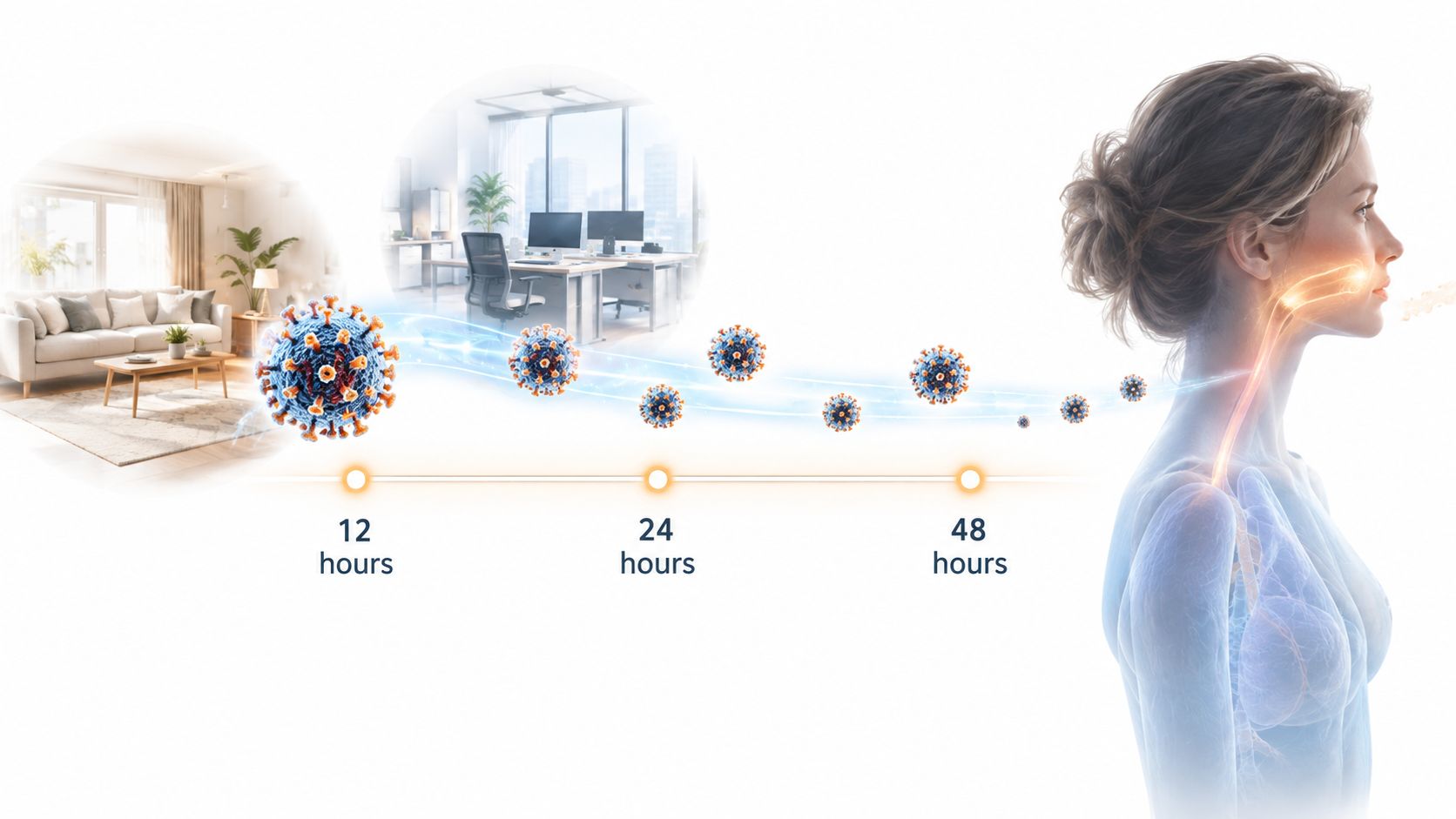
Norovirus symptoms in adults typically begin 12 to 48 hours after exposure, with a median onset of about 33 hours. That means a person can feel completely well after contact and still become suddenly ill within the next day or two.
This narrow window helps explain why norovirus outbreaks can seem to appear all at once. One adult becomes infected, shares a bathroom, handles food, touches a door handle, or vomits in a communal area, and other people may begin developing symptoms soon afterward. The illness itself is usually brief, but the infection-control timeline is longer than the symptom timeline. Understanding that difference is central to protecting households, workplaces, hospitals, cruise ships, and long-term care settings.
Understanding the Norovirus Incubation Period in Adults
A systematic review of 2,540 observations estimated the median norovirus incubation period in adults at 1.2 days, or roughly 29 hours. Public health guidance places symptom onset at 12 to 48 hours after exposure, while the same evidence base describes an average of about 33 hours. These figures explain why many adults first feel ill around the second day after contact. (CDC epidemiological review of norovirus)
The timeline is useful, not exact. Exposure dose, immune status, age, route of exposure, and repeated contact can affect how infection develops. For practical purposes, 12 to 48 hours is the useful working range when an adult is trying to connect sudden vomiting or diarrhea with a recent exposure.
Why the window feels so sudden
Norovirus has a very low infectious dose. The CDC describes infection as possible from roughly 10 to 100 virions, a small amount that helps explain why brief contact with contaminated material can be enough to cause illness. (CDC norovirus infection-control background)
That low threshold produces several familiar outbreak patterns:
- A small exposure can be sufficient: An adult does not need prolonged contact with someone who appears ill to become infected.
- Symptoms arrive quickly: By the time vomiting or diarrhea begins, the original exposure may be difficult to identify.
- Shared areas amplify contact: Bathrooms, kitchens, break rooms, elevator buttons, and care equipment can connect people who never speak directly.
- The source may be unclear: Exposure could have occurred at home, work, during travel, or in another shared setting.
An adult may feel normal in the morning and become sick that evening or the next day. That timing does not prove the latest contact caused the infection. The exposure may have happened earlier in the incubation window, so outbreak investigators examine several prior contacts rather than assuming the last place visited was the source.
Feeling well also does not make the period risk-free. An infected person may contribute to contamination before symptoms are obvious, while virus can remain relevant for cleaning decisions after the person feels better. The biological clock therefore works like a delayed alarm: symptoms mark a visible change, not necessarily the beginning or end of transmission risk.
Practical rule: Treat the 12 to 48 hours after a plausible exposure as an active monitoring period, not as proof that infection is impossible if symptoms have not started.
The incubation window indicates when symptoms may begin, but a sound infection-control timeline must also account for pre-symptomatic contamination, environmental persistence, and post-recovery shedding. Those factors determine how facilities plan cleaning, manage shared spaces, and decide when precautions can safely ease.
The Day by Day Timeline of Adult Infection
A useful adult timeline begins with exposure, moves through a short incubation phase, and then separates illness duration from infection-control duration. Norovirus often resolves quickly, but people and facilities need to make decisions before symptoms start and after they stop.

From exposure to first symptoms
Exposure day: An adult may ingest virus from contaminated food, hands, objects, or surfaces. There may be no immediate warning. Feeling well shortly after contact doesn't rule out infection.
The next day: Symptoms can begin during this period because the documented incubation range starts at 12 hours. Nausea, vomiting, diarrhea, abdominal cramps, and general weakness may appear abruptly rather than building gradually.
The following day: Many cases become apparent by this point because symptom onset commonly falls within 24 to 48 hours. The CDC uses a mean incubation period of 24 to 48 hours, together with vomiting in more than half of cases, as part of the Kaplan criteria used to identify likely norovirus outbreaks. (CDC norovirus outbreak guidance)
The exact order of symptoms varies. Some adults first notice nausea or stomach cramps, while others begin with vomiting or diarrhea. A sudden cluster of similar gastrointestinal illness after a shared meal, event, or period in a communal setting gives investigators a stronger reason to examine a common exposure.
During the acute illness
The active illness commonly lasts one to three days, although fatigue, reduced appetite, and weakness may make a person feel unwell after the main gastrointestinal symptoms have eased. An adult who is still vomiting or having diarrhea should remain away from work, food preparation, and close communal activities.
For outbreak teams, the most important period isn't limited to the day a person reports symptoms. Investigators generally examine the 48 hours before symptom onset for likely exposures and the first 72 hours of illness for contacts and contamination events. This approach helps them identify who may have been exposed, where contamination may have occurred, and which shared areas require attention.
A simple log can make that reconstruction easier:
- Record the last well time: Note when the adult first felt nauseated, weak, or otherwise unwell.
- List recent contacts: Include household members, coworkers, caregivers, visitors, and people involved in food service.
- Mark shared locations: Write down bathrooms, kitchens, transport, meeting rooms, and care areas used during the relevant period.
- Identify contamination events: Note vomiting, diarrhea, shared meals, laundry handling, and objects touched during illness.
The purpose isn't to assign blame. It gives a facility manager or public health team a workable timeline for notification, cleaning, and temporary separation.
The Hidden Danger of Pre and Post Symptomatic Shedding
Feeling healthy doesn't always mean a person presents no transmission risk. Norovirus can spread before or soon after symptoms become obvious, so an adult may attend work, prepare food, travel, or care for another person during the period when the infection is not yet recognizable. That creates a difficult gap between biological transmission and symptom-based decision-making.
The most contagious phase is usually active illness, particularly when vomiting is occurring. Vomiting can distribute infectious material onto nearby surfaces, clothing, fixtures, and other objects, while diarrhea increases the risk of contamination through bathroom use and hand contact. (CDC information on norovirus causes and shedding)
Why recovery can be misleading
Symptoms can stop before the body has stopped shedding virus. CDC guidance notes that viral shedding may continue for two weeks or more after symptoms end. Continued shedding doesn't mean a recovered adult is equally contagious throughout that entire period, but it does mean hygiene remains important after the person feels normal.
That distinction matters in a household. A person may return to ordinary routines, use a shared bathroom, handle refrigerator doors, or wash family laundry while assuming the risk has ended. In a workplace, the same assumption can lead to premature food handling or return to a role involving patient care.
Learn more about the broader concept of asymptomatic viral shedding to understand why the absence of symptoms cannot serve as the only infection-control signal.
A safer post-illness routine
After vomiting and diarrhea stop, adults should continue careful handwashing with soap and water, clean frequently touched surfaces, and avoid preparing food for other people until their local health guidance says it is appropriate. Alcohol-based hand sanitizer can be useful in some situations, but it shouldn't replace thorough handwashing for norovirus control.
Laundry deserves attention too. Clothing, towels, bedding, and other fabrics that may have contacted vomit or stool should be handled carefully and washed using the hottest suitable cycle for the material. Anyone cleaning a contaminated area should avoid shaking soiled fabrics, which can spread particles into the surrounding environment.
Recovery is a personal milestone, not an automatic all-clear for the people sharing your space.
How Adult Infections Differ From Pediatric Cases
Norovirus can affect adults and children in the same household, but they may not show the illness in the same way. Consumer health guidance notes that adults more often experience diarrhea, while children more often vomit. The pattern isn't absolute, and either age group can have both symptoms, but the difference is useful when caregivers decide what to monitor. (FoodSafety.gov norovirus symptom guidance)

Symptoms change the care priorities
For an adult, frequent diarrhea may be the most obvious problem, with dehydration developing through ongoing fluid loss. For a child, repeated vomiting can make it difficult to keep fluids down and can cause deterioration that caregivers notice quickly. The response should focus on the person's actual symptoms, not on an assumption that every case follows the same pattern.
Caregivers should watch for inability to keep fluids down, worsening weakness, confusion, faintness, or markedly reduced urination. Older adults and people with underlying health conditions may need earlier medical advice because dehydration can become more serious when a person has less physiological reserve.
Adults also often have responsibilities that obscure the illness. They may dismiss diarrhea as something they can work through, or they may return to normal activity as soon as vomiting ends. Children depend on adults to enforce rest, hydration, bathroom separation, and cleaning. That difference in supervision can make adult cases less visible even when the person is still capable of contaminating shared spaces.
Age and immunity affect expectations
Weaker immunity in older adults may lengthen the time before symptoms appear, according to consumer health guidance. It can also change how confidently someone interprets the usual timeline. A delayed onset doesn't disprove an exposure, particularly if the person had repeated contact with a contaminated environment.
A mixed-age household should therefore avoid using one person's experience as a prediction for everyone else. If a child becomes ill quickly and an older relative remains well, the relative may still be within a monitoring window. Conversely, if an adult has diarrhea without prominent vomiting, other household members shouldn't assume norovirus is impossible.
The practical comparison is straightforward:
| Adults | Children |
|---|---|
| Diarrhea may be more prominent | Vomiting may be more prominent |
| Work and caregiving duties can hide early illness | Caregivers usually observe symptoms directly |
| Older age or weaker immunity can alter expected timing | Fluid loss can become difficult to manage quickly |
| Adults may resume shared routines too soon | Children require supervised separation and hydration |
Outbreak Implications in Workplaces and Congregate Settings
A norovirus cluster can take shape before anyone recognizes an outbreak. An employee may use a shared bathroom, touch a break-room handle, attend a meeting, or handle food while feeling well. Symptoms can begin soon after exposure, so several adults may become ill before a manager connects the cases. The timeline has two practical blind spots: exposure can occur before symptoms, and shedding may continue after recovery.
The virus's low infectious dose helps explain why a brief contact can matter in a household, workplace, school, or healthcare setting. A contaminated hand or surface may spread infection even when no one remembers prolonged contact with a visibly ill person. Cleaning therefore needs to address the environment, not only the person who reports symptoms.
Why shared settings are vulnerable
Congregate settings bring people, surfaces, and repeated routines together. Office kitchens, hospital bays, cruise-ship facilities, residential care areas, and workplace bathrooms can all support indirect contact. One contaminated location may be used by people who never overlap in time, like a shared relay point passing contamination from one person to the next.
Facility managers should respond to a cluster while the pattern is still developing, rather than waiting for perfect certainty. The first step is separating actively ill adults from shared work areas, especially food-service and patient-facing duties. Then notify potentially exposed contacts about symptoms to watch for, review recent shared meals and bathroom use, and prioritize cleaning contamination events.
A practical response can be organized around these questions:
- What needs attention first? Areas affected by vomit or diarrhea, along with frequently touched surfaces, should receive prompt cleaning and disinfection.
- Who needs follow-up? Record symptom-onset times, work locations, shared rooms, and relevant contacts so clustering becomes easier to see.
- Which routines need support? Provide soap, running water, disposable towels, and clear instructions where people can readily use them.
- What should policy recognize? Reporting should include vomiting and diarrhea, not only fever or respiratory symptoms. An adult can feel capable of working shortly before gastrointestinal symptoms begin.
A person who has recovered may still shed virus, so a cleaned bathroom, break room, or care area can remain part of the risk picture if contamination was missed. This matters especially in clinical environments involving patients, visitors, staff, and shared equipment. The guidance on norovirus spread in hospitals examines those setting-specific challenges.
Managers do not need laboratory confirmation for every suspected case before taking sensible precautions. Early separation, targeted environmental disinfection, and clear communication can limit further contact while the cluster is assessed.
Practical Guidance for Isolation and Return to Work
The safest return-to-work decision starts with symptom resolution, not with the moment an adult feels capable of answering email. A person who is still vomiting or experiencing diarrhea should stay home and avoid preparing food for others. Once symptoms stop, use a 48-hour symptom-free interval as a practical minimum before resuming routine work or food-handling duties, while following any stricter local, employer, healthcare, or public health requirement.
That interval reduces the chance of returning during the period of highest active illness risk. It doesn't erase the possibility of continued shedding, so hand hygiene and environmental cleaning still matter after a person returns.
During illness
Keep the sick adult in a separate room when possible and limit use of shared bathrooms. If there is only one bathroom, clean high-touch fixtures after use and make soap and disposable towels available. Don't allow the ill person to prepare meals for other household members.
A practical household checklist includes:
- Use dedicated items: Keep towels, cups, and personal care items separate where possible.
- Handle laundry carefully: Move soiled clothing and bedding without shaking them, then wash them promptly using a suitable hot cycle.
- Clean high-touch points: Include toilet handles, taps, light switches, door handles, counters, and phones.
- Protect the cleaner: Wear appropriate disposable gloves when handling vomit, stool, or contaminated materials, and wash hands afterward.
- Keep a symptom record: Note the last episode of vomiting or diarrhea to establish the symptom-free interval accurately.
Employers can support compliance by allowing prompt reporting, flexible absence arrangements, and a clear route back to work. A return to work policy guide for HR can help human resources teams document consistent procedures without pressuring employees to return while they're still symptomatic.
After symptoms stop
Continue soap-and-water handwashing after bathroom use and before eating or handling food. Clean shared surfaces regularly, and take extra care with the bathroom used by the recovering adult. If the person works in healthcare, food service, childcare, or another setting with vulnerable people, the employer's occupational-health policy may require a longer exclusion period.
Seek medical advice if the adult cannot keep fluids down, develops signs of dehydration, has unusually severe symptoms, or doesn't improve as expected. Older adults, people with weakened immunity, and those with significant underlying conditions should contact a clinician earlier when fluid loss is a concern.
Environmental Persistence and Effective Surface Disinfection
Norovirus is a small, non-enveloped virus, so many routine disinfectants and alcohol-based hand sanitizers may not control it reliably. Its structure helps explain why a quick wipe can leave contaminated areas ready for renewed transmission, even after the sick person feels better.
Cleaning and disinfection are separate steps. Cleaning removes vomit, stool, and other organic material. Disinfection then treats the exposed surface under the conditions listed on the product label. Remove visible contamination carefully before applying disinfectant, because organic material can reduce the product's performance.
Match the product to the pathogen
Select a product whose label states that it works against norovirus or another suitable non-enveloped virus. Check the directions for surface compatibility, ventilation, safe handling, and wet contact time. A wipe that dries quickly may not keep the surface wet long enough, so apply enough product for the full label-directed period.
Prioritize areas that hands touch often:
- Toilet seats, flush handles, taps, and bathroom rails
- Door handles, light switches, and handrails
- Kitchen counters, refrigerator handles, and tables
- Shared phones, keyboards, touchscreens, and care equipment
- Floors and nearby surfaces affected by vomiting or diarrhea
Never mix cleaning chemicals, and use a product on a surface only when its label allows that application. Workplaces and care facilities should store the selected disinfectant, gloves, waste bags, and written procedures together. Staff can then respond promptly without improvising during an outbreak.
The survival of norovirus on surfaces makes timing important. Contamination may occur before symptoms are recognized and may remain a concern after recovery, so environmental cleaning should continue alongside symptom monitoring.
After a suspected exposure, separate anyone with active vomiting or diarrhea, record the last symptom time, stock soap and disposable gloves, and keep a label-approved norovirus disinfectant available. Apply it for the stated contact time, keep gloves and waste bags accessible after cleanup, and maintain supplies through the full two-week post-symptom shedding window rather than removing them when symptoms first stop.
Leave a Reply