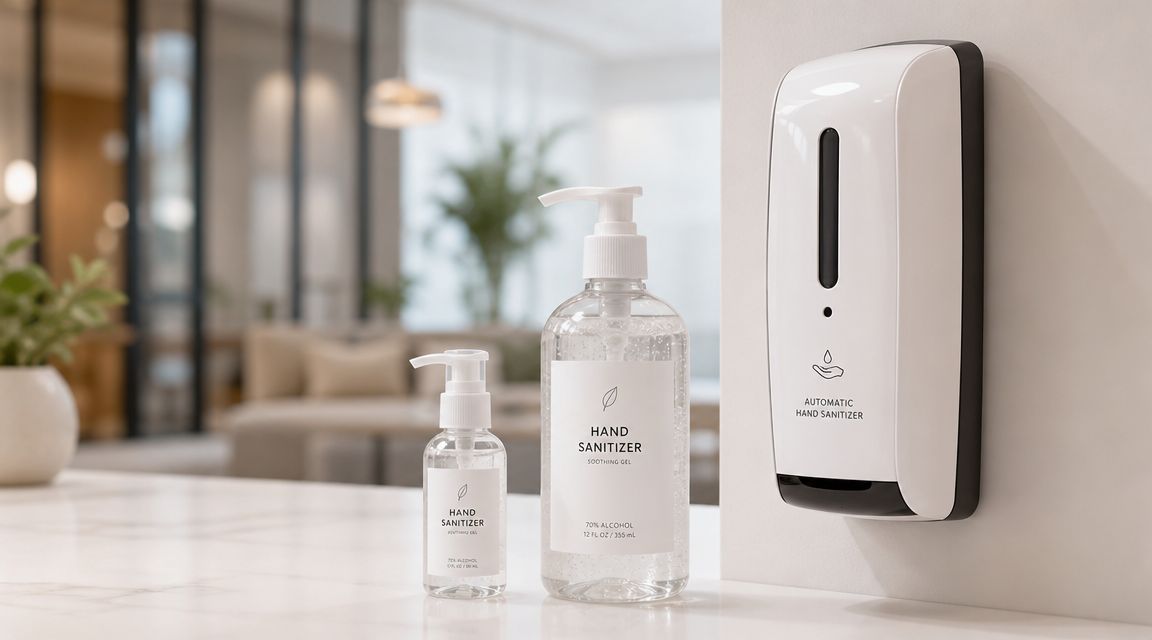
You've probably used several hand sanitizer pumps this week without thinking much about them. One worked smoothly at a clinic front desk. Another sputtered on a store counter. A third sat in a lobby looking modern and touchless, but dispensed almost nothing. Those small differences matter more than they seem.
A hand sanitizer pump isn't just packaging. It's a delivery tool for a hygiene product that people rely on when soap and water aren't close by. If the pump gives too little product, leaks, clogs, or is hard to use, people often skip it or use it incorrectly. In public health, that's a practical problem, not a minor annoyance.
Why Hand Sanitizer Pumps Matter in Public Health
In everyday life, hand sanitizer pumps sit at entrances, reception desks, school offices, waiting rooms, break rooms, and checkout counters. They are often only noticed when they fail. But when they work well, they make one protective action easy, fast, and repeatable.

That convenience has a history. Modern hand sanitizer pumps became practical for broad use after key developments in the 1960s, including the 1965 introduction of Sterillium and a 1966 proposal by nursing student Lupe Hernandez for an alcohol gel form, as described in this history of hand sanitizer. That history also notes that alcohol-based hand sanitizers are typically formulated at 60% to 95% alcohol, with guidance emphasizing at least 60% alcohol when soap and water aren't available.
Why the pump matters, not just the sanitizer
A good dispenser does three things:
- It delivers a controlled dose so users get enough sanitizer to cover both hands.
- It supports repeated use in busy places where many people need quick access.
- It lowers friction because people are more likely to sanitize when the tool is obvious and easy.
A poor dispenser creates the opposite effect. People press harder, get too little product, drip sanitizer onto surfaces, or give up after one weak pump.
Practical rule: If a sanitizer station is hard to use, many people won't use it well enough for it to help.
Where confusion starts
Many readers assume all hand sanitizer pumps do the same job. They don't. The pump design affects dose control, contamination risk during refilling, accessibility for children or older adults, and whether the dispenser can handle a gel or a thinner liquid.
Another common misunderstanding is treating sanitizer as a complete infection-control solution. It isn't. Sanitizer helps with hand hygiene in the right situations, but it doesn't replace handwashing, and it doesn't clean contaminated counters, door handles, or shared devices. For that, surface cleaning and disinfection still matter.
How Sanitizer Pumps Work Manual vs Touchless
Manual and touchless dispensers solve the same problem in different ways. Both move sanitizer from a container to your hand. The difference is how that movement starts.

How a manual pump works
A manual pump is basically a small mechanical transfer system. When you press the top, you push down a plunger. Inside, that motion moves a piston and spring assembly that forces sanitizer upward through the pump and out through the nozzle.
Think of it like a tiny hand-powered lift for liquid or gel.
Most manual pumps include these parts:
- Pump head that your hand presses
- Spring that returns the pump to its starting position
- Dip tube that reaches down into the bottle
- Valve system that helps pull product up and push it out in one direction
When you release the pump head, the spring lifts it back up. That upward movement helps draw more sanitizer into the pump chamber so it's ready for the next press.
How a touchless dispenser works
A touchless unit replaces hand pressure with a sensor and powered mechanism. Usually, a user places a hand beneath the outlet, the sensor detects it, and the device activates a motor or dispensing mechanism.
That means the user doesn't touch the dispenser body during normal use.
If you want a closer look at sensor-based units, VirusFAQ also has a guide to the automatic hand sanitizer dispenser.
A touchless dispenser reduces contact with the device itself, but it still needs the right refill, regular maintenance, and proper placement to work reliably.
Side-by-side comparison
| Feature | Manual pump | Touchless dispenser |
|---|---|---|
| Activation | Hand presses pump head | Sensor triggers motor |
| Power source | None | Battery or built-in power system |
| Common strength | Simple and portable | No-contact operation |
| Common weakness | Users touch shared surface | Sensor or motor can fail |
| Best fit | Desks, counters, personal stations | Entrances, lobbies, public areas |
Where people get frustrated
Manual pumps often fail because product dries in the nozzle, the spring weakens, or the refill is too thick for the mechanism. Touchless dispensers create different problems. Sensors may misread hand position, batteries can run down, and some units are picky about refill type.
Neither format is automatically better. The better choice depends on where the dispenser will sit, who will use it, and what kind of sanitizer goes inside.
The Role of Hand Sanitizer in Stopping Viruses
Hand sanitizer works by chemistry, not by magic. Alcohol-based sanitizers can quickly damage certain microbes, but only under the right conditions and against the right targets.

What alcohol does
Alcohol helps by disrupting important structures that microbes need to function. In practical public health terms, that's why alcohol-based sanitizers are useful against many everyday infectious threats.
Formulation matters. The hand sanitizer reference on Wikipedia's hand sanitizer page states that alcohol rub sanitizers containing at least 70% alcohol have been reported to kill 99.9% of bacteria on hands in 30 seconds, and 99.99% to 99.999% in one minute. The same source notes an optimum concentration range of 70% to 95% for disinfection and says products with at least 60% alcohol are recommended when handwashing isn't possible.
Why that doesn't mean sanitizer works for every situation
Readers often hear “kills germs” and assume that means the same level of performance for every virus, on every hand, in every setting. That's not how it works.
Alcohol-based sanitizers are especially useful against many enveloped viruses, which have an outer lipid layer that alcohol can disrupt. That matters for viruses such as influenza viruses, SARS-CoV-2, and herpes simplex viruses. But sanitizer has limits. Some non-enveloped viruses are harder to inactivate with alcohol alone, so sanitizer may be less reliable in those situations.
For a broader explanation of those virus-specific differences, see VirusFAQ's article on does hand sanitizer kill viruses.
When sanitizer is the wrong tool
Use plain judgment here. If your hands are visibly dirty, greasy, or contaminated with food residue, sanitizer doesn't remove that material. It's not a cleaning agent. It won't wash off grime, and it can't work well through heavy debris.
That's why soap and water remain the better choice when hands are soiled.
- After using the restroom: Washing is better because you need removal, not just chemical action.
- After handling raw food or grease: Sanitizer won't clean residue off your skin.
- After touching body fluids or obvious dirt: Physical washing matters.
- After contact with high-touch surfaces in a messy environment: You may need both hand hygiene and surface disinfection.
Hand sanitizer is most useful on hands that are already free of visible dirt.
That last point often gets missed in community settings. If people keep sanitizing their hands but continue touching contaminated counters, phones, carts, or door hardware, the chain of transmission may continue. Hand hygiene and surface hygiene work together, not separately.
Choosing a Hand Sanitizer Pump for Home Office or Public Space
The right dispenser for a kitchen counter isn't the right dispenser for a school entrance. People make better choices when they match the pump to the setting instead of buying whatever looks familiar.
For home use
At home, a compact countertop pump usually makes sense. It's easy to move, simple to monitor, and less complicated to refill or replace. For many households, a bottle in the kitchen or near the entryway is enough.
A practical countertop pump bottle for office or commercial-style use often falls in the 236 mL to 16 oz range, according to this commercial pump bottle listing. That size works at home too because it balances convenience with enough volume that you're not replacing it constantly.
If you want a smaller option for bags, reception giveaways, classrooms, or family use outside the home, Custom Mark's hand sanitizer solutions show the kind of small-format bottle some groups prefer when portability matters more than reservoir size.
For offices and shared workspaces
Office use changes the decision. A desk bottle works for one person, but a front desk, conference room, or break room needs something more visible and durable.
Look for these traits:
- Stable base: A bottle that tips easily becomes a spill hazard.
- Easy one-hand use: Staff may sanitize while carrying folders, food, or equipment.
- Clear refill compatibility: Mixed products often cause trouble later.
- Readable labeling: People should be able to identify what's in the dispenser.
Accessibility matters here too. Some users have arthritis, reduced grip strength, limited reach, low vision, or difficulty lining up their hand under a sensor. A dispenser that works well for a healthy adult may still be frustrating for a child, an older adult, or someone with limited dexterity.
For public spaces
A public dispenser has a harder job. It must survive frequent use, give consistent output, and stay simple enough that first-time users understand it immediately.
This quick comparison helps:
| Setting | Good choice | Why it fits |
|---|---|---|
| Home kitchen or entryway | Small manual pump | Easy to move and monitor |
| Office reception | Mid-size countertop pump | Visible and convenient for moderate shared use |
| School lobby or clinic entrance | Wall-mounted touchless unit | Better suited to repeated use by many people |
| Community event table | Portable manual pump bottle | Fast setup and transport |
The best dispenser is the one people can use correctly without instructions.
That includes height, pump resistance, stability, and whether the nozzle gives a predictable amount of product. Accessibility isn't a bonus feature. In a public setting, it's part of whether the station works at all.
Preventing Contamination During Refilling and Maintenance
A dispenser can become part of the problem if it's refilled carelessly. Many people assume sanitizer protects itself from contamination under all conditions. That's too simplistic. The inside of a dispenser, the refill method, and the product match all affect safety and reliability.

Don't top off old product
One common mistake is “topping off” a partially filled dispenser by adding new sanitizer on top of what's already inside. That sounds efficient, but it creates avoidable risk. Old residue remains in the container. The pump surfaces may already be dirty. If the dispenser wasn't cleaned first, the fresh product enters a system that may not be clean.
A safer routine is to empty, clean, dry, and then refill.
A practical refill routine
Use this sequence for reusable dispensers:
- Let the dispenser empty fully so old and new product aren't mixed.
- Wash the reservoir and parts that are meant to be cleaned with soap and water.
- Allow everything to air dry completely before refilling.
- Refill with a fresh, sealed, compatible sanitizer product.
- Reassemble carefully and test the pump before placing it back into service.
If you switch brands or formulations, this matters even more.
Match the refill to the pump
Formulation compatibility is one of the least discussed reasons pumps fail. A product listing for a larger pump bottle from Safetec specifies 66.5% ethyl alcohol in one sanitizer formula, which shows that sanitizer chemistry can vary by product. The same source supports an important practical point: if a refill is too thick or too thin for the pump, you can get clogging, inconsistent dosing, or pump damage, as noted on this 64 oz hand sanitizer product page.
That's one reason homemade mixtures can create trouble. People often guess at consistency, ingredients, or container fit. For context on that issue, VirusFAQ has a separate article on how do you make homemade hand sanitizer.
Maintenance note: A dispenser is a system, not just a bottle. The refill, nozzle, pump design, and cleaning routine all have to work together.
If you manage dispensers in a school, office, clinic, or community site, assign responsibility clearly. Someone should check function, cleanliness, and refill status on a routine schedule. Otherwise, stations stay empty, sticky, or clogged long after people assume they're ready to use.
How to Fix a Clogged or Leaking Sanitizer Pump
When a sanitizer pump stops working, the cause is often mechanical buildup or a mismatch between the dispenser and the refill. Many reliability issues come from incompatibility between the sanitizer formulation and the pump mechanism. Large units may use peristaltic pumps to handle a wider range of viscosities, while standard pumps often struggle when a thick gel is used in a dispenser designed for a thinner liquid, as described on this industrial product page discussing pump types.
If the pump is clogged
Dried sanitizer often blocks the nozzle or upper channel first. Start with the simplest fix.
- Remove visible buildup: Wipe the nozzle and clear crusted product carefully.
- Flush with warm water: If the pump parts are washable, run warm water through the mechanism.
- Prime it again: Reassemble and pump several times to pull product back up.
If the clog keeps returning, the sanitizer may be too thick for that pump.
If the pump won't dispense
Sometimes the pump isn't blocked. It just hasn't primed.
Try this short checklist:
| Problem | Likely cause | What to do |
|---|---|---|
| No product comes out | Pump lost prime | Press several times in a row after checking the dip tube |
| Very weak output | Partial clog or air in system | Clean nozzle, then retry |
| Pump sticks down | Dried residue or worn spring | Clean mechanism or replace pump top |
| Leaking around neck | Loose fit or bad seal | Tighten cap and inspect gasket |
If it leaks
Leaks usually point to a seal problem, overfilling, cracked threads, or a formula the pump doesn't handle well. A thin liquid in a pump meant for gel can drip. A thick gel in the wrong pump can force product out oddly and leave residue around the head.
If cleaning and tightening don't solve it, replacement is often the safest choice. A leaking dispenser wastes product and leaves sticky surfaces that collect dirt.
The Future of Hand Hygiene and Surface Disinfection
Hand sanitizer pumps will remain part of daily life because they solve a real problem. They make fast hand hygiene possible where sinks aren't nearby. That matters in offices, schools, clinics, transit spaces, and community buildings.
But sanitizer works best when people understand its place. It's a strong backup when soap and water aren't available. It isn't a universal answer for all microbes, all messes, or all settings. It also can't compensate for a dirty environment.
A practical hygiene hierarchy
For most community settings, the order is simple:
- First choice: Wash hands with soap and water when they're visibly dirty or after messy contact.
- Second choice: Use an alcohol-based hand sanitizer correctly when washing isn't available.
- At the same time: Clean and disinfect high-touch surfaces that many people share.
That last step matters because viruses don't only travel on hands. They can move through shared surfaces such as handles, counters, keyboards, carts, and railings. If those surfaces stay contaminated, people can recontaminate clean hands minutes later.
What communities should focus on
A better hygiene setup doesn't require complicated technology. It requires good placement, product compatibility, accessible design, and realistic expectations.
Community groups, schools, and workplaces should ask:
- Can people reach and operate the dispenser easily?
- Does it deliver a reliable amount of sanitizer every time?
- Is the refill process clean and consistent?
- Are high-touch surfaces being cleaned and disinfected too?
Clean hands help. Clean hands plus clean shared surfaces help more.
That's the most useful way to think about hand sanitizer pumps. They're not trivial accessories, and they're not complete protection on their own. They're one practical part of a larger prevention system that includes handwashing, sensible maintenance, and surface disinfection where it counts.
If you're reviewing your own hygiene setup, start with the basics: make sure the dispenser works, the sanitizer is compatible, the station is accessible, and the surfaces around it aren't being ignored.
Leave a Reply