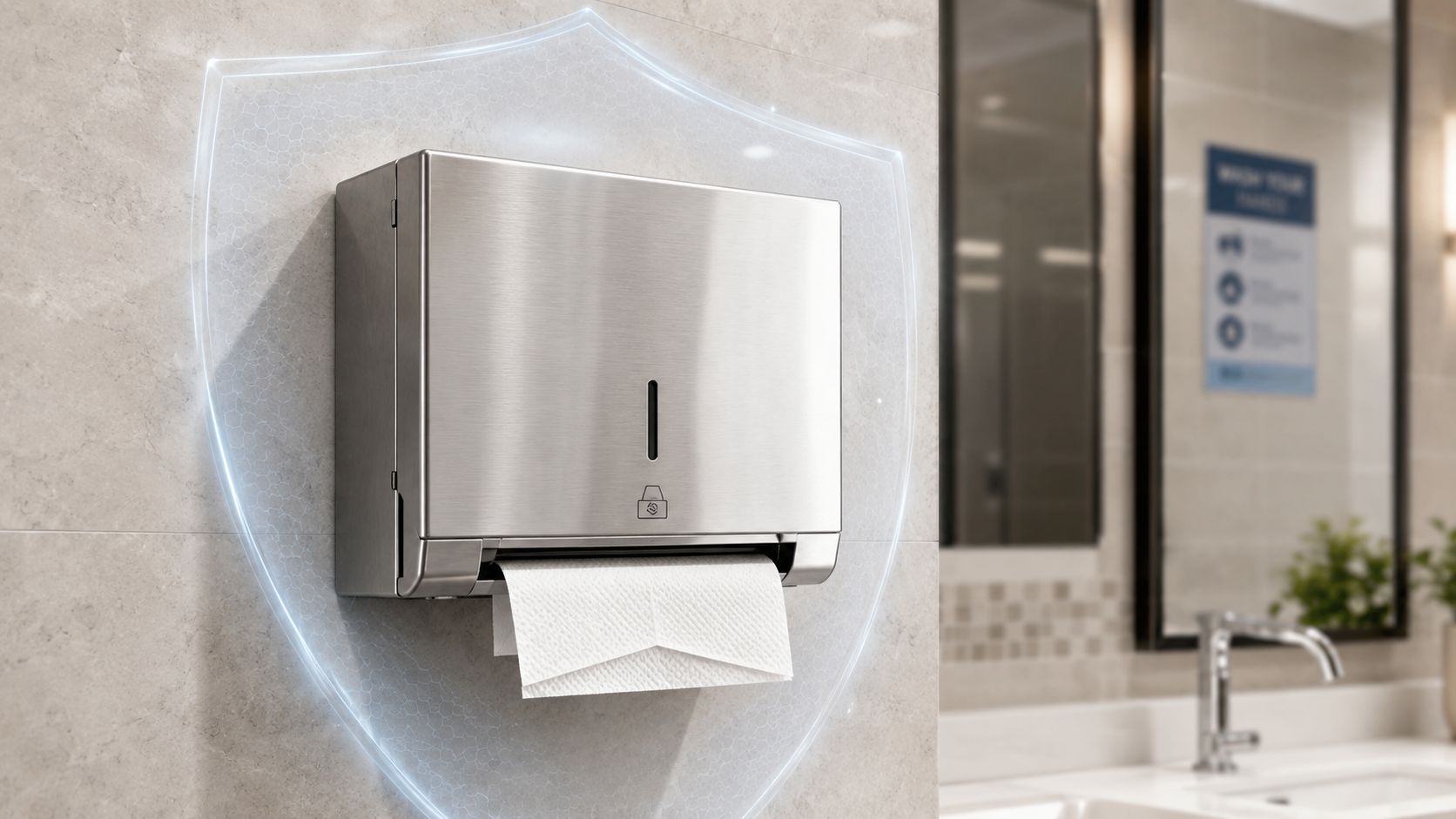
You wash your hands in a public restroom, reach for a towel, and touch the front edge of the dispenser without thinking about it. Instead, individuals typically focus on whether paper is available, whether the cabinet looks clean, and whether the towel comes out easily.
A facility manager has to notice more than that. The dispenser is part storage unit, part traffic control device, and part infection-control surface. If it jams, users grab extra towels. If it sits in a splash zone, contamination builds. If staff refill it poorly or clean it inconsistently, the dispenser itself can become one more stop in the chain of transmission.
The Unseen Guardian in Public Health
In shared buildings, small design decisions shape daily hygiene. A folding paper towel dispenser is one of those decisions. It seems ordinary until you watch how many hands interact with it in a school restroom, clinic washroom, office break area, or food-service sink station.
The basic public health idea behind the dispenser is old and still sound. The folding paper towel dispenser traces its roots to the early 1900s, when paper towels emerged as a sanitary substitute for shared cloth towels, and Scott Paper Company later marketed disposable “Sani-Towels” with the slogan “For use once by one user” to reduce disease spread in shared spaces such as schools (paper towel history overview).
Why that history still matters
That slogan captured the core infection-control principle. Separate one user's hand-drying material from the next user's. A shared cloth towel fails that test. A single-use folded sheet supports it.
Facility managers still face the same question today, just with better hardware. Will users touch one towel, or several? Will they touch the cabinet opening? Will moisture and residue collect where hands cluster? Will staff know when a unit needs attention before it runs empty?
Practical rule: If a restroom hand-drying setup encourages extra touching, bunching, fishing, or reaching, it also creates more opportunities for contamination.
A folding dispenser works best when the system around it works too. Placement, refill practice, and surface cleaning matter as much as the cabinet itself. That broader idea is worth reinforcing in any hygiene program. Resources on clean living from Calibre Cleaning help frame why visible cleanliness and infection control often rise or fall together.
For managers reviewing restroom risk, it also helps to think beyond the sink and include the whole room workflow, especially in public sites with mixed users and uneven habits. This broader view is central to cleaning public bathrooms safely.
What readers often miss
People often judge dispensers by convenience alone. Public health asks a stricter question. Does the dispenser reduce shared contact, protect clean towels before use, and stay clean enough between service visits to avoid becoming part of the problem?
That is why the humble paper towel dispenser deserves more attention than it gets.
How Dispensers Can Spread or Stop Viruses
A dispenser can interrupt transmission, but it can also help it along. The difference comes down to fomite transmission, which means the movement of infectious material through contaminated surfaces.

Think of the dispenser as a tollbooth. One person arrives with contaminated hands and leaves traces on the cabinet edge, lever, button, or towel opening. The next person touches that same spot, then touches the towel, faucet, face, phone, or door handle. The surface doesn't infect people by itself. People move contamination from surface to hand, then from hand to mouth, nose, eyes, food, or another object.
The transmission path in plain language
The chain usually looks like this:
- A contaminated hand touches the dispenser.
- Virus-containing material remains on a hard surface.
- Another user touches the same contact point.
- That user transfers contamination elsewhere.
This matters for viruses that spread efficiently through hands and surfaces in crowded settings. Norovirus is the classic example in restrooms and shared buildings. Rhinoviruses also fit the everyday pattern of hand-to-surface-to-hand spread. In practical terms, the dispenser isn't just a fixture. It's part of the contact network.
For readers who want a deeper explanation of that surface pathway, this primer on what fomite transmission means is useful.
Why design changes the risk
Not all dispenser interactions are equal. A unit that releases one visible towel cleanly gives the user a short, simple action. A unit that jams, hides the towel edge, or allows bunching creates extra hand movement and more surface contact.
Three design details matter most:
- The pickup point: If users have to pinch around a narrow slot or reach into the cabinet opening, they touch more shared surface area.
- The towel presentation: If the next towel is easy to grasp, the user is less likely to brush the cabinet again.
- The refill condition: If towels are overstuffed, misaligned, or dampened by nearby splashing, the dispensing path becomes less reliable.
A dispenser doesn't have to look dirty to participate in virus spread. It only has to be touched often enough, cleaned rarely enough, or designed poorly enough.
That is why infection control staff and facility managers should evaluate dispensers the same way they evaluate other high-touch restroom surfaces. The mechanism may be simple, but the exposure pathway is not.
Comparing Common Folding Towel Dispenser Designs
A facilities manager comparing dispensers is really making a transmission-control decision. The question is simple: during a rushed hand-drying moment, how many shared surfaces does one person need to touch before getting a clean towel?
That question matters because folded-towel dispensers do two jobs at once. They store a dry hand hygiene product, and they create a repeated contact point in a restroom, break room, clinic, or food-service wash area. If the dispenser presents towels poorly, users search with their fingers, brush the cabinet opening, or touch the next sheet. Each extra contact is another opportunity for a contaminated surface to join the chain of infection.
The main paper formats are C-fold and M-fold, also called multifold. A folded-towel explainer from IMC Teddy notes that C-fold towels do not interlock, while multifold towels are folded to interlock and present the next towel more consistently (folded towel dispenser explainer). In practice, that mechanical difference affects hygiene. A non-interlocked stack can behave like a loose deck of cards. A user may pull one sheet and disturb several. An interlocked stack works more like linked pages. One towel leaves, and the next is easier to grasp.
What changes at the point of use
A manual C-fold dispenser can be acceptable in a low-traffic area with careful loading and regular checks. The weakness is predictability. If towels shift, bunch, or sit too deep in the opening, users often pinch around the slot or touch neighboring sheets to get a usable grip. That turns the dispenser face and exposed towel edges into shared contact points.
A manual multifold dispenser usually supports cleaner pickup. Because the towels interlock, the next sheet is more likely to remain visible after each pull. That means less searching, fewer repeat grabs, and less hand contact around the opening. For infection control, that is the practical advantage. It reduces the number of chances for contamination to move from hands to cabinet and back again.
A touchless folded-towel unit changes the workflow but does not remove the dispenser from the exposure pathway. The benefit here is narrower and specific: the user may avoid pressing or tugging on a release point during dispensing. The remaining risks depend on cabinet surfaces, refill handling, towel-path cleanliness, and placement near splash zones. Those details matter enough to evaluate touchless systems separately.
Dispenser design comparison for infection control
| Dispenser Type | Hygiene Risk (Touchpoints) | Waste Control | Typical Setting |
|---|---|---|---|
| Manual C-fold dispenser | More shared contact around the opening when towels shift, bunch, or require users to touch adjacent sheets | Less controlled if multiple towels come out together | Small offices, older restrooms, lower-traffic areas |
| Manual multifold dispenser | Lower contact at pickup when the next sheet stays visible and easy to grasp | Better controlled because dispensing is usually one towel at a time | Offices, schools, clinics, medium-use restrooms |
| Touchless folded or sensor-based dispenser | Lower hand contact during dispensing, with continued risk on exterior surfaces and during refill | Usually controlled at the dispensing step | Public buildings, healthcare-adjacent spaces, higher-expectation restrooms |
Construction affects hygiene, not just durability
The cabinet itself also deserves attention. Surface-mounted, recessed, and semi-recessed housings create different cleaning demands, and door fit affects how reliably towels present at the opening. A dispenser with a loose door, rough edges, or a misaligned slot tends to create jams and hand searching. A unit with a stable front, a clean dispensing path, and a secure lock supports more consistent use and easier environmental cleaning.
This is why dispenser selection should be treated like sink and soap-dispenser selection. You are choosing a shared surface that many people will approach with wet hands, incomplete attention, and varying hand hygiene habits. The best design is the one that presents one towel clearly, limits unnecessary touching, tolerates frequent cleaning, and keeps performing after repeated refills.
For food-handling environments, the dispenser should also support a broader cross-contamination plan. This practical guide to essential food safety for cafes is helpful because it shows how hand hygiene equipment fits into a larger prevention system rather than standing alone.
The Hidden Hygiene Risk of Touchless Systems
A parent washes a child's hands in a busy restroom, reaches for a towel, and never touches a lever or crank. The interaction feels safer. The catch is that the dispenser door, face, lock area, and towel opening may still carry contamination from splash, refill handling, and repeated contact around the unit.
That distinction matters for infection control. Touchless dispensing reduces contact at the moment a towel is released. It does not remove the dispenser from the chain of transmission. In practical terms, the unit is still a shared environmental surface, or fomite, inside a space where Norovirus, SARS-CoV-2, and other pathogens can move by hands, droplets, and contaminated moisture.
Why low-touch still requires surface hygiene
Facility teams often focus on the sensor because it is the visible feature. The higher-value question is broader: what parts of the dispenser do people and staff still touch, and what contamination reaches those surfaces between cleanings?
A touchless folded-towel unit usually lowers one exposure point. Users do not need to press a button, pull a lever, or tug repeatedly at a stack. That can reduce hand contact during dispensing. Yet the cabinet exterior still sits near sinks, wet hands, coughs, toilet plume, and routine traffic. If the faceplate or towel slot becomes contaminated, the benefit of touchless dispensing narrows.
The dispenser works like a door handle that fewer people turn, but many people still brush past. Lower-touch is helpful. It is not self-sanitizing.
The risk point procurement teams often miss
Material choice and hardware still matter, but mainly because they affect cleaning and consistent towel presentation. Smooth metal or coated surfaces can be easier to wipe than damaged, rough, or poorly fitted housings. Locks and doors protect the paper supply, yet they also create hand-contact points for staff during service.
That is why a touchless model should be evaluated as two systems at once. One system dispenses towels. The other is an environmental surface that must tolerate frequent disinfection without trapping debris, moisture, or residue near the opening.
Refilling can reintroduce contamination
Refill is the moment when a low-touch dispenser becomes a hands-on object again.
A worker opens the cabinet, contacts the latch or lock, handles the towel pack, adjusts the stack, closes the unit, and secures it. If gloves are soiled, hands are not cleaned before loading, or the interior is not checked for splash and paper dust, contamination can be transferred to the areas users approach most closely. A sensor does not prevent that.
Poor loading creates another problem. If towels bunch, tear, or fail to present clearly, users start probing the opening with their fingers. At that point, a touchless dispenser begins behaving like a manual one from a hygiene standpoint.
Common failure points include:
- Cabinet face contamination: droplets, fingerprints, and residue build up on the front surface and near the opening.
- Lock and latch contact: refill staff repeatedly touch these points, but they are easy to miss during disinfection.
- Splash exposure: placement too close to sinks increases wetting and surface contamination.
- Misfeeds after refill: poorly aligned stacks lead users to touch the slot or interior edge.
- Interior debris: paper dust and moisture near the dispensing path interfere with clean towel release.
Touchless should be treated as one layer of protection, not a final answer. The safer outcome comes from combining low-contact dispensing with correct placement, clean refilling, and routine disinfection of the dispenser itself. For a facility manager, that mindset keeps the technology useful without overestimating what it can do.
Selecting Dispensers for High-Risk Environments
The right dispenser for a quiet office restroom may be the wrong one for a school, outpatient clinic, or busy food-service handwashing station. In higher-risk settings, selection should focus on reliability, protected towel storage, controlled dispensing, and fewer refill interruptions.
A useful technical benchmark is capacity. Commercial surface-mounted folded-towel dispensers commonly hold 200 C-fold towels, 275 multifold towels, 400 C-fold towels, or 525 multifold towels, depending on cabinet geometry and towel type. One practical example is that a standard unit can hold 525 multifold towels versus 400 C-fold towels, which matters in busy areas because it cuts refill frequency and reduces service contact opportunities (capacity examples for folded dispensers).
Healthcare and clinical settings
In healthcare-adjacent spaces, towel availability is part of compliance and safety. Empty dispensers lead to workarounds, and workarounds usually create risk.
Prioritize:
- A lockable cabinet: This helps control tampering and keeps the paper supply protected.
- A format with predictable single-sheet presentation: That supports cleaner handoffs during busy periods.
- A surface that tolerates frequent disinfection: Stainless steel is often a practical choice for that reason.
- Placement away from sink splash: Dry paper must stay dry to dispense correctly.
A clinic manager should ask a simple question. If five people use this sink in quick succession, will the sixth person still find a clean, accessible towel without touching the cabinet excessively?
Schools and campuses
Schools create a different pressure profile. Users vary in age, patience, and hand hygiene technique. A dispenser that requires careful pinching or a precise pull usually performs worse here than one that presents a towel clearly.
For schools, I'd lean toward:
- Simple operation so younger users don't fumble with the opening.
- Protected towel storage because exposed stacks get handled.
- Enough capacity to avoid frequent empty periods between custodial rounds.
A bigger paper load doesn't just save labor. It reduces how often staff have to open the unit, load it, and re-establish a clean setup.
Food service and kitchen handwashing points
In food service, the handwashing station is part of contamination control, not just employee comfort. That means the dispenser should support fast use, easy monitoring, and low failure rates during rush periods.
Look for these features:
- Clear sight access or service visibility so staff can spot low stock quickly
- Stable mounting that doesn't loosen near prep or dish areas
- Easy-to-clean exterior surfaces
- Reliable towel fit matched to the exact fold format in use
Operational takeaway: Capacity isn't only a supply issue. It affects how often workers touch the unit during service and how often users encounter empty or jammed dispensers.
The procurement mistake I see most often is buying by cabinet appearance first and towel compatibility second. Reverse that order. Fit, refill burden, and hygienic operation matter more than the finish.
Evidence-Based Cleaning and Disinfection Protocols
A paper towel dispenser should be cleaned like other high-touch restroom infrastructure. That starts with a distinction many teams blur. Cleaning removes visible soil and residue. Disinfecting applies a product intended to inactivate pathogens on the surface. You need both.
This is especially important for norovirus control. The CDC notes that norovirus can remain infectious on hard, non-porous surfaces such as stainless steel for several weeks, which is why frequent disinfection of high-touch restroom objects matters in outbreak prevention and routine hygiene programs (CDC information on norovirus transmission).

A practical protocol staff can follow
Use a written routine, not memory. That makes performance more consistent across shifts.
- Inspect before touching the interior. Check for visible grime, splash residue, paper dust, and any jam at the opening.
- Clean exterior surfaces first. Remove soil from the front, sides, lower edge, and access points.
- Address the dispensing area. Clear lint, torn paper, or debris near the towel exit.
- Disinfect high-touch zones. Focus on handles, levers, door edges, latch areas, buttons, and the towel opening perimeter.
- Allow proper contact time. The disinfectant needs to stay wet for the product's labeled dwell time.
- Refill with clean hands or clean gloves and a clean workflow. Avoid overstuffing the cabinet.
- Close and recheck function. Pull a towel or test the mechanism so the next user doesn't have to troubleshoot.
Where teams usually slip
Many staff members wipe the outside and move on. That may improve appearance, but it can miss the riskiest contact points. The dispenser opening, latch area, and refill touch surfaces often need the most attention.
A few reminders help:
- Use the right product: For outbreak-minded cleaning plans, choose a disinfectant appropriate for the pathogens you're planning against.
- Don't substitute a quick dry wipe for disinfection: If the surface isn't kept wet for the labeled contact time, you may not get the intended effect.
- Pair refilling with surface care: A refill is a good trigger for inspection, cleaning, and disinfection.
Clean first if the surface is dirty. Disinfect after. Doing only one of those steps leaves a gap.
Restroom teams also benefit from standardizing this process across sinks, dispensers, stall touchpoints, and door hardware rather than treating the dispenser as an isolated object. A broader protocol for cleaning the restroom effectively can help align staff routines.
Why wipes often make practical sense
In many facilities, wipes are useful because they simplify access to a ready-to-use disinfecting product for small, repeated touchpoint care. They don't replace training or dwell time, but they can support more consistent treatment of cabinet fronts, latch areas, and other small surfaces that are easy to miss during rushed cleaning rounds.
Your Role in Breaking the Chain of Infection
A folding paper towel dispenser isn't just restroom hardware. It's part of your infection-control system.
Its history reflects that purpose. Its design affects how many shared surfaces users touch. Its placement changes whether clean towels stay protected. Its maintenance determines whether the cabinet helps interrupt transmission or subtly participates in it.
For facility managers, the takeaway is practical. Choose towel and dispenser formats that match each other. Favor reliable single-sheet presentation. Reduce unnecessary refill events where possible. Clean visibly so users trust the space, and disinfect consistently so the surface doesn't become a weak point in your hygiene program.
For everyone else, the message is just as direct. If a restroom dispenser is empty, jammed, dirty, or badly placed, that isn't a minor inconvenience. It's a systems problem with public health consequences.
Good hygiene infrastructure works best when people treat it as infrastructure, not décor.
A safer building doesn't depend on one product or one habit. It depends on many small controls working together. The folding paper towel dispenser is one of them, and it deserves to be managed that way.
If you want more plain-language guidance on how viruses spread through shared surfaces and how to interrupt that chain in everyday settings, explore more educational resources at VirusFAQ.com.
Leave a Reply