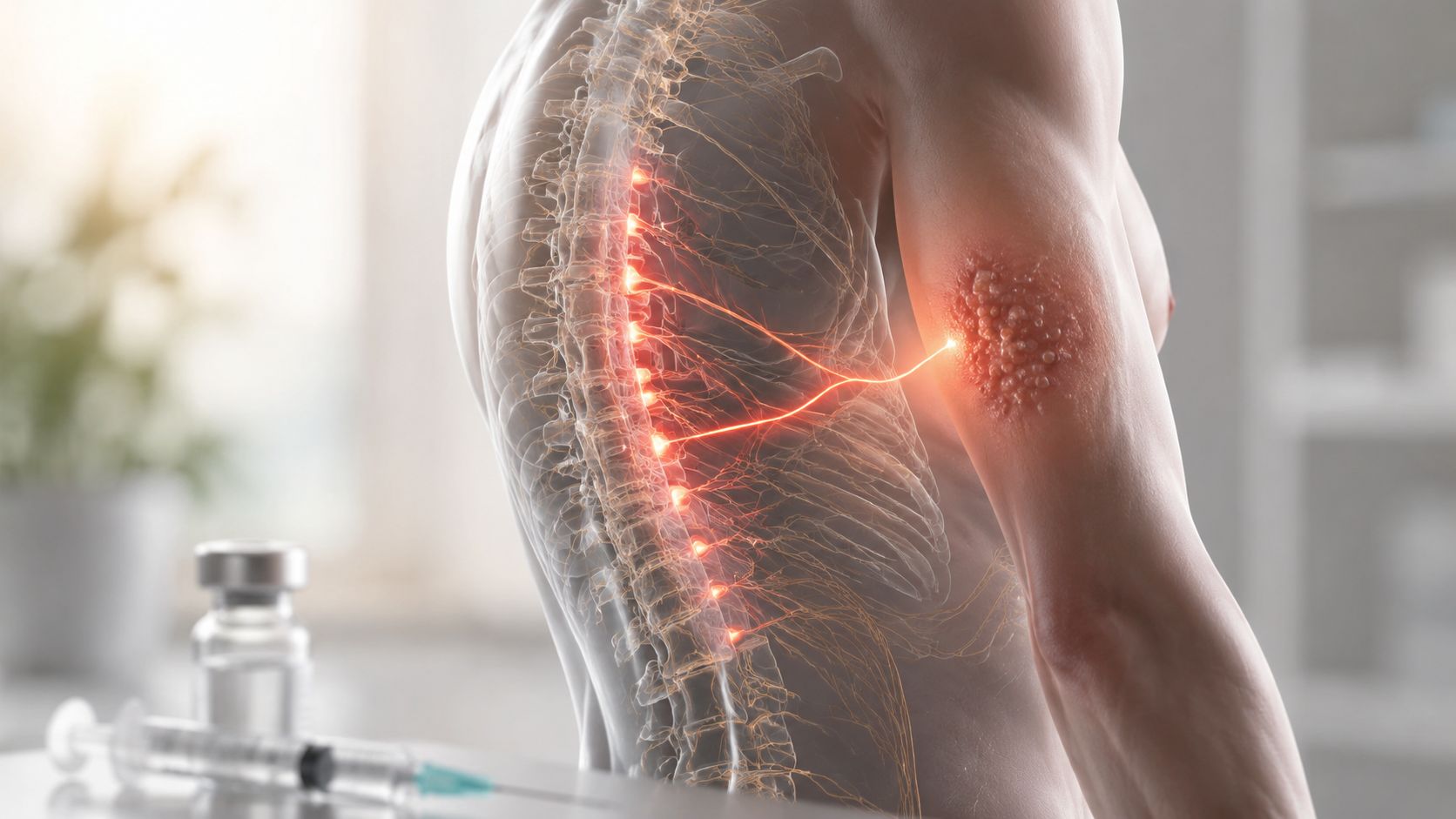
Chickenpox feels like an illness you finish in childhood. Varicella zoster reactivation changes that story. The virus that caused chickenpox can remain in the body for years and later return as shingles.
That's not a rare twist. The CDC clinical overview of shingles states that about 1 in 3 people in the United States will develop herpes zoster during their lifetime, with about 1 million cases each year. For many readers, that's the number that reframes everything. This isn't an obscure complication. It's a common lifelong consequence of an earlier infection.
People often think of shingles as “just a rash.” It can be a rash, but that description is too small. Reactivation can bring burning pain, weeks of disrupted sleep, lingering nerve symptoms, and in some people, far more serious problems. It also matters at the public health level because a virus acquired early in life can continue shaping risk decades later.
The practical question isn't just what shingles looks like. It's why the virus stays, what lets it come back, who's most vulnerable, how clinicians diagnose it when the presentation is odd, and what prevention can still do long after chickenpox is over.
The Hidden Threat After Chickenpox
After a person gets chickenpox, the varicella zoster virus, often shortened to VZV, usually isn't gone. It becomes quiet. The immune system stops the active infection, but the virus remains inside the body in a dormant state.
That dormant phase is why shingles can appear long after childhood. Years may pass with no visible sign of the virus at all. Then, under the right conditions, it reactivates and causes herpes zoster, the medical name for shingles.
Why this catches people off guard
Chickenpox and shingles are caused by the same virus, but they feel like different diseases. Chickenpox is usually remembered as a diffuse childhood rash. Shingles is more localized and often more painful. Because the second illness arrives so much later, many people don't connect the two.
A simple way to think about it is this:
- Chickenpox is the first encounter: The virus spreads widely enough to cause the initial illness.
- Latency is the quiet interval: The virus stays in nerve tissue without causing obvious symptoms.
- Shingles is the comeback: The same virus reactivates and travels along a nerve, producing pain and a rash in a limited area.
Practical rule: If you've had chickenpox, the virus may still be with you even if you've been healthy for decades.
This matters beyond individual discomfort. A virus with lifelong persistence creates a prevention challenge that spans childhood, adulthood, aging, and immune health. It also helps explain why shingles prevention is aimed at adults, not just children.
Why public health takes it seriously
When a condition affects such a large share of the population over a lifetime, it stops being a niche issue. It becomes something clinicians discuss routinely with older adults and with people whose immune systems are weakened by illness or treatment.
For patients, the main lesson is simple. Chickenpox can be the beginning of a long relationship with VZV, not the end of it.
How the Virus Hides and Reawakens
VZV behaves like a houseguest who never fully leaves. After chickenpox, it retreats into sensory nerve ganglia, where it can remain silent for years. The body's defenses keep it under control, but control isn't the same as eradication.
The key defense is cell-mediated immunity. That's the arm of the immune system that helps recognize and contain infected cells. When that protection weakens, the virus gets an opportunity to reactivate. The CDC notes that VZV reactivation is strongly linked to waning cell-mediated immunity, especially with age or immunosuppression, in its guidance on varicella and healthcare epidemiology.

A plain-language model of latency
Think of VZV as a spark tucked inside the wiring behind a wall. As long as the circuit control is working, nothing happens. If control weakens, the spark can travel back down the line and show up where you can see it.
That's roughly what shingles is. The virus reactivates inside nerve tissue and moves along the affected nerve toward the skin. The result is often a stripe or patch of painful rash that corresponds to that nerve's distribution.
For readers who want a virology frame, VZV belongs to the group of herpesviruses that establish latency. If you want a broader primer on that kind of viral biology, this overview of what DNA viruses are helps place VZV in context.
Why age and immune suppression matter
The body doesn't lose all immune function at once. What changes is the efficiency of surveillance. In older adults, VZV-specific control may weaken enough that the virus can start replicating again. A similar problem can happen in people with HIV, cancer, organ transplants, or medications that suppress immunity.
That's why shingles is tied so closely to immune status. The virus doesn't need a new exposure from outside. It uses an opening from within.
When reactivation doesn't look typical
The classic picture of shingles is a painful unilateral rash. But VZV can also reactivate in ways that confuse patients and clinicians, especially when neurologic symptoms appear without a visible rash.
In those atypical cases, diagnosis may require cerebrospinal fluid testing. The CDC notes that clinicians may test CSF for VZV DNA by PCR and for anti-VZV IgG or IgM. In some neurologic syndromes, CSF IgG can be more sensitive than PCR. That detail matters because a missed diagnosis can delay treatment in conditions involving the brain, spinal cord, cranial nerves, or blood vessels.
When a patient has neurologic symptoms that fit VZV but no rash, “no rash” doesn't rule it out.
The Clinical Spectrum of Reactivation
Shingles first presents as pain, tingling, or burning in one area of the body. Then a rash appears, usually on one side, often in a band-like pattern. Blisters can follow. The skin findings are visible, but the nerve pain is often what patients remember most.
A common story goes like this: a person thinks they pulled a muscle, irritated their skin, or slept in an awkward position. A day or two later, the area becomes sharply tender, and the rash makes the diagnosis more obvious. That sequence matters because the pain can begin before the rash.

The familiar form and the lingering pain
The straightforward case is still miserable. Shingles can make clothing painful, sleep difficult, and routine movement unpleasant. Some people recover once the rash resolves. Others develop postherpetic neuralgia, in which nerve pain continues after the skin has healed.
Clinically, that's a major dividing line. A rash is visible and temporary. Persistent nerve pain can alter daily life much longer, affecting concentration, mood, and function.
Eye, ear, and nervous system involvement
VZV reactivation can also hit more specialized parts of the nervous system. A reactivation near the eye can threaten vision. Involvement of cranial nerves can affect facial movement, hearing, or balance. More severe neurologic disease can include meningitis, encephalitis, myelopathy, or other inflammatory syndromes.
Here's a compact way to think about the spectrum:
| Clinical form | What it may look like | Why it matters |
|---|---|---|
| Classic shingles | Painful blistering rash along one nerve region | Most recognizable presentation |
| Postherpetic neuralgia | Pain that persists after rash clears | Can be disabling and slow to resolve |
| Ocular involvement | Eye pain, facial rash, vision symptoms | Can threaten sight |
| Neurologic involvement | Headache, weakness, cranial nerve findings, altered neurologic symptoms | May require urgent evaluation |
The systemic risk many people miss
One of the biggest changes in how clinicians think about shingles is the growing attention to vascular complications. A 2023 study published in PMC examined 581 people living with HIV. In that study, 45/581 reported herpes zoster, and ischemic events followed shingles significantly more often than in those without reactivation, 13% vs. 5%, with p = 0.01. The authors also reported higher ischemic risk associated with positive serology for both VZV and herpes zoster, with odds ratios of 4.01 and 3.14. They further noted that recent studies in the general population have connected shingles to short- and medium-term ischemic cardiac and cerebral events, especially during the first 3 months after reactivation.
That doesn't mean every person with shingles will have a vascular event. It does mean shingles isn't only a skin problem. In some settings, it may also signal a period of higher systemic risk.
A painful rash can be the visible part of a process that also affects nerves, blood vessels, and sometimes critical organs.
Who Is at Risk for Shingles
Not everyone who has had chickenpox will experience reactivation at the same time or under the same conditions. Risk rises when the immune system has a harder time keeping latent virus contained.
The broad rule is straightforward. People who are older or immunocompromised face the greatest concern. That doesn't make younger, otherwise healthy adults immune to shingles, but it does shift where prevention and clinical suspicion matter most.

The biggest risk patterns
Advancing age sits at the top of the list because immune control of latent VZV weakens over time. Immunosuppression is the other major category. That includes people living with HIV, people receiving chemotherapy, transplant recipients, and others taking medications that dampen immune function.
A few practical examples make this easier to remember:
- Older adult with no major illness: Risk rises because immune surveillance naturally becomes less effective.
- Younger transplant recipient: Risk may also rise because medications suppress the very immune responses that help restrain latent virus.
- Person with prior chickenpox under major physiologic strain: Reactivation may become more plausible when the body's defenses are under pressure.
What about stress and environmental triggers
Patients often ask whether stress can “cause” shingles. The careful answer is that stress is discussed as a plausible trigger, but it's best understood in the larger context of immune function rather than as a single switch. For a broader discussion of that relationship, this article on whether stress can weaken the immune system is useful background.
Researchers have also explored whether the environment plays a role. A longitudinal analysis in the American Journal of Epidemiology found that shingles incidence had a strong correlation with seasonal ultraviolet radiation, including lagged and unlagged associations. The authors concluded that chickenpox transmission and shingles reactivation are driven by separate processes with out-of-phase seasonality.
That finding matters because it pushes against the idea that reactivation is purely random. It suggests that, in some settings, biology and environment may combine to influence when latent virus reawakens.
A short checklist for readers
- Had chickenpox before: You carry the underlying prerequisite for shingles.
- Older age: The most familiar risk pattern in everyday practice.
- Weakened immunity: A high-priority group for prevention and prompt evaluation.
- Unusual symptoms during a vulnerable period: Pain, rash, or neurologic changes deserve attention.
Diagnosis and Modern Treatment Strategies
For many patients, diagnosis starts with pattern recognition. A clinician hears about burning or stabbing pain on one side of the body, then sees a localized blistering rash that follows a nerve distribution. In that setting, shingles is often a clinical diagnosis.
Things get more complicated when the presentation is incomplete. Some people seek care before the rash appears. Others have pain with only subtle skin changes. A few have neurologic disease with no rash at all. That's when testing becomes more important.
How clinicians confirm tricky cases
In straightforward shingles, lab confirmation may not be necessary. In severe, atypical, or neurologic cases, clinicians may use laboratory methods to clarify what's happening.
Common diagnostic approaches include:
- Clinical examination: The distribution and character of the rash often provide the first clue.
- PCR-based testing: Useful when a sample can be obtained from suspicious lesions or, in selected neurologic cases, from cerebrospinal fluid.
- CSF antibody testing: Particularly important when VZV is suspected in the nervous system and the rash is absent or no longer visible.
The practical point is that diagnosis isn't just about naming the virus. It's about identifying the form of disease. Skin-limited shingles, ocular disease, and VZV vasculopathy don't all require the same level of urgency.
Treatment has two jobs
Modern treatment usually aims to do two things at once. First, clinicians try to suppress viral replication with antiviral drugs such as acyclovir, valacyclovir, or famciclovir. Second, they try to control pain, which can be severe even in otherwise uncomplicated cases.
Pain management isn't one-size-fits-all. Depending on severity, clinicians may use:
- Simple analgesics: For mild to moderate discomfort.
- Prescription pain strategies: When pain is intense or sleep-disrupting.
- Nerve-pain focused medications: Especially if symptoms continue after the rash improves.
Clinical reminder: Early medical evaluation matters because antivirals work best when started promptly after symptoms begin.
When urgency rises
Some presentations should push patients toward faster care. Eye involvement is one. Neurologic symptoms are another. Extensive rash in an immunocompromised patient also changes the stakes.
A useful rule for non-clinicians is this: if shingles affects the face, eye, hearing, balance, strength, or mental status, treat it as more than a routine skin problem and seek prompt medical attention.
Preventing VZV Reactivation and Transmission
Shingles prevention has a lifelong arc. The same virus that causes chickenpox in childhood can reappear decades later, so prevention is not a one-time decision. It starts with childhood protection against primary infection and continues with adult vaccination to reduce the chance that a dormant virus will break through later in life.
For adults, the main preventive tool is vaccination. The CDC shingles clinical overview recommends recombinant zoster vaccine (Shingrix) as a 2-dose series for adults 50 years and older and for immunocompromised adults 19 years and older.
This recommendation is important because shingles prevention reaches beyond avoiding a rash. It can lower the risk of severe pain, missed work, loss of independence, and some of the broader complications linked to reactivation, including neurologic and vascular problems that can affect health well beyond the skin.

Why vaccination is the center of prevention
VZV latency works like a fire that never fully went out. After chickenpox, the virus stays quiet inside nerve tissue. A shingles vaccine helps the immune system keep watch over those hidden embers, making it less likely that they flare back into active disease.
That is why lifestyle habits alone cannot provide the same protection. Sleep, nutrition, and general health support the body, but they do not remove latent VZV from nerve cells. For readers who want to understand the vaccine itself, this guide on what subunit vaccines are explains the design approach behind Shingrix.
Some readers also look for broader wellness strategies. A balanced discussion of naturally supporting immune function can complement medical care, but it should not replace evidence-based vaccination.
What shingles can spread, and what it cannot
A person with shingles does not pass “shingles” to someone else through casual contact. The transmissible part is varicella-zoster virus in the blister fluid. If that virus reaches someone who is not immune, that person may develop chickenpox.
That distinction helps with real-life decisions. The goal is to prevent contact with the rash while it is active, especially around pregnant people without immunity, newborns, and anyone with weakened immune defenses.
Practical steps include:
- Keep the rash covered when possible.
- Avoid direct contact with blister fluid.
- Wash hands carefully after touching the rash or bandages.
- Avoid sharing items that may have contacted lesions.
- Limit close contact with high-risk people until lesions have crusted over.
What prevention looks like in daily life
For one person, prevention means getting vaccinated at a pharmacy after age 50. For another, it means asking a specialist about the best timing during cancer treatment or after an organ transplant. In a household with active shingles, it means covering lesions, cleaning hands well, and protecting people who could still get chickenpox.
The public health lesson is simple. Preventing VZV reactivation protects the individual from pain and disability, and it also reduces opportunities for the virus to spread and cause harm across generations.
Frequently Asked Questions About Shingles
Can you get shingles more than once
Yes, it can happen. A prior episode doesn't guarantee lifelong protection from another reactivation. That's one reason prevention still matters even for people who've already had shingles.
Is shingles contagious to someone who already had chickenpox
Usually, the concern is greatest for people who aren't immune to chickenpox. The fluid from shingles lesions can transmit VZV. Whether exposure leads to infection depends on the exposed person's immune history.
For day-to-day decisions, the safest approach is to avoid direct contact with the rash and keep lesions covered until they've healed.
If you don't have a rash, could it still be VZV reactivation
Yes. That possibility is easy to miss. Some neurologic forms of VZV disease can occur without a classic rash, which is why clinicians sometimes use CSF PCR and antibody testing when symptoms point toward VZV involvement.
This is one reason unexplained facial weakness, severe localized nerve pain, meningitis-like symptoms, or new neurologic findings deserve proper medical evaluation.
Can stress cause shingles
Stress is better thought of as a contributing factor than a single direct cause. Varicella zoster reactivation is most strongly tied to weakened immune control. Stress may matter insofar as it affects the body's ability to maintain that control, but it's rarely the whole story by itself.
Is shingles only a problem for older adults
No. It's more strongly associated with aging and immunosuppression, but younger adults can still develop it. The difference is in likelihood and context, not in absolute possibility.
Why is shingles pain sometimes worse than the rash looks
Because the main target is the nerve, not just the skin. The rash is the surface sign. The pain often reflects inflammation and injury along the affected nerve pathway, which is why symptoms can feel out of proportion to what others can see.
Don't judge shingles severity by the skin alone. Patients often suffer most from the nerve pain underneath it.
Should you seek care quickly or wait it out
Quick evaluation is the better move, especially if the rash is new, the pain is intense, or the face and eye are involved. Antiviral treatment is most useful when started early, and certain complications are much easier to manage if clinicians catch them before they worsen.
Does cleaning the home matter if someone has shingles
Cleaning isn't the main defense against reactivation, but it can matter during an active rash. If lesion fluid may have touched shared items or surfaces, careful hygiene and cleaning reduce the chance of spreading virus to someone who isn't immune to chickenpox. In homes with infants, pregnant people, or immunocompromised family members, that added caution makes even more sense.
Varicella zoster reactivation is one of the clearest examples of how a childhood infection can remain biologically relevant for life. It can stay silent for years, then return as a painful rash, a neurologic syndrome, or a broader systemic problem with real public health implications. Vaccination, prompt diagnosis, and practical hygiene all matter.
If you want more evidence-based explainers on viruses, transmission, and prevention, explore the educational resources at VirusFAQ.com.
Leave a Reply