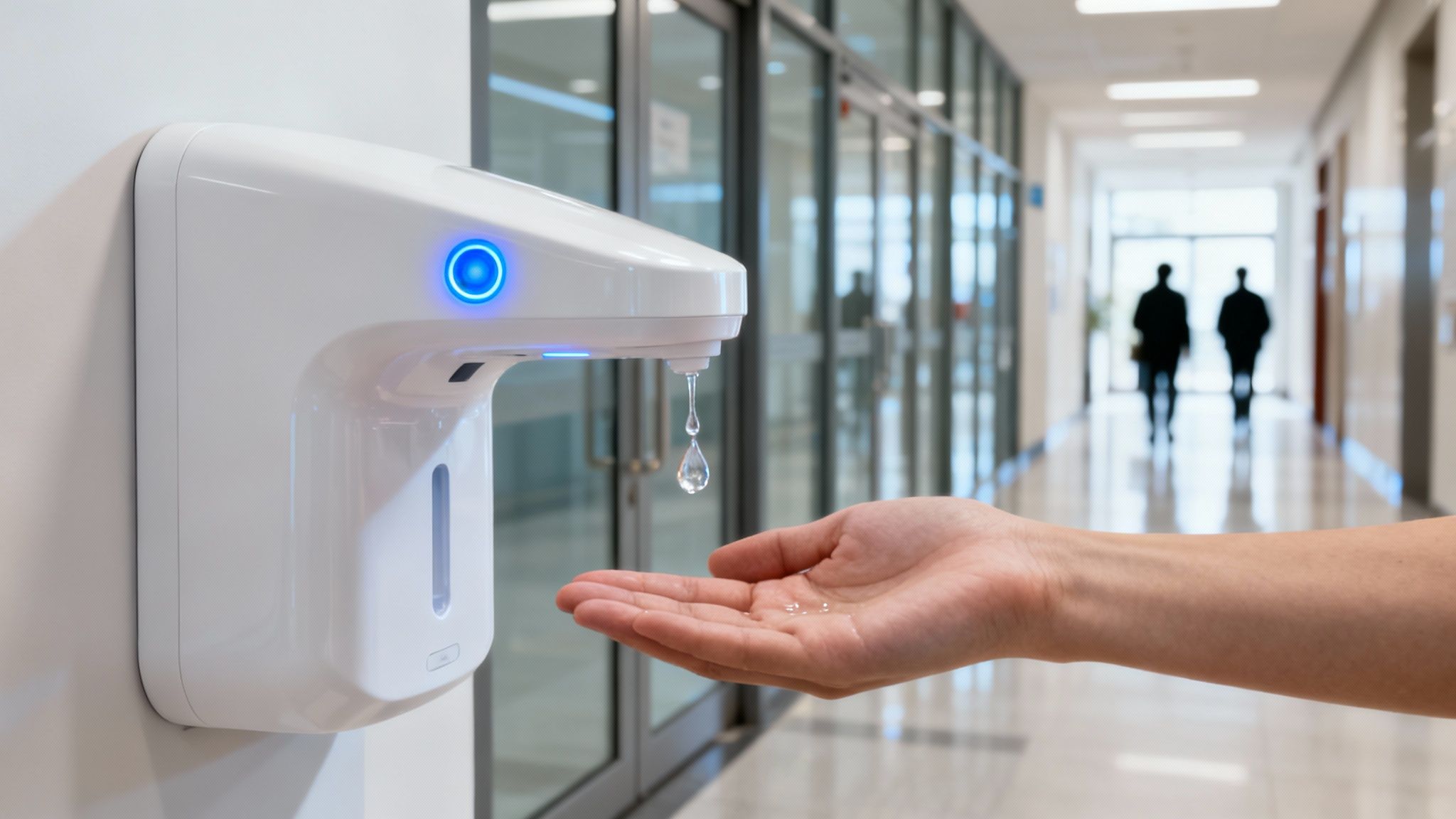
An automatic hand sanitizer dispenser is a simple but brilliant idea: a device that gives you a perfect dose of sanitizer without you ever having to touch it. It uses sensors to see your hands, making it a key player in public health by getting rid of a major weak spot in shared spaces—the pump handle itself.
Why Touchless Technology Is Now Essential for Public Health
In recent years, we've all become much more aware of how easily germs travel on shared surfaces. What used to be a convenience is now a critical part of keeping public spaces safe. The humble hand sanitizer dispenser has transformed into a silent guardian, standing at doorways and in hallways, actively cutting down the risk of cross-contamination.
The real power of an automatic hand sanitizer dispenser is how it breaks the chain of transmission. Viruses like Norovirus (Norwalk Virus) and SARS-Related Coronavirus 2 (SARS-CoV-2) can stick around on surfaces for hours or even days. A manual pump handle can quickly become a hotspot for germs, where every person who touches it either picks something up or leaves something behind. By removing this shared touchpoint, these dispensers, combined with effective disinfecting wipes for surfaces, create a powerful dual-barrier against pathogens.
Breaking the Chain of Transmission
Touchless technology completely sidesteps this problem. By getting rid of the need to push a lever that hundreds of other people have already touched, these dispensers stop germs from hopping from one person to the next. It’s a small change with a huge impact, especially in high-traffic areas like lobbies, cafeterias, and entrances. While dispensers handle hand hygiene, consistent use of disinfecting wipes on high-touch surfaces like doorknobs and countertops is crucial for comprehensive protection.
There's also a psychological benefit at play. Seeing a touchless dispenser sends a clear message to employees, customers, and visitors: their health is being taken seriously. This builds trust and encourages people to sanitize their hands more often, fostering a stronger culture of safety.
By removing the physical touchpoint, touchless dispensers make hand hygiene easier, more intuitive, and—most importantly—safer. They represent a fundamental shift from just cleaning up messes to proactively preventing them.
The Surge in Adoption
The explosive growth in this technology shows just how much global hygiene habits have changed. The hand sanitizer dispenser market was valued at $74.62 million globally in 2020, with automatic models seeing a massive spike in demand. Projections show the market is expected to hit $181.97 million by 2027, growing at a strong compound annual growth rate of 13.60% since 2020. This growth reflects a broader understanding that tools like dispensers and disinfecting wipes are essential investments in public health.
Of course, dispensers are just one part of a complete hand hygiene strategy. For environments like food service, it's also important to have the right equipment for thorough handwashing, which you can learn more about in this catering hand wash sink guide.
Ultimately, the automatic dispenser is more than just a gadget. It’s a vital piece of a larger strategy to protect public health in our highly connected world.
How an Automatic Dispenser Works
Ever wondered what’s going on inside an automatic hand sanitizer dispenser? It might seem complex, but the technology is surprisingly simple—it works a lot like the automatic doors at a grocery store. Just as the door senses you walking up and slides open, the dispenser senses your hands and delivers a perfect shot of sanitizer.
This touchless magic is all thanks to a few key parts working together. Think of it as a tiny, well-oiled machine. There’s an infrared (IR) sensor that acts as the “eye,” a small circuit board that’s the “brain,” and a pump that works as the “heart” of the whole operation.
When you stick your hands under the nozzle, the sensor—the eye of the system—gets to work. It’s constantly sending out a beam of invisible infrared light. The moment your hands enter that field, the light bounces off your skin and reflects right back to the sensor.
The Sensor and Brain Connection
That reflected light is the trigger. The sensor instantly sends a signal to the circuit board—the brain—which processes the command in a fraction of a second. The brain then tells the pump, or the heart, to dispense the sanitizer. The whole thing happens so fast it feels instant, creating a reliable, hands-free experience that helps stop the spread of viruses like Influenza A Virus (H1N1) or Rhinovirus Type 14.
The "automatic" part hinges entirely on sensor technology. If you're curious about the nuts and bolts, you can learn more about how motion sensors enable touchless operation to see the principles behind these smart devices.
This process is a key part of modern public health strategy, helping to interrupt germ transmission by cutting down on shared touchpoints.

As you can see, touchless technology is a critical piece of the puzzle, working alongside other hygiene measures to create safer spaces for everyone.
From Signal to Sanitizer
Once the pump gets its orders from the brain, it pushes out a pre-measured dose of sanitizer. This is a huge advantage. It ensures everyone gets enough product to properly clean their hands without any wasteful drips or spills. Over time, this controlled dosage not only improves hygiene but also helps manage refill costs.
Of course, not all dispensers deliver sanitizer the same way. The mechanism inside is often tailored to the specific type of sanitizer formulation it's designed for.
Different sanitizer formulations call for different delivery systems. Here's a look at the most common types you'll find.
Comparing Dispensing Mechanisms
| Mechanism Type | How It Works | Best For | Advantages | Considerations |
|---|---|---|---|---|
| Foam | A special pump infuses air into the sanitizer liquid, creating a rich lather. | High-traffic areas like schools, offices, and public restrooms. | Spreads easily, feels pleasant, and provides excellent hand coverage with less product. | Requires specific foam-compatible sanitizer refills. |
| Liquid/Gel | A simple pump pushes out a set amount of liquid or gel sanitizer. | Versatile for most settings, including healthcare and retail. | Reliable, straightforward, and works well with common alcohol-based formulas. | Can sometimes drip if the viscosity is too thin. |
| Spray | An atomizer turns the liquid sanitizer into a fine mist. | Entrances, lobbies, and areas where quick, light coverage is needed. | Provides wide, even coverage with a minimal amount of product; dries quickly. | The mist can sometimes disperse into the air. |
Each mechanism gets the job done, but the choice often comes down to user preference and the specific needs of the environment.
The real beauty of this whole automated process is its consistency. Every single time someone uses it, they get an effective dose, taking the guesswork out of hand hygiene. This ensures each use is a meaningful step toward reducing pathogens like Human Rotavirus or Norovirus (Norwalk Virus). It’s this seamless, instant response that makes automatic dispensers such a powerful tool in any public space.
Strategic Placement for Maximum Virus Interruption
An automatic hand sanitizer dispenser is a fantastic tool, but its true power lies in its placement. Just having one isn't enough. To be truly effective, it needs to be positioned where it can do the most good—interrupting the journey of viruses like Hepatitis B Virus (HBV) and Feline Calicivirus before they get a chance to spread. Think of it this way: smart placement turns your building from a passive space into an active defense zone against germs.

The goal is to create a "hygiene pathway" that nudges people to clean their hands at critical moments, almost without thinking. It’s like putting a stop sign at a busy intersection. By setting up dispensers at key transition points, you make hand hygiene an intuitive part of everyone's routine.
Identifying Your Hygiene Hotspots
Every facility has high-traffic areas where germs are most likely to be exchanged. These "hygiene hotspots" are the perfect spots to install a dispenser. Focusing your efforts here means you’re targeting the points of greatest risk for the biggest impact.
Points of entry and exit are always at the top of the list. Just think about major airports, which can see over 30 million passengers a year. Every doorknob, button, and handrail becomes a potential transmission point. By placing dispensers right at the entrance, you stop germs at the door. For complete environmental safety, pairing these dispensers with readily available disinfecting wipes allows for quick sanitization of personal spaces and shared surfaces.
Here are the primary hotspots to prioritize in almost any building:
- Main Entrances and Lobbies: This is your first line of defense. A dispenser here greets every employee, visitor, and delivery driver, encouraging them to sanitize right as they arrive.
- Elevator Banks and Stairwell Doors: Elevator buttons are notorious for being one of the most-touched surfaces in any building. A nearby dispenser lets people clean their hands right after touching them.
- Cafeteria and Break Room Entrances: This one is a no-brainer. Before anyone eats or grabs a snack, they need an easy way to clean their hands. A dispenser right at the entrance is the perfect reminder.
- Near Shared Equipment: Think about printers, copiers, time clocks, or any other communal device. These are hotspots for viruses like Herpes Simplex Virus 1 (HSV-1), which can easily spread through shared surfaces.
The Do's and Don'ts of Dispenser Placement
Beyond picking the right room, the exact placement matters. Getting it wrong can make a dispenser useless or even create a safety hazard. A few practical rules can make all the difference.
A well-placed dispenser should be impossible to miss but easy to ignore if you're not using it. It should integrate seamlessly into the environment, promoting hygiene without obstructing movement or causing damage.
Best Practices for Installation:
- Ensure High Visibility: Don't hide it in a corner. The dispenser should be obvious and easy to spot from a distance. A little signage above the unit can help draw the eye.
- Maintain ADA Compliance: For wall-mounted units, make sure they’re accessible to everyone. The dispensing mechanism should typically be no higher than 48 inches from the floor to accommodate individuals in wheelchairs.
- Consider Floor Safety: Alcohol-based sanitizer can stain or damage certain floors, like carpet or porous stone. Avoid placing dispensers directly over these surfaces. If you must, use a floor stand with a built-in drip tray.
- Avoid Electrical Hazards: This is a big one. Never install a dispenser directly above an electrical outlet or light switch. A stray drip of alcohol-based sanitizer could create a serious fire risk.
Following these simple rules helps you build a robust hygiene network that actively reduces the spread of germs. It transforms your automatic hand sanitizer dispenser from a nice-to-have amenity into a core part of your building's health and safety plan, protecting everyone who walks through your doors.
Choosing the Right Dispenser for Your Needs
Not all automatic hand sanitizer dispensers are created equal. Think of it like choosing the right tool for a job—you wouldn't use a delicate screwdriver for industrial work. The ideal dispenser for a bustling hospital wing has to be tough and ready for constant use, which is a world away from the sleek, quiet model you'd want in a corporate office where looks matter.
Making the right choice comes down to balancing durability, power source, capacity, and smart features with what your specific environment demands. A smart decision here means your dispenser isn't just a hygiene station; it's a reliable, cost-effective part of your facility’s health and safety plan.
Comparing Core Hardware Features
The physical build of a dispenser is its foundation. It dictates how long it will last and where it will work best. The two most common materials you'll see are stainless steel and a tough plastic called Acrylonitrile Butadiene Styrene (ABS). Each has its place.
-
Durability and Material: For high-traffic areas like airports, schools, or busy public restrooms, stainless steel is the clear winner. Its rugged, corrosion-resistant body can take a beating from constant use and harsh cleaning chemicals, making it a solid long-term investment. On the other hand, ABS plastic is a great, budget-friendly option for offices or lighter commercial settings where you need good durability but not industrial-grade toughness.
-
Power Source: You’ll find dispensers that run on batteries or plug directly into the wall with an AC adapter. Battery-powered units give you total freedom to place them anywhere, no outlet needed. The trade-off? Someone has to keep an eye on them and swap out the batteries. Wired-in models offer plug-and-play reliability, which is perfect for critical hygiene spots where a dead dispenser is not an option. Just remember they require professional installation near a power source.
Getting this initial hardware choice right really sets the stage for how the dispenser will perform and how much work it will be to maintain.
Reservoir Size and Refill Systems
How big is the sanitizer tank? This simple question directly impacts how often your maintenance team has to stop what they're doing to service the unit. A small-capacity dispenser might be fine for a private office, but it would need constant attention in a busy lobby.
Reservoir capacity usually falls somewhere between 400 mL to over 1200 mL. A bigger tank means fewer refills, which saves on labor costs and reduces the risk of the unit being empty when someone needs it. For perspective, a 1000 mL dispenser set to a 1 mL dose can serve 1,000 users before it needs a refill, making it a great fit for high-demand areas.
Choosing the right reservoir size is a strategic balance between the unit's physical footprint and its service interval. The goal is to maximize uptime without installing a dispenser that is oversized for its location.
It’s also critical to think about the sanitizer itself. Most dispensers are built for alcohol-based gels that are effective against viruses like Avian Influenza Virus (H5N1), but some are calibrated for thinner liquids or foams. Using the wrong type can cause clogs, drips, or leaks. If you're exploring different formulations, it's worth understanding what works and what doesn't. You can dig deeper in our guide on whether alcohol-free hand sanitizers work to make an informed decision.
Advanced and Smart Features
Today’s automatic dispensers can do more than just spit out sanitizer without a touch. Modern features can make a huge difference in efficiency and hygiene management, especially in larger buildings.
One of the most useful features is adjustable dose control. This lets facility managers set the amount of sanitizer dispensed per use, usually from 0.4 mL to 1.5 mL. It’s a simple way to control how much sanitizer is used, cut down on waste, and manage costs over the long run.
Some models also come with smart tech, like LED indicators or audible alerts that signal when sanitizer or battery levels are running low. These little cues are a huge help for maintenance staff, allowing them to fix the problem before the dispenser is completely empty—which would defeat the whole purpose of having it.
Feature Checklist for Dispenser Selection
Choosing the right dispenser can feel overwhelming, but breaking it down by your environment's specific needs makes it much simpler. This checklist highlights the key features to consider, whether you're outfitting a hospital, an office, or a stadium.
| Feature | Healthcare Setting Priority | Office/Corporate Priority | Public Venue Priority | Key Consideration |
|---|---|---|---|---|
| Material Durability | High | Medium | Very High | Stainless steel for high-traffic; ABS plastic for lower-traffic, controlled areas. |
| Reservoir Capacity | Very High | Medium | Very High | Larger (1000-1200mL+) reservoirs reduce labor in busy areas. |
| Power Source | High (Wired) | Medium (Battery) | High (Wired/Battery) | Wired models ensure uptime; batteries offer placement flexibility. |
| Adjustable Dose | Medium | High | High | Helps manage costs and reduce waste and mess from overuse. |
| Low-Level Alerts | Very High | High | High | Essential for ensuring dispensers never run empty, maintaining compliance. |
| Formulation Type | High (Gel/Foam) | Medium (Gel) | High (Gel/Liquid) | Ensure dispenser mechanism is compatible with your chosen sanitizer to avoid clogs. |
| Aesthetics | Low | High | Medium | Design should match the environment, from sleek and modern to purely functional. |
By carefully matching these features to your space, you can select a dispenser that is not just functional but truly effective, ensuring reliable and efficient hand hygiene for everyone who uses it.
Essential Maintenance and Refill Best Practices
An automatic hand sanitizer dispenser is only as good as its last cleaning. Think about it: an empty, clogged, or grimy unit isn't just failing to do its job—it's actively undermining the trust people place in your facility's hygiene. Consistent, simple maintenance is what keeps these dispensers ready to defend against tough viruses like Hepatitis C Virus (HCV) and Bovine Viral Diarrhea Virus (BVDV).

This isn't complicated stuff, but it's absolutely crucial. A few minutes of regular upkeep can prevent the small glitches that lead to dispenser failure, making sure they remain a reliable part of your health and safety strategy.
Your Simple Maintenance Checklist
Keeping a dispenser in peak condition boils down to a few key tasks. If you can work this quick routine into your facility's regular cleaning schedule, you'll ensure your units stay up and running.
Here’s a quick guide to what matters most:
- Clean the Sensor Eye: The infrared sensor is the dispenser's "eye," and if it gets clouded with dust or sanitizer residue, it can't see hands. A quick wipe with a soft, dry cloth once a week is all it takes to keep it clear and responsive.
- Clear the Nozzle: Sanitizer, especially thicker gels, can dry and build up around the nozzle. This is what causes clogs and messy drips. Just use a damp cloth or a soft brush to gently clear away any gunk you see.
- Check Battery Levels: For battery-powered models, weak power is the number one cause of failure. Most units have a little indicator light that blinks when the batteries are getting low. Be proactive and swap them out every few months, or follow the manufacturer's guidance to avoid any downtime.
Sealed Cartridges Versus Bulk Refills
When it’s time to refill, you really have two main options: sealed cartridges or bulk-refill tanks. Each system comes with its own set of pros and cons, mostly revolving around contamination risk, cost, and convenience.
A sealed cartridge is basically a pre-filled, disposable bag of sanitizer that clicks into the dispenser. When it's empty, you just pop it out and put a new one in. This method is incredibly hygienic because the sanitizer is never exposed to air or outside germs until the moment it hits someone's hands.
Sealed systems are the gold standard for hygiene. They completely eliminate the risk of environmental bacteria or viruses like Duck Hepatitis B Virus (DHBV) getting into the sanitizer during a refill, which is why they're the go-to choice for hospitals and restaurants where sanitation is everything.
On the flip side, bulk-refill dispensers have an internal tank that you top off from a big jug of sanitizer. This approach is often cheaper and creates less plastic waste. The catch? The open-refill process creates a window of opportunity for airborne germs or bacteria on the refill bottle to contaminate the whole supply if you're not careful.
The Non-Negotiable Role of Sanitizer Quality
Finally, what you put inside the dispenser is just as important as the unit itself. Using a cheap or incompatible sanitizer formula can do more than just fail to kill germs—it can actually damage the dispenser's pump over time.
For a sanitizer to be effective against viruses, it needs to contain at least 60% alcohol. Anything less than that might not be strong enough to handle resilient viruses like Norovirus (Norwalk Virus). It’s also critical to use the right type of sanitizer—gel, liquid, or foam—that your specific model was designed for. Using the wrong one is a fast track to clogs and incorrect dosages.
While it can be tempting to mix your own sanitizer, homemade formulas often have the wrong consistency and can wreck a dispenser's internal parts. For a safe and effective product, it's best to stick with commercially prepared solutions. But if you’re curious about the process, make sure to follow trusted guidance on how do you make homemade hand sanitizer. Proper maintenance plus a quality refill is the combination that keeps your dispensers working as a trustworthy tool for public health.
Troubleshooting Common Dispenser Problems
Even the best automatic hand sanitizer dispensers hit a snag now and then. Before you write it off as broken, take a breath. Most "failures" are actually quick fixes you can handle in a minute or two. Let's walk through the most common glitches so you can get your hygiene stations back online fast.
The number one complaint we hear? A dispenser that just won't respond. You wave your hand, you do a little dance, and… nothing. Don't worry, this is almost always a simple power or sensor issue, not a dead unit.
Solving Activation and Dispensing Failures
When a dispenser plays dead, it's best to start with the most obvious suspects first. A little methodical troubleshooting saves a ton of time and guesswork.
Here’s a quick diagnostic checklist to run through:
- Check the Power Source: In battery-powered models, weak or improperly installed batteries are the culprit 90% of the time. Pop in a fresh set and double-check that the positive and negative ends are facing the right way. If it’s a plug-in unit, make sure the adapter is pushed firmly into the wall outlet and the dispenser.
- Clean the Sensor Eye: That little sensor is the dispenser's eye, and it can get smudged with dirt, dust, or even dried sanitizer gunk. A gentle wipe with a soft, dry cloth is usually all it takes to clear its vision and get it working again.
- Inspect for Clogs: Do you hear the motor trying to work but nothing comes out? You've probably got a clog on your hands. Sanitizer, especially thicker gels, can dry up and block the nozzle. A pin or a small paperclip can be carefully used to clear the gunk out of the tip.
Addressing Leaks and Inconsistent Dosing
A dispenser that’s constantly dripping is more than just wasteful—it’s a slip-and-fall waiting to happen. Likewise, if it’s sputtering out inconsistent amounts of sanitizer, something’s not right. These problems almost always point to an issue with the sanitizer formula or a bad seal.
The viscosity of your sanitizer is a huge factor here. If you pour a watery liquid into a dispenser designed for a thick gel, it’s going to leak. On the flip side, trying to force a super-thick gel through a pump made for foam can strain the motor, leading to clogs or inconsistent pumps.
Always use the sanitizer formulation recommended by the dispenser manufacturer. This prevents leaks, ensures the correct dosage, and protects the internal pump mechanism from damage, ultimately extending the life of your automatic hand sanitizer dispenser.
If you're using the right sanitizer but the unit still leaks, take a look at the refill cartridge or reservoir. Make sure it's clicked in place properly. Check the seal where the bottle connects to the pump—if it’s cracked, worn, or out of place, you'll get a slow, steady drip.
Running through these simple troubleshooting steps can solve most common dispenser problems in just a few minutes. Keeping your dispensers in good working order is a critical step in ensuring your facility stays protected against viruses like SARS-Related Coronavirus 2 (SARS-CoV-2) and Human Coronavirus.
We Answer Your Most Common Questions
Even after you've done your homework, a few specific questions always seem to pop up. Here are some quick, clear answers to the most common things people ask about automatic hand sanitizer dispensers.
Are Automatic Dispensers Really Better Than Manual Pumps?
Yes, and the main reason comes down to cross-contamination. Think about a manual pump in a busy restroom or office lobby—it’s a shared touchpoint. Every single person who uses it can leave germs behind or pick new ones up.
Studies have shown that viruses like Rhinovirus Type 39 can easily linger on these surfaces. An automatic hand sanitizer dispenser sidesteps that problem entirely. It’s a touch-free system that breaks a key link in the chain of infection, making it a much smarter choice for high-traffic areas and healthcare settings where hygiene is non-negotiable.
The real advantage of touchless technology is that it takes a major variable out of the hygiene equation: the shared surface. That one simple change makes a space significantly safer by cutting down on opportunities for germs to travel from one person to the next.
Can I Just Pour Any Hand Sanitizer into My Automatic Dispenser?
Not usually, and this is a big one. It's so important to check what the manufacturer recommends. These dispensers are calibrated to work with a specific type of sanitizer, whether it's a thin liquid, a thicker gel, or a light foam. Using the wrong kind is one of the top reasons they malfunction.
For instance, if you pour a thick gel into a dispenser made for a watery liquid, you're just asking for a clog. On the flip side, a thin liquid will probably leak right out of a unit designed for gel. To keep your dispenser working properly and avoid damaging the pump, always stick with the right refills.
How Often Should I Clean an Automatic Dispenser?
Regular cleaning is key, both for keeping it working and making it look inviting. In busy spots, you should wipe down the outside of the unit every day. This gets rid of smudges and any grime, which helps encourage people to actually use it. A quick pass with a disinfecting wipe is an excellent way to handle this daily cleaning.
The most critical part, though, is the sensor and the nozzle. These should get a quick inspection and cleaning at least once a week. Sanitizer residue and dust can build up and block the sensor’s little "eye" or clog the nozzle. A few minutes of simple maintenance each week ensures the dispenser stays reliable and ready for action.
Leave a Reply