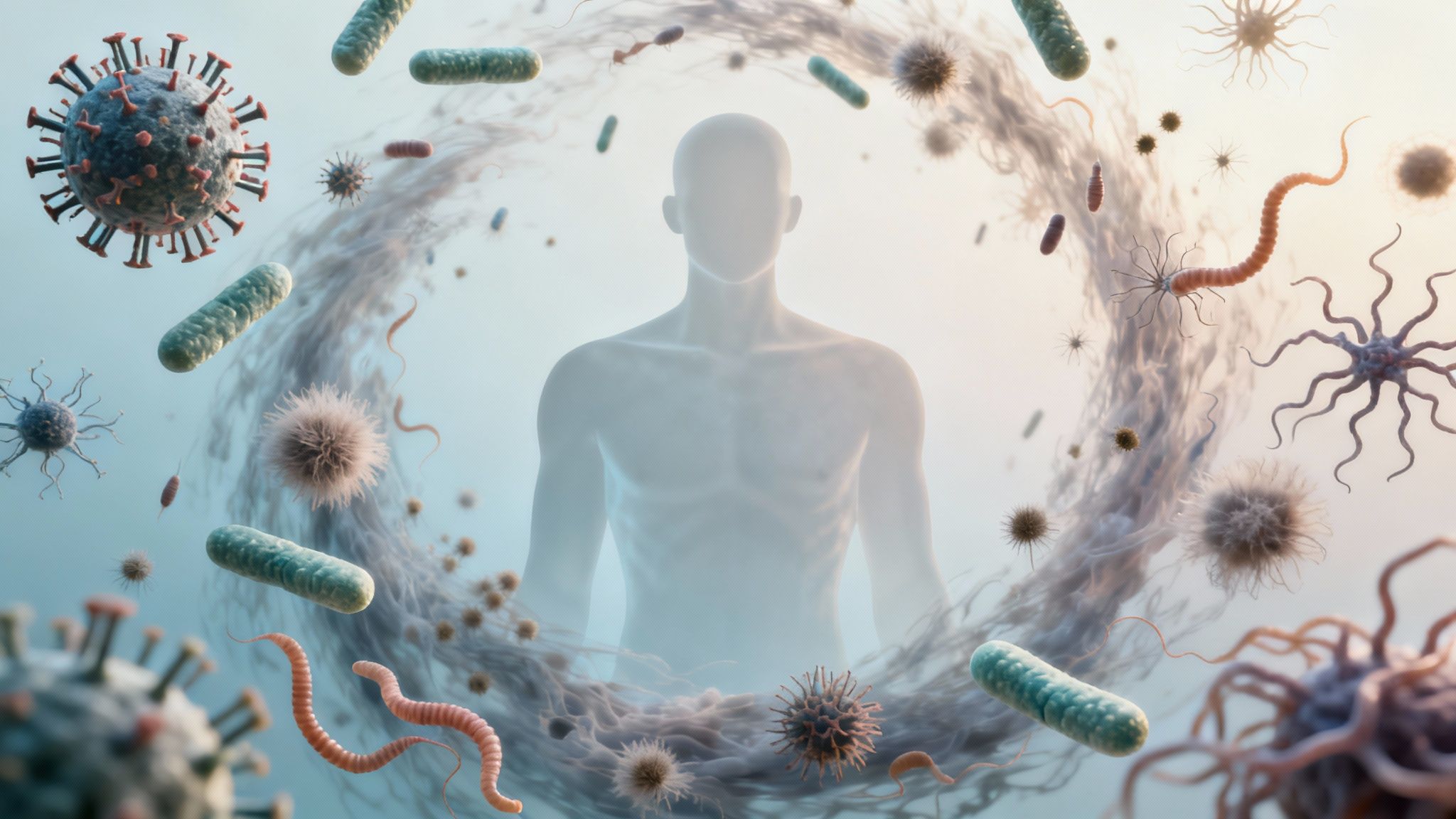
At its simplest, a pathogen is any tiny organism—like a virus, bacterium, or fungus—that can make you sick. Think of it as an uninvited guest crashing the party inside your body, disrupting how things are supposed to work and causing disease. This guide breaks down what a pathogen is and how you can protect yourself.
Defining the Unseen Invaders Around Us
The world is teeming with microscopic life. Pathogens are the troublemakers of this unseen world, the agents responsible for illness. They’re an incredibly diverse bunch, from the bare-bones genetic code of a virus to more complex single-celled bacteria and even multi-cellular parasites.
You can find them almost anywhere: in the air we breathe, on the surfaces we touch, and even in the food we eat.
While countless microorganisms are either harmless or actively helpful to us, pathogens operate differently. Their main drive is to survive and multiply, and they often do it at our expense. To achieve this, they have to get creative—invading our cells, stealing our resources, and dodging our immune systems.
The Main Types of Pathogens
Not all germs are created equal. Scientists group these disease-causers into a few main families, each with its own unique way of causing trouble.
- Viruses: These are the ultimate hijackers. Viruses are little more than genetic material wrapped in a protein coat, and they can't reproduce on their own. Instead, they have to invade a living cell and take over its machinery to make more copies of themselves, often destroying the cell in the process. Influenza, Human Immunodeficiency Virus Type 1 (HIV-1), and SARS-Related Coronavirus 2 (SARS-CoV-2) are notorious examples.
- Bacteria: These are single-celled organisms that are fully capable of living and multiplying independently. While most bacteria are harmless, the pathogenic ones can cause illness by releasing harmful toxins or provoking a powerful, damaging inflammatory response from our own bodies. Strep throat is a classic bacterial infection.
- Fungi: This category includes everything from yeasts to molds. Some fungi can cause infections, especially if they get a chance to overgrow on or inside the body. This is a common problem for people with weakened immune systems. A familiar example is Athlete's foot.
Understanding the difference between viruses and bacteria is especially crucial because it determines how we treat an infection. You can dive deeper into this in our guide on the difference between virus and bacteria.
To make it even clearer, here’s a quick breakdown of the major pathogen families.
The Main Types of Pathogens at a Glance
| Pathogen Type | Basic Description | Common Example |
|---|---|---|
| Viruses | Genetic material that hijacks host cells to replicate. Cannot survive on its own. | Influenza A Virus (H1N1) |
| Bacteria | Single-celled organisms that can reproduce independently and release toxins. | Streptococcus (Strep Throat) |
| Fungi | Yeasts or molds that can cause infections, often on surfaces or in weakened hosts. | Tinea pedis (Athlete's Foot) |
| Parasites | Organisms that live on or in a host, feeding off it to survive. | Giardia lamblia (Giardiasis) |
| Prions | Misfolded proteins that cause other proteins to misfold, leading to neurodegenerative disease. | Creutzfeldt-Jakob Disease |
This table just scratches the surface, but it shows how diverse these microscopic threats can be.
Why Pathogens Matter
The story of humanity is deeply intertwined with the story of pathogens. From localized outbreaks to global pandemics, they have shaped our health and history for millennia. A pathogen’s power to cause disease isn't just about the bug itself; it’s about the dance between the invader and its host.
Your age, the strength of your immune system, and your overall health all play a massive role in determining how sick you might get from a given pathogen.
The scientific community continuously monitors hundreds of pathogens that can cause disease in humans. Identifying priority pathogen families helps focus research and development on the greatest threats to public health.
Learning to recognize these unseen threats is key to staying healthy. That includes being aware of what’s in our environment and taking preventative measures against common indoor pathogens like mold. When we understand what pathogens are and how they work, we give ourselves a fighting chance to stay one step ahead.
Meet the Five Major Types of Pathogens
Pathogens are a surprisingly diverse bunch. They’re all microscopic agents that can make us sick, but each group has its own unique playbook for survival and attack. If you want to understand disease, you have to understand the players involved, and they can be sorted into five main types.
This simple hierarchy gives you a visual breakdown of some of the most common pathogen families.

As you can see, viruses, bacteria, and fungi are all distinct categories under the main classification of "pathogen," and each one represents a different kind of microscopic threat.
Viruses: The Biological Hijackers
Viruses really push the definition of what it means to be alive. They are the ultimate parasites—nothing more than a bit of genetic code (DNA or RNA) wrapped in a protein shell. A virus can’t eat, grow, or reproduce on its own. To do any of that, it needs a living host.
Think of a virus as a biological hijacker. It breaks into one of your cells, takes over the controls, and forces the cell's own machinery to churn out thousands of new copies of the virus. This process usually destroys the host cell, unleashing a new army of viruses to infect its neighbors. Well-known examples include the Influenza A Virus (H1N1), Hepatitis C Virus (HCV), and SARS-CoV-2, the virus behind COVID-19.
Bacteria: The Self-Sufficient Cells
Unlike viruses, bacteria are fully independent, single-celled organisms. They can live and multiply on their own in a huge range of environments, from a kitchen countertop to the inside of your gut. While most bacteria are harmless (and many are actually helpful), the pathogenic ones cause disease by releasing toxins or provoking a powerful and destructive inflammatory response from your immune system.
- How They Work: Once inside the body, pathogenic bacteria can multiply incredibly fast, competing with your own cells for nutrients and space.
- Examples: A nasty strain of Escherichia coli (E. coli) can cause severe food poisoning, while Streptococcus pyogenes is the bug responsible for strep throat.
Because bacteria are living cells with their own unique structures, we can often fight them with antibiotics. These drugs are designed to target specific parts of the bacterial cell to either kill it outright or stop it from multiplying.
Fungi: The Opportunistic Invaders
The fungal kingdom includes everything from yeasts and molds to mushrooms. The vast majority are harmless, but a few can cause infections, especially in people with weakened immune systems. Fungal pathogens are often opportunistic, meaning they wait for a breakdown in the body's defenses to make their move.
Fungal infections can be as minor as athlete's foot (Tinea pedis) or as serious as systemic candidiasis. These invaders thrive in warm, moist environments, which is why good hygiene is one of our best defenses against them.
Fungi reproduce by releasing spores that can be inhaled or land on the skin. Most of the time, this is no big deal. But when the conditions are just right, these spores can take root and cause an infection.
Parasites and Prions: The Less Common Culprits
Beyond the big three, two other types of pathogens pose their own unique dangers.
Parasites are organisms that live on or inside a host, feeding off it at the host's expense. This group is incredibly varied, from single-celled protozoa like Giardia, which contaminates water and causes brutal digestive illness, to much larger, multi-celled worms.
Prions are the strangest of them all. They aren't even organisms—they're just misfolded proteins. The real danger is that they can trigger a chain reaction, causing healthy proteins in the brain to misfold in the same way. This domino effect leads to severe and untreatable neurodegenerative diseases, like Creutzfeldt-Jakob disease. The study of prions is still a frontier of biology, showing just how many strange forms a pathogen can take.
How Pathogens Turn into Disease
Just because a pathogen gets inside your body doesn't mean you're guaranteed to get sick. The journey from exposure to illness is really a microscopic war, a dynamic struggle unfolding between the invader and your body's defenses.
Think of it as a biological battlefield. To win, the pathogen has to successfully invade, multiply, and somehow overcome your immune system, which is armed and ready for a fight.

The process kicks off the moment a pathogen gets past your first line of defense—like your skin or the mucous membranes in your nose and throat. Once inside, its only mission is to find a good spot to replicate. For a virus like Herpes Simplex Virus 1 (HSV-1), that means hijacking your own cells to do the work, while some bacteria might just form colonies directly in your tissues.
To get a foothold, many pathogens have developed some pretty clever tricks to either disarm or hide from your immune system. Some produce toxins that directly damage cells, while others cloak themselves in protective capsules to avoid being spotted by patrolling immune cells.
The symptoms we feel—fever, inflammation, exhaustion—are often just the side effects of this intense battle between the invader and our body's response. You can dive deeper into this fascinating clash by learning about the immune response to viral infection.
Pathogenicity vs. Virulence
So why do some bugs give you a mild cold while others are life-threatening? To understand that, we need to get two key concepts straight: pathogenicity and virulence. People often use them interchangeably, but they describe very different things about a pathogen's potential for destruction.
Pathogenicity is simply the ability of a microbe to cause disease in the first place. By its very definition, a pathogen is pathogenic. If it has the genetic toolkit to invade a host and cause harm, it’s pathogenic—no matter how sick it actually makes you.
Virulence, on the other hand, measures the degree of harm a pathogen causes. It’s a measure of severity. A highly virulent pathogen can cause devastating illness, while one with low virulence might only lead to minor symptoms.
Think of it this way: Pathogenicity is a simple yes-or-no question—can it make you sick? Virulence is a spectrum—how sick will it make you?
This distinction is crucial for understanding why different microbes pose such wildly different threats.
Factors That Determine Disease Severity
The outcome of an infection isn't just up to the pathogen. It's a two-way street, where the severity of the illness is shaped by the unique characteristics of both the invader and you, the host.
- Infectious Dose: This refers to the number of individual pathogens needed to actually start an infection. Some microbes, like Norovirus, have a ridiculously low infectious dose, meaning just a handful of viral particles are enough to make you miserable.
- Toxin Production: Many bacteria, including notorious strains of E. coli, do their damage by releasing powerful toxins that mess with your cells' normal functions. The type and strength of these toxins play a huge role in how sick you get.
- Host Immune Status: The strength of your immune system is a massive factor. Someone with a compromised immune system is far more vulnerable to severe disease from an opportunistic pathogen that a healthy person might fight off without even noticing.
Ultimately, whether a pathogen is just a microbe passing through or the cause of a serious illness all comes down to the complex dance between its attack strategies and your body's defensive power.
How Pathogens Spread: Understanding Transmission
For a pathogen to do any real damage, it has to be a master traveler. Figuring out how these microscopic hitchhikers move from one person to the next is the absolute cornerstone of preventing infections. It’s like mapping out an enemy’s supply lines—once you know their routes, you can set up roadblocks.
Pathogens have developed some pretty clever strategies to get around, each one fine-tuned to its structure and the environment it likes best. The most common methods involve catching a ride on the air we breathe, hiding out on surfaces, or sneaking into our food and water.
Airborne and Droplet Transmission
One of the most efficient ways for respiratory viruses to spread is to simply go airborne. When an infected person coughs, sneezes, or even just talks, they launch thousands of tiny, moisture-filled droplets into the air. These droplets are perfect little vehicles for pathogens like the Influenza A Virus (H1N1) or Rhinovirus Type 14, which causes the common cold.
Bigger droplets are heavy and tend to fall quickly, usually contaminating whatever is nearby. But the smaller ones, known as aerosols, are the real trouble. They can hang suspended in the air for minutes or even hours, traveling much farther and putting anyone who breathes them in at risk. This is exactly why good ventilation is so important, especially indoors.
Contact Transmission: Direct and Indirect
Contact is another huge pathway for germs, and it comes in two flavors.
Direct contact is pretty straightforward—it’s a person-to-person transfer through physical touch. This could be shaking hands with someone who hasn't washed theirs, or through contact with bodily fluids. Viruses like Herpes Simplex Virus 2 (HSV-2) are spread almost exclusively this way.
Indirect contact is far more common and a bit sneakier. This is what happens when an infected person touches an object, leaving microbes behind for the next person to pick up. That contaminated object is called a fomite, and it can be anything from a doorknob to your own smartphone.
A single doorknob can become a transfer point for a virus like Norovirus (Norwalk Virus), which is incredibly tough and can survive on surfaces for days. This is a perfect example of why disinfecting high-touch surfaces with effective wipes is a powerful way to break the chain of infection.
Once the pathogen gets onto your hands, it’s only a matter of time before you touch your eyes, nose, or mouth—the main gateways into your body.
Other Routes of Transmission
While air and contact are the main highways for pathogens, they have other clever routes to get around.
- Foodborne and Waterborne: Bacteria like E. coli or viruses such as Hepatitis B Virus (HBV) can easily contaminate food or water. When a central supply line gets compromised, it can lead to widespread outbreaks affecting tons of people all at once.
- Vector-Borne: Some pathogens use other critters as their personal taxi service. Mosquitoes, ticks, and fleas are common vectors that can transmit diseases like malaria or Lyme disease from one host to another every time they bite.
- Fecal-Oral Route: It sounds unpleasant because it is. This route is common for germs that infect the gut, like Human Rotavirus. The microbe is shed in an infected person’s feces and can spread through contaminated hands, surfaces, or water, eventually getting swallowed by someone else.
Understanding these routes isn’t just an academic exercise; it’s incredibly practical. Knowing that a virus like Feline Calicivirus can survive on surfaces makes you more likely to wipe down counters. Realizing the flu spreads through the air reminds you to cover your cough. Every little preventive action we take is a direct counter-move to a pathogen’s known travel plans.
The Unseen Forces That Shape Our World
Pathogens aren't just microscopic troublemakers; they're powerful forces that have steered the course of human history, sparked incredible scientific breakthroughs, and laid bare the deep cracks in global equality. From small-town outbreaks that can bring a community to its knees to global pandemics that halt the world in its tracks, the influence of these invisible invaders is massive.
This constant battle against infectious diseases has been the catalyst for some of our greatest medical achievements. Think about it—vaccines, antibiotics, and the high-tech tools we use to diagnose illnesses were all born from this fight. Every major outbreak forces us to get smarter, pushing us to rethink public health, forge international alliances, and build surveillance systems that can spot the next big threat before it spirals.
From Ancient Plagues to Modern Crises
History is filled with examples of pathogens reshaping entire civilizations, like the Black Death that swept through Europe in the 14th century. But in our hyper-connected modern world, the game has changed. A new virus can hop on a plane and be on the other side of the planet in hours. The COVID-19 pandemic, caused by SARS-CoV-2, was a brutal reminder of just how quickly an unknown pathogen can upend daily life, tank economies, and push healthcare systems to the absolute brink.
This ongoing struggle also shines a harsh light on global health disparities. A disease that might be a manageable problem in a country with top-tier hospitals and clean water can be an outright catastrophe in a place without those resources. This isn't just a local tragedy—it creates dangerous reservoirs where diseases can thrive, evolve, and ultimately threaten everyone.
Global health security is only as strong as its weakest link. An outbreak anywhere can become a threat everywhere, underscoring the critical need for international cooperation and investment in public health infrastructure worldwide.
Familiar Foes Keep Coming Back
While new, headline-grabbing pathogens get a lot of attention, some of our most persistent challenges come from old adversaries. Take influenza. It stands as one of the most frequently reported pathogens in global outbreak history, a testament to its remarkable ability to dodge our immune systems and trigger recurring pandemics. Strains like Avian Influenza Virus (H5N1) show the constant potential for new threats to emerge.
Between 1996 and 2023, influenza was responsible for a staggering 771 distinct outbreak events—more than any other tracked infectious disease. This relentless cycle shows just how good some pathogens are at sticking around. You can explore more data on the global patterns of infectious disease outbreaks and their causes.
Ultimately, the global impact of pathogens is a humbling reminder of our own vulnerability. It drives home the need for constant vigilance, relentless scientific research, and fair access to healthcare to protect us from the threats we know—and the ones we have yet to meet.
Your Guide to Prevention and Treatment
Knowledge is your first line of defense against pathogens. When you understand how they live and spread, you can take practical steps to disrupt their cycles and protect your health. This isn't just about high-tech medical treatments; it's also about simple, everyday habits that make a massive difference.

Here's a look at our most effective strategies, from groundbreaking science to the basics of good hygiene, giving you actionable steps to guard against these unseen threats.
The Power of Vaccines
Vaccines are one of the greatest triumphs in public health history, essentially serving as a training camp for your immune system. They work by introducing a harmless piece of a pathogen—like a weakened virus or just a single protein—into your body. Your immune system learns to recognize and fight this imposter without you ever having to get sick.
Think of it as giving your body a "wanted" poster. If the real pathogen ever shows up, your immune system is already primed to launch a swift, powerful attack, neutralizing the invader before it can gain a foothold. This proactive defense has brought diseases that once devastated entire populations under control.
Choosing the Right Tool for the Job
Not all treatments work on all pathogens, which is why getting a proper diagnosis is so critical. A perfect example of this is the classic mix-up between bacteria and viruses.
- Antibiotics are powerful drugs designed specifically to kill bacteria. For bacterial infections, they are lifesavers, but they are completely ineffective against viruses.
- Antivirals, on the other hand, are medications that disrupt a virus's replication cycle. They don't "kill" the virus in the same way antibiotics destroy bacteria, but they stop it from making more copies, giving your immune system the chance to clear the infection.
Taking an antibiotic for a viral illness like the common cold won't help you get better, and it actually contributes to the growing global threat of antibiotic-resistant bacteria.
The resurgence of diseases like Tuberculosis (TB) is a stark reminder that even treatable pathogens can remain a global threat. TB has reclaimed its spot as the world's leading infectious killer, causing an estimated 1.25 million deaths annually. It's a clear signal that we need constant vigilance and strong public health systems to keep these enemies at bay.
Your First Line of Defense is in Your Hands
While medical science gives us incredible tools, your best and most immediate defense is personal hygiene. Simple habits are incredibly effective at breaking the chain of transmission before a pathogen even gets a chance to enter your body.
Proper handwashing is the undisputed champion of prevention. Washing your hands with soap and water for at least 20 seconds physically removes and destroys microbes you’ve picked up from touching contaminated surfaces.
Just as important is disinfecting those surfaces. Germs like Norovirus (Norwalk Virus) and Rhinovirus Type 39 can survive on doorknobs, countertops, and light switches for hours or even days. Regularly cleaning these high-touch spots with disinfectant wipes eliminates these microbial traps, stopping indirect transmission in its tracks. In severe contamination scenarios, more intensive steps like professional biohazard cleanup may be necessary to ensure an environment is truly safe.
By layering these strategies—vaccination, the right medical care, and diligent personal hygiene—you build a formidable defense. You can learn more about specific tactics in our guide on preventing viral infections.
Leave a Reply