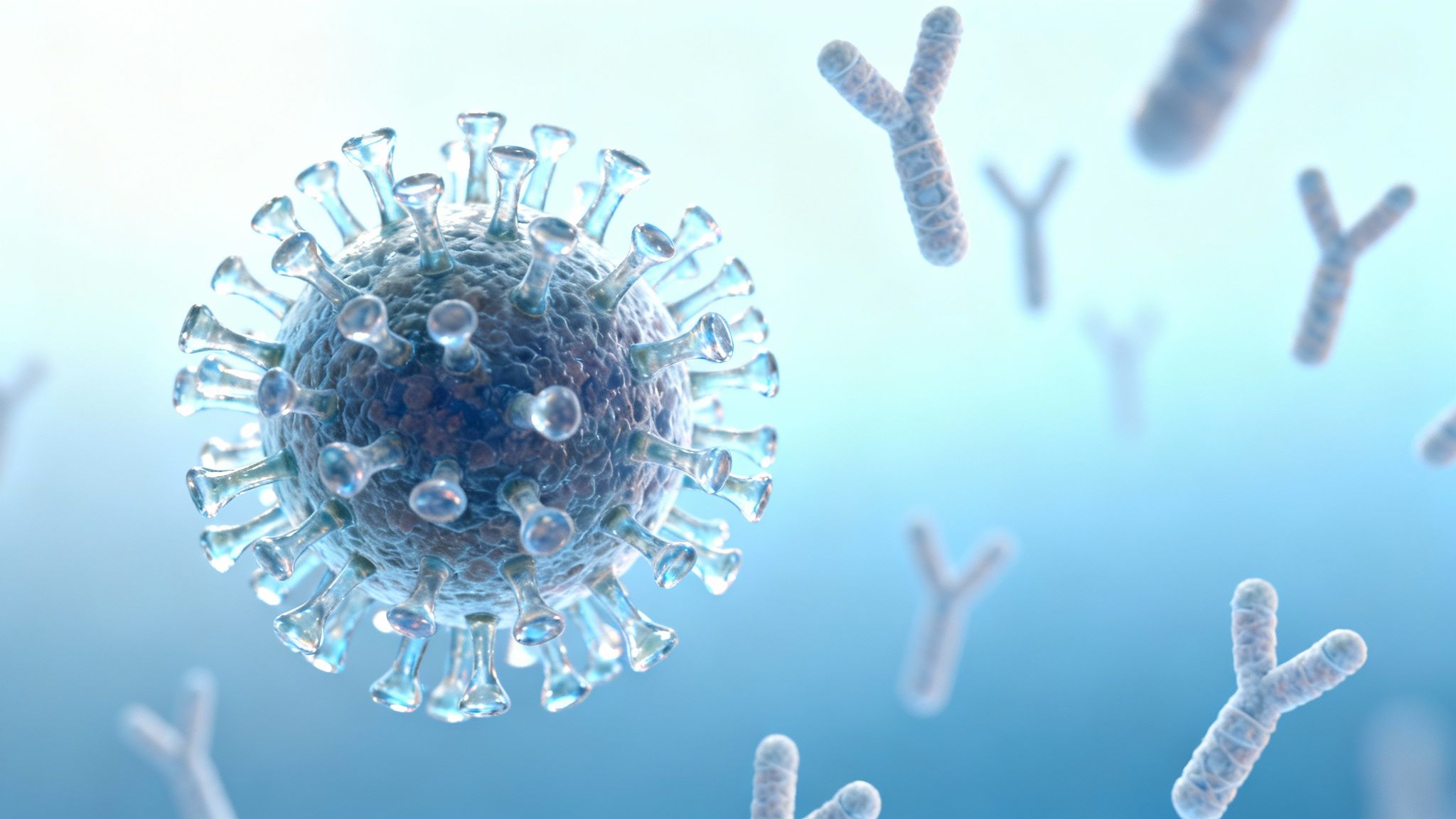
When your immune system fights off a virus, it doesn’t just throw everything it has at the problem. It builds a highly specific arsenal, and at the top of that list are neutralizing antibodies.
Think of them as your body's special forces. While many antibodies can flag an invader for destruction, neutralizing antibodies are the elite operatives that can stop a virus dead in its tracks—before it even has a chance to start an infection. They are the key to what we call protective immunity, the kind you get from a highly effective vaccine or after recovering from an infection.
Your Immune System's Elite Virus Blockers

When a virus like Influenza A or SARS-CoV-2 enters your body, your immune system churns out a whole library of different antibodies. But here's the thing: not all of them have the same job.
Most of the antibodies produced are simply binding antibodies. They can grab onto the virus, but not always in a way that stops it from being infectious. Imagine a virus is like a burglar trying to use a specific key to unlock the door to your cells. A binding antibody might be able to grab the burglar's arm, slowing them down but not preventing them from getting the key in the lock. It’s helpful, but not foolproof.
A neutralizing antibody, on the other hand, is like jamming a broken key into the lock or slapping a custom-fit cover over it. It latches onto the most critical part of the virus—the exact "key" it needs to enter a cell, like the spike protein on coronaviruses. By physically blocking that entry mechanism, the virus is effectively disarmed. It’s neutralized.
The Critical Difference in Function
This distinction isn't just academic; it's the entire basis for how we measure effective immunity. While having any antibodies shows your immune system has seen a threat before, it's the quantity and quality of your neutralizing antibodies that truly predict how well-protected you are.
It’s why vaccine developers, whether they're working on shots for Human Immunodeficiency Virus (HIV) or Hepatitis B Virus (HBV), are laser-focused on one primary goal: triggering the production of these elite defenders.
Neutralizing antibodies are the cornerstone of protective immunity. Their primary function is to block a pathogen's entry into host cells, effectively preventing the initial stage of infection and halting disease before it starts.
This ability to shut down an infection before it gets a foothold makes neutralizing antibodies infinitely more powerful than those that just help clean up the mess after your cells are already hijacked.
Neutralizing vs. Non-Neutralizing Antibodies at a Glance
This quick comparison breaks down the key differences between the two main types of antibodies your body makes in response to a pathogen.
| Feature | Neutralizing Antibodies | Non-Neutralizing (Binding) Antibodies |
|---|---|---|
| Primary Function | Physically block viral entry into host cells. | Tag pathogens for destruction by other immune cells. |
| Binding Location | Binds to specific, critical sites on the virus (e.g., receptor-binding domain). | Can bind to any part of the virus surface. |
| Outcome | Prevents infection from starting. | Helps clear an existing infection. |
| Immunity Role | Considered the primary measure of protective immunity. | Contributes to the overall immune response. |
While both types play a role in a healthy immune response, it’s the neutralizing antibodies that provide the powerful, upfront shield against future infections.
Uncovering the Body's Invisible Shield
The power of neutralizing antibodies might seem like a recent discovery, especially with all the talk about them during the COVID-19 pandemic. But the story of these invisible defenders actually began over a century ago, long before we even had the tools to see a virus. It’s a journey that started with simple, brilliant observations.
Back in the late 19th century, scientists were battling deadly diseases without really knowing what caused them. They noticed something interesting, though: people who survived an illness often seemed to gain a mysterious, lasting protection against it. This sparked a groundbreaking idea: could that protective force be transferred from one person to another?
The Birth of Serum Therapy
That single question led to one of immunology's most important breakthroughs. In 1890, two pioneers, Emil von Behring and Shibasaburo Kitasato, ran a landmark experiment with diphtheria. They found that the blood serum from an animal that had recovered from the disease contained something that could disarm the diphtheria toxin. When they gave this "immune" serum to a sick animal, it worked like a cure.
This work, which they called "serum therapy," was the first real proof that immunity wasn't just some vague internal state—it was a tangible, transferable substance floating around in the blood. It was such a monumental discovery that von Behring received the very first Nobel Prize in Physiology or Medicine in 1901.
That "antitoxin" they discovered? We now call it an antibody. To really get how these proteins work, it helps to understand their relationship with their targets. Our guide on antibodies and antigens breaks down that interaction in more detail.
These early experiments laid the entire foundation for everything we know today. They proved the body could create specific molecules to fight specific threats, a concept that underpins all of modern vaccine development and therapeutic medicine.
From Historical Insight to Modern Science
This history is so important because it validates the principles we still rely on. The idea of a neutralizing antibody isn't a new fad; it's a scientific reality built on more than 130 years of research.
The early work on serum therapy demonstrated a core principle of immunology: the body produces specific, targeted molecules that can neutralize a threat and confer protection. This discovery remains a cornerstone of virology and vaccine science.
To really appreciate how our immune system pulls this off, it helps to know a bit about the biological machinery involved. For instance, understanding the key differences between DNA and RNA clarifies how viruses hijack our cells and, in turn, how our cells churn out the very antibodies that fight back.
The path from observing immunity in the 1890s to engineering monoclonal antibodies in a lab today is a straight line of scientific progress—and it all started with that invisible shield found in blood serum.
How Neutralizing Antibodies Stop a Virus Cold
To really get a feel for what makes neutralizing antibodies the elite special forces of your immune system, we have to zoom way in—down to the molecular battlefield. This isn't just a random scrum; it’s a high-stakes, precision-guided mission where the right antibody can disarm a virus before it even gets a chance to breach your cells.
The most common tactic is a brilliant bit of molecular blocking called direct steric hindrance. Think of a virus like SARS-CoV-2. It’s studded with spike proteins, which act like tiny keys the virus uses to unlock a specific receptor on our cells, known as ACE2. A neutralizing antibody is perfectly shaped to latch onto the most important part of that key: the receptor-binding domain (RBD).
By grabbing onto that exact spot, the antibody essentially puts a cap on the key. It physically blocks the spike protein from ever fitting into the ACE2 receptor. With its key disabled, the virus is locked out, and the infection is stopped before it can even begin.
More Than Just a Blockade
While blocking the front door is their primary job, neutralizing antibodies have a few other tricks up their sleeves. Their classic "Y" shape isn't just for show; it's a key part of their versatile strategy.
Each antibody has two arms, which means a single antibody can grab onto two separate virus particles at once. Now, imagine thousands of antibodies doing this simultaneously. They start clumping viruses together into big, sticky messes, a process known as agglutination. These large, antibody-coated clusters are much easier for cleanup cells, like macrophages, to spot and devour.
The diagram below maps out the early scientific journey that led to the discovery of these powerful immune components in the first place.

This process, from finding a mysterious protective factor in blood serum to identifying it as an antibody, laid the foundation for modern immunology.
Another clever tactic involves stopping a virus from changing shape. Many viruses, including Influenza and HIV, have to perform a little molecular contortion after attaching to a cell to finalize their entry. Certain neutralizing antibodies can bind to a virus in a way that locks it into its initial shape, effectively freezing it in place. The virus gets stuck, unable to complete the final step of infection.
A neutralizing antibody doesn't just bind to a virus; it binds to a functionally critical site. By interfering with the machinery the virus needs for entry, fusion, or replication, it renders the pathogen inert.
A Multi-Pronged Defense
All these mechanisms show why neutralizing antibodies are considered the gold standard of protective immunity. They don’t just flag an intruder for later cleanup; they proactively stop the threat in its tracks using several distinct methods:
- Direct Blocking: They physically cover the viral parts needed to attach to our cells, making entry impossible.
- Viral Aggregation: They clump viruses together, neutralizing many at once and making the whole mess an easy meal for other immune cells.
- Conformational Freezing: They lock the virus into a rigid state, preventing the shape-shifting it needs to fuse with and infect a cell.
Ultimately, these tactics are what make neutralizing antibodies so incredibly powerful. Whether they’re fighting a common Rhinovirus or a more complex foe like Hepatitis C Virus (HCV), their ability to intercept and disarm invaders right at the source is a cornerstone of a truly robust immune defense. By understanding how they work on a molecular level, we can better appreciate how modern vaccines and antibody therapies are designed to call these highly effective defenders into action.
Putting Neutralizing Antibodies to the Test
Molecular diagrams and lab data are one thing, but the real power of neutralizing antibodies comes to life when you see them in action against some of humanity's toughest viral enemies. In the real world, these specialized proteins are frontline weapons in the ongoing battle against viruses like Human Immunodeficiency Virus (HIV) and Hepatitis C Virus (HCV).
For decades, these two viruses were especially tricky. They're masters of disguise, constantly mutating their outer proteins to slip past the immune system. This rapid shape-shifting makes it incredibly difficult for our bodies to create a single antibody that can keep up for long. But the fight took a major turn with one groundbreaking discovery.
The Rise of Broadly Neutralizing Antibodies
Scientists eventually found a rare but incredibly powerful class of defenders: broadly neutralizing antibodies, or bNAbs.
Think of a typical antibody as a key that fits only one specific lock (a single viral strain). If the virus changes the lock, the key no longer works. But bNAbs are different. They’re like a master key. They target a part of the virus that it can't easily change without breaking itself—an Achilles' heel that stays the same across many different mutations.
The discovery of bNAbs in patients who naturally kept HIV under control for years was a game-changer. It proved the human body was capable of making a "super antibody" that could outsmart the virus's most cunning tricks. This cracked open entirely new doors for developing both vaccines and antibody-based therapies.
Broadly neutralizing antibodies completely changed how we think about fighting viruses. Their ability to shut down so many different viral strains gives us a blueprint for creating universal vaccines and powerful drugs for enemies like HIV, influenza, and HCV.
Proving Their Power in the Real World
This isn't just theory—it's been proven time and again in clinical settings. Neutralizing antibodies are a cornerstone of our immune response to a huge range of viruses, and the research on HIV and HCV goes way back.
In the 1990s, early HCV studies using chimpanzee models showed that serum packed with neutralizing antibodies could literally block the virus from causing an infection. It was one of the first definitive proofs of their protective power. You can read the full research about these early HCV findings to see how this foundational work was done.
These examples make it clear: whether we're fighting the common flu or a complex retrovirus, neutralizing antibodies are a fundamental part of our immune defense. Their discovery continues to drive some of the most important breakthroughs in modern medicine.
The Role of Antibodies in Vaccines and Modern Medicine

The science behind neutralizing antibodies has officially left the lab and entered the real world, becoming a cornerstone of modern public health. The COVID-19 pandemic threw this concept into the global spotlight, completely changing how we design, test, and even talk about vaccines.
When a new vaccine is developed, the ultimate goal is to train your body to produce an elite army of these virus-stopping defenders. Because of this, measuring the level of neutralizing antibodies in a vaccinated person’s blood has become the gold standard for predicting just how protected they are. High levels are a very good sign, strongly correlating with a lower risk of getting infected and developing severe disease.
A Benchmark for Vaccine Effectiveness
Scientists rely on neutralizing antibody levels as a key correlate of protection. It’s a technical-sounding term, but the idea is simple: the presence of these specific antibodies is a reliable sign that you have functional immunity. If a vaccine can consistently trigger a strong and lasting neutralizing antibody response against a virus like SARS-CoV-2 or Influenza, it's considered a win.
This measurement gives us a clear biological answer to what vaccine efficacy actually means. It’s not just about tracking symptoms in a population; it's about confirming the immune system has built the right molecular tools to shut a virus down before it can gain a foothold. This allows researchers to compare different vaccines more quickly and figure out when a booster shot might be needed to shore up our defenses.
Engineering Antibodies as Medicine
Our understanding of neutralizing antibodies has also given us a powerful new class of medicines: monoclonal antibodies. Unlike the antibodies your body makes, these are mass-produced in a laboratory.
Monoclonal antibodies are essentially lab-made clones of the single most potent neutralizing antibody discovered in a recovered patient. This allows doctors to deliver a concentrated dose of perfect virus-blockers directly to someone who is already sick or can't mount a strong immune response on their own.
This technology is a form of passive immunity. Instead of waiting for the body to build its own shield, this treatment provides one that’s ready to go. The COVID-19 pandemic dramatically accelerated the discovery and deployment of potent neutralizing antibodies that target the SARS-CoV-2 spike protein—the key it uses to unlock our cells. As a result, monoclonal antibody therapies became a lifeline for immunocompromised patients and others for whom vaccines were less effective. For more on this immunological milestone, check out Nature's report on neutralizing antibodies.
These treatments highlight the direct line from basic science to life-saving medicine. By identifying the body’s most effective defenders and figuring out how to manufacture them, we can now use neutralizing antibodies in two powerful ways: as a training tool (vaccines) and as a direct-action therapeutic. This dual role puts them right at the heart of modern virology and patient care, giving us powerful new strategies to protect individuals and entire communities from viral threats.
Your Immune System’s Best Friend: Proactive Defense
So, what does all this mean for you? Knowing what neutralizing antibodies are is one thing, but putting that knowledge to work is what really matters.
The whole point of a vaccine is to give your body a head start by training it to produce these elite virus-blockers. That way, they’re ready to go the moment an invader shows up. Keeping that defense force strong and up-to-date is crucial, and our guide to the immunization schedule for adults can help you figure out what you need.
But as powerful as they are, neutralizing antibodies are just one piece of a much bigger puzzle. The smartest strategy is always a proactive one—reducing the number of fights your immune system has to get into in the first place.
Good Hygiene Is Your First Line of Defense
Simple, everyday hygiene habits are your real front-line defenders. By cutting down your exposure to germs, you give your immune system a much-needed break.
It’s time to think about disinfection differently. It’s not just about wiping up a spill; it’s a fundamental part of supporting your body’s natural ability to protect itself.
Proactive hygiene reduces the amount of virus you’re exposed to. This ensures that your body’s sophisticated immune responses—including the production of neutralizing antibodies—are saved as a powerful last resort, not an overwhelmed first response.
Regularly using disinfectant wipes on high-touch surfaces like doorknobs, phones, and countertops can slash the presence of viruses like Influenza A Virus, Rhinovirus, and Norovirus in your environment. This simple habit helps keep invaders out of your system entirely, letting your neutralizing antibodies stay in reserve—well-rested and ready for when you really need them.
Your Top Questions About Neutralizing Antibodies, Answered
Even after getting the basics down, a few questions always pop up. Let's dig into some of the most common ones to make sure these concepts are crystal clear.
What's the Real Difference Between Binding and Neutralizing Antibodies?
This is a great question because it gets to the heart of what makes certain antibodies so special.
Think of it this way: a binding antibody is like a security guard who can grab a burglar's shirt. They've made contact, but the burglar might still be able to cause trouble. A neutralizing antibody, on the other hand, is the guard who snatches the exact key the burglar needs to unlock the door.
By blocking that critical entry point, the threat is stopped cold. So, while all neutralizing antibodies are a type of binding antibody, not all binding antibodies have what it takes to neutralize a virus.
How Long Do Neutralizing Antibodies Stick Around?
There’s no single answer here—it really depends on the virus, the vaccine, and your own immune system. For a virus like measles, the neutralizing antibodies you develop can provide what is essentially lifelong protection.
For others, like Influenza or SARS-CoV-2, those antibody levels can fade over a few months or years. This is exactly why we need booster shots. A booster is like a training exercise for your immune system, reminding it to ramp up production of these elite defenders and keep your protection strong.
The bottom line is that immunity isn't always a one-and-done deal. How long neutralizing antibodies persist is the key to lasting protection, which is why staying up-to-date on recommended immunizations is so important.
Can a Virus Evolve to Dodge These Antibodies?
Absolutely. This is one of the biggest challenges in immunology, a phenomenon called viral escape.
Viruses like Influenza A Virus and SARS-Related Coronavirus 2 are constantly making tiny mistakes as they copy themselves, leading to mutations. If a mutation changes the shape of the viral “key” that our antibodies are trained to recognize, those antibodies might not be able to grab on anymore.
This is precisely why we see new flu strains pop up each year and why new COVID-19 variants emerge. It’s an endless evolutionary race between our immune system’s memory and the virus's ability to change its disguise.
Leave a Reply