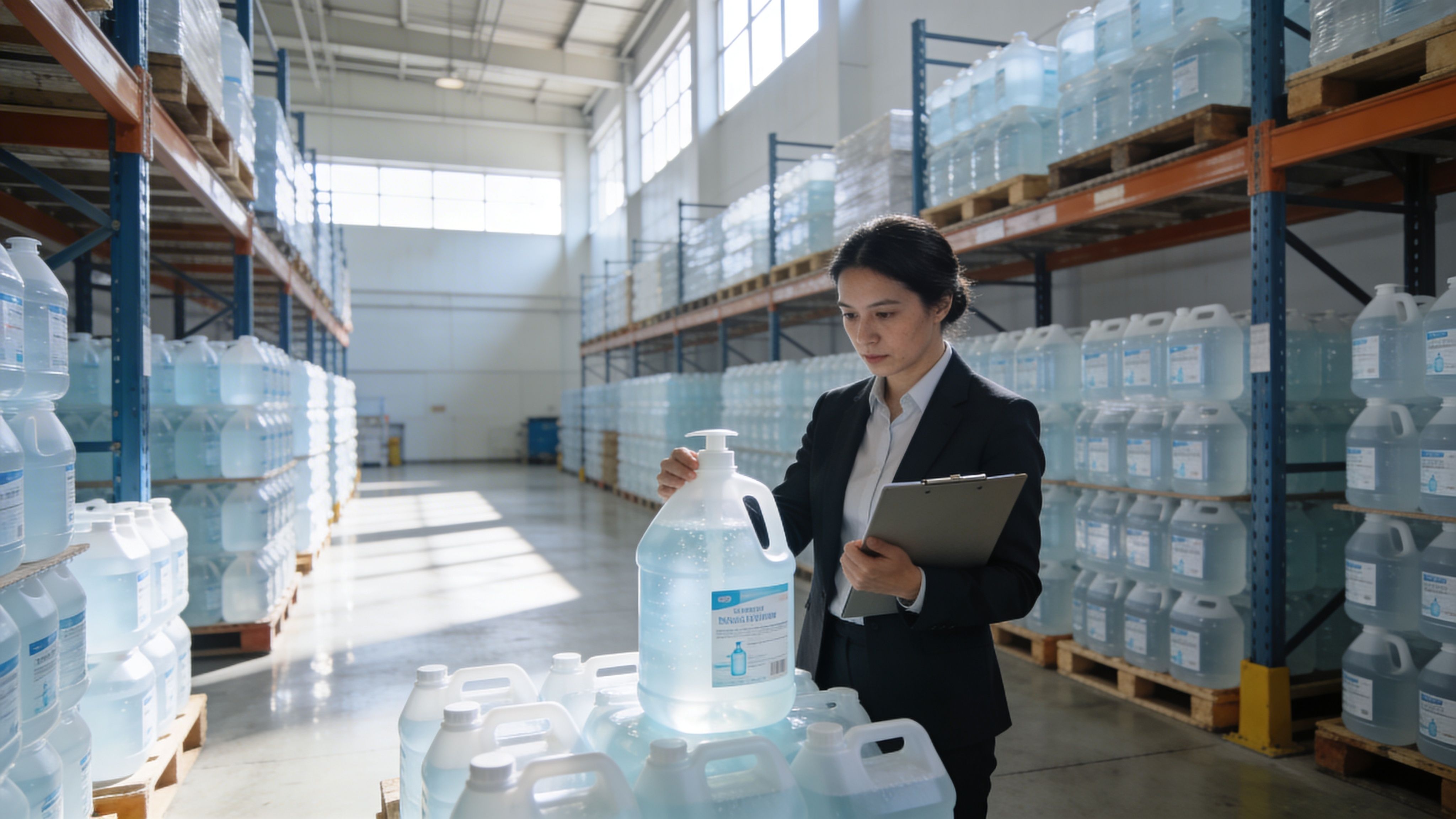
You’re probably dealing with a familiar institutional problem. A school district wants refill stock before winter illness season. A clinic network needs one product that works across waiting rooms, exam areas, and staff entrances. A warehouse or office campus wants to simplify purchasing by moving from many small bottles to fewer, larger orders.
That sounds straightforward until the questions start. Which formulation fits the viral risks in your setting? Can your receiving team store it safely? Will your dispensers handle it without clogging or leaking? If you buy too much, will potency drop before the product is used?
For anyone buying hand sanitizers bulk, the primary task isn’t just finding a lower unit price. It’s building a system that keeps the product effective from purchase order to dispenser use.
The Challenge of Bulk Hand Sanitizer Procurement
A facilities manager at a mid-sized campus might get three quotes in one afternoon. One vendor sells gel in gallon containers. Another pushes alcohol-free foam. A third offers tote delivery and promises lower packaging waste. On paper, all three look useful.
In practice, they create different risks.

A hospital has to think about infection prevention and flammable liquid handling. A school has to think about younger users, refill discipline, and product placement. A gym has to think about high-volume use, spill risk, and skin tolerance. The wrong choice doesn’t just waste money. It can create compliance problems, user complaints, and false confidence during outbreaks.
Why the market still feels crowded
Hand sanitizer buying didn’t become simpler after the pandemic. It became more layered. Large institutions now have more product formats, more supplier types, and more operational expectations than they did before.
The category also remains large. The global hand sanitizer market is projected to reach USD 9.47 billion by 2035, growing at a 2.46% CAGR from 2026 to 2035, driven by hygiene awareness and institutional adoption in healthcare, schools, and offices, according to Precedence Research’s hand sanitizer market analysis.
That growth matters because it means buyers will keep seeing more offers, more packaging options, and more marketing claims. Growth attracts suppliers. It also attracts confusion.
What buyers often miss
The most common purchasing mistake is treating sanitizer like a commodity. It isn’t. Two products can look similar in a spreadsheet and perform very differently once they reach your building.
A practical review should cover at least these issues:
- Viral fit: Is the formulation appropriate for the viruses most likely to spread in your setting?
- Dispensing fit: Will it work in your current dispensers, or will it drip, foam poorly, or clog?
- Storage fit: Can your site safely store flammable product in the volume you’re ordering?
- Shelf-life fit: Will you use the shipment quickly enough to avoid degradation and waste?
- Regulatory fit: Do the labels, shipping papers, and packaging align with transport and workplace requirements?
Practical rule: If your team can’t explain how the product will be stored, dispensed, rotated, and replaced, you’re not ready to buy at scale.
Bulk buying works best when procurement, safety, infection prevention, and facilities operations make the decision together. Price still matters. It just can’t be the first filter.
Understanding Formulations and Mechanisms of Action
Most confusion starts with one simple question. What exactly are you buying?
When buyers compare products, they often focus on format first. Gel, liquid, or foam. That matters for dispensing and user preference, but the more important distinction is the active system. In plain terms, is the sanitizer alcohol-based or alcohol-free?
How alcohol-based sanitizers work
Alcohol-based sanitizers usually rely on ethanol or isopropyl alcohol. For bulk manufacturing, keeping that alcohol evenly distributed throughout the batch is critical. Silverson’s manufacturing guidance notes that 60% to 95% v/v alcohol concentration must remain consistent, and that high-shear mixing helps create stable emulsions and uniform dispersion of gelling agents.
That consistency matters because alcohol doesn’t work by magic. It works by chemistry.
For many viruses, especially enveloped viruses, alcohol disrupts the outer lipid envelope and denatures proteins. A useful analogy is a coated water balloon. If the outer layer breaks down, the virus loses the structure it needs to infect cells.
Why texture matters operationally
Buyers often ask whether gel is “better” than liquid or foam. Usually, the answer is operational, not absolute.
A short comparison helps:
| Format | Common advantage | Common concern |
|---|---|---|
| Gel | Familiar feel, easier to control in the hand | Can clog some pumps if viscosity varies |
| Liquid | Fast spreading, simple formulation | More drip risk at wall units |
| Foam | Good user acceptance, lower mess in some settings | Requires dispenser compatibility |
The hidden issue is batch quality. A bulk product with poor mixing can separate, become inconsistent, or behave differently from container to container. That creates trouble for both efficacy and dispensing.
What “uniform dispersion” means in real life
Procurement teams sometimes hear manufacturing terms like carbomer, high-shear mixer, or stable emulsion and tune out. Don’t. Those terms point to whether the sanitizer will stay usable across the full order.
If a supplier is making gel sanitizer, the gelling agent has to be dispersed evenly. Otherwise:
- One container may dispense too thickly
- Another may feel watery
- Alcohol concentration may not remain consistent throughout use
- Staff may lose confidence in the product and stop using it correctly
A bulk sanitizer that separates in storage is not just annoying. It can undermine the reason you bought it.
Alcohol-free products are different tools
Alcohol-free products are not “gentler versions” of alcohol sanitizer. They are different formulations with different strengths and limits.
Some rely on ingredients such as benzalkonium chloride. In procurement terms, that means you shouldn’t substitute them blindly for alcohol-based products across every location. A daycare, food service area, athletics facility, and outpatient clinic may not need the same answer.
Many institutional buyers get tripped up at this stage. They try to pick one universal product for every building and every viral concern. Sometimes that works. Often it doesn’t.
A better approach is to match the formulation to the use case:
- public entrances
- patient-facing spaces
- classrooms
- staff-only back-of-house areas
- norovirus-prone settings
- high-turnover restrooms and break rooms
That decision gets much clearer once you separate how a sanitizer feels from how it acts on different viruses.
Viral Efficacy and Critical Limitations
The biggest mistake in sanitizer purchasing is assuming all hand sanitizers stop all viruses equally well. They don’t.
That matters because buyers often approve products based on broad “germ-killing” language. For viral prevention, broad wording can hide an important limitation.

Enveloped viruses versus non-enveloped viruses
The easiest way to understand sanitizer performance is to separate viruses into two broad groups.
Enveloped viruses have an outer lipid layer. Alcohol-based sanitizer is generally effective against these because alcohol disrupts that envelope. In practical public health terms, this includes viruses such as SARS-CoV-2 and Influenza A.
Non-enveloped viruses are tougher in this context. They don’t have that same lipid envelope, so alcohol-based sanitizer may be much less reliable against them.
That distinction is central to bulk purchasing. A product that works well for one outbreak pattern may not be your best choice for another.
The norovirus problem
Norovirus is where many sanitizer programs run into trouble. According to Zogics’ discussion of hand sanitizer types and efficacy, alcohol-based sanitizers with 60% to 95% ethanol inactivate enveloped viruses like SARS-CoV-2 but are often ineffective against non-enveloped viruses such as norovirus, which causes 58% of foodborne illnesses in the US. The same source notes that some alcohol-free sanitizers using benzalkonium chloride show 99.9% efficacy against norovirus surrogates in lab tests.
That doesn’t mean every alcohol-free product is automatically the right answer. It means buyers need to stop asking only, “Does this kill germs?” and start asking, “Which viruses are most relevant in this building?”
Where buyers should be more selective
A hospital lobby, an elementary school restroom corridor, and a food service break area don’t present the same viral profile.
Consider how the risk picture changes:
- Healthcare front desks: Alcohol-based sanitizer may fit routine use for common enveloped viral threats.
- Childcare and K-12 settings: Norovirus concerns justify closer review of alcohol-free options and stronger handwashing policies.
- Food service operations: Hand hygiene planning must account for gastrointestinal viruses, not just respiratory ones.
- Athletic and recreation spaces: High-contact surfaces increase the need for a broader hygiene plan beyond hand rub alone.
Sanitizer is one layer. It’s not the whole infection-control plan.
That’s where purchasing decisions often need a reset. If your setting has recurring vomiting or diarrheal illness events, sanitizer choice shouldn’t be made in isolation from sink access, cleaning protocols, and surface disinfection supply.
Why wipes and handwashing still matter
This is the operational point many teams miss. If your staff rely on sanitizer in situations where handwashing is preferred, or where a virus is less susceptible to alcohol, you create a gap in protection.
A smart program usually combines:
- Hand sanitizer for fast access
- Soap and water when hands are visibly soiled or when gastrointestinal illness is a concern
- Surface disinfection tools for shared-touch points
That last point deserves attention. In many institutional outbreaks, hands aren’t the only problem. Shared surfaces keep transmission going. If your buyers are already reviewing hand hygiene stock, it’s wise to review your wipe program at the same time, especially in restrooms, break rooms, nursing stations, desks, and high-touch counters.
For a broader review of where sanitizer helps and where it falls short, this related guide on does hand sanitizer kill viruses is a useful companion.
A simple decision frame
Use this quick frame when choosing between products:
| Setting question | Procurement implication |
|---|---|
| Are respiratory viruses the main concern? | Alcohol-based options may be a practical fit |
| Is norovirus a recurring concern? | Review alcohol-free options more carefully |
| Are users likely to have visibly dirty hands? | Prioritize sink access and handwashing support |
| Are shared surfaces part of transmission risk? | Pair sanitizer with a strong disinfecting wipe strategy |
Buyers who understand this distinction make better choices. Buyers who don’t often overbuy the wrong product, place it everywhere, and assume the label solved the problem.
Navigating Regulatory Labeling and Shipping Rules
Once you’ve chosen a formulation, the next test is less glamorous but just as important. Can the product be shipped, received, and stored legally and safely?
Bulk sanitizer procurement often breaks down at the loading dock. The purchasing team approved the order, but the receiving team wasn’t prepared for hazardous material labeling, storage separation, or container handling.

What the shipping classification means
For alcohol-based sanitizer shipped in bulk, the transport rules are not optional. The PHMSA guidance for shipping alcohol-based hand sanitizer.pdf) identifies these products as UN 1987, Alcohols n.o.s., Class 3 Flammable Liquid and requires specific packaging and hazard communication, including Class 3 labels and use of ERG Guide 127.
For a facility manager, that translates into practical questions:
- Does the shipment arrive with proper hazard labels?
- Do shipping papers match the material being delivered?
- Has your receiving team been told this is a flammable liquid?
- Do you have a designated place for it before the truck shows up?
What to check on labels and paperwork
You don’t need to be a transport specialist to screen for obvious problems. You do need a repeatable review process.
A receiving checklist should include:
- Product identity: The container label should clearly identify the product and active ingredient system.
- Hazard communication: Alcohol-based bulk shipments should display flammability information appropriate to the classification.
- Shipping documents: Paperwork should align with what is physically delivered.
- Container condition: Look for leaks, damaged closures, or signs of improper overpacking.
- Internal routing: Staff should know whether the product goes directly to secure storage or to a staging area.
A common institutional mistake
Some organizations treat sanitizer like janitorial soap during intake. They stack it wherever there’s room, often near heat, sunlight, or general consumable storage. That’s a poor fit for a flammable product.
Receiving advice: If a shipment needs special hazard labeling in transit, it also needs deliberate handling after arrival.
That doesn’t mean every buyer needs to master every code book. It does mean procurement staff should involve environmental health and safety, facilities, or warehouse operations before approving large-volume deliveries.
Questions worth asking vendors
Vendors who are prepared for institutional work should answer basic compliance questions clearly. If they can’t, that’s a warning sign.
Ask for:
- Label samples before purchase
- Packaging specifications for the shipment format
- Safety documentation appropriate to the product
- Clear receiving and storage instructions
- Dispensing compatibility information for your installed units
Regulatory review isn’t separate from procurement quality. It’s part of it. A sanitizer that arrives with weak documentation or confusing packaging is harder to manage safely at every step after purchase.
Best Practices for Storage Handling and Shelf Life
Most product failures don’t begin in the dispenser. They begin in storage.
A well-made sanitizer can still lose value if your organization stores too much of it, stores it too warm, or refills dispensers carelessly. Many hand sanitizers bulk programs lose effectiveness and money due to these factors.
Heat is not a minor issue
Shelf life is often treated as a background detail. It shouldn’t be. According to Staples Advantage’s discussion of bulk hand sanitizer shelf life, ethanol gels can lose 20% potency after 12 months in suboptimal bulk storage conditions such as high heat, while some alcohol-free options may maintain efficacy for up to 24 months. The same source states that proper storage below 25°C is essential.
That means a hot back room, loading-area cage, or sun-exposed storage closet can undermine your purchase.
Storage discipline beats bargain buying
A lower price per container can become expensive if half the order sits too long. Institutions often overbuy because bulk pricing looks attractive. Then usage turns out to be slower than expected.
A better approach is to match order size to realistic consumption and actual storage conditions.
Use these questions before placing a large order:
- Where will the shipment sit on day one?
- Is that area temperature-controlled?
- Who tracks lot rotation and expiration?
- How quickly do your busiest dispensers empty?**
- Can slower buildings use the same product before potency becomes a concern?
Store sanitizer like a controlled consumable, not like extra paper towels.
Refilling practices can create avoidable problems
Bulk refill systems save packaging, but they also create handling risk. Staff may top off partially full dispensers, mix old and new product, or refill unclean units. Each of those habits makes the program less reliable.
The practical concerns include:
| Refill practice | Likely problem |
|---|---|
| Topping off old product | Unknown age and mixed batch turnover |
| Using unclean refill funnels or containers | Contamination risk |
| Keeping refill stock near heat sources | Potency loss |
| Using incompatible dispensers | Leaks, clogs, user frustration |
Some institutions solve this by using sealed cartridges. Others stick with refillable systems but standardize process and training. There isn’t one universal answer. There is one universal requirement, though. Staff need a written method.
Warehouse operations matter more than buyers expect
If your sanitizer program uses central storage and distribution, inventory handling becomes part of infection prevention. That means procurement should borrow from broader effective warehouse management practices such as organized stock…com/warehouse-management-ecommerce/) such as organized stock rotation, location control, and receiving discipline.
Those practices help prevent a common failure pattern: newer stock gets used first because it’s easier to reach, while older product lingers in the back until it’s no longer the lot you want in circulation.
Dispenser planning affects shelf life too
Dispenser choice changes how fast product moves. Manual wall pumps in a low-traffic corridor may leave product sitting far longer than an automatic unit in a clinic entrance. Product that turns over quickly is easier to manage than product that lingers in dozens of half-used dispensers across a campus.
If you’re reviewing hardware at the same time, this guide to the automatic hand sanitizer dispenser is worth comparing against your current refill model.
A practical storage routine
A simple institutional routine works better than a complicated policy nobody follows.
- Receive deliberately: Log arrival dates and lot details as stock comes in.
- Store cool: Keep product below the recommended temperature range and away from heat sources.
- Rotate first in, first out: Use older acceptable stock first.
- Audit dispenser age: Check whether low-use locations are holding product too long.
- Train refill staff: Show exactly how to refill, clean, cap, and document.
The product doesn’t protect anyone while it’s degrading in a warm closet. Post-purchase handling is part of efficacy.
A Strategic Approach to Procurement and Cost
The best sanitizer purchase isn’t the cheapest line item. It’s the order that performs well, fits your viral risk, moves through storage predictably, and doesn’t create maintenance headaches.
That means procurement has to look at total operating fit, not just container price.

Start with usage, not volume discounts
A common buying error is choosing order size first and demand estimate second. That reverses the logic.
Build your estimate from actual use patterns:
- high-traffic entrances
- staff break areas
- restrooms
- clinical points of care
- classroom or office zones
- seasonal surge periods
If you can’t measure exact use yet, start with a pilot group of buildings and compare refill frequency by location type. A lobby dispenser and a back-office dispenser won’t empty at the same pace.
Vet suppliers like operational partners
A supplier isn’t just providing liquid in a container. They’re affecting your receiving process, safety plan, and maintenance workload.
Look for clear answers on:
- dispenser compatibility
- label clarity
- refill instructions
- packaging options
- shelf-life handling
- shipping documentation
- lot traceability
When buyers document these details, purchase order numbers become more useful for tracking recurring shipments, investigating issues, and reconciling what was ordered against what was received. This explainer on purchase order numbers is a good reference for teams tightening procurement controls.
Think in total cost of ownership
A sanitizer that looks inexpensive can cost more if it creates spills, labor, complaints, or waste. A product with a higher unit cost may still be the better institutional choice if it reduces refill errors or turns over more reliably.
Compare options across these categories:
| Cost area | What to ask |
|---|---|
| Product cost | What is the delivered price for the usable format? |
| Dispenser impact | Will current hardware work, or will replacement be needed? |
| Labor | How much staff time will refilling and cleaning require? |
| Waste | Are you likely to overstock or discard aging product? |
| Risk | Will the product support your actual viral prevention goals? |
Procurement checklist for final approval
Before you sign off on a bulk sanitizer order, make sure the answer is yes to most of the following:
- Formulation fit: The active system matches the main viral concerns in the setting.
- Operational fit: The product works with current dispensers or a planned hardware change.
- Storage fit: The receiving and storage areas can handle the shipment safely.
- Rotation fit: You have a realistic plan to use the stock before quality becomes a concern.
- Supplier fit: The vendor provides clear documentation and consistent packaging.
- Program fit: The sanitizer purchase aligns with handwashing access and surface hygiene planning.
For buyers reviewing larger hygiene programs rather than one product line, this broader guide to hygiene products in bulk can help frame sanitizer as one part of a wider prevention system.
Buy for the setting you operate, not the generic claim on the label.
That single habit prevents a surprising number of expensive mistakes.
Frequently Asked Questions About Bulk Sanitizer Use
Can we refill smaller bottles from a large bulk container?
Sometimes, but only if your process is controlled and your product format supports that use. The main risks are contamination, mixing old and new product, and using containers that weren’t meant for repeated refilling.
A good rule is simple:
- Use clean equipment
- Don’t top off partially full containers
- Label refill dates
- Train a limited number of staff to handle refills
If your team can’t maintain that discipline, sealed cartridges are often the safer operational choice.
Does dispenser type affect hygiene performance?
Yes. It affects user compliance, mess, maintenance, and product turnover.
Manual dispensers are simple and common. Automatic dispensers can reduce touch points and may improve user acceptance in some public settings. Foam systems may reduce dripping, while gel systems may feel more familiar to users.
The best choice is usually the one your staff can maintain consistently and your users will use.
Is bulk packaging always better for the environment?
Not automatically. Bulk formats can reduce packaging volume, but the benefit shrinks if product expires in storage, leaks during handling, or gets wasted through poor refill practices.
The environmentally better option is the one your organization can use efficiently. For some sites, that means large refill containers. For others, it means controlled cartridge systems with less misuse.
Should sanitizer replace handwashing in our program?
No. Sanitizer is valuable, especially when sinks aren’t immediately available, but it shouldn’t replace handwashing where handwashing is the better measure. That is especially important when hands are visibly soiled or when gastrointestinal illness is a concern.
What’s the most common mistake after rollout?
Organizations often launch the purchase but not the system.
They buy the product, place the dispensers, and assume the program is finished. Then refill duties are unclear, stock sits too warm, problem locations go unmonitored, and no one reviews whether the chosen formulation still matches outbreak patterns in the building.
Should procurement teams coordinate with cleaning teams?
Absolutely. Hand hygiene and surface hygiene should support each other. If you’re worried about viral spread in shared spaces, sanitizer alone won’t cover every route of transmission. Procurement should align sanitizer purchasing with soap access, dispenser maintenance, and surface disinfection supplies so the program works as a whole.
For more evidence-based guidance on viruses, transmission, and prevention tools that fit real-world settings, visit VirusFAQ.com.
Leave a Reply