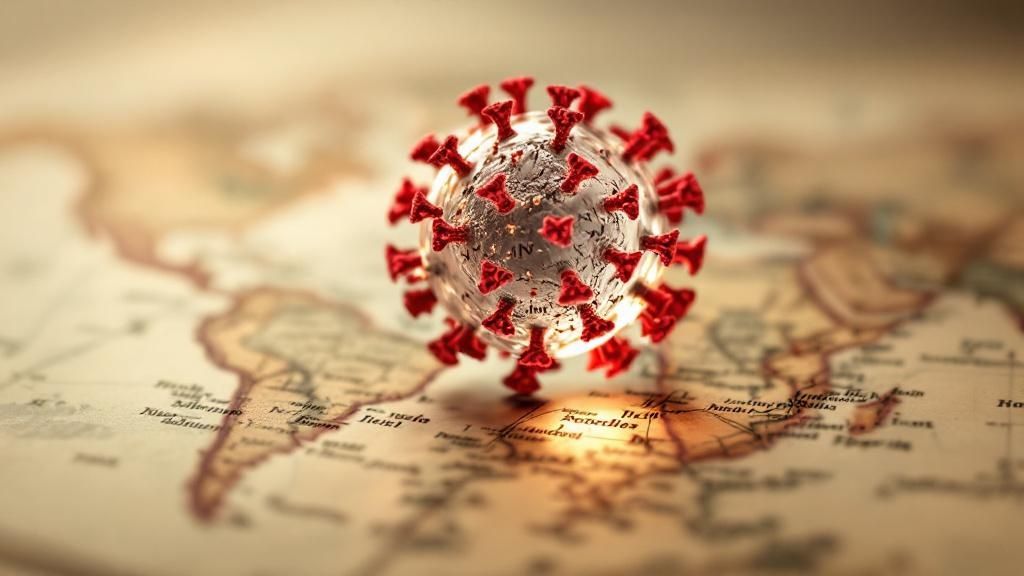
More than a century ago, the world was rocked by a pandemic so devastating it remains one of the worst public health crises in human history. The 1918 Spanish influenza, caused by an H1N1 influenza A virus, wasn’t just an unusually bad flu season—it was a global catastrophe. It’s estimated that the virus infected a staggering one-third of the world's population, leaving an indelible scar on an entire generation.
A Devastating Global Crisis Unfolds

Emerging in the final, exhausting year of World War I, the 1918 pandemic unleashed a wave of death that quickly eclipsed the war's own horrific toll. What made this strain so terrifying wasn't just its rapid spread but who it killed. Unlike a typical flu that poses the greatest risk to the very young and the very old, this virus hit healthy adults between the ages of 20 and 40 the hardest. This bizarre and frightening pattern baffled doctors and turned the established understanding of influenza on its head.
The sheer scale of the outbreak is hard to comprehend even today. The virus infected an estimated 500 million people across the globe, at a time when the world's population was just over 1.8 billion. While the exact numbers are lost to history, credible estimates place the death toll somewhere between 17 million and 50 million people, a figure that marks it as one of the deadliest disasters ever recorded. For a deeper look at its global reach, you can explore more historical context on this influenza pandemic.
To help put these numbers into perspective, here is a quick overview of the pandemic's impact.
1918 Pandemic Key Statistics at a Glance
This table provides a quick summary of the most critical figures associated with the 1918 Spanish influenza pandemic to help readers grasp its immense scale.
| Metric | Estimated Figure |
|---|---|
| Global Infections | 500 million (one-third of world population) |
| Global Deaths | 17 million to 50 million (some estimates are higher) |
| Most Affected Age Group | 20-40 years old |
| Waves of Infection | 3 distinct waves (Spring 1918 – Spring 1919) |
These figures underscore just how profoundly the virus reshaped communities worldwide in a remarkably short period.
Understanding the Pandemic's Three Waves
The virus didn't just strike once and disappear. It came in three distinct, relentless waves over the course of about a year, with each one bringing its own unique horrors.
- The First Wave (Spring 1918): This initial outbreak was deceptive. It felt like a typical, albeit widespread, flu. Symptoms were relatively mild, and the death rate wasn't high enough to cause widespread panic. This false sense of security was its secret weapon, allowing it to silently seed itself across the globe.
- The Second Wave (Fall 1918): This is when the true nightmare began. The virus returned with a vengeance, having mutated into a far more virulent form. It caused severe, hemorrhagic pneumonia that could kill within hours of the first cough. This catastrophic second wave was responsible for the vast majority of the pandemic's deaths.
- The Third Wave (Winter 1918-1919): While not as ferocious as the second wave, this final wave was still deadlier than a normal flu season. It continued to claim lives into the early months of 1919 before finally burning itself out.
This terrifying pattern of waves taught us a crucial lesson about influenza viruses: they change. Their ability to mutate rapidly is what makes them such a persistent threat. It's a lesson that directly informs modern pandemic preparedness, reminding us why vigilance can't be relaxed even when an initial outbreak seems to be fading.
The societal disruption was total. Faced with an invisible enemy, communities around the world resorted to desperate measures like mandatory quarantines, mask-wearing, and the shutdown of nearly all public life. Studying what happened in 1918 isn't just a history lesson; it’s a timeless case study in virology, public health, and the simple, powerful act of hygiene in the face of an infectious disease.
Unpacking the Origins of the Deadly H1N1 Virus

To really get a handle on the 1918 pandemic, we have to start with the virus itself. The culprit was a particularly nasty strain of Influenza A virus, subtype H1N1. We now know it was an avian flu, meaning it almost certainly jumped from wild birds to humans, possibly after a pit stop in pigs.
Think of a virus's genetic code like a key. Most bird flu viruses don't have the right key to unlock and hijack human cells. But this H1N1 strain was different. Through a series of mutations—tiny tweaks to its genetic instructions—it not only figured out how to get into human cells but also how to spread from person to person with terrifying speed.
This leap from animals to humans is called a zoonotic spillover, and it’s at the heart of how most pandemics get started. The 1918 virus was a master adapter, and scientists are still piecing together its biological puzzle more than a century later.
Why Was It Called the "Spanish Flu"?
One of the most stubborn myths about the pandemic is its name. Despite what it’s called, the Spanish flu absolutely did not start in Spain. That nickname is a historical accident, born out of the chaos of World War I.
During the war, countries like Germany, France, the UK, and the United States were censoring their newspapers heavily to keep public morale high. Reporting on a new, deadly disease sweeping through the population was simply not allowed. But Spain was neutral. Its press was free.
Because Spanish newspapers were the first to report openly on the illness—they even covered King Alfonso XIII's severe case—the world got the false impression that Spain was ground zero. The name "Spanish flu" stuck, and it's been misleading people ever since.
This naming error is a powerful lesson in how wartime information control and global politics can shape our understanding of history, even when it completely misses the scientific reality.
The Hunt for the True Epicenter
So if not Spain, then where? The honest answer is that nobody knows for sure. But researchers have a few compelling theories, each pieced together from a mix of historical detective work and modern virology.
Three places are consistently flagged as possible ground zeros for the pandemic:
- Haskell County, Kansas: In early 1918, doctors here noted an unusually aggressive flu. The theory goes that the virus spread from this rural community to Camp Funston, a nearby military base, and then traveled to Europe with American soldiers.
- Étaples, France: Another strong candidate is this massive British military camp in France. Overcrowded, stressful, and filled with soldiers, pigs, and poultry, it was the perfect "mixing bowl" for a new virus to emerge and take hold.
- Shanxi, China: A third theory points to a mysterious respiratory illness that hit parts of China in 1917. Some believe this could have been the pandemic's opening act, with Chinese laborers carrying the virus to Europe where they worked behind the front lines.
Each scenario underscores a critical fact: the massive movement of troops during WWI turned a local outbreak into a global catastrophe. The true starting point remains one of history's great epidemiological mysteries. This constant threat of new viruses highlights the importance of maintaining clean environments to reduce the risk of transmission.
How Three Waves of Flu Swept the Globe
The story of the 1918 Spanish influenza is a tragic play in three acts. This global disaster didn't just show up as one overwhelming catastrophe. Instead, it rolled across the world in a series of devastating waves, each with its own terrifying personality. Understanding this progression is key to seeing how a seemingly manageable flu outbreak spun into one of the deadliest pandemics in human history.
The first wave, which surfaced in the spring of 1918, was deceptively mild. While it spread like wildfire, its symptoms were hard to tell apart from a bad seasonal flu. People suffered through fevers, chills, and body aches, but almost everyone recovered within a few days. This initial wave moved far and wide but didn't cause many deaths, lulling the world into a false sense of security.
But this was just the prologue. As Allied and Central Powers' troops crisscrossed the globe during the final brutal months of World War I, they unknowingly carried this new H1N1 virus with them. In the cramped, filthy conditions of military camps and transport ships, the virus found the perfect breeding ground to mutate into something far more sinister.
The Second Wave Unleashes a Nightmare
By late summer and early fall of 1918, the second wave crashed down on the world, and it was a biological monster. The virus that returned was exponentially more lethal. This version of the Spanish flu was responsible for the vast majority of the pandemic’s staggering death toll, killing with shocking speed and ferocity.
Patients' conditions would spiral with frightening speed. One day a person might feel perfectly healthy; the next, they could be fighting for their life. The virus triggered a vicious form of pneumonia that filled the lungs with fluid, essentially causing victims to drown from the inside out. A telltale sign of a severe infection was a dark blue or purplish tint to the skin—a condition known as cyanosis—as the body was starved of oxygen.
What made this wave so unusual and terrifying was its attack on the young and healthy. Instead of preying on the very old or the very young, this flu targeted people in their 20s and 30s. Scientists now believe this was because their strong immune systems overreacted—a phenomenon called a "cytokine storm"—where the body's defenses go into overdrive and attack its own tissues, leading to catastrophic organ failure.

This image of officials posting quarantine notices captures the desperate public health efforts made to stop the virus's relentless spread during the pandemic's deadliest phase.
October 1918 became the deadliest month in American history. An estimated 195,000 people died in the U.S. alone. Hospitals were completely overwhelmed, morgues ran out of space, and a sense of absolute dread paralyzed communities across the globe.
The Final Echo of the Pandemic
As winter gave way to spring in 1919, a third and final wave emerged. This wave wasn't as severe as the second, but it was still far deadlier than a typical flu season. It continued to claim lives, often hitting more isolated communities that had been spared the first two onslaughts.
By the time this last echo of the pandemic faded in the summer of 1919, the virus had completed its deadly world tour. The progression of the 1918 Spanish flu through these three distinct waves is a powerful lesson on the unpredictable nature of viruses. It’s a stark reminder of how a seemingly mild bug can rapidly transform into a killer, and why public health vigilance and proper sanitation are so critical.
How Society Fought Back Against the Virus
In 1918, the world was up against an invisible, lightning-fast enemy. With no vaccines, no antiviral drugs, and not even antibiotics for the brutal secondary infections, communities had to get creative. They fell back on the most basic tools of public health, creating a playbook that would look strikingly familiar to anyone who lived through the COVID-19 pandemic.
As the deadly second wave of the 1918 Spanish influenza crashed over cities and towns, officials knew they had to do something. Even with a limited understanding of the virus, the desperate need to act pushed them to implement quarantines and isolation orders. They shut down schools, churches, theaters, and dance halls—anyplace people gathered.
These measures weren't always popular, but they were the best tools they had. The goal was simple, and it’s been a cornerstone of public health ever since: slow the virus down and "flatten the curve," even if they didn't call it that back then.
Public Health Measures in an Era Before Modern Medicine
Without a cure in sight, the only real options were prevention and damage control. Cities plastered notices everywhere, urging people to take precautions. Most of it boiled down to basic hygiene and what we now call social distancing—a testament to human ingenuity when facing impossible odds.
The core strategies they used included:
- Mandatory Mask Wearing: Gauze masks became a common, almost iconic, sight. Many cities passed laws requiring them in public, with fines or even jail time for those who refused. "Spitless Sundays" were promoted, and laws against public spitting were enforced with surprising strictness.
- Business and School Closures: To break the chains of transmission, officials ordered non-essential businesses to lock their doors. Schools were shuttered for weeks, sometimes months, turning bustling city centers into ghost towns in an effort to starve the virus of new hosts.
- Staggered Business Hours: Some cities got clever and staggered work hours for factories and shops. The idea was to thin out the crowds on public transit, which had become a major hotspot for the virus's spread.
These century-old tactics highlight a fundamental truth about viral outbreaks. Long before advanced virology, communities understood that controlling the spread of disease depended on changing human behavior and maintaining clean environments. Simple actions like wearing a mask, frequent hand washing, and keeping surfaces disinfected were the most powerful weapons they had.
The Heroic Efforts on the Front Lines
The strain on the healthcare system was immediate and crushing. Hospitals were swamped, forced to turn away the sick as beds filled up almost instantly. Communities scrambled to set up makeshift hospitals in schools, armories, and public halls just to handle the overflow of the sick and dying.
The medical community was stretched to its breaking point. A huge number of doctors and nurses were already overseas serving in World War I, creating a severe shortage right when they were needed most. This is where volunteers, especially women, stepped up to fill the void.
The American Red Cross and other groups mobilized legions of volunteer nurses and aides. Many of these women had little to no formal training, yet they worked tirelessly in horrific conditions. They provided basic care, fed the sick, comforted the dying, and risked their own lives every single day. Their heroism was a critical, and often unsung, part of the fight against the 1918 Spanish influenza.
Economic and Psychological Scars
The pandemic’s reach extended far beyond the sick wards. It inflicted deep economic and psychological wounds on a world already shell-shocked from war. With so many people sick, essential services from coal mining to telephone operation ground to a halt. Fear kept everyone at home, causing consumer spending to plummet and businesses to go under.
The mental toll was just as heavy. The constant presence of death created an atmosphere of pervasive anxiety and grief. Public funerals were often banned to stop the spread, forcing families to mourn alone. This collective trauma left deep scars on the generation that survived, shaping their outlook long after the virus finally faded. It's a powerful reminder of why foundational hygiene, like hand washing and disinfecting surfaces with reliable products, has always been humanity's first and most reliable line of defense against viral threats.
Rethinking the Pandemic's True Death Toll
For decades, the death toll of the 1918 Spanish influenza has been a staggering, almost mythical figure, usually quoted somewhere between 50 and 100 million people worldwide. That massive range alone tells you one of the biggest stories of the pandemic: just how hard it was to get an accurate count.
The chaos of World War I, combined with patchy record-keeping and a barely-there understanding of viruses, made a precise tally impossible at the time.
In the middle of a global war, many countries actively suppressed news about the flu to keep morale from cratering, which meant official numbers were often wildly underreported. In other parts of the world, especially in colonial territories and rural areas, the infrastructure to track deaths just didn't exist. There was simply no system in place to follow a pathogen that moved so quickly and hit so hard.
On top of that, many deaths weren't even blamed on the flu. Doctors would often write "pneumonia" on the death certificate—a common and deadly secondary infection—without ever noting the influenza virus that kicked the whole thing off. This kind of misattribution hid the pandemic's true scale, leaving future historians with a messy, fragmented puzzle to solve.
Using Modern Science to Look Back
Today, researchers are going back to the historical data, but this time they're armed with advanced statistical modeling. They're looking at things like excess mortality—the number of deaths above and beyond what you'd normally expect in a given year. This kind of data forensics helps them cut through the historical noise and get a much clearer picture, even in places with spotty records.
These modern reassessments are starting to challenge those long-held upper estimates. Instead of just accepting the massive range of 50 to 100 million, new data-driven analyses are pointing toward more refined, and frankly, more believable figures. It’s a fascinating look at how our scientific understanding can evolve as we develop better tools.
Even as the numbers shift with new research, one thing is beyond dispute: the 1918 pandemic was a catastrophe on an almost unimaginable scale. Debating the exact figures doesn't diminish its horror; it just shows our commitment to getting the story right.
Recent scholarly work has started to zero in on a revised global death toll. A key study, for example, used sophisticated models on mortality data from 13 countries and suggested the real number might have been closer to 17 million. This type of scientific reassessment is vital, as it constantly refines our knowledge of the past and sharpens our understanding of viral behavior.
Comparing Mortality Estimates of the 1918 Pandemic
Putting the old figures side-by-side with newer, data-driven estimates reveals a major shift in our understanding. The traditional numbers captured the sheer horror of the event, but modern methods give us a more nuanced, evidence-based perspective.
This table contrasts the widely cited historical estimates of the Spanish flu's death toll with more recent statistical reassessments, showing the evolution of our understanding.
| Source Type | Estimated Global Deaths |
|---|---|
| Traditional Historical Estimates | 50 million to 100 million |
| Modern Statistical Reassessments | 17 million to 25 million |
Ultimately, it doesn't matter which estimate you lean toward—the 1918 Spanish influenza was a monumental tragedy. The ongoing effort to clarify its death toll isn't just an academic exercise. It sharpens our understanding of the pandemic's impact and gives us crucial lessons for how we track and respond to viral threats today, reinforcing the need for both advanced medical interventions and basic preventative measures like surface disinfection.
What the 1918 Flu Teaches Us About Modern Pandemics
The 1918 Spanish influenza wasn't just a historical catastrophe; it was a brutal, unforgettable lesson. That devastating year completely changed how we think about public health, and its teachings are still the foundation for how we fight viral threats today. Its legacy is etched into the very DNA of modern medicine and pandemic response.
One of the biggest takeaways was the birth of modern epidemiology. Doctors and officials, grappling with an invisible enemy they couldn't yet identify, started methodically tracking who was falling ill and where. This crisis forced the world to admit that a patchwork of local health efforts just wasn't enough. It drove the creation of coordinated, national public health systems and health ministries in many countries.
Before 1918, public health was mostly a local affair. After, everyone understood that a virus doesn’t care about borders. It demanded a unified, global strategy for watching and responding to disease.
The Long Shadow of the H1N1 Virus
The genetic ghost of the 1918 virus never really went away. Scientists have since discovered that its direct descendants are behind nearly every major influenza A pandemic that followed. It’s the direct ancestor of the H1N1 viruses that caused the 1977 pandemic and, most famously, the 2009 "swine flu" pandemic.
This stubborn family tree is a stark reminder of how influenza viruses can stick around for decades, evolving and re-emerging when we least expect it. It’s why we now constantly monitor viral genetics—to see what’s changing and what might be coming next. The 1918 strain showed the world how one adaptable virus can echo for a century.
The link between the 1918 flu and the 2009 H1N1 outbreak is history talking directly to us. It proves that studying old pandemics isn't just for the history books; it's essential for predicting and fighting new ones.
Timeless Lessons for Today's Challenges
When you compare 1918 to recent pandemics, you realize many of the core problems are exactly the same. The basic tools they used back then—like wearing masks, keeping distance, and closing down public gatherings—turned out to be our most effective weapons again during COVID-19. It just goes to show that some public health fundamentals never go out of style.
Several hard-learned lessons from the 1918 Spanish influenza are just as relevant now as they were then:
- Act Early and Act Fast: The data is crystal clear. Cities that put safety measures in place quickly and kept them there longer saw far fewer deaths. It’s a powerful historical argument for not waiting to act.
- Tell People What's Happening: In 1918, wartime censorship and rumors fueled confusion and panic. Today, we know that honest, transparent communication from health officials is crucial for guiding public behavior and shutting down misinformation.
- Viruses Hit the Vulnerable Hardest: The 1918 flu hit poor and marginalized communities disproportionately hard. We see that same tragic pattern repeat in every modern pandemic, reminding us that we have to tackle underlying health disparities to keep everyone safe.
These insights from the past also highlight the power of community action. A strong public health defense isn't just a government job. It relies on concepts like herd immunity, where the choices we each make help protect everyone around us. You can learn more by reading our guide that explains what herd immunity is and how it works.
Ultimately, the 1918 pandemic taught us a simple but powerful truth: individual preparedness, including keeping our homes clean and regularly disinfecting surfaces, is one of the most fundamental ways we build a resilient community against any viral threat.
Frequently Asked Questions About the 1918 Flu
Even a century later, the sheer scale of the 1918 Spanish influenza raises a lot of questions. Let's break down some of the most common ones to get a clearer picture of what happened.
How Did the 1918 Flu Actually Kill People?
Unlike the seasonal flu we know today, the 1918 H1N1 virus was incredibly aggressive. For many, the primary cause of death was a brutal form of pneumonia that filled the lungs with fluid, essentially causing them to drown. This was often kicked into overdrive by a secondary bacterial infection that the body just couldn't fight off.
But for a huge number of young, healthy adults, the real killer was their own body. The virus triggered a violent overreaction of the immune system called a "cytokine storm." Instead of just fighting the virus, the immune system went haywire, causing massive inflammation that destroyed healthy tissue and led to catastrophic organ failure.
Did People Wear Masks During the 1918 Pandemic?
They absolutely did. Mask-wearing became a common public health order in many cities and towns. It was often mandatory to wear a simple gauze mask in public, and people could be fined or even arrested for not complying.
Of course, the effectiveness of these early masks was up for debate, but they were one of the few real tools people had. Along with shutting down public gatherings and enforcing quarantines, masks became a powerful symbol of a community fighting back together.
The widespread use of masks in 1918 highlights a timeless public health reality: even simple physical barriers can make a difference in slowing down respiratory viruses. It’s a powerful historical lesson that gives us context for the same debates we have today.
Why Did So Many Young Adults Die?
This is one of the most haunting and unusual aspects of the 1918 Spanish influenza. The virus had a terrifyingly high death rate among healthy adults between 20 and 40 years old.
Scientists now believe this was largely due to the cytokine storms we just talked about. Younger people with the strongest, most robust immune systems were ironically the most vulnerable to this deadly overreaction. Their bodies launched such a ferocious attack that they ended up destroying themselves in the process.
There's also a theory that older generations might have had some leftover immunity from a similar flu virus that circulated decades earlier, in the late 19th century. To learn more about how viruses can affect different demographics, check out our guide to common virus infections.
Leave a Reply