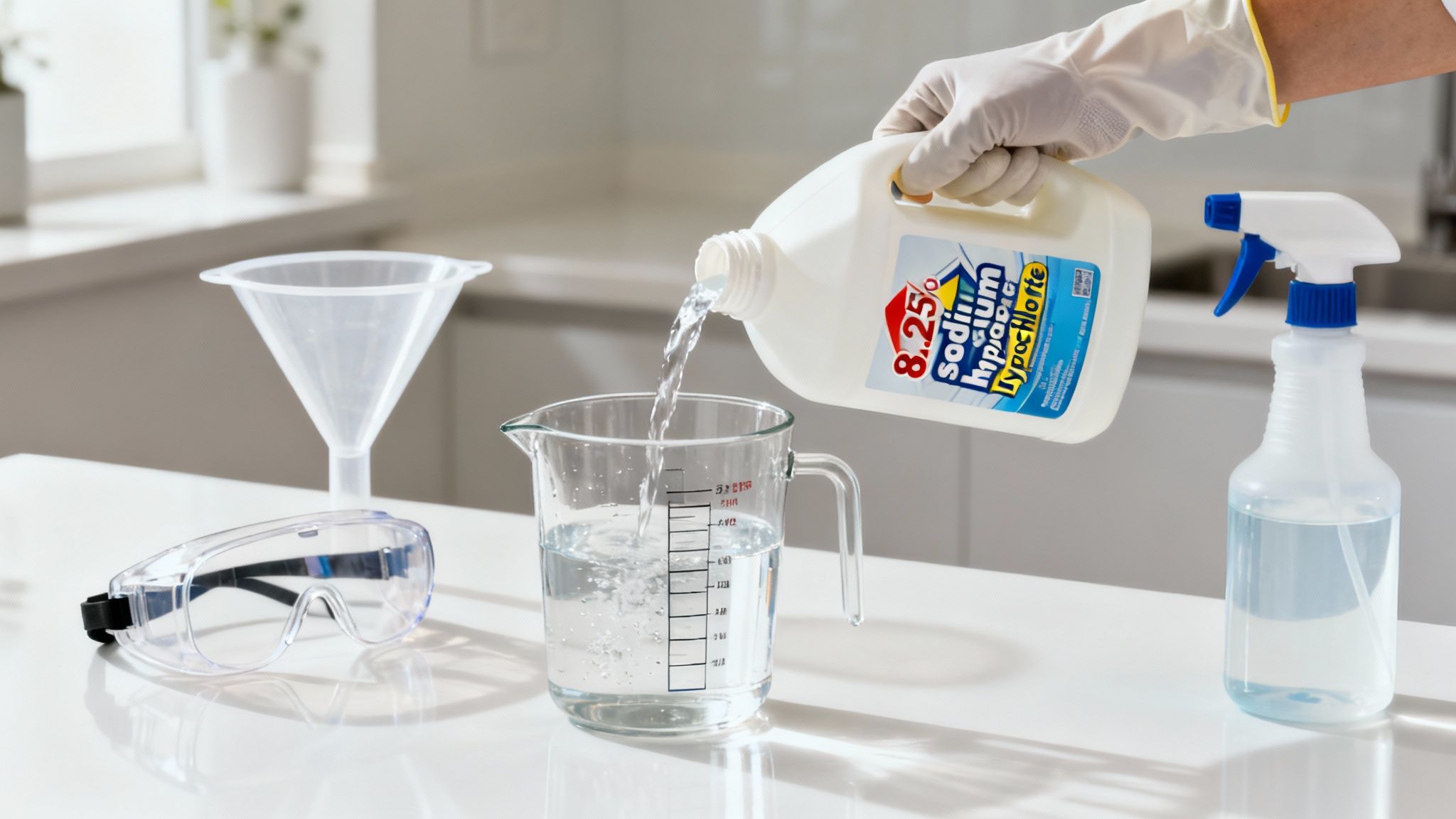
Even with a whole aisle of specialized cleaners at the store, a simple disinfectant bleach solution is still one of the most powerful tools you can have in your fight against viruses and bacteria. Its effectiveness comes down to some pretty basic chemistry, making it a reliable workhorse for everything from kitchen counters to critical healthcare settings. Understanding how bleach inactivates viruses like Human Immunodeficiency Virus Type 1 (HIV-1) and Influenza A Virus (H1N1) is the first step to using it correctly.
Why Bleach Is Still a Disinfection Powerhouse
In a world of fancy formulas and pleasant scents, you might wonder why bleach still holds its ground. It’s simple: it works.
The active ingredient, sodium hypochlorite, is a potent oxidizing agent. When it meets pathogens like viruses and bacteria, it literally dismantles them from the inside out by destroying their essential proteins and nucleic acids. They don't just get wiped away; they get chemically annihilated.
This isn't a targeted attack, either. It’s a broad-spectrum assault that works on a huge range of microorganisms. That’s why we trust bleach to take out everything from common viruses like Rhinovirus Type 14 to more resilient, non-enveloped pathogens like Norovirus.
The Science of Destruction
The real power of a bleach solution is its raw, brute-force approach. Unlike some cleaners that just lift dirt and grime, bleach fundamentally destroys the molecular structure of germs on contact. This process, known as oxidation, is ruthlessly efficient on hard, non-porous surfaces.
It's precisely why hospitals and clinics depend on it to sterilize equipment and keep environments safe. When you absolutely, positively have to kill the germs, you reach for bleach. The goal is the complete inactivation of viruses such as:
- Influenza A Virus (H1N1)
- SARS-Related Coronavirus 2 (SARS-CoV-2)
- Hepatitis C Virus (HCV)
- Herpes Simplex Virus 1 (HSV-1)
The role of sodium hypochlorite is so critical that disinfection applications make up about 43.7% of its entire market revenue. That’s a massive slice, covering everything from water treatment to food processing. If you want to dive deeper into the numbers, you can explore a detailed market analysis from Future Market Insights.
This widespread trust is exactly why it’s so important to know how to mix and use it correctly, whether you're making a DIY spray or just grabbing a pack of disinfecting wipes.
Getting Your Hands on the Right Bleach and Supplies

Before you even think about mixing up a disinfectant, let’s talk about getting the right tools for the job. You can’t just grab any old bottle of bleach off the shelf. Skipping this first step is a classic mistake that can leave you with a solution that’s either too weak to do any good or so strong it's a safety hazard.
The star of the show is, of course, the bleach. Flip that bottle around and check the label. You’re looking for a plain, unscented household bleach with a sodium hypochlorite concentration somewhere between 5% and 8.25%.
Steer clear of anything labeled "splash-less," "color-safe," or loaded with extra scents. Those versions often have thickeners and other additives that get in the way of the disinfecting process. Against tough germs like Norovirus (Norwalk Virus) or its surrogate, Feline Calicivirus, you want the basic, no-frills original—it’s the one that gets the job done.
Your Safety and Mixing Toolkit
Once you’ve found the right bleach, it's time to gather your gear. This part isn’t optional. We're dealing with chemicals, and even common household ones demand a little respect.
Here’s a quick rundown of what you absolutely need:
- Chemical-resistant gloves: Good old rubber dishwashing gloves are perfect. They’ll protect your skin from the irritation and burns bleach can cause.
- Eye protection: A simple pair of goggles or a face shield is non-negotiable. An accidental splash to the eyes is a serious risk you don’t want to take.
- A well-ventilated space: Fumes are no joke. Crack open a window or turn on an exhaust fan to get some air moving before you start pouring.
- Dedicated measuring tools: Grab a set of measuring cups and spoons that you’ll only use for cleaning. You never, ever want to mix these up with the ones you use for cooking.
Here’s a pro-tip from someone who's made a mess or two: use a funnel. Pouring bleach from a big, clumsy jug into a tiny measuring cup is a recipe for disaster. A funnel keeps the process clean, safe, and precise, making sure every drop ends up exactly where you want it. For a quick and effortless alternative, consider pre-made disinfecting wipes.
Getting the Bleach Dilution Ratios Right
The real secret to using bleach as a disinfectant isn't its raw power—it's getting the mix just right. If your solution is too weak, you're not actually killing the viruses you’re targeting. But if it's too strong, you can damage surfaces and create a health hazard. Nailing the dilution is everything.
Fortunately, you don't need a chemistry set to get this done. All it takes is some standard household bleach and basic measuring tools. The goal is simple: create a solution with enough sodium hypochlorite to obliterate the tough outer shells of pathogens like Influenza A2/305/57 Virus (H2N2) or the infamous Norovirus.
Standard Dilution for Everyday Disinfecting
For daily wipedowns of high-touch surfaces, a milder solution is your best friend. Think doorknobs, light switches, and countertops. This ratio is strong enough to handle common germs without being overly aggressive on your home’s surfaces.
- For a big batch: Mix 5 tablespoons (or 1/3 cup) of bleach into one gallon of cool water.
- For a smaller spray bottle: Use 4 teaspoons of bleach per quart (4 cups) of water.
This is the perfect mix for the things you touch all the time. I'm talking remote controls, faucet handles, and even plastic phone cases. It’s your go-to for keeping those germ hotspots under control.
Stronger Solution for Tougher Jobs
There are times when you need to bring in the heavy artillery. If you're sanitizing a bathroom after someone's been sick, cleaning up after handling raw meat, or dealing with a known contamination spot, you need a stronger disinfectant.
You’ve probably heard of the 1:10 dilution rule (one part bleach to ten parts water). That’s a great guideline, but for household use, it’s easier to measure it out. A slightly stronger mix ensures you have enough power to knock out resilient viruses like Feline Calicivirus, which researchers often use as a surrogate for the incredibly tough Norovirus.
To make things foolproof, here's a quick reference table. Just remember to use standard household bleach that has a 5% to 8.25% sodium hypochlorite concentration.
Bleach Solution Dilution Ratios for Disinfection
This table is your quick cheat sheet for mixing the right bleach solution for the job. Always start with cool water, as hot water can reduce bleach's effectiveness.
| Bleach Concentration | Amount of Bleach | Amount of Water | Best For |
|---|---|---|---|
| Everyday Surfaces | 4 Teaspsoons | 1 Quart (4 Cups) | General disinfection of countertops, doorknobs, and toys. |
| Bathroom/Tough Messes | 1/2 Cup | 1 Gallon | Sanitizing toilets, showers, and non-porous floors after illness. |
| Food Surfaces | 1 Tablespoon | 1 Gallon | Sanitizing kitchen counters and cutting boards (must rinse thoroughly). |
After mixing your solution, remember to label the container clearly and store it away from children and pets. Or, skip the hassle entirely with ready-to-use disinfecting wipes that offer the same powerful cleaning without the prep work.
How to Safely Mix and Apply Your Solution
You've got your supplies and you understand the ratios. Now it's time to put that knowledge into action.
The first, non-negotiable rule is to always work in a well-ventilated space. I can't stress this enough. Crack a window, turn on the exhaust fan—do whatever you need to do to get some air moving and dissipate those fumes. Once you've got your protective gloves and eyewear on, you're ready to mix.
Here’s a critical safety tip: Always add the bleach to the water, never the other way around. Pouring water into a bottle of concentrated bleach can cause a nasty, dangerous splashback right into your face. Instead, gently pour your measured bleach into the cool water and give it a light swirl to combine. Simple, but crucial.
Applying Your Solution for Maximum Effect
Okay, let's talk about application. The real-world effectiveness of your disinfectant bleach solution boils down to one key concept: contact time. This is just a technical term for how long the solution needs to stay visibly wet on a surface to actually inactivate pathogens like Avian Influenza Virus (H5N1) or SARS-CoV-2.
Here are a couple of real-world examples of how this plays out:
- For food surfaces: Say you just prepped raw chicken. You'll want to wipe down that counter with your solution and let it sit for at least one full minute before you rinse it off with fresh water.
- For high-touch areas: During flu season, I make it a habit to spray doorknobs, light switches, and railings. For these spots, you can just let the solution air-dry completely. No rinsing needed.
This infographic is a great visual for breaking down the dilution process for different cleaning jobs.

As you can see, a little bit of bleach goes a long way for everyday cleaning, while you'll want a slightly stronger mix for those more serious messes. For maximum convenience, you can achieve the same level of clean with specially formulated disinfecting wipes.
The most important thing to remember is that the surface has to stay wet for the entire contact time. This is typically between one and five minutes, depending on the virus you're targeting. If it dries too quickly, just reapply it to make sure you’re actually killing the germs.
Understanding these application principles is non-negotiable. For a deeper dive, our guide on how to disinfect surfaces effectively covers even more detail. Proper technique is what separates just wiping a surface from truly disinfecting it.
Critical Safety Rules for Handling Bleach

When you’re working with a disinfectant bleach solution, you need more than the right dilution ratio—you need a healthy respect for its chemical power. A few simple, non-negotiable safety rules will keep you safe and make sure your cleaning efforts actually work.
Let’s get the most important one out of the way first: never mix bleach with other household cleaners. Seriously. It's a recipe for disaster.
Combining bleach with ammonia-based products creates toxic chloramine gas, a nasty chemical that can cause serious respiratory damage. Mix it with an acidic cleaner, and you can release chlorine gas. Just don't do it. Stick to mixing bleach with cool water, and nothing else.
Proper Storage and Handling
Once your solution is mixed, it needs to be handled and stored correctly. The first step is to always label your container clearly. Slap a label on it that says "Bleach Solution" and add the date you mixed it. This tiny step prevents someone from accidentally misusing it and serves as a reminder of its short lifespan.
From there, find a secure spot for both your concentrated bleach and your freshly mixed solution—somewhere well out of reach of children and pets. Proper storage is just as fundamental as wearing the right gear. For more on that, check out our guide on how to use personal protective equipment before you start mixing.
Your homemade disinfectant bleach solution is only at full strength for about 24 hours. After that, the sodium hypochlorite starts to break down, and it just won't be effective. To make sure you’re actually inactivating viruses like Human Coronavirus or Rhinovirus Type 39, you have to mix a fresh batch every day.
The push for effective disinfectants isn't slowing down. In fact, the global bleach market is expected to grow by USD 408 million between 2024 and 2029. This boom shows just how much people are prioritizing hygiene, which in turn pressures manufacturers to focus on making safer, more effective products like ready-to-use disinfecting wipes. You can read more about the trends shaping the bleach industry here.
A Simpler Alternative for Quick Disinfecting
Mixing your own disinfectant bleach solution is a great, cost-effective way to kill germs. But let's be real—it takes time, careful measurement, and dedicated supplies. When life gets crazy and you're dealing with a quick spill or a sudden mess, you need something faster and more convenient.
That’s where disinfecting bleach wipes come in.
Think of them as the perfect complement to your homemade solution. They deliver the same germ-killing power of bleach in a stable, pre-moistened, ready-to-use format. With wipes, there’s zero guesswork, no mixing, and no risk of getting the dilution wrong—just powerful disinfection right out of the canister.
When Wipes Are the Smarter Choice
Disinfecting wipes truly shine when speed, convenience, and precision are top priorities. They're perfect for those grab-and-go moments when you need immediate peace of mind.
For instance, they're a lifesaver for:
- On-the-go disinfecting: Keep a canister in your car for wiping down shopping cart handles, public touchscreens, or high-touch surfaces in hotel rooms.
- Quick kitchen cleanups: Perfect for immediately wiping down the sink area after handling raw chicken or disinfecting cutting boards.
- Targeted sanitizing: Great for zapping germs on a light switch, the TV remote, or a doorknob without having to mix a whole batch of solution. They are your best defense against viruses in an instant.
Because they’re pre-moistened and single-use, they’re ideal for containing a mess without just spreading germs around. If you're looking for other options, it's always smart to explore various Safer Alternatives to Bleach to find what works best for your home.
The demand for this kind of convenience is huge. The global bleach wipes market was valued at around USD 3.7 billion in 2024 and is expected to rocket to USD 7.1 billion by 2035, growing at a rate of 6.1% each year. Their effectiveness against a whole range of pathogens has made them a staple in homes, scientific labs, and businesses everywhere. You can read more about this growing market at Fact.MR.
If you’re interested in other easy-to-use disinfectants that are becoming more popular, our article on hypochlorous acid for cleaning is a great read.
Ultimately, having both a DIY solution on hand and a canister of ready-to-use wipes gives you the flexibility to tackle any cleaning challenge that comes your way, ensuring your environment is always protected.
Answering Your Top Questions About Bleach Solutions
When it comes to mixing and using bleach for disinfection, a few key questions always pop up. Let's clear the air on some of the most common ones I hear.
Can I Use Scented or Splash-Less Bleach?
In a word, no. I know it's tempting to grab the scented or splash-less versions, but for true disinfection, you need to stick with the original.
These specialty bleaches often have a lower concentration of the active ingredient, sodium hypochlorite, or they contain thickeners and other additives. These extras can get in the way of the disinfecting process, making your solution less effective at killing tough, non-enveloped viruses like Human Rotavirus.
Always grab a bottle of plain, standard household bleach. Check the label to make sure it has a sodium hypochlorite concentration between 5% and 8.25%.
How Long Does a Diluted Bleach Solution Last?
Once you mix bleach with water, the clock starts ticking. A homemade bleach disinfectant is only at its peak strength for about 24 hours.
Why so short? The sodium hypochlorite starts breaking down pretty quickly once it's diluted. To make sure you’re hitting viruses like Hepatitis B Virus (HBV) or its relative, Duck Hepatitis B Virus (DHBV), with a full-strength solution, get in the habit of mixing a fresh batch for each day you plan to disinfect. Or, simply use a disinfecting wipe, which remains stable and effective until its expiration date.
Is It Safe for All Surfaces?
Definitely not. Bleach is a powerful chemical, which means it’s also corrosive and can permanently damage certain materials.
It works great on hard, non-porous surfaces—think countertops, tile floors, and most plastics. But you need to steer clear of using it on porous materials like wood, as it can soak in and cause damage. It's also a bad idea for metals like stainless steel, aluminum, and copper, where it can quickly lead to rust, corrosion, and ugly discoloration.
For answers to common queries about bleach solutions and their effectiveness in specific scenarios, you might find valuable insights in articles such as this definitive guide: Does Bleach Kill Black Mold?
Leave a Reply