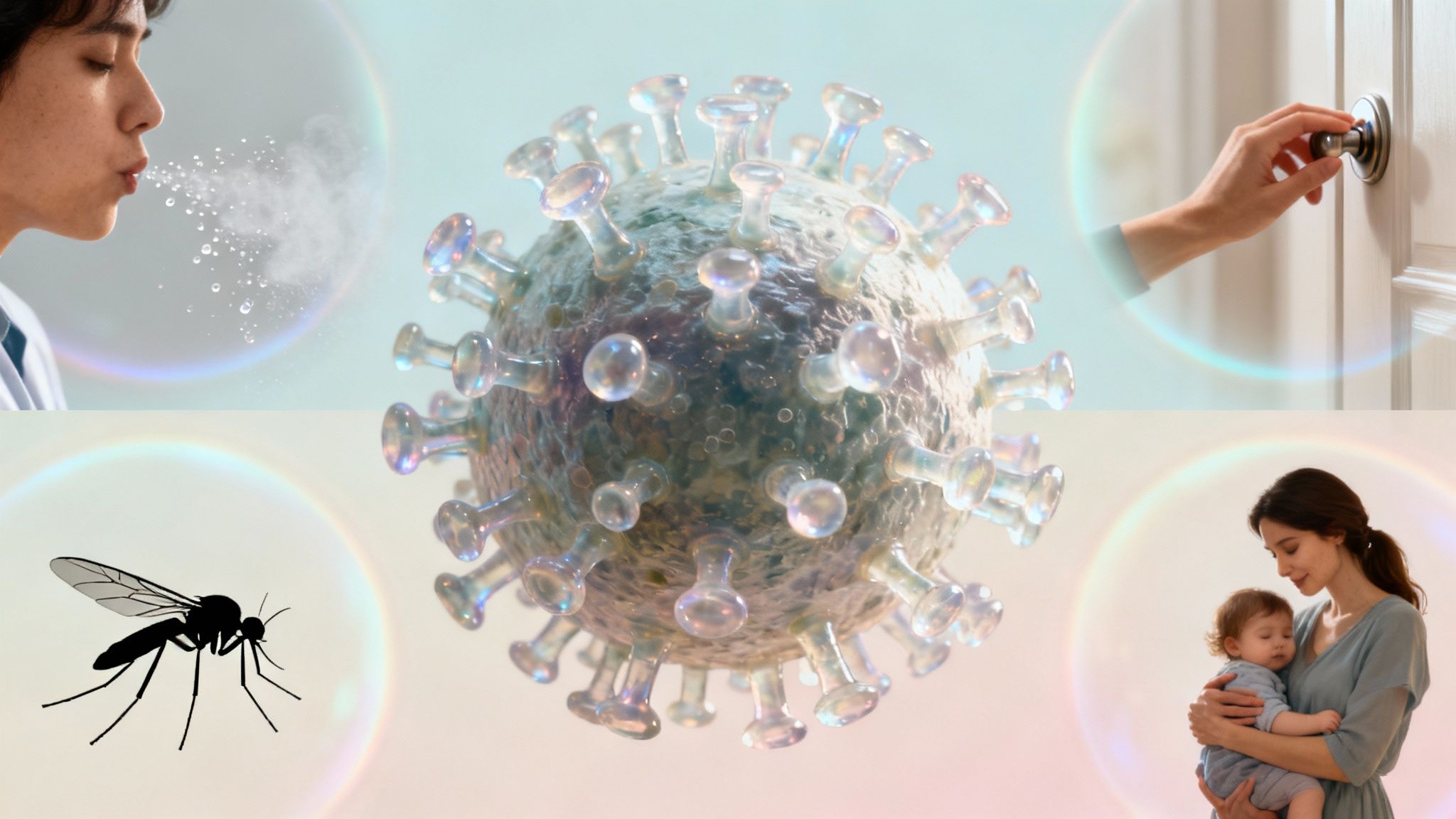
Viruses are crafty little hitchhikers. They can ride on tiny airborne droplets when someone coughs, linger on a doorknob waiting for the next hand, or even sneak into our bodies through contaminated food and water. They’re essentially microscopic survival machines.
The Viral Travel Plan Uncovered
Ever wonder how something so incredibly small can wreak so much havoc? A virus is nothing more than a bit of genetic code wrapped in a protein shell, but its entire existence is geared toward one thing: finding a host to replicate inside. To get there, it relies on a handful of clever travel strategies.
Understanding these pathways is the first step toward building a solid defense. This visual breaks down the most common ways these tiny invaders get from point A to point B.

As the infographic shows, there’s no single answer to how viruses spread. They're opportunistic, using whatever route is available—whether that's floating through the air, sticking to surfaces, or catching a ride with an insect.
Core Transmission Routes
To really get a handle on this, it helps to break down their main strategies. Each route presents a different challenge, which is why a multi-layered approach to hygiene, including the regular use of disinfecting wipes, is so critical.
The main transmission strategies viruses use are:
- Direct Contact: This is the most straightforward route—spreading through physical touch. A simple handshake, a shared drink, or a kiss can be enough for viruses like Herpes Simplex Virus 1 (HSV-1) and Herpes Simplex Virus 2 (HSV-2) to find a new host.
- Indirect Contact (Fomites): Ever heard the term "fomite"? It just means any inanimate object that can carry infectious particles. Think doorknobs, remote controls, or cell phones. Small non-enveloped viruses like Norovirus and Rhinovirus are notorious for this, surviving for days on a surface just waiting for someone to come along.
- Droplet/Airborne Spread: When an infected person coughs, sneezes, or even talks, they expel tiny respiratory droplets loaded with viral particles. Influenza A Virus (H1N1) and SARS-Related Coronavirus 2 (SARS-CoV-2) are masters of this method, which is why they can spread so quickly through a room.
- Vector-Borne: Some viruses use a middleman. They infect an intermediary—usually an insect like a mosquito or a tick—which then carries the virus to its next victim. Dengue fever and Zika are classic examples of this sneaky tactic.
To give you a quick cheat sheet, here’s a breakdown of these routes in a simple table.
Viral Transmission Routes at a Glance
This table offers a quick summary of the primary ways viruses get around, with simple explanations and common examples.
| Transmission Route | How It Works | Common Virus Examples |
|---|---|---|
| Direct Contact | Spreading through physical touch or exchange of bodily fluids. | Herpes Simplex Virus (HSV-1, HSV-2), Human Immunodeficiency Virus (HIV-1), Ebola |
| Indirect Contact (Fomite) | A person touches a contaminated surface, then touches their face. | Norovirus, Rhinovirus (Types 14, 39), Feline Calicivirus |
| Droplet/Airborne | Inhaling respiratory droplets from an infected person's cough or sneeze. | Influenza (H1N1, H2N2), Coronaviruses (SARS-CoV-2), Measles |
| Vector-Borne | An insect (like a mosquito or tick) bites an infected host and then bites another. | Dengue Virus, West Nile Virus, Zika Virus |
| Fecal-Oral | Consuming food or water contaminated with fecal matter from an infected person. | Hepatitis A, Poliovirus, Human Rotavirus |
| Vertical (Mother-to-Child) | Passing from mother to baby during pregnancy, childbirth, or breastfeeding. | HIV-1, Hepatitis B Virus (HBV), Zika Virus |
Seeing it all laid out like this really highlights the diverse and adaptable nature of these pathogens.
Viruses are incredibly adaptive. Their simple structure allows them to exploit different environmental conditions and host behaviors to ensure their survival and replication. This adaptability is why understanding their specific transmission routes is critical for public health.
Of course, learning how viruses travel is just one piece of the puzzle. Once they arrive, they have to get inside our cells. To complete your understanding, check out our guide on how viruses infect cells. By knowing both how they get to you and what they do when they get there, you’ll be much better equipped to stay healthy.
Understanding How Viruses Spread Through the Air

Whenever someone coughs, sneezes, sings, or even just talks, they release thousands of tiny particles from their respiratory tract into the air. It’s the main way viruses like Influenza A (H1N1) and SARS-CoV-2 get from one person to another. But not all of these particles are created equal.
Think of it like a spray bottle. Some settings produce a direct, heavy spritz—larger, heavier droplets that travel a short distance before gravity pulls them down, usually within about six feet. This is known as droplet transmission.
But switch the nozzle to a fine mist, and you get a completely different effect. Tiny, lightweight particles can hang in the air for minutes, even hours, and drift far beyond the person who released them. This is airborne transmission, and it’s the reason viruses can spread so efficiently in indoor spaces.
Droplets vs. Aerosols: What’s the Difference?
Getting the distinction between these two types of particles is the key to understanding how to protect yourself. It explains why some preventative measures are more effective than others depending on the situation.
- Droplets are the bigger particles (>5 microns). They’re the primary culprits in close-contact transmission. If you’re standing near someone when they sneeze, these droplets can land directly on your eyes, nose, or mouth.
- Aerosols are the tiny ones (<5 microns) that can stay suspended in the air for a long time. They’re the bigger threat in poorly ventilated indoor areas, where they can accumulate and be inhaled by anyone in the room, even if they’re keeping their distance.
This is exactly why context matters so much. A brief chat outdoors is far less risky than spending an hour in a crowded, stuffy room where aerosols have had a chance to build up.
The spread of respiratory viruses is driven almost entirely by human-to-human transmission through these droplets and aerosols. The COVID-19 pandemic was a powerful lesson in how quickly global travel can turn a local outbreak into a worldwide crisis. Meanwhile, diseases like tuberculosis continue to highlight ongoing vulnerabilities.
How to Protect Yourself from Airborne Viruses
Knowing how viruses travel through the air gives you the power to take smart, targeted actions to avoid them.
Simple strategies can make a huge difference. Wearing a well-fitting mask, for instance, creates a physical barrier that filters out both large droplets and smaller aerosols before you can breathe them in.
Improving ventilation is another incredibly effective tool. You can disperse and remove virus-filled aerosols by opening windows, using fans to keep air moving, or bringing in an air purifier. By actively managing the air you breathe, you create a much safer personal environment. You can explore our guide on finding the best air purifier for viruses to learn more about improving your indoor air quality.
How Viruses Spread Through Touch and Surfaces
We spend a lot of time worrying about what's in the air, but some of the most common viruses take a far more direct route: physical touch. This all comes down to two main pathways—direct contact and indirect contact through contaminated surfaces, which experts call fomites.
Direct, skin-to-skin contact is a pretty straightforward way for viruses like Herpes Simplex Virus 1 (HSV-1) to jump to a new host. But it's the indirect route that plays a much bigger role in our daily lives. Just think about how many surfaces you touch in a single day—doorknobs, elevator buttons, your phone, a grocery cart. Every single one is a potential transfer station for a virus.
It's a simple chain of events. An infected person coughs into their hand and then grabs a railing. A few minutes later, you touch that same spot and then rub your eye. That's all it takes. This is exactly how incredibly tough viruses like Norovirus tear through communities, causing massive outbreaks in schools, nursing homes, and other crowded places.
The Secret Life of Viruses on Surfaces
Unlike bacteria, viruses are pretty helpless on their own. They can't replicate without a living host. Still, a surprising number of them are masters of survival, capable of waiting patiently on an inanimate object until a person comes along. How long they can last depends entirely on the virus and the type of surface.
Some viruses, especially small non-enveloped ones, are built to last. Norovirus, for example, can hang around on surfaces for days or even weeks, making it a nightmare to get rid of. This is why just wiping something down often isn't enough—you need to actually disinfect it.
This diagram is a great visual for how both airborne particles and contaminated surfaces (fomites) work together to spread disease.

You can clearly see the virus moving from a sick person to a table, and then to a new person who touches it. It really drives home the critical role that surfaces play in the chain of infection. If you want to go deeper on this, we have a detailed guide on how long different viruses live on surfaces.
Breaking the Chain of Transmission
Once you understand how easily viruses travel by touch, the prevention strategy becomes crystal clear. It's a two-part solution: clean your hands constantly and disinfect the surfaces around you.
Consistent hand hygiene is one of the most powerful tools we have against fomite transmission. Washing hands with soap and water physically removes viral particles, while alcohol-based sanitizers can inactivate many types of viruses.
But washing your hands is only half the battle if you immediately touch a dirty doorknob. This is where disinfecting your environment comes in. Regularly using disinfecting wipes on the things people touch most often creates a strong defense, neutralizing pathogens before they have a chance to spread.
Here are the key hotspots to focus on:
- Door handles and light switches
- Kitchen and bathroom faucets
- Remote controls and keyboards
- Phones and tablets
By building these simple habits into your daily routine, you can effectively break this common transmission pathway and dramatically lower your risk of getting sick.
When Viruses Jump from Animals to Humans

Many of the most dangerous viruses we face didn't actually start out in people. A huge number of emerging infectious diseases, including well-known threats like Avian Influenza (H5N1), begin in animal populations and make the incredible leap to humans. This jump is a process known as zoonotic spillover.
But how does a virus cross that species barrier? Often, it needs a middleman—or a "vector"—to carry it from its animal host to a person. Think of these vectors as tiny, flying delivery drivers. Mosquitoes, ticks, and fleas are the most common culprits, picking up a virus from an infected animal's blood and injecting it directly into the next person they bite.
This method, called vector-borne transmission, is behind a long list of well-known diseases. While viruses can spread through direct contact or the air, vectors add a whole new layer of complexity. Bovine Viral Diarrhea Virus (BVDV) and Duck Hepatitis B Virus (DHBV) are prime examples of viruses that circulate in animal populations, highlighting the vast reservoir of pathogens in nature.
The global impact is staggering. Between January and September 2025 alone, over 445,000 chikungunya cases and 155 related deaths were reported across 119 countries. It's a clear demonstration of how the presence of a vector, combined with human travel, can spread a virus across the globe. You can discover more insights about these worldwide virus patterns on who.int.
The Spillover Effect and Our Environment
Not all zoonotic viruses need an insect taxi to make the jump. Sometimes, all it takes is direct contact between humans and infected animals for a spillover to happen. This is becoming more common as human activities push deeper into natural habitats.
When we clear forests for farms or build cities where wilderness once stood, we force humans and wildlife into closer, more frequent contact. This proximity creates the perfect storm for viruses that were once isolated in animal populations to find a brand-new host: us.
Zoonotic spillover isn't just a biological event; it's an ecological one. It's a powerful reminder of the deep connection between our health, animal health, and the health of the planet itself.
Several key factors ramp up the risk of a spillover event:
- Deforestation: When we chop down forests, we remove the natural barriers that once separated wildlife from human settlements.
- Live Animal Markets: These markets bring diverse species—both wild and domestic—together in crowded, often stressful conditions, creating a mixing pot for viruses.
- Climate Change: A warming planet alters the geographic range of animals and vectors like mosquitoes, introducing viruses to new regions that were previously safe.
Understanding this dynamic forces us to think bigger about preventing the next pandemic. It’s not just about washing our hands or wearing masks. It’s also about responsible environmental stewardship and keeping a close eye on the health of animal populations. The journey of a virus from an animal in a remote forest to a human in a bustling city is a stark reminder of just how interconnected our world truly is.
Other Ways Viruses Find a Host
So far, we’ve covered the obvious culprits—airborne particles and contaminated surfaces. But viruses are crafty, and they’ve figured out some other clever ways to get from one person to another. Some of the most persistent pathogens bypass our usual defenses entirely by taking advantage of the most fundamental parts of our lives, like food, water, and even childbirth.
It just goes to show how relentlessly adaptable viruses are in their mission to find a new host and replicate.
The Fecal-Oral Route: Not Pretty, but Effective
One of the most common—and frankly, unpleasant—pathways is the fecal-oral route. The name says it all: viruses shed in an infected person's feces end up contaminating food, water, or surfaces, which are then swallowed by someone else.
Viruses like Human Rotavirus and Norovirus are masters of this method. They’re incredibly tough and can easily survive the harsh acid in our stomachs, making this a shockingly effective way to spread. This is exactly why public sanitation, clean water, and proper food handling are the bedrock of public health. All it takes is one contaminated water source or a single sick food handler to kick off a massive outbreak.
From Mother to Child
Another profound route is vertical transmission, where an infection passes directly from a mother to her child. This can happen during pregnancy, childbirth, or even through breastfeeding.
Viruses like Human Immunodeficiency Virus Type 1 (HIV-1), Hepatitis B Virus (HBV), and Hepatitis C Virus (HCV) can cross the placental barrier or be transmitted as the baby passes through the birth canal. The infant gets infected before its immune system has even had a chance to fully form. Thankfully, modern medicine has made huge strides here. Antiviral therapies for expectant mothers have dramatically cut down the risk of vertical transmission for many of these viruses.
The Ever-Changing Threat
Finally, the viral world is never standing still. Viruses are constantly mutating, and sometimes, a tiny genetic change is all it takes to unlock a completely new way for a virus to spread. This is a huge concern for scientists who keep a close eye on viruses that typically infect animals.
Emerging diseases often pop up when a mutation or an environmental shift gives a virus a new opportunity. Take Avian influenza (H5N1), for example. It's a bird virus, but in 2024 alone, it has already caused over 60 severe infections in humans. Right now, it rarely spreads from person to person. But the nightmare scenario is a single mutation that allows it to jump between humans as easily as the historic Influenza A2/305/57 Virus (H2N2), potentially sparking a pandemic.
The impact isn't just on human health. These viruses threaten our food security and economy by devastating poultry and livestock populations worldwide. It’s a constant reminder of why we need to monitor viruses in animals and stay prepared for the next big threat. You can read the full analysis of emerging viral threats on healthhiv.org.
How to Stop Viruses From Spreading
Knowing how viruses get around is the first step, but putting that knowledge into action is what really keeps you and your community safe. You can build a powerful defense against infection by matching your prevention strategy to the way a specific virus travels.
It’s often the simplest habits that make the biggest difference. Good hygiene isn’t just a nice idea—it’s one of your most effective weapons against getting sick.
Master Your Personal Habits
Think of frequent and thorough handwashing as your frontline defense, especially against viruses that spread on surfaces. Tough bugs like Norovirus can survive for days on a countertop, but good old soap and water physically lift them off your skin and wash them down the drain.
- Proper Handwashing: You have to lather up with soap for at least 20 seconds. Don't forget to scrub every part of your hands. This is way more effective than hand sanitizer for certain viruses that lack a protective outer layer.
- Smart Coughing and Sneezing: Always cover your mouth and nose with your elbow or a tissue. It’s a simple move that traps the respiratory droplets carrying viruses like Influenza, stopping them from going airborne.
Beyond what you do with your hands, the air you breathe matters. Improving indoor air quality is a game-changer for reducing the risk of airborne transmission. This can be as simple as opening a window to get fresh air circulating or understanding the role of air purifiers in filtering out tiny virus-carrying particles.
Don’t forget that vaccination is still the cornerstone of preventing viral diseases. Vaccines train your immune system to recognize and neutralize a virus before it can make you sick, stopping the chain of transmission right at the source.
Create a Safer Environment
Your personal habits are critical, but so is the space around you. Viruses love to hang out on high-touch surfaces, turning everyday objects into infection hotspots. That's why regular cleaning and disinfecting has to be a non-negotiable part of your prevention plan.
This is especially true for fomites—any object that gets contaminated with a pathogen. Think about every doorknob, light switch, and phone screen you touch. Each one is a potential transfer point.
Using disinfecting wipes on these surfaces helps knock out viruses before they can jump to the next person. To get the most bang for your buck, focus on the things people touch all day long:
- Handles and Knobs: Doors, cabinets, and faucets are touched constantly.
- Electronics: Remote controls, keyboards, and phones are germ magnets.
- Shared Surfaces: Kitchen counters, tables, and desks see a lot of action.
When you combine all these actions—from washing your hands and getting vaccinated to disinfecting surfaces—you create layers of protection. This integrated approach is the most reliable way to stop viruses in their tracks and protect your health.
Got Questions About How Viruses Spread? We’ve Got Answers.
When it comes to viruses, a little bit of knowledge goes a long way. Here are some quick, no-nonsense answers to the questions we hear most often about how germs get around.
How Long Can Viruses Actually Survive on Surfaces?
It’s a great question, and the answer is: it depends. A virus’s lifespan on a surface is a mixed bag of factors—the type of virus, the surface it's on, and even the room's temperature and humidity.
Take the flu, for example. The influenza virus can hang around for up to 48 hours on hard, non-porous surfaces like a stainless steel countertop. But then you have tougher characters like Norovirus, a small non-enveloped virus that can survive for days or even weeks on surfaces. That huge difference is exactly why wiping down high-touch spots (doorknobs, light switches, remotes) with a good disinfecting wipe is such a non-negotiable habit.
Is Hand Sanitizer as Good as Washing My Hands?
Hand sanitizer is a fantastic tool, but it's not a silver bullet for every germ. Alcohol-based sanitizers (make sure it’s at least 60% alcohol) are great at destroying enveloped viruses like coronaviruses because the alcohol breaks down their fragile outer layer.
However, they don't work nearly as well against those hardy, non-enveloped viruses we just talked about—like Norovirus or Rhinovirus.
When you're dealing with stomach bugs like Norovirus, nothing beats a thorough handwashing with good old soap and water. The soap and the physical friction from scrubbing literally lift and wash the viral particles right off your skin. Think of sanitizer as your best backup plan for when a sink isn't nearby.
Can I Get Sick From a Package Delivered to My House?
Let's put this one to rest: the odds of getting sick from your mail or a delivered package are incredibly low.
While it's true that some viruses can live on cardboard for a bit, they start to break down pretty quickly. The journey through different temperatures and conditions during transit only speeds up that process.
The main ways viruses spread are still the old-school ones: direct contact with someone who's sick or breathing in the respiratory droplets they release. Just wash your hands after bringing in the mail, and you can focus your energy on the prevention strategies that make a real difference, like using disinfecting wipes on your high-touch household surfaces.
Leave a Reply