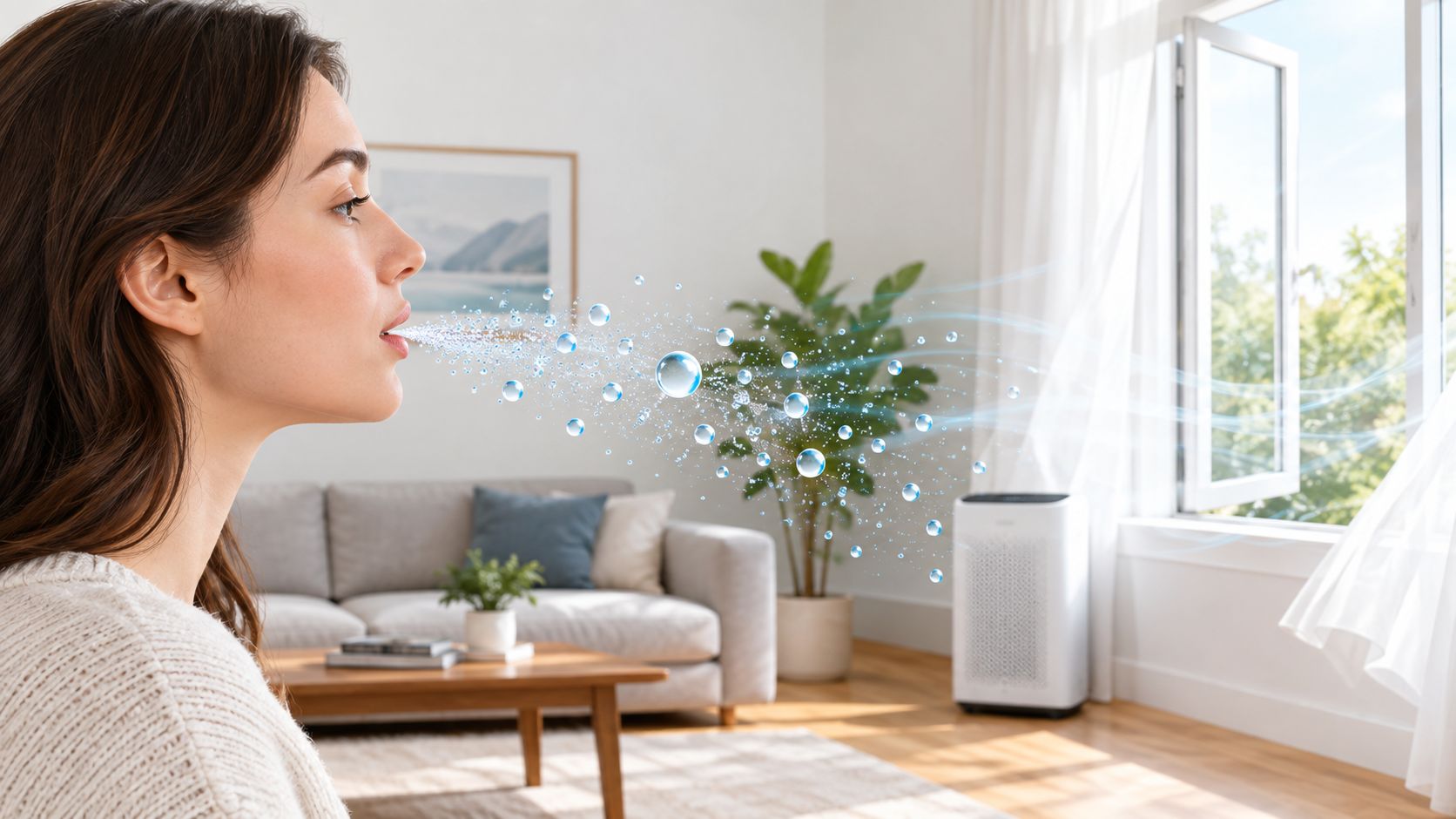
“Open a window” is useful advice, but it isn't a complete answer to flu airborne transmission. Influenza doesn't travel through only one route, and the risk changes with particle size, airflow, crowding, humidity, timing, and contact with contaminated objects. A safer approach treats the air and the surrounding environment as connected parts of the same infection-control problem.
That doesn't mean every encounter with someone who has flu creates the same airborne danger. It means the old question, “Is flu airborne or not?” is too narrow to guide practical decisions. The better question is: When can virus-containing particles in the air or on surfaces create meaningful exposure, and which control works at that point?
Rethinking How Influenza Spreads Through the Air
Flu is not neatly a droplet-or-contact illness. That familiar model focuses on a cough or sneeze, larger droplets falling quickly, and infection spreading through close contact, hands, or contaminated surfaces. It describes part of influenza's behavior, but it misses smaller particles that can stay suspended and move with indoor air.
The CDC describes influenza as spreading mainly through larger respiratory droplets at close range, generally less than 2 meters, or 6 feet. It also recognizes that small-particle aerosols can transmit flu in confined spaces. (CDC influenza transmission guidance) Distance can lower exposure, but it does not eliminate risk when a room has poor ventilation or people remain inside for an extended period.
Why the binary language creates confusion
“Droplet” and “airborne” suggest two separate boxes. Human respiratory emissions behave more like a continuum. Breathing, talking, coughing, and sneezing release particles of different sizes, and evaporation can change how those particles travel after leaving the body.
WHO-related terminology discussions increasingly use the broader phrase “transmission through the air,” including inhalation and direct deposition. That wording fits real exposures more closely. Someone may inhale a fine aerosol nearby, receive a larger particle directly, or touch a surface after particles settle. (WHO terminology discussion)
Influenza can therefore reach a person through several connected routes, rather than one fixed mechanism. A CDC review concluded that influenza can spread through aerosols and that this route may affect pandemic planning and respirator guidance. (CDC review of influenza aerosol transmission)
Practical rule: Ask whether the room, exposure duration, ventilation, and activity make inhalation a meaningful concern, rather than asking whether flu is exclusively airborne.
Airborne transmission also does not make surfaces irrelevant. Effective prevention combines ventilation and other air controls with respiratory protection in higher-risk situations, hand hygiene, and appropriate cleaning. Surface disinfection belongs in the same plan because influenza can spread through multiple routes.
The Physics of Respiratory Particles and Suspension
Respiratory particles behave less like a single substance and more like a changing cloud. A large wet droplet resembles heavy rain. Gravity pulls it down quickly, so it tends to expose people nearby. A fine aerosol behaves more like smoke. Air currents can carry it, and poor ventilation can allow it to accumulate indoors.
CDC infection-control guidance distinguishes larger droplets from droplet nuclei, residual particles that can dry to roughly 1–5 μm and remain suspended as an airborne route of spread. (CDC environmental control guidance) Particle size also affects settling time. A detailed influenza aerosol review reports that a 5 μm particle can take about 33 minutes to settle from 1.5 meters in still air, while a 1 μm particle can remain suspended for more than 12 hours. (Science review of influenza A aerosol transmission)

Why six feet isn't a force field
The familiar six-foot idea describes a useful close-range precaution, not a universal boundary. Fine particles can travel with room air, particularly when ventilation is weak or airflow directs exhaled air toward another person.
Research summarized in the aerosol-size literature detected influenza cough aerosols at 1 foot, 3 feet, and 6 feet. Particles smaller than 4.7 μm were present at all three sampling distances, while very few large particles were found at the farthest distance. (Influenza cough aerosol evidence)
| Particle behavior | Practical meaning |
|---|---|
| Larger, rapidly settling droplets | Close-range exposure matters most |
| Fine suspended aerosols | Ventilation and room airflow become important |
| Settled particles and fomites | Hands and surface hygiene matter |
This explains why a crowded room can remain concerning even when people aren't standing face to face. The relevant exposure may come from a mixture of direct emissions, short-range aerosols, and particles circulating through shared indoor air. More detail on the distinction appears in airborne versus droplet transmission.
Experimental Evidence for Aerosolized Influenza
Airborne influenza is supported by several independent findings, not one dramatic experiment. Researchers have detected influenza RNA in indoor environments, recovered viable virus from exhaled breath, and identified infectious particles within the respirable size range. Taken together, these results show that an infected person can release virus into shared air that another person may inhale.
A historical CDC review helped connect aerosol transmission with healthcare protection and pandemic planning. It also examined practical implications for respirator use, including N95 protection in healthcare settings. (CDC historical review)
Small doses can matter
Later influenza transmission literature summarizes a human challenge study that reported an inhaled infectious dose for influenza A aerosols as low as 0.6–3 TCID₅₀. (Influenza aerosol dose and transmission literature) This finding does not mean every airborne exposure causes illness. It shows that infection may begin with a small inhaled dose, so repeated exposure in an enclosed room deserves attention.
Field observations align with these laboratory results. Influenza virus has been detected in emergency-department air, and aerosolized droplets have been identified during the tidal breathing of infected people. Emission is also heterogeneous. Some infected individuals release far more virus into the air than others, so average estimates can hide higher-risk emitters.
A review of influenza transmission evidence estimated that airborne spread accounted for roughly half of influenza A transmission in a household-setting study. (Review of influenza aerosol transmission) The review also discussed influenza-containing particles carried on micron-sized aerosolized fomites. Airborne spread therefore includes more than classic cough droplets. Particles can enter shared air directly, or become airborne again after contaminated material is disturbed.
Airborne risk is measurable, but it is not uniform. The infected person, activity, room, and time spent there all shape exposure.
These findings support a layered response. Surface cleaning interrupts contact transmission after contaminated material reaches hands or objects, while ventilation and filtration reduce inhalation exposure from suspended particles. Neither measure replaces the other. A cleaned shared keyboard does not remove virus already circulating in the room, and improved airflow does not disinfect a door handle or other surface where contaminated material has settled.
Environmental Modifiers That Amplify Airborne Risk
Influenza does not remain infectious in air under one fixed set of conditions. Humidity, temperature, particle composition, ventilation, and surrounding biological material can change how much viable virus remains available for inhalation. These factors modify risk rather than determine it alone, because the person, activity, room, and exposure time also shape transmission.
Laboratory measurements show why viral RNA and infectious virus must be interpreted separately. In one aerosol study, RNA copies remained detectable while viable virus declined by 10⁴–10⁵ during aerosolization and air sampling. Another experiment found that, after 15 minutes, survival was about 9.5% in effloresced aerosols compared with 0.40% in non-effloresced aerosols. (Influenza aerosol survival and humidity conditions)

Indoor air is a moving system
Ventilation dilutes contaminated air and changes its path. It can carry particles away from one occupant, yet poor design may direct them toward another. Filtration removes particles from recirculated air, while germicidal ultraviolet systems can inactivate airborne pathogens when selected and installed correctly.
ASHRAE guidance identifies outdoor-air dilution, filtration, airflow patterns, and germicidal ultraviolet light as ways to reduce exposure to infectious aerosols. (ASHRAE engineering guidance) Indoor air quality therefore depends on both equipment and how the room is managed, not on opening a window.
Timing can alter the hazard. Aerosol risk may be higher soon after symptom onset, when influenza RNA in aerosols is more abundant. Another virology study found that influenza A remained infectious for at least 45 minutes under indoor air conditions when co-aerosolized with bacteria.
A practical indoor air quality improvement guide can help assess whether air is replaced or cleaned, whether airflow reaches occupied areas, and whether people are gathering near exhaled air. These checks complement surface disinfection, which addresses contaminated objects and hands rather than suspended particles.
Layered Defense Strategies for Indoor Environments
A strong indoor prevention plan starts by matching the control to the route. If the concern is suspended aerosol, improve dilution or filtration. If people are close together, reduce direct exposure and consider a well-fitting respirator. If someone is ill, rapid separation limits the amount of virus released into shared spaces.
Start with the room
Openable windows can introduce outdoor air, but they aren't always practical or sufficient. Mechanical ventilation should be maintained, and portable air cleaners can support air cleaning where fresh-air supply is limited. Airflow matters as much as equipment. A fan that blows contaminated air directly from an infected person toward another occupant may worsen the exposure path even while making the room feel more comfortable.
Use a risk-based sequence:
- Identify crowded areas: Focus on classrooms, waiting rooms, shared offices, public transport, and other places where people spend time close together.
- Improve dilution: Bring in outdoor air where feasible, while avoiding airflow that carries exhaled air toward another person.
- Add filtration: Use a properly selected air cleaner or building filtration system when ventilation alone can't manage the space.
- Reduce source release: Encourage people with respiratory symptoms to stay away from shared indoor areas when possible.
- Protect high-risk workers: Fit-tested respirators have a specific role in healthcare and other settings where exposure to infectious aerosols is more likely.
For households, practical choices include ventilating rooms during and after visits, keeping symptomatic people separated from others, and avoiding prolonged gatherings in small enclosed rooms. Readers comparing heating, cooling, filtration, and ventilation options can consult home air quality solutions for context on residential systems.
Make masking situational
Masks and respirators can reduce the amount of inhaled infectious material, but fit and consistent use affect performance. A loose face covering may provide less protection than a well-fitting respirator, especially during close contact or in a crowded indoor environment.
Decision point: The more crowded, enclosed, poorly ventilated, and prolonged the exposure, the stronger the case for combining ventilation with respiratory protection.
Schools and workplaces should pair engineering controls with clear illness policies. A room cannot compensate fully for someone remaining in close contact with others while actively shedding virus. Rapid isolation during an outbreak protects both the person who is ill and the people sharing the space.
The Critical Role of Surface Disinfection
Ventilation cannot remove every influenza hazard. Respiratory particles eventually settle, and an infected person may transfer virus to tissues, phones, desks, door handles, keyboards, or shared equipment. Another person can then touch the object and bring contamination to the eyes, nose, or mouth. Air transmission and surface transmission form a continuum, so prevention should address both routes.
Some aerosolized material can also settle onto surfaces and contribute to contamination. That does not make every contaminated object equally hazardous. It shows why air filtration alone leaves a gap in a multi-route prevention plan.

Clean where hands actually travel
Focus on objects many people touch repeatedly:
- Door hardware: Wipe handles, push plates, and entry points in shared rooms.
- Shared technology: Include keyboards, mice, phones, tablets, and touchscreens, following the manufacturer's compatibility guidance.
- Common equipment: Clean refrigerator handles, faucet levers, light switches, remote controls, and communal tools.
- Work surfaces: Disinfect desks, counters, and tables after use by someone with respiratory symptoms.
A disinfecting wipe works only when it suits the surface and remains wet for the label-specified contact time. Rushing the wipe, covering only a small visible area, or drying the surface immediately can reduce its intended effect. Follow product directions, keep chemicals away from children, and never mix disinfectants.
For practical guidance on cleaning sequence, contact time, and surface selection, consult the Maid in America disinfection guide. For product and method questions specific to influenza virus, see what kills flu virus on surfaces.
Pair cleaning with hand hygiene
Surface disinfection reduces contamination where hands travel. Handwashing removes what hands may collect afterward. Wash hands after touching shared objects, before eating, and before touching the face. If soap and water are unavailable, an alcohol-based hand sanitizer can serve as a temporary option when hands are not visibly soiled.
A sound prevention routine uses cleaning and air controls together. Influenza can reach people through inhalation, direct respiratory deposition, or contact with contaminated materials, and no single measure closes every route.
Building a Complete Flu Prevention Routine
A useful flu-prevention routine does not depend on one perfect control. It combines several measures that close different routes of spread: reduce contaminated air, limit close exposure, remove virus from hands and surfaces, and use vaccination as a protective layer. The goal is a routine people can follow on ordinary days and strengthen for crowded indoor events or outbreaks.

A practical five-part checklist
- Ventilate: Open windows when practical, improve airflow, and use filtration or air cleaning when a room cannot receive enough outdoor air.
- Mask strategically: Wear a well-fitting mask or respirator in crowded indoor settings, particularly when ventilation is poor or someone nearby has respiratory symptoms.
- Disinfect high-touch surfaces: Keep disinfecting wipes available for door handles, shared devices, desks, counters, and equipment.
- Wash hands after contact: Clean your hands after touching shared surfaces, coughing, sneezing, or handling used tissues. Wash before touching your face or eating.
- Get an annual flu vaccine: Vaccination adds protection for individuals and communities.
Each action interrupts a different part of the transmission chain. Ventilation and filtration lower inhalation exposure. Masks reduce what enters or leaves the breathing zone. Surface cleaning addresses contaminated objects, while hand hygiene helps stop transfer from those objects to the face.
Adjust the routine to the setting
At home, separate the ill person when possible, bring in fresh air, clean shared touchpoints, and avoid prolonged close contact in small rooms. In workplaces and schools, managers can improve ventilation, maintain air-cleaning equipment, provide tissues and handwashing supplies, and set clear expectations for staying away from others during illness.
For healthcare workers and people caring for vulnerable individuals, stronger precautions may be appropriate sooner. Fit-tested respirators, airborne infection-control rooms where indicated, and prompt isolation can matter during suspected outbreaks. Earlier WHO guidance for airborne threats included respirators and negative-pressure airborne infection isolation rooms with 6–12 air exchanges per hour, as discussed in a CDC review discussing WHO airborne precautions.
VirusFAQ.com offers educational material on virus characteristics, transmission, and prevention for general readers and scientifically trained audiences. Use that information alongside advice from local health authorities and healthcare professionals, especially when someone has severe symptoms or belongs to a high-risk group.
Remember: Clean air reduces inhalation risk, clean surfaces reduce contact risk, and consistent habits make both controls more reliable.
Prepare before flu activity rises. Check ventilation in rooms where people gather, stock suitable disinfecting wipes, identify high-touch surfaces for regular cleaning, and make a household or workplace plan for separating someone who becomes ill. Share this flu airborne transmission guide with the people responsible for your home, classroom, office, or care setting, then put the five-part checklist into practice.
Leave a Reply