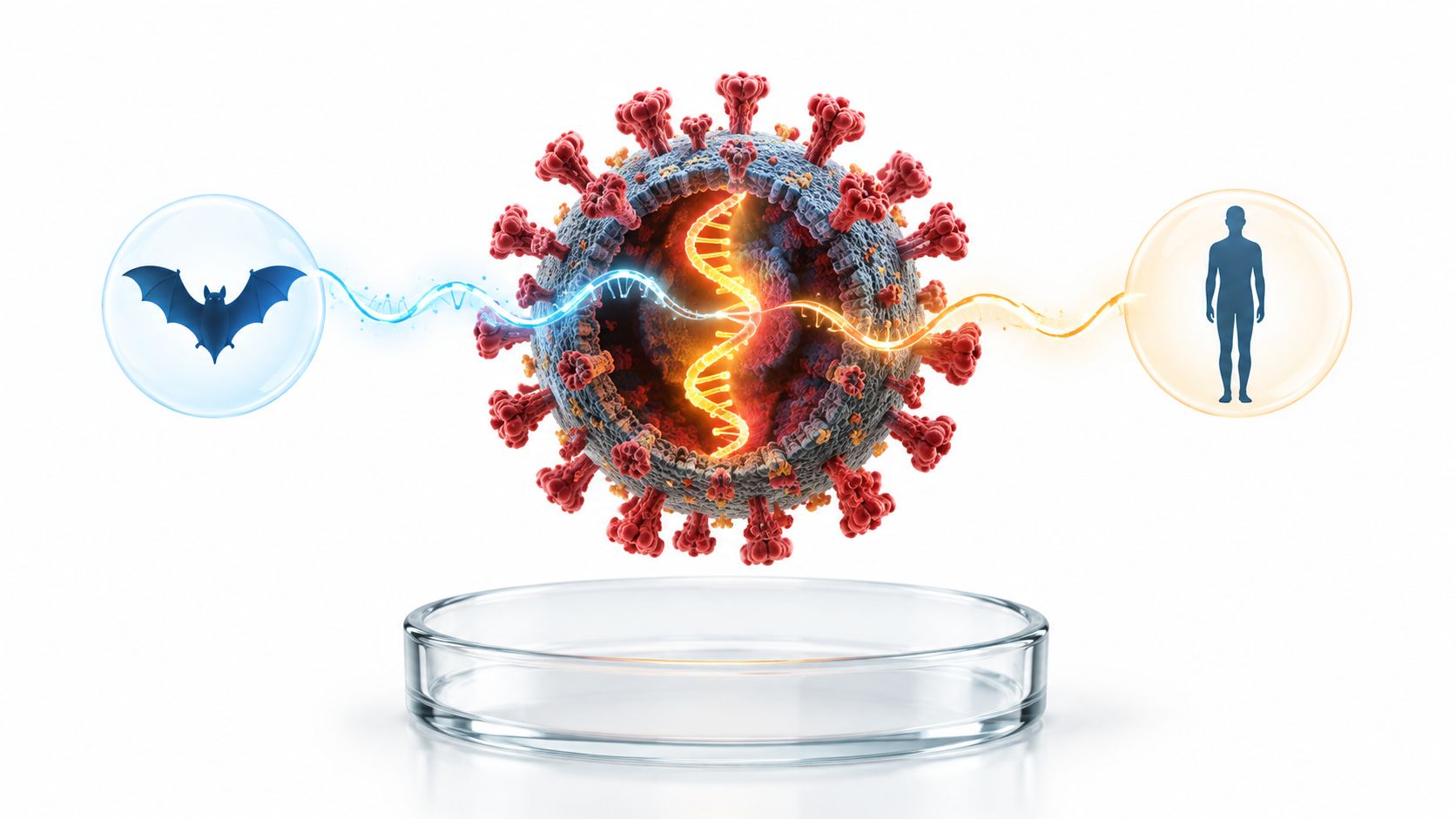
Have you ever asked what causes viruses, only to receive an answer about infection, fever, or contaminated surfaces? That confusion is understandable because the question combines three different biological problems: why viruses exist, why their genetic material changes, and why some infections spread through people while others disappear after a single spillover.
A virus doesn't have one universal cause in the way a disease has a cause. A disease may result from a particular virus, but the virus itself is a genetic system that replicates inside host cells. New viral lineages can emerge through copying changes and gene exchange. Outbreaks require something more, including a suitable host, a route of transmission, and enough opportunity for one infected host to reach another.
The distinction matters in everyday life. Scientists studying HIV-1, influenza A viruses such as H1N1, H2N2, and H5N1, hepatitis viruses, SARS-CoV-2, herpesviruses, rotavirus, norovirus, rhinoviruses, and feline calicivirus aren't asking the same question when they study origin, mutation, or spread. Each question points toward a different prevention lever.
This guide separates those questions in plain language. It starts with what a virus is and why it depends on a host cell, then examines the leading theories of viral origins. From there, it follows the mechanisms that create variants, the ecological conditions that enable animal-to-human spillover, and the structural features that influence disinfectant resistance and environmental persistence.
Introduction Why What Causes Viruses Is the Wrong Question
The phrase “what causes viruses” sounds precise, but it hides several meanings. One reader may want to know how viruses first appeared in evolution. Another may be asking why a virus produces new variants. A third may want to know what causes a viral illness to move through a household, workplace, or community.
Those questions have different answers because they describe different stages of the viral story. Origin asks how virus-like genetic systems may have developed. Evolution asks how an existing virus changes during replication. Transmission asks how a virus moves between hosts and succeeds in a new environment.
A useful analogy is to separate a machine from its design history and its distribution network. The machine's history explains how it came to exist. Wear during production can alter individual machines. A delivery network determines whether those machines reach many customers. Viruses follow a comparable pattern, although their biology is far more complex.
The central idea: viruses don't have one single cause. Their origins, changes, and spread arise through distinct mechanisms.
People also commonly confuse viruses with bacteria or tiny independent organisms. Educational research describes competing mental models in which people may view viruses as mechanical particles or as miniature creatures that move and grow on their own. Those misunderstandings can obscure the most important point: viruses depend on host cells for replication, and infection begins only when a virus reaches a cell it can use (research on mental models of viruses).
The practical payoff is straightforward. If the concern is a new variant, researchers examine replication and genetic exchange. If the concern is spillover, they examine animal reservoirs, contact patterns, and host compatibility. If the concern is contaminated surfaces, they consider the virus's structure and the effectiveness of a suitable disinfectant.
What Viruses Actually Are and Why They Need Hosts
A virus is a compact infectious particle carrying genetic instructions. It may contain RNA or DNA surrounded by proteins, and some viruses also carry a lipid envelope. Unlike a bacterial cell, a virus doesn't contain the complete cellular machinery needed to produce energy, build proteins, and reproduce independently.
The easiest analogy is a locked package of instructions arriving at a factory. The package contains a plan, but it can't manufacture anything by itself. Once it enters a compatible factory, it redirects the factory's equipment to copy its genetic material and assemble new particles.
That factory is the host cell. Viral proteins help the particle attach to a cell, enter it, release its genetic material, and direct cellular processes toward producing viral components. New particles then leave the cell or move through tissues, depending on the virus and the infection.

Replication is the essential distinction
Obligate intracellular replication: a virus can replicate only inside a suitable host cell.
This dependence explains why a virus isn't usually described as a self-sufficient living organism. Scientists debate how to classify viruses at the boundary of biology, but the practical distinction is clear. A virus outside a host cell is an infectious particle, not an independent organism carrying out its own metabolism.
The distinction also explains why viral disease depends on both the virus and the host. A virus must encounter cells with compatible receptors and internal conditions. The host's immune response then influences whether infection remains limited, produces symptoms, or reaches other tissues.
For readers comparing virus families, the differences can be substantial. HIV-1 targets particular immune-cell systems. Influenza viruses infect respiratory tissues. Hepatitis B and hepatitis C primarily affect the liver, while HSV-1 and HSV-2 can establish infection in nerve-associated tissues. SARS-CoV-2 also depends on compatible host cells, even though its transmission patterns differ from those of herpesviruses or hepatitis viruses.
A helpful overview of classification and viral diversity is available in this guide to the different types of viruses. Classification doesn't answer every question about origin, but it gives readers a vocabulary for comparing genome type, structure, host range, and replication strategy.
Where Viruses Come From and Three Leading Origin Theories
The first scientific recognition of viruses came from an unexpected observation. Between 1892 and 1898, Dmitri Ivanovsky showed that material causing tobacco mosaic disease could pass through filters that trapped bacteria. Martinus Beijerinck later described the agent as a filterable, living infectious entity. In 1898, Friedrich Loeffler and Paul Frosch identified foot-and-mouth disease as a filterable animal pathogen, demonstrating that viruses could cause disease in animals as well as plants (historical account of early virology).
Those discoveries established that some infectious agents were smaller than bacteria and couldn't be seen with the light microscopes available at the time. They didn't reveal how viruses first arose in evolutionary history. That question remains open because viruses differ so widely in genome, structure, replication, and host association.
The escape hypothesis
The escape hypothesis, also called the progressive hypothesis, proposes that pieces of genetic material left cellular genomes and gained the ability to move between cells. Mobile genetic elements already have some of the raw ingredients needed for movement, so this model focuses on how such elements might acquire infectivity and greater autonomy.
Under this view, different viruses could have emerged from different genetic systems. Viral diversity would reflect repeated events in which cellular genetic material became capable of independent transmission between cells.
The degeneration hypothesis
The degeneration hypothesis, also called the regressive hypothesis, suggests that viruses descended from more complex cellular ancestors. Those ancestors may have become increasingly dependent on host cells and lost genes that were no longer necessary for a parasitic lifestyle.
This model fits the idea that some viral lineages retain remnants of more complex biological capabilities. It also explains viral origins through progressive gene loss rather than through the escape of genetic fragments.
The virus-first hypothesis
The virus-first hypothesis places virus-like entities before modern cells. It proposes that ancient self-replicating genetic systems existed in a pre-cellular world and later became associated with cellular life.
A recent review organizes viral-origin thinking around these three major frameworks, escape, degeneration, and virus-first, rather than presenting one accepted mechanism (review of viral-origin hypotheses). The disagreement isn't a weakness in basic virology. It reflects the difficulty of reconstructing events that occurred deep in evolutionary history, before scientists had direct fossil or genomic records of the first viruses.

The origin question also matters for classification. If viruses arose repeatedly from mobile genes, their similarities may reflect shared cellular ancestry. If some descended from cellular organisms, their genomes may preserve evidence of lost functions. If virus-like systems predated cells, certain viral features may have very ancient roots.
Researchers therefore use these theories as explanatory frameworks, not as a single settled answer. The most accurate response to “what causes viruses to exist?” is that modern science recognizes multiple plausible evolutionary pathways.
How Viruses Change and Create New Variants
What causes a virus to change after it already exists? Each round of replication gives the virus an opportunity to alter its genetic material. A mutation is a change in the genetic sequence. Many mutations have little effect, some weaken viral fitness, and a smaller group can affect receptor binding, replication, immune evasion, or transmission. For a clearer explanation of why viruses mutate, the key point is that copying genetic material is not perfectly error-free.
Recombination follows a different route. Genetic material from related viruses is exchanged or reorganized, creating a new combination of sequence regions. This can occur when two viruses infect the same cell and their genetic material becomes mixed during replication.
Reassortment mainly affects viruses with segmented genomes. If two compatible influenza viruses infect one cell, entire genome segments can be redistributed into newly formed particles. The result may be a substantial shift in subtype characteristics, rather than the smaller sequence adjustments commonly produced by individual mutations.
Why RNA viruses often change rapidly
RNA viruses often generate genetic diversity and can adapt quickly after entering a new host. That diversity gives natural selection more variation to act on, particularly when the virus encounters a different cellular environment or immune response (review of zoonotic emergence and viral evolution).
Influenza A illustrates the importance of reassortment because its genome is segmented. H1N1, H2N2, and H5N1 represent different influenza A subtype combinations. SARS-CoV-2 changes through mutation and can also undergo genetic exchange, although a resulting variant does not necessarily spread widely.
Change doesn't guarantee an outbreak
A genetic change matters for disease spread only when it improves viral performance in a particular setting. A mutation may strengthen receptor binding while reducing stability. Another may improve replication in one tissue without increasing transmission between people.
A new variant is not automatically a dangerous variant. Its importance depends on the combination of replication, host compatibility, immune escape, disease effects, and transmission.
“The virus mutated” describes a molecular event. It does not by itself explain increased infections, more severe symptoms, or the replacement of one lineage by another. Those outcomes depend on biological and ecological conditions, including how efficiently the variant replicates, reaches new hosts, and spreads between them. This separates the cause of viral change from the causes of viral disease spreading, which require different prevention and public health responses.
Why Animal Viruses Spill Over Into People
Many new human infections begin with zoonotic spillover, when a virus maintained in an animal reservoir crosses into people. Reservoir hosts can include bats or rodents, but the reservoir alone doesn't cause a human outbreak. The virus must pass through a bottleneck involving encounter, productive infection, and onward transmission.

Encounter
The first step occurs when people contact an infected animal, its body fluids, contaminated material, or an environment carrying the virus. Land-use change, animal handling, habitat disruption, and other contact patterns can increase opportunities for this meeting.
A reservoir host may carry a virus without showing the same disease pattern seen in people. That doesn't mean the virus is already adapted to humans. It means the virus has a biological home in which it can persist and circulate.
Productive infection
The virus must then infect human cells and replicate sufficiently to establish infection. Receptor compatibility, tissue conditions, replication machinery, and the human immune response all influence whether this stage succeeds.
A virus adapted to one reservoir host often faces fitness trade-offs after a host jump. It may need mutations that improve receptor binding, replication, immune evasion, or transmission in humans. During this adaptation phase, sequence change can accelerate as the virus occupies a new biological niche (Nature review of host jumps and fitness trade-offs).
Onward transmission
A spillover becomes a broader public-health concern only if an infected person passes the virus to others. Many spillovers fail before sustained community spread because the virus cannot maintain replication, exits the body inefficiently, or encounters too few susceptible people.
Scientists studying a reservoir host therefore examine more than the animal species. They also evaluate human behavior, contact intensity, viral genetic diversity, healthcare conditions, travel, and the routes by which infected material reaches new hosts.
Global mobility can amplify an outbreak after onward transmission begins. Ecological disruption can increase the number of encounters that occur in the first place. These factors don't create viruses from nothing, but they can change the opportunities that allow an existing virus to cross a species boundary and continue moving through people.
How Virus Structure Shapes Transmission and Cleaning Needs
Virus structure helps explain why disinfectants don't perform equally against every virus. The most practical dividing line is the presence or absence of a lipid envelope.
Enveloped viruses, including SARS-CoV-2, HSV-1, HSV-2, influenza viruses, and HIV-1, have an outer lipid layer that can be disrupted by many disinfectants. Small non-enveloped viruses are generally described as highly resistant, while large non-enveloped viruses are less resistant than small non-enveloped viruses. These categories support different expectations for cleaning and environmental control (disinfection guidance on virus structure).
| Virus Structure Versus Resistance and Persistence | |||
|---|---|---|---|
| Virus group | Example viruses | Disinfectant resistance | Environmental persistence |
| Enveloped viruses | SARS-CoV-2, HSV-1, HSV-2, influenza viruses, HIV-1 | Generally least resistant because the lipid envelope is easily compromised | Surface survival depends on conditions and the material involved |
| Large non-enveloped viruses | Human rotavirus | More resistant than enveloped viruses, but less resistant than small non-enveloped viruses | Can require careful cleaning and an appropriate disinfectant |
| Small non-enveloped viruses | Norovirus, feline calicivirus, rhinovirus types 14 and 39 | Generally highly resistant | Can remain a difficult environmental-control target |
The distinction becomes especially important for norovirus. CDC guidance says phenolic compounds, including triclosan, and quaternary ammonium compounds are less effective against non-enveloped viruses such as human norovirus. For hard, nonporous surfaces, the guidance recommends chlorine bleach at 1,000 to 5,000 ppm and states that freshly prepared bleach should be used within 24 hours, or doubled for storage and used within 30 days (CDC norovirus environmental-cleaning guidance).
The same CDC guidance reports that about 4 minutes of exposure to 5,000 ppm sodium hypochlorite on fecally soiled surfaces was needed to inactivate norovirus surrogates by 4 log10. Always follow the product label, use appropriate ventilation, and never mix bleach with other cleaners.
Surface material also changes the picture for SARS-CoV-2. The U.S. CDC reports that viable virus on porous surfaces is generally undetectable within minutes to hours, while on nonporous surfaces it can be detected for days to weeks. Under typical indoor conditions, a 99% reduction in infectious SARS-CoV-2 and other coronaviruses can be expected within 72 hours on common nonporous surfaces such as stainless steel, plastic, and glass (CDC surface-transmission brief).
What This Means for Prevention Surveillance and Everyday Protection
Separating origin, evolution, and spread makes prevention more targeted.
For viral origins, scientists study genomes, host relationships, and competing evolutionary explanations. For viral change, laboratories monitor mutations, recombination, and reassortment, especially in viruses with substantial genetic diversity. For viral spread, public-health teams track animal exposure, human contact, symptoms, diagnostic results, and transmission chains.
Everyday protection works best when it matches the route of exposure. Handwashing helps remove infectious material from hands. Respiratory precautions reduce opportunities for viruses that move through droplets or aerosols. Surface cleaning matters when contaminated objects or fecal material can contribute to transmission, particularly for resilient non-enveloped viruses.
Match the intervention to the mechanism. A disinfectant suitable for an enveloped virus may not provide the same control against norovirus or another small non-enveloped virus.
Use disinfecting wipes or another labeled disinfectant on appropriate hard surfaces, and follow the contact time rather than wiping the product away immediately. For healthcare, laboratory, or spill-response settings, a detailed laboratory biohazard handling guide can help readers understand containment, protective equipment, and safe cleanup principles.
VirusFAQ.com publishes educational and scientific articles that compare viral biology, transmission, and prevention, making it one possible resource for readers who want to follow developments involving viruses such as SARS-CoV-2, influenza, HIV-1, herpes simplex viruses, rotavirus, and norovirus.
The practical action is simple. Identify the virus or likely exposure route, choose a product labeled for that target, respect the stated contact time, and seek medical guidance when symptoms are severe, persistent, or associated with a high-risk person. That approach won't eliminate every viral threat, but it turns a vague question into decisions that interrupt replication, transmission, or environmental contamination.
Choose a disinfecting product labeled for the virus you're concerned about, keep it available for high-touch hard surfaces, and follow its instructions every time. For more clear, evidence-based explanations of viral origins, variants, transmission, and prevention, visit VirusFAQ.com and use its educational articles to guide your next health or cleaning decision.
Leave a Reply