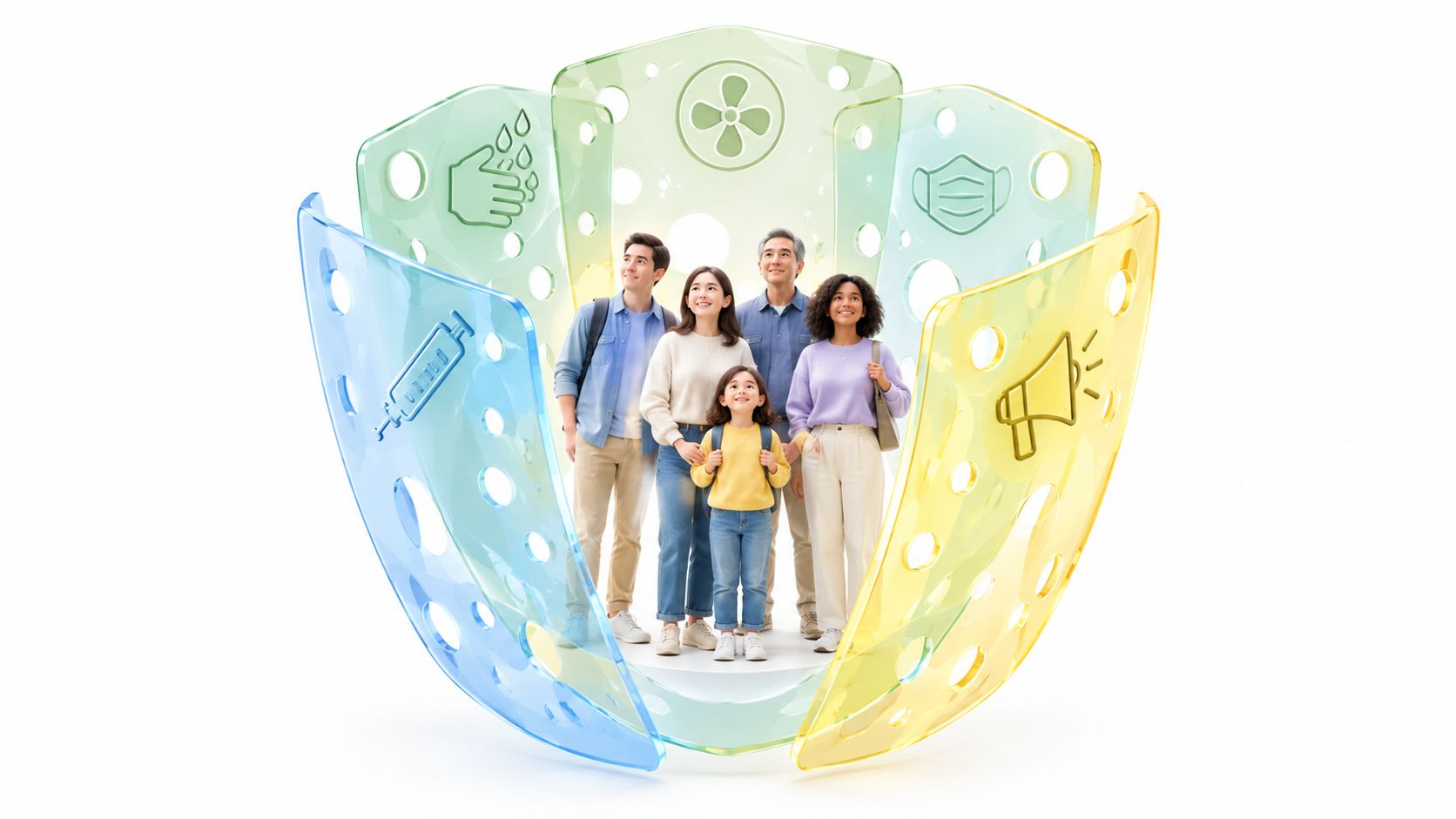
A layered prevention system is the practical answer to infectious disease: vaccination, hand hygiene, clean environments, ventilation, surveillance, isolation, and clear communication must reinforce one another. In health-care facilities, infection prevention and control programmes can prevent 35% to 70% of health care-associated infections. (World Health Organization)
No single measure reliably stops an outbreak. A vaccine can reduce susceptibility, but it won't remove every exposure. Handwashing can interrupt transfer from contaminated hands, but it won't detect a new cluster. Isolation can stop onward spread from a known case, but it depends on people recognizing symptoms and receiving practical support. Public health measures to prevent infectious diseases work like overlapping shields, with each layer covering weaknesses in the others.
What Public Health Measures Are and Why Layering Matters
Public health measures are organized actions that protect groups before illness spreads or while transmission remains controllable. They include vaccination, infection prevention and control in clinics, surveillance, safe water and food systems, environmental disinfection, ventilation, isolation, quarantine, health education, and policies that make safer behavior possible.
Their unit of action is the population. A clinician diagnoses and treats one patient. A public health team identifies patterns, reduces exposure across a school or neighborhood, protects people at higher risk, and builds conditions that prevent illness from reaching many individuals.
In health-care settings, the WHO describes infection prevention and control as a major way to reduce health care-associated infections. Evidence-based programmes can prevent 35% to 70% of these infections, and hand hygiene remains the most proven measure for reducing microorganism transmission in clinical care. (World Health Organization IPC guidance)

The Swiss cheese idea
The Swiss cheese model compares prevention to several slices placed together. Each slice blocks some routes but contains gaps. Vaccination may leave people unprotected because of access barriers or incomplete uptake. Masks depend on fit and consistent use, cleaning can miss contaminated surfaces, and surveillance may overlook people who never enter the health system.
Layering closes gaps across different stages of exposure. A vaccinated person who stays home while ill, improves indoor airflow, and practices hand hygiene has several safeguards instead of relying on one. In a hospital, triage, isolation, PPE, cleaning, hand hygiene, and organizational monitoring act at separate points, so one missed barrier does not automatically lead to transmission.
The appropriate combination depends on the pathogen, setting, and level of risk. Respiratory viruses call for greater attention to vaccination, ventilation, source control, and early testing. Norovirus makes hand hygiene, safe food handling, and environmental disinfection especially important. Invasive procedures require strict clinical IPC. In a school, guidance on how to improve classroom air quality can turn the ventilation layer into practical building changes.
The threshold for action also changes by setting. A crowded classroom may need better airflow when respiratory illness is circulating, while a hospital procedure requires controls before exposure occurs.
Practical rule: Choose measures by asking three questions: which pathogen is involved, where are people exposed, and which groups face the most serious consequences if transmission continues?
How Surveillance and Early Detection Trigger Outbreak Response
Surveillance turns scattered illness into actionable information. Without it, a health system may have vaccines, laboratories, isolation rooms, and communication plans, yet activate them too late. The process works as a chain, and each link answers a different operational question.
From a case to a verified signal
First, detect unusual illness. Clinicians report suspected cases, laboratories identify pathogens, sentinel sites watch selected populations, and digital tools can add broader signals such as wastewater monitoring. These sources don't all measure the same thing, but together they can reveal that ordinary background illness has changed.
Second, aggregate and verify the information. Public health analysts bring reports into health information systems, check whether cases meet a common definition, and investigate whether an apparent increase reflects a genuine cluster or a reporting artifact. A single unusual result may require follow-up rather than an immediate public warning.
Third, characterize the risk. Investigators map who is exposed, where cases occur, how transmission may be happening, and which venues amplify contact. They examine links between cases, possible environmental sources, and groups that face greater risk. The question isn't only “How many cases are there?” It's also “What connects them, and what action could break that connection?”

Turning evidence into response
Response activation follows risk assessment. Depending on the pathogen and setting, authorities may start case isolation, contact tracing, targeted vaccination, environmental testing, treatment access, travel advice, or public communication. The response should match the transmission route rather than defaulting to the same checklist for every event.
The final step is feedback. Teams track whether cases decline, whether exposed contacts develop illness, and whether the chosen controls are reaching the affected population. Those observations refine future detection and response thresholds.
For a deeper explanation of how public health teams collect and interpret these signals, see what epidemiological surveillance means. Surveillance matters because it compresses the time between the first detectable signal and the first intervention. Earlier action gives every other layer a better chance to work before transmission expands.
Vaccination as the Population-Level Backbone of Prevention
Vaccination changes the conditions present before an outbreak begins. It reduces the number of people who can become infected or develop severe disease, so response teams are not forced to block every exposure after transmission has started. That makes immunization a backbone of public health measures to prevent infectious diseases, supported by surveillance and other controls chosen for the setting.
WHO reported that in 2025, about 85% of infants worldwide, or roughly 110 million children, received three doses of diphtheria-tetanus-pertussis vaccine. The same report recorded 84% measles-containing vaccine coverage by the second birthday and 77% receipt of a second measles dose. Measles shows why national averages are not enough. WHO identifies 95% coverage in every community as the level needed to prevent outbreaks. (WHO immunization coverage data)
The effect extends beyond one disease. Over the past 50 years, vaccination against 14 diseases has contributed to reducing infant deaths by 40% globally and by more than 50% in the African Region. Immunization efforts have also saved at least 154 million lives.
Individual protection and community protection
A vaccinated person may have protection against illness or severe outcomes. At population level, protection works like gaps in a chain. When enough people are protected, an infectious agent encounters fewer susceptible hosts and transmission chains become harder to continue.
The required threshold differs by pathogen and by place. Highly transmissible infections need stronger coverage, while an overall average can hide under-protected neighborhoods, schools, or care facilities. A vaccination program therefore needs a local view: coverage should be assessed where people gather and where transmission could accelerate.
COVID-19 showed the population-scale effect of this layer. A global peer-reviewed analysis estimated that vaccination prevented 14.4 million deaths between December 8, 2020 and December 8, 2021 when official reported deaths were used, and 19.8 million deaths when excess deaths were the comparator. The study estimated a 63% reduction in total deaths during that first year of vaccine rollout. (Bulletin of the World Health Organization analysis)
| Vaccine | Deaths averted or impact | Approx. herd immunity threshold | Notes |
|---|---|---|---|
| Diphtheria-tetanus-pertussis vaccines | Part of the reduction in infant mortality associated with vaccination against 14 diseases | Varies by pathogen | Routine coverage protects children before exposure |
| Measles-containing vaccine | Measles vaccines prevented 25.5 million deaths since 2000 | 95% coverage in every community is needed to prevent outbreaks | Local gaps can sustain transmission |
| COVID-19 vaccines | 14.4 million deaths prevented using reported deaths, or 19.8 million using excess deaths, during the first year of rollout | Varies by transmission conditions and immunity | Vaccination reduced population-level mortality during vaccine rollout |
For a plain-language explanation of immune priming and viral infection, read how vaccines work against viruses. Waning immunity, changing viral variants, incomplete schedules, and unequal access can weaken this layer. Vaccination works best as part of a wider system, with coverage thresholds and follow-up measures matched to the pathogen and setting.
Hand Hygiene and Environmental Disinfection Done Right
Hand hygiene is a behavior, but effective hand hygiene is also a technique. Wet your hands, apply enough soap to cover every surface, rub the palms, clean between the fingers and around the thumbs, scrub the backs of the fingers and hands, rinse thoroughly, and dry completely. CDC materials recommend scrubbing with soap and water for at least 20 seconds, because that removes more germs than shorter washing. (CDC handwashing guidance)
Wash after using the toilet, before preparing or eating food, after coughing or sneezing, after caring for someone who is ill, and whenever your hands are visibly dirty. Alcohol-based hand rub is useful when soap and water aren't available, but hand hygiene still needs to match the pathogen and situation. Gloves don't replace hand cleaning, because contaminated gloves can transfer organisms just like contaminated skin.

Cleaning and disinfecting are different jobs
Cleaning removes dirt and organic material. Disinfection uses a chemical process to inactivate microorganisms on a cleaned surface. If a product label specifies a contact time, the surface must remain visibly wet for that period. Wiping a product away immediately may leave too little time for the active ingredient to work.
WHO guidance gives specific coronavirus disinfection rules. After cleaning, 70% to 90% ethanol, 0.1% sodium hypochlorite, or hydrogen peroxide above 0.5% can achieve greater than 3 log10 reduction of human coronavirus, with a minimum contact time of 1 minute. For large blood or body-fluid spills, WHO specifies 0.5% sodium hypochlorite, or 5,000 ppm. (WHO environmental disinfection guidance)
In a household, focus on surfaces frequently touched by people sharing the space, such as handles, taps, switches, and bathroom fixtures. Food-service settings require careful separation between food-contact surfaces and other areas, while hospitals need documented schedules, approved products, correct dilution, and monitoring.
A practical infection-control resource can help organizations build routines around cleaning, hand hygiene, and exposure response, including Restore Heroes infection control. For the mechanics of washing hands correctly, see this proper hand-washing technique guide.
Isolation, Quarantine, and Masking to Interrupt Transmission
Isolation separates someone with a confirmed or suspected infection from people who are not infected. Quarantine separates and monitors people who may have been exposed, even without symptoms. The difference is practical: isolation responds to infection, while quarantine responds to possible exposure before illness is clear.
Isolation usually begins when infection is suspected or confirmed. Quarantine depends on exposure risk, the pathogen's incubation pattern, local guidance, and whether the person can monitor symptoms or obtain testing. Both measures work only when instructions are clear and people can follow them. Income or caregiving support, along with realistic alternatives to crowded housing or workplaces, can determine whether separation is possible.
For respiratory illness, CDC guidance advises staying home and away from others until at least 24 hours after symptoms are improving overall and there has been no fever without fever-reducing medicine. (CDC respiratory virus guidance) This provides a practical baseline for workplaces and schools, although pathogen-specific guidance may call for longer precautions.
Masks add source control
Masks work as a barrier in two directions. They can reduce infectious material released by a person who is ill and reduce the amount inhaled by someone nearby. Protection varies with fit, filtration, breathing resistance, correct use, and the setting. A loose cloth covering, a surgical mask, and a well-fitted respirator do not provide the same level or type of protection.
The setting determines how much masking can accomplish. In a crowded clinic or poorly ventilated room, a well-fitted respirator may provide more protection than a loose covering. During prolonged respiratory exposure, masking should be paired with ventilation, distance, vaccination, early detection, and staying home while infectious. For reusable options, people can buy multi-layer charcoal face mask information to compare construction and fit. No mask can compensate for extended exposure in stagnant air.
| Measure | Who it applies to | When and how long | Evidence of impact |
|---|---|---|---|
| Isolation | People with suspected or confirmed infection | While infectious, according to current pathogen-specific guidance | Reduces opportunities for onward transmission |
| Quarantine | People who may have been exposed | During the relevant monitoring period | Allows early detection before further exposure |
| Masking | Infected people and people at exposure risk | During respiratory exposure, especially in crowded or clinical settings | Combines source control with personal protection |
Why Prevention Often Fails Before Biology Does
Prevention tools are often available before communities use them consistently. That makes delivery, access, and trust central public health problems, not secondary administrative details.
The pattern appears in official monitoring. The ECDC reported that only nine of 25 EU/EEA countries reached the 95% childhood hepatitis B vaccination target, while only seven countries met the sterile injection-equipment target for people who inject drugs. The same ECDC reporting shows that prevention gaps extend beyond vaccination, reaching harm reduction and other measures that interrupt transmission. (ECDC communicable disease threat reporting)
NFID highlighted 2,144 U.S. measles cases in 2025, the highest level since 2000. (National Foundation for Infectious Diseases) These figures don't show that vaccines have stopped working. They show what happens when protection becomes uneven across communities.

Three failure points
Logistics can block prevention even when people want it. Clinics may be difficult to reach, appointment systems may be inflexible, and health workers may lack the supplies or data needed for follow-up. A national average can look reassuring while a remote settlement, informal neighborhood, or displaced population remains exposed.
Information changes behavior only when it is understandable and relevant. People may underestimate a disease because they rarely see its consequences, or overestimate a rare adverse event because misinformation repeats it vividly. Clear communication should explain who benefits, what a measure can and can't do, and where people can obtain trustworthy help.
Trust grows from respectful service and accountability. Historical inequity, discrimination, political conflict, and poor communication can make official messages less persuasive. Canada's 2026 to 2027 departmental plan explicitly prioritizes reducing vaccination gaps, an acknowledgment that coverage depends on reaching underserved populations rather than publishing recommendations. (Government of Canada departmental plan)
The practical conclusion is uncomfortable but useful: prevention science has many effective tools. The open challenge is delivering them reliably, affordably, and fairly.
Putting It Together With Context-Specific Action Steps
Prevention works like a set of filters along a transmission route. The right combination depends on the setting, the suspected pathogen, and who faces the greatest risk. Use this decision rule: identify the pathogen or syndrome, locate the main exposure, identify the people most likely to become severely ill, and choose the layer that acts earliest. Then add measures that close the remaining gaps.
In a household
For respiratory symptoms, reduce close contact, improve airflow, avoid sharing personal items, and use a mask when proximity cannot be avoided. Apply the isolation timing described above, including the instruction to wait until symptoms are improving overall before resuming usual contact. If contact is unavoidable, keep it brief and improve ventilation during that interaction.
Vomiting or diarrhea requires a different emphasis. Wash hands with soap and water, clean contaminated bathrooms and high-touch surfaces according to the product label, and keep food preparation separate from cleaning. If someone has a condition that increases the risk of severe illness, contact a health professional early instead of waiting for symptoms to worsen.
In a school classroom
Children need routines they can repeat without constant supervision. Put soap, water, drying materials, tissues, and bins within reach. Teach pupils to cover coughs and sneezes, dispose of tissues promptly, and clean their hands afterward.
Fresh air supports respiratory prevention. Open windows or doors when safe, use mechanical ventilation correctly, and identify rooms that remain poorly ventilated. If a room feels stuffy or airflow is weak, move activities outdoors or to a better-ventilated space when possible. Combine these controls with vaccination communication, symptom guidance, regular cleaning of high-touch areas, and a clear process for unusual absenteeism or clusters.
In a clinical facility
A clinical IPC bundle begins at entry. Triage people with potentially transmissible symptoms, separate them when appropriate, select suitable PPE, perform hand hygiene at the point of care, clean equipment and surfaces, and monitor whether staff follow the process. The WHO framework describes IPC as several measures working together at different points in transmission, not a single barrier.
Protect healthcare workers through recommended vaccination, training, adequate supplies, and rapid reporting. Assign responsibility for reviewing surveillance data so a change in cases leads to investigation or operational action rather than remaining unused in a dashboard.
In a community outbreak
Begin by verifying the signal and mapping risk. Public health teams identify cases, trace contacts when appropriate, communicate what is known and unknown, offer vaccination or treatment where indicated, and apply targeted controls to venues or environments. Match the response to the exposure. Broad restrictions can cause harm when transmission is limited to a specific setting.
Use this checklist as a trigger system:
- Before exposure: Keep routine vaccinations current and improve ventilation in crowded indoor spaces.
- At a possible exposure: Check symptoms, identify close contacts, and seek advice about testing or monitoring.
- During illness: Stay away from others, use source control for respiratory symptoms, and increase hand hygiene.
- After contamination: Clean first, then disinfect according to the product's concentration and required contact time.
- When cases cluster: Report the pattern to the relevant health authority so investigation can begin.
- When uptake is low: Remove access barriers, use trusted local messengers, and offer convenient services instead of repeating generic warnings.
Future prevention must also address unequal access, environmental changes that alter vector exposure, and antimicrobial resistance. These pressures make reliable vaccination, surveillance, hygiene, ventilation, environmental controls, and trusted communication more important across households, schools, workplaces, and clinics.
VirusFAQ.com publishes accessible and scientific material about viruses, transmission, and prevention. It can serve as one reference alongside official health-agency guidance and advice from qualified clinicians. Prefer sources that explain both the evidence and the limits of each measure, rather than sources that provide only a reassuring checklist.
Use the decision rule in a setting you control. Check vaccination access, place soap and drying supplies where people need them, inspect airflow in shared rooms, review cleaning contact times, and write a simple stay-home and reporting plan before illness appears. These preparations give people more than a list of precautions. They create a layered response that can adjust to the exposure, the setting, and the people at risk.
Leave a Reply