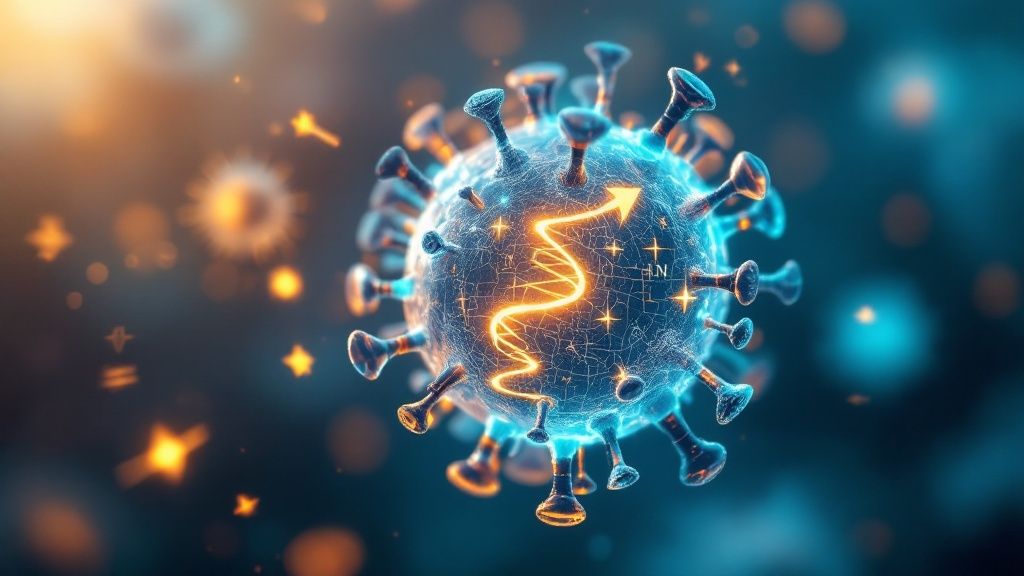
So, what exactly is a virus?
It's tempting to fall back on a dry, scientific definition, but that misses the point. A virus is essentially a microscopic hijacker. It's one of the simplest—and most brutally effective—infectious agents on our planet, responsible for everything from a common cold to a global pandemic.
Decoding the Microscopic Hijacker
Let's ditch the textbook jargon. The best way to think of a virus is as a tiny pirate's treasure chest. The chest itself is a protective protein shell called a capsid. Inside, instead of gold, is the virus's treasure map: its genetic blueprint, made of nucleic acid (either DNA or RNA).
This simple little package is the core of every virus, whether it's the influenza virus or a more complex one like Human Immunodeficiency Virus Type 1 (HIV-1).
By itself, this chest is completely inert. It can’t move, it can’t eat, and it definitely can’t reproduce. It exists in a strange limbo between living and non-living. But everything changes the moment it bumps into a suitable host cell. Using special proteins on its surface like a key, it unlocks and invades the cell.
Once it's inside, the virus cracks open and releases its genetic map. It then forces the cell's own machinery to stop its regular job and start churning out thousands of new copies of the virus. This act of hijacking is what makes a virus fundamentally different from other microbes. For a closer look, we break down the key distinctions between a virus and bacteria in another guide.
The Two States of Viral Existence
To really get a handle on viruses, you need to understand their two-faced nature.
When it's outside a host cell, a virus is just an inactive particle called a virion. In this form, it can survive on surfaces for hours or even days, but it's completely dormant. The moment it infects a cell, however, it transforms. It sheds its passive shell and becomes an active agent of replication—the hijacker it was born to be.
A virus is a piece of bad news wrapped in a protein.
— Peter Medawar, Nobel Laureate
This dual life is what makes viruses so tricky to deal with. As dormant virions, they can just sit there on a doorknob, a countertop, or a keyboard, waiting for someone to come along. This is exactly why surface hygiene, using things like disinfecting wipes, is such a critical first line of defense in breaking the chain of infection.
The Blueprint of a Viral Invader
So, what exactly is a virus? Let's peel back the layers. Viruses aren't just random specks of biological gunk; they're incredibly precise, microscopic hijackers. Each part is perfectly designed for one mission: getting inside a living cell and taking over.

At the very center of every virus is its nucleic acid core. This is the virus's instruction manual—the genetic blueprint it needs to force a host cell to make more copies of itself.
Protecting that precious cargo is the capsid, a tough outer shell built from proteins. The capsid’s shape isn't just for looks; it’s the key that lets the virus unlock and enter a specific host cell. These shells come in all sorts of forms, from simple rods to complex, almost geometric structures.
The Cloak of Invisibility
Some viruses, like the ones that cause the flu (Influenza A Virus) or COVID-19 (SARS-Related Coronavirus 2), have an extra trick up their sleeve. As they burst out of an infected cell, they snatch a piece of the cell's own outer membrane.
This stolen layer becomes a fatty wrapper called an envelope. Think of it as a biological cloak of invisibility. It helps the virus disguise itself from the host's immune system, making it look like just another friendly cell.
But this clever disguise is also its biggest weakness. The fatty envelope is fragile and easily destroyed by soaps, alcohols, and many disinfectants. That makes these enveloped viruses surprisingly easy to kill outside the body with simple cleaning products.
On the other hand, non-enveloped viruses—like the notorious Norovirus (Norwalk Virus) or Rhinovirus Type 14 (a common cold)—don't have this delicate outer layer. Their tough protein capsid is exposed directly to the world, making them far more rugged and harder to kill on surfaces.
This single structural difference is a huge deal. It dictates how long a virus can survive on a doorknob and which cleaners, like disinfecting wipes, will actually work against it.
Enveloped vs Non-Enveloped Viruses: A Key Difference
Understanding the difference between these two types of viruses is critical for effective disinfection. This table breaks down what sets them apart.
| Feature | Enveloped Viruses (e.g., SARS-CoV-2, Hepatitis B Virus) | Non-Enveloped Viruses (e.g., Norovirus, Human Rotavirus) |
|---|---|---|
| Outer Layer | A fragile lipid (fatty) envelope stolen from the host cell. | A tough, resilient protein capsid. |
| Environmental Stability | Generally less stable; vulnerable to heat, drying, and detergents. | Highly stable; can survive harsh conditions for long periods. |
| Resistance | More susceptible to disinfectants that can dissolve lipids. | More resistant to common disinfectants and requires specific agents. |
In short, the presence or absence of that fatty envelope fundamentally changes how a virus behaves in the environment and how we need to fight it, highlighting the importance of choosing the right disinfectant.
How a Virus Takes Over a Cell
Once a virus latches onto a suitable host cell, it doesn't just move in—it stages a full-blown cellular heist. This process, known as the viral life cycle, is a stunning display of biological efficiency that turns your own cells into enemy territory. It all unfolds in a few calculated steps.
First up is attachment. Think of it like a key finding its perfect lock. Proteins on the outside of the virus are shaped to bind with specific receptor molecules on a host cell. This is why a virus like Influenza A Virus (H1N1) only targets cells in your respiratory tract—it has the right "key" for those specific "locks."
Next comes entry, where the virus or its genetic payload makes its way across the cell’s border. Some viruses are like tiny syringes, injecting their DNA or RNA directly inside. Others are more cunning, tricking the cell into swallowing them whole. Either way, once inside, the viral instruction manual is officially unleashed.
Hijacking the Cellular Machinery
This is where the real takeover begins. The virus’s genetic code forces the cell to halt its normal operations and kickstarts replication. Instead of making the proteins it needs to function, the cell is converted into a viral factory, churning out thousands of copies of viral genetic material and protein parts.
After all the new parts are made, it’s time for assembly. All the viral components—the capsids, genetic material, and other essential proteins—are pieced together to build brand-new, complete viruses, or virions.
The final stage is release. These newly built viruses have to escape to find new cells to infect. This often happens in a dramatic, destructive burst called lysis, which ruptures and kills the host cell, releasing a fresh army of viral particles. Each one is now ready to start the cycle all over again, causing the infection to multiply exponentially.
This infographic breaks down the core steps of the viral replication cycle, from entry all the way to release.

The visualization shows just how quickly a single invading particle can explode into countless copies. You can dive deeper into the specific mechanics of this hostile takeover in our detailed guide on how viruses infect cells.
The elegance of this process is also its danger. A virus is an incredibly simple entity that leverages the complexity of a living cell to achieve its single goal: making more of itself.
This multi-stage invasion is exactly why a viral illness can seem to come on so fast. A single infected cell can unleash thousands of new viruses, all set to continue the attack.
Meet the Different Families of Viruses
Just like the animal kingdom is organized into families like felines and canines, the massive world of viruses is sorted into distinct groups. This isn’t just for scientific neatness; understanding these families explains why a treatment for one virus is completely useless against another. It's like knowing you can't use a dog whistle to call a cat.

The main way scientists classify viruses is by looking at their genetic blueprint. Some viruses, known as DNA viruses, carry their instructions as DNA—the same double-stranded molecule we have. Others, called RNA viruses, use RNA, a less stable, single-stranded cousin of DNA.
This fundamental difference completely changes how a virus behaves. RNA viruses, like Influenza A Virus and SARS-CoV-2, tend to mutate much faster than their DNA counterparts. Their replication process is sloppy and full of errors, creating countless new variants that can dodge our immune system. It’s the very reason we need a new flu shot every single year.
Well-Known Viral Families
Beyond their genetic code, viruses are also grouped by their structure, shape, and the specific hosts they infect. This gives us a much clearer picture of some of the most common threats to human health.
- Coronaviridae: This family includes some common cold viruses (like Human Coronavirus) as well as more serious pathogens like SARS-CoV-2. They get their name from the crown-like spikes on their surface, which they use to invade our cells.
- Orthomyxoviridae: This is the influenza family. Viruses like Influenza A Virus (H1N1) and Avian Influenza Virus (H5N1) are masters of disguise, constantly shuffling their genetic segments to create brand-new strains that our bodies don't recognize.
- Herpesviridae: These are DNA viruses famous for their ability to lie dormant in the body for years before suddenly reactivating. This family includes Herpes Simplex Virus 1 (HSV-1) and Herpes Simplex Virus 2 (HSV-2).
- Hepadnaviridae: This family of DNA viruses primarily infects the liver, with notable members like Hepatitis B Virus (HBV) and Duck Hepatitis B Virus (DHBV).
Understanding a virus family’s playbook—its genetic makeup and method of attack—is the first step in designing effective vaccines and antiviral treatments. Each family requires a unique strategy.
Knowing these categories gives you a mental map for placing different viruses in a broader context. For instance, when you learn that Norovirus is a tough, non-enveloped RNA virus, it suddenly makes sense why it spreads so easily on doorknobs and countertops and requires such thorough disinfection with specialized wipes to get rid of it.
Viruses aren't just microscopic hijackers—they're powerful forces that have repeatedly rerouted the course of human history. To understand the threats we face today, we have to look back at the immense societal upheaval they’ve caused and the scientific breakthroughs they’ve forced us to make.
The Spanish Flu: A Stark Reminder
Take the 1918-1919 Spanish Influenza pandemic. It’s a chilling reminder of just how devastating a new virus can be. Caused by an Influenza A Virus (H1N1), it ripped through a world already reeling from war, infecting roughly one-third of the global population at the time.
The final toll was staggering: an estimated 17 to 100 million deaths worldwide. It remains one of the deadliest pandemics in modern history, a brutal lesson in how quickly an unknown pathogen can spread. You can find more details on historic outbreaks on Wikipedia's comprehensive list of pandemics.
The Ongoing Battle Against Viral Threats
But this fight isn't just something for the history books. The emergence of Human Immunodeficiency Virus (HIV-1) in the 1980s introduced a completely different kind of global challenge. Unlike pandemics that explode and then burn out, HIV settled in for the long haul.
It has become a persistent public health crisis, infecting over 75 million people and demanding decades of relentless scientific research just to develop treatments that can manage it.
From the sudden, explosive spread of influenza to the slow, persistent march of HIV, viruses have consistently tested our resilience, forcing us to adapt, innovate, and work together on a global scale.
These battles, both past and present, drive home a critical lesson. Humanity has been locked in a struggle with viruses for centuries, and each outbreak reinforces the need for scientific research, global cooperation, and simple, proactive hygiene. Preparation and prevention have always been our best weapons in this ancient conflict.
Your Practical Guide to Viral Protection
Now that we know what a virus is and how it operates, let's talk about the important part: defending against it. Protecting yourself isn't about complicated protocols. It’s about building simple, powerful habits that stop the viral life cycle in its tracks—often before it even gets a chance to start.

The absolute cornerstone of defense is good old-fashioned hygiene. Thorough handwashing with soap and water is still one of the single most effective ways to get rid of viruses. When you can't get to a sink, an alcohol-based hand sanitizer is the next best thing.
And don't forget about surfaces. Many viruses, like Rhinovirus Type 39 (a common cold) and the dreaded stomach bug Norovirus, can hang around on objects for hours or even days. This is where regular disinfection becomes your best friend.
Prioritizing High-Touch Surfaces
So, where should you focus your cleaning efforts? Think about the spots that multiple people touch all day long. These are the superhighways for viral particles.
- Doorknobs and Handles: Everyone coming in or out of a room touches these. No exceptions.
- Light Switches: We flick them on and off without a second thought, making them a major hotspot.
- Phones and Remotes: Our personal devices are practically extensions of our hands and get held right up to our faces.
- Countertops and Tables: These are landing pads for groceries, mail, keys, and food, making them prime real estate for germs.
A proactive approach to hygiene creates an environment where a virus just can't survive, let alone spread. When you clean these key areas with a quality disinfecting wipe, you're breaking the chain of transmission.
Of course, cleaning is just one piece of the puzzle. Vaccination remains our most powerful weapon for preventing serious viral diseases. It essentially gives your immune system a training manual to recognize and defeat specific invaders before they can do real damage.
On top of that, a healthy lifestyle—eating well, getting some exercise, and prioritizing sleep—keeps your body’s natural defenses in top fighting shape.
For a deeper dive into all the ways you can stay safe, you can learn how to protect yourself from viruses in our complete guide. The key is to empower yourself with these simple, actionable steps.
Still Have Questions? Let's Clear a Few Things Up
To wrap things up, let's tackle a couple of the most common points of confusion about viruses. Getting these ideas straight will help you feel more confident in your understanding of how these microscopic hijackers work—and why our daily habits matter so much.
Why Don't Antibiotics Work on a Virus?
Ever wondered why the doctor won't give you antibiotics for a cold? It’s because antibiotics are designed to kill bacteria, which are living, single-celled organisms with their own cellular machinery to keep them running.
A virus, on the other hand, isn't really "alive" in the same way. Think of it as a tiny parasite made of genetic code that can't do anything on its own. It has to hijack our cells to make copies of itself. Since viruses don't have the bacterial parts that antibiotics are built to destroy, the medicine has nothing to attack.
This is a critical distinction. Taking antibiotics for a viral infection like the flu is not only useless, but it also helps create dangerous, drug-resistant superbugs.
While it's easy to think of pandemics as rare, once-in-a-century events, the math tells a different story. Research suggests the annual probability of a pandemic on the scale of COVID-19 is about 2%.
That means someone born in the year 2000 had roughly a 38% chance of experiencing one by now. You can discover more insights about these pandemic statistics and what they mean for our future.
Leave a Reply