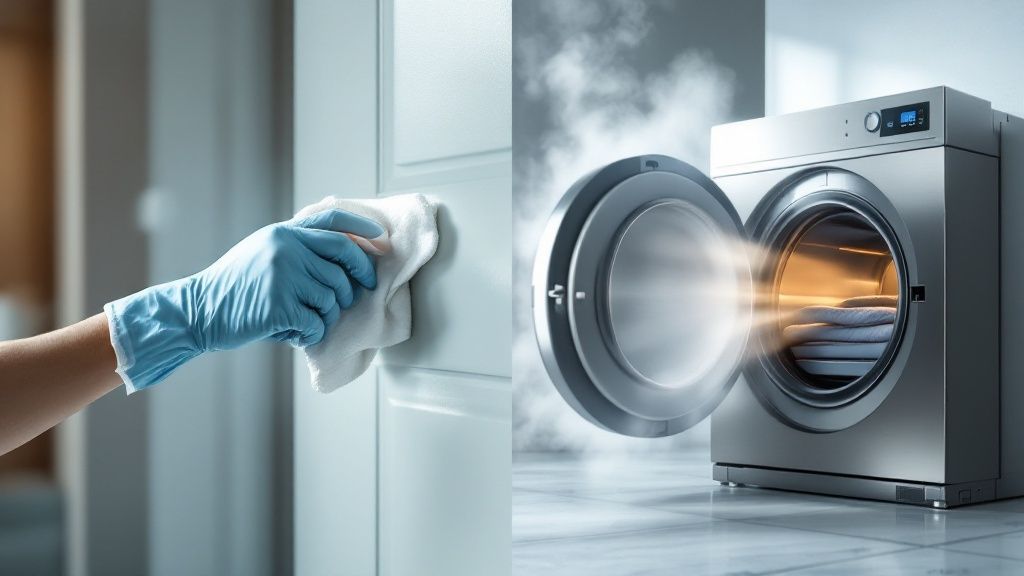
When you get down to it, the biggest difference between disinfecting and sterilizing comes down to one thing: the level of microbial kill. Disinfecting gets rid of most harmful microorganisms on a surface, but sterilizing kills all of it—including the toughest bacterial spores.
Think of it this way: disinfecting reduces the threat to a safe level. Sterilizing achieves a complete and total wipeout of every living organism.
Understanding Microbial Load Reduction
In any cleaning protocol, the main goal is to reduce the "microbial load," which is just a technical term for the number of germs on an object. But whether you need to disinfect or sterilize depends entirely on how much you need to reduce that load. Each process has a critical job, whether you're in your kitchen at home or a hospital operating room.
For most of what you do every day, like cleaning a countertop after making dinner or wiping down a doorknob, a good disinfectant is exactly what you need. It targets the specific pathogens that make us sick, like Influenza A Virus (H1N1), Human Coronavirus, or Norovirus (Norwalk Virus). For these situations, a convenient disinfecting wipe is often the most practical and effective solution.
The key distinction lies in the endpoint. Disinfection aims to kill 99.9% to 99.999% of targeted bacteria and viruses, making a surface safe for its intended use. Sterilization is an absolute process that results in a 100% kill rate of all microorganisms, achieving a state known as sterility.
At a Glance: Key Distinctions Between Disinfecting and Sterilizing
To make it even clearer, here’s a quick side-by-side look at the fundamental differences between these two critical processes. This table breaks down what each one does, where it's used, and the methods involved.
| Attribute | Disinfecting | Sterilizing |
|---|---|---|
| Level of Microbial Kill | Eliminates most pathogenic microorganisms but not all bacterial spores. | Kills all microbial life, including bacteria, viruses, fungi, and spores. |
| Primary Use Cases | High-touch surfaces (doorknobs, countertops), non-critical medical equipment. | Surgical instruments, implantable medical devices, laboratory equipment. |
| Typical Methods | Chemical liquids (bleach, alcohol), disinfecting wipes, UV-C light. | Autoclave (steam under pressure), ethylene oxide gas, dry heat. |
As you can see, the methods and applications are worlds apart. You wouldn't use bleach to sterilize a scalpel, and you wouldn't use an autoclave to clean your kitchen counter.

This visual reinforces a simple but crucial point: while both processes are essential for safety, they aren’t interchangeable. The right choice always depends on the level of risk involved.
To see how these terms stack up against other cleaning actions, check out the nuances of disinfection and antiseptics in our detailed guide.
The Science of How Each Method Eliminates Microbes
To really get the difference between disinfecting and sterilizing, you have to look at how each one actually attacks microscopic threats. We're talking about more than just cleaning here; these are precise, scientific actions meant to tear pathogens apart at a cellular level. Each approach uses a totally different mechanism to get the job done, whether you’re wiping down a kitchen counter or prepping a surgical tool for the operating room.
Understanding this distinction is absolutely critical in high-stakes environments. A failure to properly disinfect or sterilize equipment can open the door to dangerous pathogens such as Hepatitis B Virus (HBV) or Human Immunodeficiency Virus Type 1 (HIV-1). With millions of invasive medical procedures performed in the U.S. every year, these processes are non-negotiable for keeping patients safe. The CDC's stringent guidelines on disinfection and sterilization show just how vital these practices are.

How Disinfectants Target and Destroy Pathogens
Disinfection is basically chemical warfare on a microscopic scale. The disinfecting wipes you have under your sink use active ingredients like alcohols, bleach, or quaternary ammonium compounds to go after specific parts of a microorganism.
For instance, alcohol-based disinfectants work by denaturing proteins. Think of it like unraveling a knitted sweater—the alcohol messes up the essential proteins that form a virus’s structure, causing it to collapse and become useless. This is especially good against enveloped viruses like Influenza A Virus (H1N1) and SARS-Related Coronavirus 2 (SARS-CoV-2) because it wrecks their protective outer layer.
Other chemicals, like quaternary ammonium compounds, go straight for the cell membrane. They punch holes in that protective barrier, causing all the important stuff inside the bacteria or virus to leak out, which ultimately kills it.
A disinfectant’s power is in its ability to selectively target and destroy the structures of common pathogens. It’s a focused attack designed to neutralize the most prevalent threats on everyday surfaces.
The Absolute Destruction of Sterilization
Sterilization, on the other hand, is all about overwhelming force. It employs methods so aggressive and indiscriminate that they guarantee the total obliteration of all life forms. This is achieved with physical or chemical force that no microorganism—not even the toughest bacterial spores—can survive.
Common sterilization methods are pretty intense:
- Autoclaving: This is the gold standard, using high-pressure steam cranked up to 121°C (250°F) or hotter. The combination of extreme heat and pressure denatures every protein and melts cellular structures into oblivion.
- Ethylene Oxide (EtO) Gas: Used for items that can't handle the heat, this chemical gas messes with the DNA and RNA of microorganisms. By scrambling their genetic code, it stops them from reproducing or doing anything a living cell does.
- Dry Heat: Just like it sounds, this method uses high temperatures for a long time to essentially bake and oxidize cells until they’re nothing but dust.
Unlike the targeted chemical strikes of disinfection, sterilization is total annihilation. It doesn’t just deactivate pathogens; it ensures every single microbial entity is rendered permanently lifeless, leaving a surface completely sterile and safe for critical applications like surgery.
Comparing Effectiveness Against Different Pathogens
The real difference between disinfecting and sterilizing snaps into focus when you look at what each process actually kills. Not all germs are created equal. Some are surprisingly fragile, while others are tough as nails. Understanding this hierarchy of microbial resistance is what helps you choose the right tool for the job.
Think of it like this: Disinfecting is your high-end security system, capable of stopping most intruders. Sterilization is the impenetrable bank vault. You don't need a vault for your house, but you absolutely need one for the crown jewels.

The Spectrum of Disinfection
Disinfection isn’t a one-size-fits-all process. It works on a spectrum, from low-level to high-level, depending on the chemical agent and how long it’s left on a surface. Its success is always measured against the specific pathogen it’s up against.
-
Enveloped Viruses (Easiest to Kill): Viruses like Human Coronavirus, Influenza A Virus (H1N1), and Hepatitis B Virus (HBV) come wrapped in a fragile, fatty outer layer. This lipid envelope is easily compromised by most common disinfectants, including the ones in your household wipes. This vulnerability makes them relatively simple to neutralize.
-
Non-Enveloped Viruses (Tougher to Kill): Then you have the hardier germs like Norovirus (Norwalk Virus) and Rhinovirus Type 14. Lacking that weak outer envelope, their tough protein shell (a capsid) makes them far more resistant to everyday chemicals. It takes stronger disinfectants and longer contact times to get rid of them.
While a low-level disinfectant works great for many enveloped viruses, you'll need an intermediate or high-level one to handle the stubborn non-enveloped types. The survival time of these germs also dictates how often you need to clean. You can learn more by checking out our guide on how long viruses live on surfaces.
Sterilization isn't a spectrum—it's an absolute. It’s the complete and total destruction of all microbial life, from the wimpiest virus to the most indestructible bacterial spore. There’s no such thing as “mostly sterile.”
The Absolute Endpoint of Sterilization
While disinfecting tackles a huge range of common threats, some microorganisms are simply in a different league. Sterilization is the only process that can guarantee their destruction, leaving zero survivors.
The ultimate benchmark for sterilization is the bacterial spore. These are dormant, armor-plated versions of bacteria that can withstand extreme heat, chemicals, and radiation—conditions that would obliterate ordinary microbes. Since disinfectants are largely useless against them, only methods like autoclaving (high-pressure steam) can ensure they are completely destroyed.
This is why the difference between disinfecting and sterilizing is non-negotiable in a hospital. A disinfectant that kills 99.9% of pathogens is fantastic for a kitchen counter. But for a surgical tool going inside a patient, that remaining 0.1% could contain deadly spores. Sterilization closes that gap, delivering a 100% kill rate for absolute safety.
Real-World Scenarios for Disinfecting and Sterilizing
Knowing the textbook definitions of disinfecting and sterilizing is one thing. Seeing how they play out in the real world is where that knowledge actually becomes useful. The choice isn't random; it's a critical decision driven by risk, the environment, and the specific germs you're up against. From a hospital operating room to your kitchen counter, the context tells you exactly how clean something needs to be.
Getting this right is the bedrock of modern infection control. In healthcare, it’s a non-negotiable system designed to keep patients safe and stop the spread of nasty hospital-acquired infections.

Healthcare Settings and the Spaulding Classification
In medical and clinical environments, the decision to disinfect or sterilize isn't a gut feeling—it's guided by the Spaulding Classification. This is a framework that sorts medical devices into categories based on how high the risk of infection is if that device is contaminated.
- Critical Items: Think of things that enter sterile parts of the body or the bloodstream, like surgical tools, scalpels, and implants. Any germ here could cause a life-threatening infection. For these items, there's no debate: they must be sterilized.
- Semicritical Items: These are tools that touch mucous membranes or broken skin. Good examples are endoscopes or respiratory therapy gear. The standard here is high-level disinfection at the very least, which wipes out all microorganisms except for large numbers of bacterial spores.
- Noncritical Items: These items only ever touch intact skin. Think stethoscopes, blood pressure cuffs, and hospital bed rails. They just need low-level disinfection to kill off the most common bad guys.
But even with clear rules, things can get blurry. For instance, instruments like arthroscopes technically enter sterile body sites, which should mean sterilization. Yet, historically, many have undergone high-level disinfection instead. This happens for practical reasons like speed and historically low infection rates, showing how even experts make nuanced risk assessments on the fly.
The Spaulding Classification gives healthcare pros a clear roadmap. It ensures the level of microbial cleanup matches the level of patient risk, perfectly illustrating the practical difference between disinfecting and sterilizing.
Everyday Life Disinfection in Your Home
For just about every situation outside a clinic or hospital, sterilization is complete overkill. Your home isn't an operating room, but it's definitely a place where pathogens like Rhinovirus Type 39, Influenza, and SARS-CoV-2 can spread like wildfire. The goal here is simple: effective disinfection to break the chain of infection.
That means focusing on high-touch surfaces—the hotspots where viruses and bacteria get passed from person to person. Regularly disinfecting these areas is one of the single best things you can do to protect your family.
Key areas to hit for household disinfection include:
- Doorknobs and light switches
- Kitchen countertops and faucets
- Keyboards, remote controls, and phones
- Bathroom surfaces, especially toilet handles
For these daily chores, you need something that's both effective and convenient. This is where disinfecting wipes really come in handy. They’re made to kill a wide variety of germs on the non-porous surfaces you touch all the time. By using a wipe and following the product's recommended contact time, you’re hitting the right level of microbial control to keep your home safe without needing to pull out the heavy-duty sterilization gear.
How to Choose the Right Method for Your Situation
Deciding between disinfecting and sterilizing isn't about which one is "better"—it's about picking the right tool for the job. Your choice depends entirely on the item, the environment it's in, and the level of risk involved.
For almost every scenario in your daily life, a good disinfection is exactly what you need. Sterilization, on the other hand, is a highly specialized process saved for situations where even a single microbe could cause serious harm.
Assessing the Risk Level
The most important question to ask is: what is this item going to touch? That simple question cuts right to the heart of the matter and tells you what level of clean you really need.
- For Everyday Surfaces: Think about kitchen counters, doorknobs, and phones. These items mostly touch intact skin, so the risk is pretty low. This makes disinfection the perfect solution. A quick wipe-down kills common pathogens like Herpes Simplex Virus 1 (HSV-1) and Human Rotavirus, breaking the chain of infection without going overboard.
- For Critical Applications: Now, think about items that will enter a sterile part of the body, like surgical tools. In this case, even a single bacterial spore is a major problem. Sterilization is mandatory—no exceptions. It’s a clear-cut situation where nothing less than a 100% kill rate is safe.
The whole decision boils down to risk. If you're cleaning a kitchen counter after cutting raw chicken, you disinfect. If you're preparing a scalpel for surgery, you sterilize. The vast majority of household and public situations fall firmly into the disinfection category.
Practicality and Environmental Considerations
Beyond risk, simple practicality plays a huge role. Sterilization methods are often complicated, take a long time, and need special equipment like autoclaves. That makes them completely impractical for home use. Disinfection, by contrast, is designed to be easy and accessible.
This is where practical tools like disinfecting wipes come in. They’re perfect for delivering a reliable level of safety on everyday non-porous surfaces, giving you the germ-killing power you need without the massive overhead of sterilization.
This distinction is also becoming more important for the environment. The demand for disinfectants shot up during the COVID-19 pandemic, with medical ethanol production jumping by 12.3% in the first year alone. This just goes to show how critical it is to use these powerful chemicals correctly—and not excessively—which reinforces why disinfection is the right call for most situations. Learn more about how improved cleaning practices reduce infection rates on PMC NCBI.
Your Top Questions About Disinfecting and Sterilizing, Answered
Even when you know the difference between disinfecting and sterilizing, figuring out how to apply that knowledge in the real world can be tricky. Let's clear up some of the most common questions people have when it comes to keeping surfaces safe.
Getting the practical application right is where the difference between disinfecting and sterilizing really counts.
Do I Really Have to Clean a Surface Before I Disinfect It?
Yes, you absolutely do. Think of dirt, grease, and crumbs as a shield for germs. Disinfectants can't kill what they can't touch, and a layer of grime physically blocks them from reaching the viruses and bacteria underneath.
Simply spraying a disinfectant over a sticky kitchen counter won't work. You have to cut through the mess first with soap and water or a good cleaner. Once the surface is actually clean, the disinfectant can get in there and do its job. For quick, two-in-one action on lightly soiled surfaces, a good disinfecting wipe can both clean and disinfect, saving you a step.
Is Sterilization Something I Need to Do at Home?
In almost every case, no. Your home isn't an operating room, and the goal is to knock down the number of germs to a safe level—not to wipe them out completely. For everyday life, a solid cleaning routine followed by proper disinfecting is more than enough.
Focus on the high-touch spots: doorknobs, light switches, remote controls, and countertops. A good disinfectant, often found in a convenient wipe format, is perfectly capable of handling common household pathogens like Feline Calicivirus, a surrogate for the tough-to-kill Norovirus. Leave the sterilizing to hospitals and labs, unless your doctor gives you specific instructions for something like baby bottles.
For a healthy home, the name of the game is consistent, correct disinfection of the surfaces you touch most often. Sterilization is a specialized process that's overkill for everyday life.
How Long Does Disinfectant Need to Sit on a Surface?
This is probably the most overlooked step in the whole process, and it's critical. It’s called contact time or dwell time, and it’s the minimum amount of time a surface has to stay visibly wet with the disinfectant to actually kill anything.
If you spray and wipe it off right away, you're pretty much just moving germs around.
Dwell times are all over the map, ranging from 30 seconds to a full 10 minutes depending on the product and the pathogen it’s targeting. The only way to know for sure is to read the label on your disinfectant spray or your package of disinfecting wipes. Find the correct time, set a timer if you have to, and let the product work. That's how you know you're truly disinfecting.
Leave a Reply