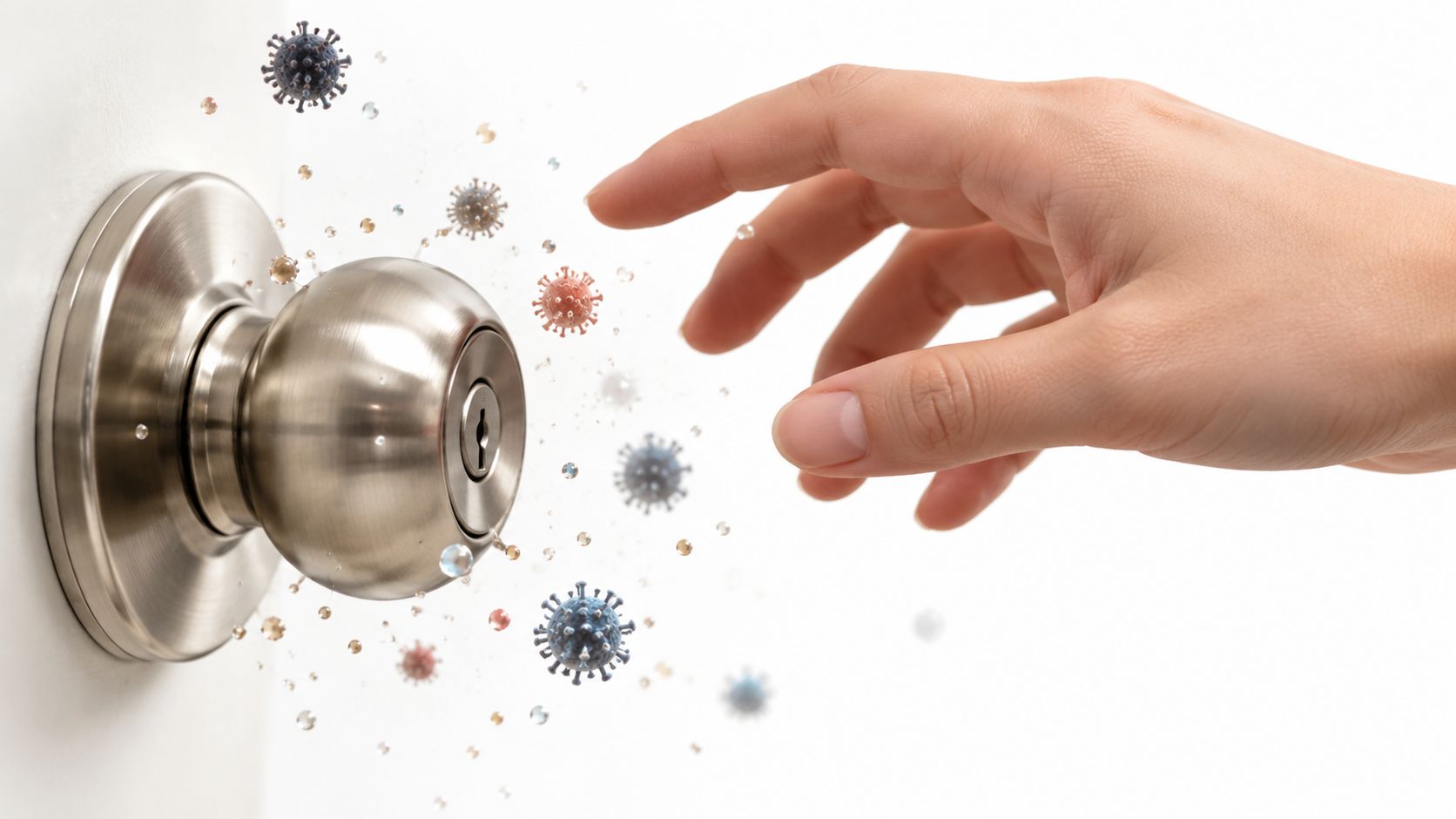
As few as 18 viral particles can cause infection, and norovirus is responsible for roughly half of all foodborne disease outbreaks in the US. That threshold is so small that contamination invisible to the eye can still start a chain of viral gastroenteritis transmission.
A person doesn't need to see a spill, touch something obviously dirty, or eat a visibly spoiled meal to encounter enough virus for infection. Norovirus can move through hands, food, water, shared objects, contaminated surfaces, and particles released during vomiting. Understanding that movement turns vague advice about “good hygiene” into practical decisions about handwashing, surface disinfection, and spill response.
Introduction – The Small Dose That Starts an Outbreak
A family member vomits beside the bathroom sink. Someone wipes the visible mess, rinses the cloth, and assumes the danger has passed. Later, another person touches the faucet, opens a refrigerator, and eats a snack. No one sees contamination on those objects, but the chain can still continue.
The infectious dose is the amount of virus needed to establish infection. For norovirus, the CDC estimates that this dose can be as low as 18 viral particles, while some CDC technical guidance has cited as few as 10 particles. Norovirus causes about 19 to 21 million illnesses annually in the United States and accounts for roughly 50% of all foodborne disease outbreaks, according to the same CDC reference.
That biology explains why norovirus serves as a useful model for understanding viral gastroenteritis transmission. The virus spreads readily in homes, schools, healthcare facilities, cruise ships, nursing homes, and other places where people share rooms, bathrooms, meals, equipment, and frequently touched surfaces.
Why visible dirt is a poor risk indicator
Visible contamination and infectious contamination aren't the same thing. A large spill may attract immediate attention, while a thin residue transferred to a door handle may look harmless. The second situation can be more difficult to notice, especially when several people touch the same object before anyone cleans it.
Norovirus also has multiple routes into a new host. Direct contact matters, but so do contaminated food and water, fomites, and aerosols produced during vomiting. A fomite is an inanimate object that carries infectious material from one place or person to another. A phone, tap, countertop, utensil, or light switch can become part of that route.
Practical rule: Treat the area around vomiting or diarrhea as a contamination zone, not just the spot where visible material landed.
Routine cleaning often fails because people use the wrong product, wipe too quickly, or focus only on what they can see. The solution isn't fear of every household surface. It's a more accurate mental model: when the infectious dose is extremely low, consistent handwashing and targeted disinfection matter even after the mess appears to be gone.
Understanding the Fecal-Oral Route and Fomite Transmission
Up to 10^11 particles per gram of stool may be shed by a person with norovirus. That quantity helps explain why a very small trace can matter. The fecal-oral route describes a sequence in which virus leaves infected stool or vomit, reaches hands, food, water, objects, or surfaces, and then enters another person's mouth. The route may involve direct contact or several unnoticed transfers.
Norovirus can also survive on environmental surfaces for days to weeks, as described in the CDC Yellow Book guidance on norovirus transmission. A person does not need to handle stool directly. Touching a contaminated bathroom fixture, preparing food, picking up a utensil, or rubbing the mouth after contacting a shared object may complete the chain.

Direct contact is only the first link
Direct person-to-person transmission can occur when an infected person cares for a child, shares objects, handles food, or touches another person's hands. The transfer does not require careless behavior. Someone may wash after using the toilet but touch a tap or towel first, or spread virus across a surface while cleaning up illness.
Food and water provide another route. An infected food handler can move contamination into a meal, while contaminated water can expose several people at once. Norovirus transmission also includes contaminated surfaces and aerosols associated with vomit, alongside direct contact and contaminated food or water.
A fomite is an inanimate object that carries infectious material from one place or person to another. Common examples include:
- Bathroom fixtures: Taps, flush handles, toilet seats, and door handles may receive contamination during illness or cleanup.
- Shared devices: Phones, remote controls, and keyboards pass between hands without routine disinfection.
- Food-contact surfaces: Cutting boards, counters, utensils, and refrigerator handles can connect a bathroom event to a meal.
- Care equipment: Shared rails, buttons, and carts may be touched repeatedly in healthcare or residential settings.
Why a small trace can matter
Surface risk depends on the route from contamination to the mouth, not on whether the surface looks dirty. Hands make that route efficient because people touch their faces, food, cups, and utensils throughout the day, often without noticing.
That low-dose mechanism changes how household cleaning should be judged. A quick wipe may remove visible residue while leaving infectious material on nearby touchpoints. Cleaning removes soil and organic material. Disinfection is the separate step intended to inactivate pathogens on a surface, and its success depends on choosing a product that works against the virus and applying it to the areas contamination could have reached.
Routine disinfection therefore matters even after the mess appears gone. The goal is targeted control of the transfer points, not fear of every household surface.
One route deserves separate attention: the droplets and fine particles released during vomiting, which can travel beyond the puddle you can see.
The Aerosol Effect – How Vomiting Spreads Invisible Contaminants
Vomiting changes the physical form of contamination. Instead of remaining only in a puddle, material can be expelled into the air as droplets and much smaller particles. Nearby people may then inhale particles or receive them in the mouth, nose, or throat, while particles can also settle on surrounding surfaces.
The National Institute of Diabetes and Digestive and Kidney Diseases explains the role of vomiting in viral gastroenteritis transmission. Experimental and outbreak evidence shows that vomiting can generate aerosol particles containing detectable norovirus, including particles smaller than 1 μm. These particles can remain inhalable and deposit in the mouth, nose, or trachea with an estimated 10% to 30% probability.

Why wiping the puddle isn't enough
A visible spill tells you where some material landed. It doesn't reveal the full area that may need attention. During an emetic event, nearby floors, clothing, furniture, fixtures, and other people may become part of the contamination zone even when no visible residue remains.
That doesn't mean every particle travels indefinitely or that every nearby person becomes infected. It means short-range airborne exposure is a meaningful secondary pathway, particularly when someone stands close to the person vomiting or begins cleanup immediately without considering the surrounding area.
The risk also continues after the air clears. Settled material can contaminate hands, shoes, equipment, and surfaces. A person who touches those items and then eats or touches their mouth can reconnect the environmental route to the digestive tract.
A safer response to an emetic event
Move people who aren't needed for care away from the immediate area. Avoid shaking contaminated fabrics, spreading material with a dry cloth, or walking through the affected space. Use appropriate protective equipment and ventilation practices for the setting, then clean visible material before applying a disinfectant that is effective against norovirus.
For readers who want a narrower discussion of the airborne question, are stomach viruses airborne provides additional context. The practical distinction is important: vomiting can create an airborne exposure opportunity, but infection still depends on whether virus reaches a susceptible person's body in an effective way.
Viral Stability – Why Non-Enveloped Viruses Survive on Surfaces
Viral structure helps determine how long contamination remains a practical concern. Influenza viruses and coronaviruses have a lipid envelope, a membrane that can be disrupted by environmental conditions and some cleaning agents. Norovirus is non-enveloped, so it lacks that fragile outer layer. Its protein capsid helps protect the virus from many standard disinfection protocols, alcohol-based sanitizers, and low-level detergents.
The review of norovirus environmental persistence and disinfection describes high stability on surfaces and in water, as well as stability across a range of pH levels. Norovirus can persist on surfaces for days to months. Our detailed discussion of norovirus survival on surfaces examines the conditions that can extend that window. Shedding in stool can continue for weeks after symptoms resolve, so contamination may remain relevant after the sick person feels better.
Enveloped and non-enveloped viruses need different strategies
A disinfectant that performs well against an enveloped virus is not automatically appropriate for norovirus. Product category alone cannot answer that question. Because the capsid resists many common active ingredients, the label's stated efficacy against non-enveloped viruses matters more than a familiar brand name or a general claim that a product kills viruses.
Alcohol-based hand sanitizers may reduce some microbes, but soap-and-water handwashing is more dependable for interrupting norovirus transmission than relying on sanitizer alone. On surfaces, the active ingredient, concentration, and required wet contact time determine whether a product can inactivate the virus under its labeled conditions.
| Intervention | What it addresses | Why product choice matters |
|---|---|---|
| Soap-and-water handwashing | Removes contamination from hands | Physical washing is more dependable for norovirus than alcohol sanitizer alone |
| General cleaning | Removes soil and organic material | A visibly clean surface may still require an effective disinfectant |
| Targeted disinfection | Inactivates susceptible virus on suitable surfaces | The label and wet contact time show whether the product fits the task |
| Surface isolation | Limits contact with a contaminated area | Fewer contacts allow less opportunity for transfer while treatment occurs |
A wipe can leave a countertop looking clean without providing the conditions needed to inactivate norovirus. Check the label for efficacy against norovirus or other non-enveloped viruses, confirm that the surface is compatible, and follow the stated contact time.
Persistence changes household habits
A contaminated handle can connect separate moments of an illness episode. One person may use a bathroom, another may touch the handle later, and someone else may encounter it while preparing food. The virus remains unnoticed because it has no visible signal.
Choose products according to their labeled effectiveness against norovirus and keep a written routine for recurring illness. A prepared routine reduces product-selection errors when cleanup is stressful and helps households treat persistence as a product-efficacy problem, not only a visibility problem.
Evidence-Based Disinfection Protocols for Vomit and Diarrhea
Disinfection begins after people are protected from the immediate spill and visible material has been removed. The objective is to treat the contaminated area and nearby surfaces that may have received droplets, splashes, hands, footwear, clothing, or cleaning tools.
The CDC's norovirus prevention guidance recommends a chlorine bleach solution at 1,000 to 5,000 ppm for areas contaminated by vomit or diarrhea. That range corresponds to about 5 to 25 tablespoons of household bleach per gallon of water, followed by a wet contact time of at least 5 minutes before wiping the surface clean.

A practical spill-response sequence
Restrict access: Keep children, pets, and unnecessary bystanders away from the contaminated area. This prevents additional footprints, hand contact, and accidental exposure while cleanup is underway.
Use suitable protection: Wear disposable gloves where appropriate and handle contaminated materials carefully. Avoid actions that spread droplets or create unnecessary contact with clean clothing and equipment.
Remove visible material: Pick up or absorb vomit and diarrhea using disposable materials, then place waste in a suitable sealed disposal bag. Clean the area before applying the disinfectant so organic matter doesn't interfere with coverage.
Apply the chlorine solution: Use the CDC concentration range of 1,000 to 5,000 ppm. Cover the contaminated surface rather than applying a thin, quickly drying film.
Keep the surface wet: Leave the solution in place for at least 5 minutes before wiping it clean, as specified by the CDC. Follow the product label for surface compatibility, ventilation, storage, and any additional handling requirements.
Contact-time rule: A disinfectant can't work for the required period if it dries immediately or is wiped away as soon as it is applied.
Choosing a commercial product
Bleach isn't suitable for every material, and household conditions don't always allow a controlled spill response. The EPA's registered antimicrobial products effective against norovirus offer a way to check whether a product has been reviewed using required laboratory testing data showing that it kills norovirus. That list matters because not every household cleaner is effective against a hard-to-kill non-enveloped virus.
For a workplace, care facility, school, or large shared building, a specialist can help define the contaminated zone, select compatible products, and document the response. AMPM Restoration commercial sanitization is one resource for organizations evaluating professional support after a contamination event.
Don't improvise by mixing products or ignoring label directions. Keep the disinfectant on the surface for the required time, dispose of cleanup materials carefully, and wash hands with soap and water after removing gloves and completing the response. For a more detailed household procedure, see how to disinfect norovirus.
Integrating Prevention into Daily Life and Critical Settings
Effective prevention uses layers because viral gastroenteritis transmission rarely depends on one route. Hands, food, water, shared objects, bathroom fixtures, and vomit-associated aerosols can connect an infected person with someone else. Removing one link helps, but a household or facility is safer when several links are addressed together.
Start with the hands that are most likely to carry contamination. Wash with soap and water after using the toilet, after caring for someone who is ill, after cleaning vomit or diarrhea, and before preparing or eating food. Hand sanitizer can be convenient, but it shouldn't replace soap-and-water washing when norovirus is the concern.
Build a layered routine
At home, separate care tasks from food preparation whenever possible. Clean bathroom touchpoints and food-contact surfaces after contamination, launder affected items according to their care instructions, and keep contaminated clothing or bedding from contacting clean surfaces.
In schools and childcare settings, staff need a clear response plan for vomiting and diarrhea. The plan should identify who restricts access, who handles cleanup, which products are approved, and how staff prevent contamination from moving into classrooms, kitchens, or shared bathrooms.
In healthcare facilities and nursing homes, environmental services, clinical staff, residents, visitors, and food-service workers all interact with the same transmission network. A response that cleans only the floor but ignores rails, handles, equipment, and hands leaves opportunities for the virus to move onward.
The same logic applies to offices, restaurants, gyms, and other shared settings. Focus attention on places where people touch the same object and then eat, drink, or touch their faces.
Use product labels as a decision tool
The EPA list is more useful than a generic promise such as “kills germs.” Check whether the product is registered for effectiveness against norovirus, whether the intended surface is compatible, and whether the label specifies a contact time. A pre-moistened disinfecting wipe can be practical for small, hard, nonporous surfaces, but the user still needs to keep the surface wet for the labeled duration.
VirusFAQ.com provides educational material about viruses, transmission dynamics, and prevention, including accessible and more technical discussions for readers who want to understand why these choices matter. It should complement, not replace, public health guidance, product labels, and professional advice for high-risk facilities.
Find the weakest link
A prevention plan becomes stronger when people ask where transfer is most likely to occur:
- Hands: Are staff or family members washing after bathroom use and cleanup?
- Surfaces: Are nearby touchpoints included, or only the visible spill?
- Food: Is anyone who may still be shedding virus preparing meals for others?
- Air and surroundings: Are people kept away during vomiting and initial cleanup?
- Products: Does the selected disinfectant specifically address norovirus?
Norovirus can remain transmissible after symptoms improve, so a person who feels better may still need to take precautions around food and shared surfaces. The safest routine combines handwashing, appropriate isolation during illness, careful food handling, and targeted disinfection rather than relying on a single product or habit.
When a vomiting or diarrhea event occurs, act promptly: restrict access, remove visible material, use an EPA-registered norovirus-effective disinfectant or the CDC bleach concentration, respect the full contact time, and wash hands with soap and water afterward. Keep a labeled disinfecting wipe or suitable product available for compatible hard surfaces, and review your home, school, or workplace response plan before the next illness makes the decision urgent.
Leave a Reply