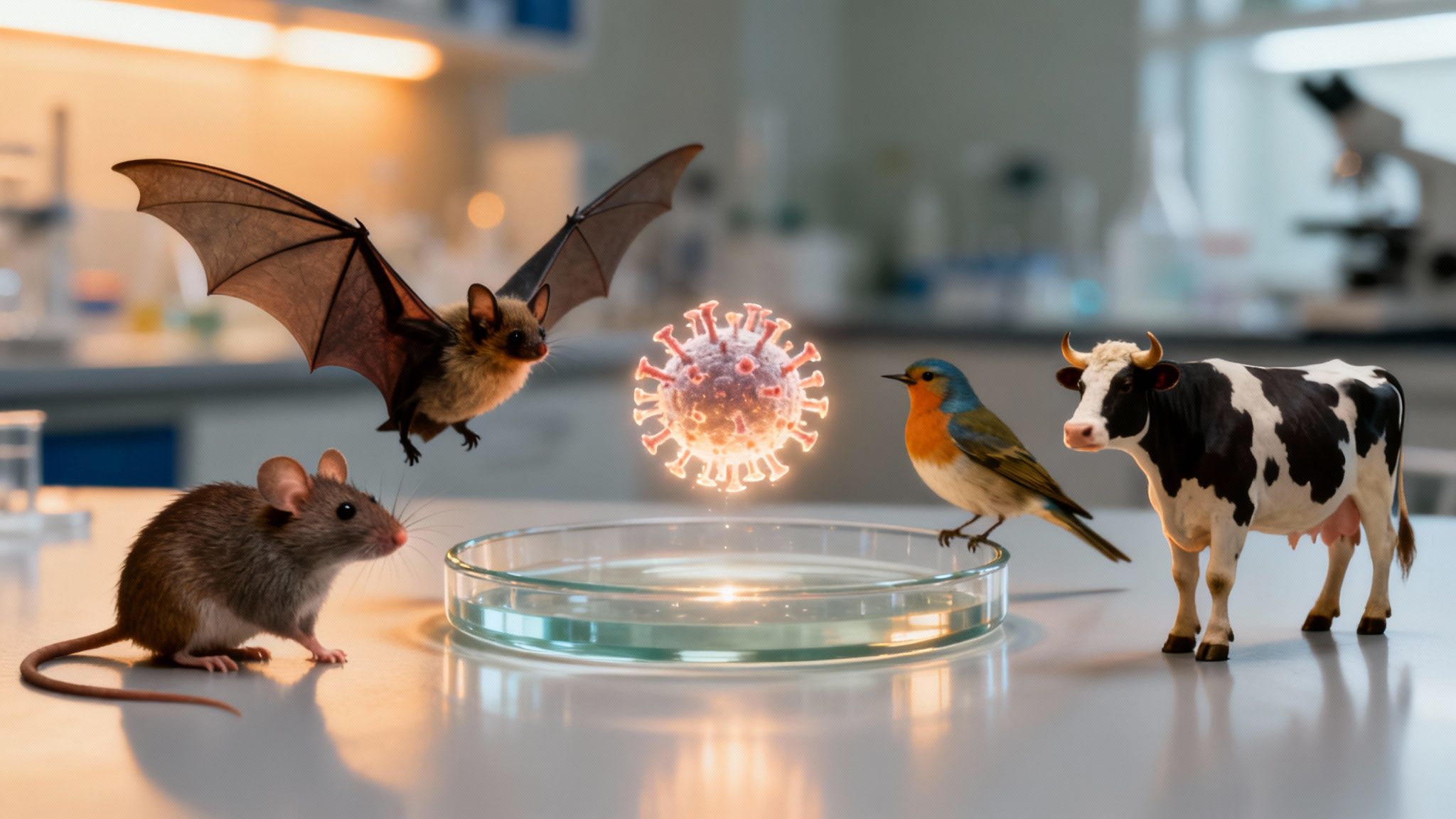
A reservoir host is an animal that carries a virus long-term, often without getting sick itself. It acts as a natural, persistent source for the pathogen.
Think of it as a virus’s secret hideout—a place where it can live quietly, multiply, and maintain its presence in the environment, always ready to spread to other species, including us. This silent carrier status is a huge reason why so many diseases, from Human Coronavirus to Avian Influenza Virus (H5N1), stick around in nature.
Defining the Role of a Reservoir Host

To really get a handle on outbreaks, we have to know where viruses hang out between epidemics. The idea of a natural reservoir is fundamental to understanding infectious diseases. It’s simply the animal population where a pathogen naturally lives and reproduces, usually without causing much trouble for the host. This stable, long-term relationship is the key to the virus's survival. For a deeper dive, you can explore the concept of natural reservoirs in epidemiology to see how this plays out on a larger scale.
This quiet coexistence is precisely what makes a reservoir host so effective.
Unlike a typical host that gets sick and either recovers or dies, a reservoir allows the virus to circulate indefinitely within its population. The virus has essentially co-evolved with its host, striking a delicate balance where it can replicate without being wiped out by the host's immune system or killing the host too quickly. Once that virus leaves the reservoir and contaminates a surface, it can pose a risk until it's eliminated.
Key Characteristics of a Reservoir Host
A true reservoir host isn't just any infected animal. It has to meet specific criteria to keep a pathogen going over time. This unique biological relationship is the engine that drives the persistence of so many viruses in the wild.
Here are a few of the defining features that separate a reservoir from other hosts:
- Long-Term Persistence: The virus is permanently maintained within the host population without needing outside sources of infection.
- Asymptomatic Infection: The host often carries and sheds the virus without showing obvious signs of illness, which makes it incredibly difficult to detect.
- Source of Transmission: It serves as the primary source from which the virus can jump to other susceptible animals, including humans.
- Sufficient Population Size: The host population must be large and dense enough to sustain an unbroken chain of transmission.
To help clarify, here's a quick summary of what makes a reservoir host unique.
Key Characteristics of a Reservoir Host
| Characteristic | Description |
|---|---|
| Long-Term Persistence | The virus can survive indefinitely within the host population without external input. |
| Asymptomatic Infection | The host carries and spreads the pathogen but rarely shows symptoms of disease. |
| Primary Transmission Source | Serves as the main "launching point" for the virus to spread to other species. |
| Sufficient Population Density | The host population is large enough to ensure continuous virus transmission. |
These traits combine to create a perfect, hidden environment where viruses can thrive.
The ability of a virus to remain completely undetected within a reservoir is a major headache for public health. These hidden viral sanctuaries can trigger unexpected outbreaks when conditions are right for the pathogen to "spill over" into new species and contaminate our environments.
Why This Concept Matters for Public Health
Getting a solid grasp on what a reservoir host is gives us critical insights into the origins of many emerging infectious diseases.
By identifying these animal populations—whether it’s bats carrying coronaviruses like SARS-Related Coronavirus 2 (SARS-CoV-2), birds carrying avian influenza, or rodents carrying hantaviruses—scientists can monitor for potential threats before they become full-blown crises.
This knowledge is the first step in predicting and preventing future pandemics. Tracking these viral sources helps public health officials develop targeted surveillance and control strategies, which ultimately protects all of us from new and dangerous pathogens.
How Viruses Thrive Within Reservoir Populations
A virus doesn't just hang out in a single animal. For long-term survival, it needs to set up shop in an entire population. This is how a species becomes a true reservoir host—a self-sustaining system where a pathogen can circulate quietly and indefinitely.
A reservoir isn't just one infected animal; it’s one or more connected populations where the virus is permanently maintained. From this stable home base, it can then spill over into other species, including us. If you want to get into the weeds on this, you can explore this key concept of pathogen maintenance to see the math behind how viruses stay active in nature.
This all hinges on a crucial idea in epidemiology called the critical community size. Think of it as the bare minimum number of hosts a virus needs to stick around. If the population is too small, the virus will burn through all the available hosts and simply fizzle out. But a large, bustling population with a steady stream of newborns provides an endless chain of new hosts, allowing the virus to jump from one generation to the next without interruption.
The Co-Evolutionary Dance
For a virus to last, it can't afford to be too aggressive. A pathogen that kills its host too quickly also kills its own chances of spreading. This is where a long, slow co-evolutionary dance begins.
Over thousands of years, the virus often adapts to become less deadly, and the host's immune system learns to tolerate it. Instead of launching a full-scale, damaging attack, the host keeps the virus in check without getting seriously ill.
This delicate truce is the secret to a successful reservoir. The infected animals stay healthy enough to live, breed, and socialize, all while quietly shedding the virus and keeping it in circulation. It's a win for the virus, which gets a permanent home, and a tolerable compromise for the host. The specific genetic tricks that enable this vary, and you can learn more about how the types of viral genomes play a role in these evolutionary paths.
Key Factors in Viral Persistence
So, what makes a species the perfect home for a virus? It’s not random. A few biological and ecological factors have to line up just right.
- Host Lifespan and Reproduction: Animals that live a long time can carry and spread a virus for months or years. Combine that with a high birth rate, and you get a constant supply of new, immunologically naive babies for the virus to infect.
- Unique Immune Responses: Some of the most notorious reservoir hosts, like bats, have incredibly specialized immune systems. They can suppress a virus enough to avoid getting sick but not enough to clear the infection entirely. This "tolerance" lets the virus persist at low levels.
- Population Dynamics and Behavior: How animals live matters. Social behaviors like roosting in massive colonies (bats) or living in dense underground communities (rodents) create the perfect storm for transmission. It’s like putting the virus in a crowded room where it can easily jump from host to host.
This delicate balance between viral replication and host survival is the engine of persistence. When these factors align, a reservoir population becomes a self-sustaining system that can maintain a virus for centuries, posing a constant, underlying risk for a spillover event.
When you put all these pieces together, you can see how an entire species can be turned into a reliable, long-term sanctuary for a virus. Understanding these dynamics is our first and best step toward predicting where the next threatening virus might emerge.
Uncovering Nature's Most Notorious Reservoir Hosts

The idea of a "reservoir host" really clicks when you look at the specific animals that carry some of the world's most troublesome viruses. It’s not just bad luck that certain species are so good at this job; it’s a unique mix of biology, behavior, and evolution.
By exploring these examples, you can see exactly how a species becomes the perfect long-term hideout for a virus. These animals can often live with pathogens that would be a death sentence for others, including us. This quiet partnership is what puts them front and center for virologists trying to get ahead of the next outbreak.
Let's dive into some of the most well-known reservoir hosts and what makes them so effective.
Bats: The Ultimate Viral Sanctuaries
Bats are probably the most famous reservoir hosts, linked to an incredible number of viruses behind diseases like rabies, Ebola, and many coronaviruses. Their top-tier status isn't an accident—it’s a direct result of their one-of-a-kind physiology.
A huge part of the story is their hyper-specialized immune system. Bats are the only mammals capable of true flight, an activity that puts immense stress on their bodies and risks cellular damage. To handle this, their immune systems evolved to be on constant high alert without kicking off massive, damaging inflammation.
So, when a bat gets infected with something like a coronavirus, its immune system keeps the virus in check enough to prevent sickness but doesn't wipe it out completely. The virus just keeps replicating at a low level, letting the bat carry it for life without getting sick.
This immunological "truce" is the secret to their success. It allows viruses to hang around and evolve inside bat populations for generations, creating a massive, diverse library of potential zoonotic threats.
Rodents: Rapid Breeders and Prolific Spreaders
Rodents, like mice and rats, are another major group of reservoir hosts, known for carrying pathogens such as hantaviruses and Lassa virus. Unlike the unique immune system of bats, what makes rodents so effective is all about their population dynamics.
Rodents are masters of rapid reproduction and have short lifespans. This creates a constant population turnover, providing a never-ending supply of new, immunologically naive babies for a virus to infect. The pathogen never runs out of hosts, ensuring the chain of transmission never breaks.
Their behavior also plays a huge role. Rodents often live in high-density groups right alongside us, scrounging for food in our homes, barns, and fields. This close contact is exactly what increases the chances of people being exposed to their virus-laden urine, droppings, or saliva—the primary way hantaviruses spread and contaminate surfaces.
Birds: Global Travelers of Avian Influenza
Wild aquatic birds—especially ducks, geese, and swans—are the original, natural reservoir for all Influenza A viruses. This includes the strains that cause avian influenza, or "bird flu." Their role as a reservoir is completely tied to their migratory lifestyle.
These birds can carry influenza viruses like Influenza A Virus (H1N1) and Avian Influenza Virus (H5N1) in their respiratory and intestinal tracts, often without showing any signs of being sick. As they fly across entire continents, they shed the virus in their droppings, contaminating lakes, ponds, and other environments they share with domestic poultry and other animals.
This global travel system allows for the massive distribution of different flu strains. It creates countless opportunities for viruses to mix and match their genes, potentially creating brand-new viruses with pandemic potential. The Avian Influenza Virus (H5N1) is a perfect example of a strain that started in wild birds before spilling over into domestic flocks and, on rare occasions, to people.
As you can see, there’s no single recipe for a perfect reservoir host. Whether it’s through a specialized immune system, explosive population growth, or globe-trotting mobility, each species offers a unique set of advantages that let viruses survive, evolve, and eventually find new hosts.
The Spillover Event: How a Virus Jumps to Humans
A virus circulating quietly in a bat colony deep in a forest feels like a distant problem. But when that same virus finds its way into a human, it can ignite a global crisis. This is the moment of zoonotic spillover—the leap a pathogen takes from its animal reservoir into a human host.
This isn't just one freak accident. It's more like a cascade of failures, where the natural firewalls that normally keep animal viruses away from us break down one by one. Think of it as a perfect storm where ecological disruption, viral evolution, and human behavior all align to build a bridge for a pathogen to cross. This is the origin story for so many modern outbreaks, including pandemics like SARS-CoV-2.
The jump itself is incredibly difficult for the virus. It's a high-stakes gamble against immense biological odds, where the pathogen has to figure out how to infect and replicate inside a completely foreign system.
Triggers That Break Down Natural Barriers
For thousands of years, humans and wildlife reservoirs have mostly kept a safe distance. But our modern activities are tearing down those natural walls, forcing us into contact with virus-carrying animals far more often.
These triggers don't just increase contact; they create brand-new opportunities for viruses to test the waters in a new species.
- Deforestation and Habitat Loss: When we clear forests for farms or cities, we squeeze wildlife into smaller and smaller spaces, pushing them right up against our communities. Animals that once lived deep in the woods are now in our backyards, creating endless chances for contact.
- Urban Expansion: As our cities sprawl, they creep into what used to be wild areas. This brings us face-to-face with highly adaptable reservoir hosts like rodents and bats, which can thrive in the environments we build.
- Wildlife Markets and Trade: "Wet markets," where different live animal species are crammed together in stressful and unhygienic cages, are notorious spillover hotspots. They act as a perfect mixing bowl for viruses to jump between species—from a reservoir to an intermediate host, and finally, to us. These environments are often contaminated with various pathogens, increasing risk.
A spillover event isn't just bad luck. It's often the direct result of environmental pressures that force humans and wildlife into unnatural, prolonged contact. Each interaction is like a lottery ticket for a virus, giving it another shot to make the jump.
The Genetic Lottery of Viral Evolution
Even with more contact, a virus can't just decide to infect a human. It needs the right genetic tools for the job. Viruses are constantly mutating inside their reservoir hosts, and every so often, a random mutation gives one a dangerous new ability.
For example, a tiny change might alter the shape of a virus's surface protein, suddenly allowing it to latch onto a receptor on human cells. It’s like finding the right key for a lock that was previously unbreakable. Most of these mutations are dead ends, but occasionally, one hits the jackpot.
A virus with that lucky adaptation is now primed for spillover. The tight relationship between a virus and its reservoir is a huge factor here. Research shows that viruses evolve to be perfectly suited for their specific reservoir hosts, and how sick a virus makes us can depend on how closely related we are to that original host. You can find more details on how reservoir hosts shape viral evolution and human disease on PMC.
This evolutionary puzzle is complex, but understanding the genetic distance between species helps scientists predict which viruses pose the biggest threat. You can learn more about how scientists map these evolutionary connections in our guide on how to read phylogenetic trees. By grasping how spillover works, we can see how our own actions directly raise or lower our risk of facing the next major outbreak.
How Scientists Find and Track Reservoir Hosts
Pinpointing a reservoir host is like a high-stakes detective story. Scientists have to venture into some of the world's most complex ecosystems to find the exact animal populations that are quietly keeping a virus alive. This work isn't just for academic curiosity; it's the front line of pandemic prevention, giving us a chance to see where the next big threat might be brewing.
This proactive search combines rugged fieldwork, advanced lab techniques, and some seriously sophisticated data analysis. Virologists and epidemiologists are essentially viral trackers, following footprints across entire landscapes to piece together clues, identify the source, and hopefully stop a potential spillover before it even starts.
The Toolkit for Viral Surveillance
Finding a virus in its natural home is a huge challenge. You can't just test every animal out there. Instead, scientists use a targeted approach, focusing their efforts on species that are biologically or behaviorally likely suspects.
The process usually starts broad and then narrows down:
- Wildlife Surveillance: Researchers head into areas where outbreaks have happened or are considered high-risk. There, they safely capture and sample animals, collecting things like blood, saliva, and feces to test for viruses.
- Serological Surveys: A key method is looking for antibodies in an animal's blood. Antibodies are a dead giveaway that the animal has fought off a particular virus in the past, even if the virus isn't active anymore. If you find widespread antibodies in a population, it's a strong sign you've found your reservoir.
- Genetic Sequencing: Once a virus is detected, its genetic code is sequenced. From there, scientists can build a viral family tree to trace its evolutionary path, which often leads them right back to the original animal source. This is exactly how the bat origins were confirmed for so many coronaviruses.
This whole process is painstaking. Teams navigate remote jungles, handle potentially dangerous wildlife, and sift through a mountain of data just to find the one species that's keeping a pathogen in circulation.
"Identifying a reservoir host is like finding a needle in a haystack, but the haystack is the entire natural world, and the needle is microscopic. Success relies on combining ecological knowledge with cutting-edge genomic tools to connect a pathogen to its long-term home."
Navigating the Challenges of Discovery
The scientific hunt for a reservoir host is absolutely riddled with obstacles. One of the biggest hurdles is just the sheer scale of what we don't know. Scientists estimate there are around 1.67 million undiscovered viral species in mammals and birds alone, and we've only identified a tiny fraction of them.
To make things even more complex, viruses in a reservoir population can be incredibly elusive. They often circulate at very low levels or only pop up seasonally, making detection a matter of being in the right place at exactly the right time. Plus, just getting to these animals to sample them in remote or hard-to-reach ecosystems requires immense logistical effort and resources.
This diagram shows how environmental factors can build a bridge between a reservoir and humans, kicking off a spillover event.

As you can see, the visualization clearly connects the dots between the reservoir's natural habitat, an environmental trigger like deforestation, and the final jump to a human host.
Despite all these difficulties, monitoring these hidden viral sources is crucial. By understanding where dangerous pathogens like Lassa fever virus and rabies virus hang out in nature, health authorities can develop targeted interventions. These might include public awareness campaigns or vaccination programs for domestic animals, effectively creating a buffer between us and the next viral threat.
Practical Ways to Reduce Spillover Risks
Now that we understand the complex world of the reservoir host, we can move from simply identifying the problem to actively finding solutions. Preventing the next spillover isn't just a job for scientists in a lab; it demands a global shift in how we see the intricate web connecting our health, animal health, and the environment.
This modern strategy is known as the One Health approach. It’s built on the simple but powerful idea that human, animal, and environmental well-being are all tangled together. A virus jumping from a stressed bat population because its forest habitat was destroyed isn't just an animal problem—it's a human health crisis waiting to happen.
Large-Scale Interventions for a Healthier Planet
To get ahead of spillover events, we need to think big. Proactive, large-scale interventions are required to tackle the root causes of increased human-animal contact and rebuild the natural barriers that have historically kept these viruses in check.
A few of the most critical global efforts include:
- Responsible Land Use: Putting a stop to rampant deforestation through sustainable agriculture and forestry is one of the most effective strategies. When we preserve wildlife habitats, we keep reservoir hosts—and the viruses they carry—at a safer distance from us.
- Wildlife Conservation: Protecting biodiversity and cracking down on the illegal wildlife trade are essential. These actions reduce the number of high-risk interactions that can spark a spillover, especially in dangerous settings like unregulated live animal markets.
- Improved Farm Biosecurity: We can create a crucial buffer between wild animals and our livestock by boosting hygiene protocols and vaccination programs on farms. This is vital, since farm animals can sometimes act as intermediate hosts that help a virus adapt to humans.
Controlling the populations of vectors and even some reservoir hosts is another key piece of the puzzle. For instance, implementing effective mosquito control is a proven way to dramatically reduce the transmission of diseases like yellow fever that rely on these insects to spread.
"The One Health concept is our most effective framework for pandemic prevention. It acknowledges that we cannot protect human health without simultaneously protecting animal health and the ecosystems we all share."
Your Role in Breaking the Chain of Transmission
While global policies are absolutely necessary, our individual actions form the final, and arguably most critical, line of defense once a virus has already made the jump. As soon as a pathogen enters the human population, it can quickly contaminate the surfaces and environments where we live, work, and gather.
This is where personal and community hygiene become non-negotiable. These aren't just about personal cleanliness; they are a powerful public health tool. Simple, consistent actions can literally break the chain of transmission, protecting both you and everyone around you.
This includes frequent hand washing and, just as importantly, regularly cleaning and disinfecting high-touch surfaces like doorknobs, light switches, and countertops. Think of this as the final barrier. It helps ensure that even if a virus successfully makes the leap from a reservoir host, its journey stops with us. Using effective disinfecting wipes is a simple and reliable way to eliminate viral threats on the surfaces you touch every day.
Your Questions About Reservoir Hosts, Answered
Let's clear up some of the most common questions people have about reservoir hosts. Getting these details straight is key to understanding how viruses stick around in nature and why public health depends on knowing where they hide.
Can a Human Be a Reservoir Host?
Absolutely, though it depends on the virus. For a fast-acting bug like measles, humans are the only reservoir, but it needs a huge, unbroken chain of people to keep going.
The more common scenario is with chronic infections. Think of viruses like Hepatitis B Virus (HBV), Hepatitis C Virus (HCV), or Human Immunodeficiency Virus Type 1 (HIV-1). Someone can carry these viruses for years, often without showing symptoms, all while being able to pass them on. In these cases, humans become long-term reservoirs, showing how different viruses have mastered different survival games.
Why Are Bats Such Common Reservoir Hosts?
Bats are practically built to be perfect reservoir hosts. Their unique immune systems, which evolved to handle the intense stress of flight, have a special trick: they can keep viruses in check without launching a massive, self-destructive inflammatory attack.
This immunological truce allows viruses to hang out at low levels for the bat's entire life. Add in their habit of roosting in massive, crowded colonies, and you’ve got the perfect storm for viruses to circulate, persist, and evolve.
What Is the Difference Between a Reservoir and a Vector?
This is a classic point of confusion, but the distinction is critical. A reservoir host is the natural home where a virus lives, reproduces, and maintains itself over the long haul. A vector, on the other hand, is just a delivery service—it picks up the virus from one host and drops it off at another.
- Reservoir: The virus's long-term, natural habitat.
- Vector: A temporary taxi for the virus (think mosquitos carrying yellow fever).
A mosquito might get infected, but its main role in the virus's life cycle is transmission, not serving as its permanent address.
How Does This Relate to Everyday Prevention?
Understanding reservoir hosts brings a sobering reality into focus: dangerous viruses are always out there in the environment, just one spillover event away from reaching us. Once a virus like Norovirus (Norwalk Virus) or Human Rotavirus makes that jump, it can easily end up on the doorknobs, countertops, and keyboards we touch every single day.
This is exactly why good old-fashioned hygiene is non-negotiable. When we consistently clean and disinfect high-touch surfaces, we’re setting up a final line of defense. It's a simple act that breaks the chain of transmission, stopping a pathogen that started in a faraway animal from causing an outbreak in our homes and communities. Keeping disinfecting wipes on hand provides a quick and effective way to neutralize these invisible threats before they can spread.
Leave a Reply