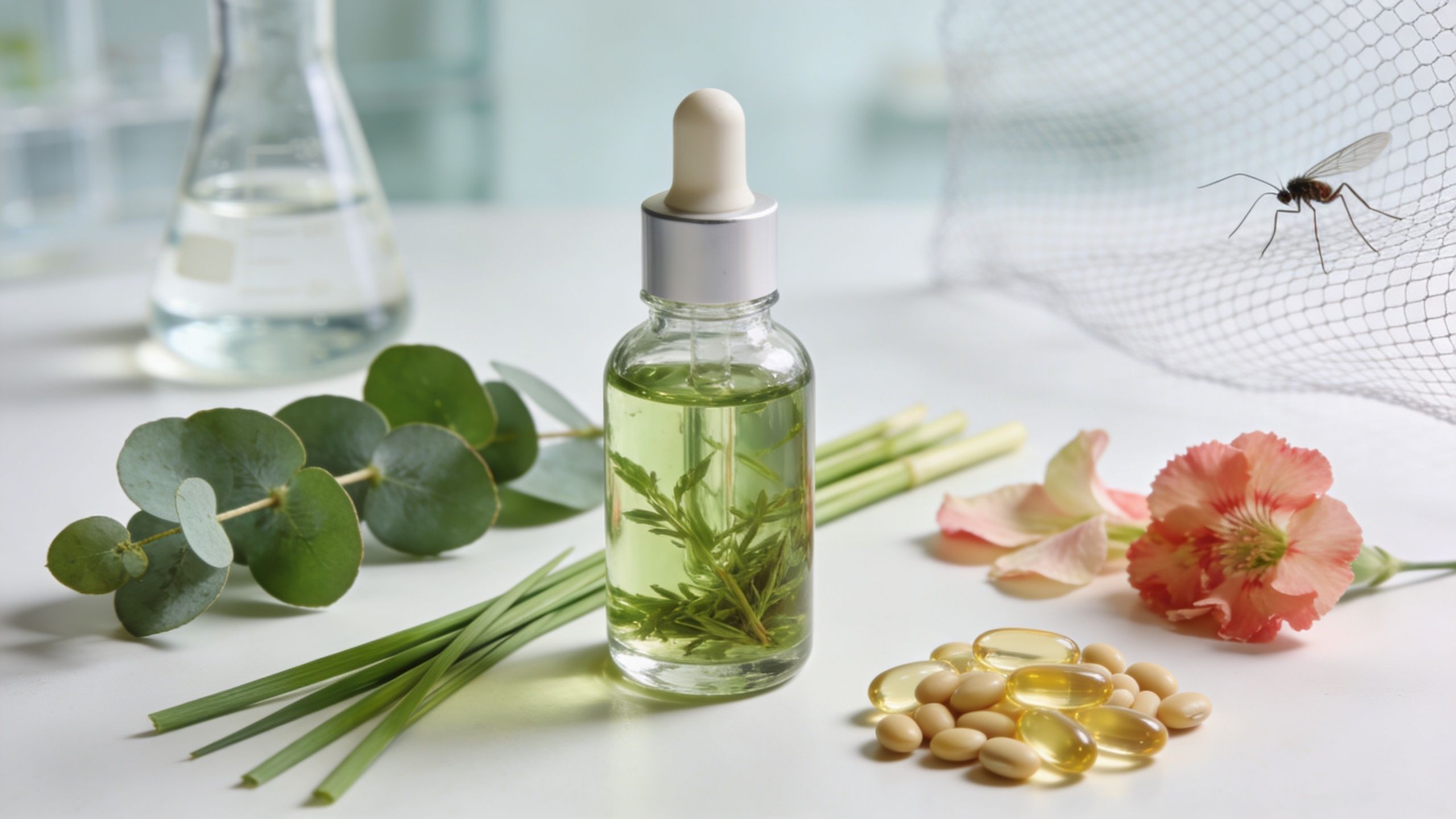
Warm evenings make bug decisions feel simple until they don't. You're packing for a camping trip, setting up a backyard dinner, or booking travel to a place where mosquitoes are more than a nuisance. Then the usual question shows up: should you choose an all natural bug repellent, or should you reach for the product with the strongest protection record?
That question matters because "natural" and "safe" aren't the same as "effective enough for your situation." A spray that feels fine for a short evening on the patio may be the wrong choice for a marshy hike, a tick-heavy trail, or travel to a region where mosquito-borne viruses are a real concern.
The Summer Dilemma Choosing Your Bug Defense
A family camping at dusk faces a familiar problem. The tent is up. Dinner is cooking. Then the insects arrive all at once, and everyone starts making fast decisions with half-read labels and strong opinions.

One person wants citronella because it sounds gentle. Another wants the product that lasts longest. Someone else says they want "chemical-free," even though everything in a bottle is made of chemicals, whether plant-derived or synthetic. That confusion is normal. Repellent labels often mix lifestyle language with public health decisions.
The market shows how common this preference has become. The U.S. natural insect repellent market reached USD 726.0 million in 2024, and approximately two out of three consumers prefer natural pest control products when possible, according to Grand View Research's market report on U.S. natural insect repellents.
Why the choice feels harder now
People aren't only trying to avoid itchy bites. They're also trying to reduce exposures they don't want, protect children, and still get dependable results. That creates tension between ingredient preference and performance.
A practical summer plan usually starts before the spray bottle. Physical barriers matter. If you're trying to reduce mosquito entry around porches, patios, or sleeping areas, this guide to installing bug screens effectively is a useful complement to repellents.
Practical rule: Repellent is one layer of protection, not the whole strategy.
What you're actually choosing
When you buy an all natural bug repellent, you're usually choosing among very different kinds of products:
- A scent-based botanical spray that may smell pleasant but may not have proven duration.
- An EPA-registered plant-derived active ingredient with evidence behind it.
- A product marketed as natural that hasn't had to prove it works well enough for disease prevention.
Those aren't small differences. They shape how long protection lasts, how often you need to reapply, and whether the product makes sense for low-risk backyard use or higher-risk travel.
Decoding What Natural Really Means on a Repellent Label
A repellent label can create the wrong kind of confidence. "Natural" sounds like a clear category, but it works more like a broad shelf sign in a grocery store. It groups products by origin or marketing style, not by how well they protect you from a mosquito that may be carrying Zika, dengue, or West Nile virus.
That distinction matters because two bottles can both look plant-based and perform very differently.
Two categories hiding under one word
One group includes botanical sprays made with ingredients such as citronella, peppermint, rosemary, geraniol, soybean oil, or lemongrass. These products may appeal to shoppers who want plant-derived ingredients, but that does not mean they were held to the same proof standard for disease-prevention claims as registered repellents.
The second group is smaller and more important from a public health perspective. These are EPA-registered repellents, including some that come from plant sources. Registration means the active ingredient was reviewed under a process that includes efficacy data and safety review. For a person choosing protection for an evening walk, that may seem technical. For a pregnant traveler going to an area with Zika transmission, it is the difference between a preference and a risk decision.
Why the wording causes so much confusion
Shoppers often treat these label terms as interchangeable:
- Natural
- Botanical
- Plant-based
- Essential oil
- EPA-registered
They describe different things.
"Natural" usually points to source or branding. "Essential oil" tells you something about formulation. "EPA-registered" tells you the product cleared a different regulatory bar. A plant-derived active ingredient can be standardized, tested, and labeled in a way that makes it much more dependable than a pleasant-smelling spray built mainly around fragrance.
Confusion gets even worse because many people already associate essential oils with antimicrobial claims. That idea spills over into bug protection, even though repelling mosquitoes and affecting microbes are different jobs. If you have seen broad claims around essential oils discussed for antiviral use, it helps to separate those discussions from repellent evidence. A substance can smell strong, seem "clean," or have interesting lab findings and still fall short as a practical mosquito repellent.
How to read the bottle like a risk manager
Start with the active ingredient, not the front-label promise. The front often highlights lavender, eucalyptus, or a leafy design because those cues sell. The active ingredient panel tells you what is expected to repel the insect.
Then check whether the product is EPA-registered. That status does not guarantee the longest protection time in every setting, but it does tell you the product passed through a clearer system for judging whether it works.
Next, separate scent from staying power. Many botanical oils evaporate quickly. A product can smell strong for a few minutes and still lose repellent activity faster than you expect.
Finally, match the bottle to the setting. Backyard gardening, an evening soccer game, and travel to a region with active mosquito-borne virus transmission should not be treated as the same exposure problem.
A good label-reading habit is to ask one plain question: "Would I trust this product only for comfort, or also for infection prevention?" That question helps cut through vague natural-language branding.
For readers comparing plant oils for home use, this homeowner guide to mosquito solutions is useful background on one of the ingredients that often appears on front labels.
The mindset shift that helps most
For casual bite reduction, many people accept a product that works somewhat and smells pleasant. For preventing infection from a virus-carrying mosquito, the standard should be higher. "Natural" is not the endpoint of the decision. It is only the start of a much more practical question about evidence, duration, and the consequences of getting that choice wrong.
The Most Common Natural Active Ingredients Explored
Not all plant-based repellents belong in the same bucket. Some have meaningful evidence. Others are promising but inconsistent. A few are mostly supported by consumer enthusiasm rather than strong performance data.
Oil of lemon eucalyptus and PMD
Oil of lemon eucalyptus, often shortened to OLE, is the natural active ingredient that deserves the closest attention. Its repellent activity comes from p-menthane-3,8-diol, or PMD.
It is often a point of confusion that OLE is not the same thing as lemon eucalyptus essential oil. The names sound nearly identical, but they are not interchangeable. The evidence-based ingredient is OLE or PMD, not just any lemon eucalyptus oil sold for aromatherapy.
Research reviewed in the PMC article on PMD and oil of lemon eucalyptus found that 30% PMD provided 96.88% protection from mosquitoes for 4 hours in field studies, and laboratory testing showed 20% PMD achieved 100% protection against Aedes aegypti for 120 minutes. That's the strongest evidence in the natural category discussed here.
Other botanical ingredients
Citronella, rosemary, peppermint, geraniol, and similar oils are common in all natural bug repellent products. They may help in some settings, but their performance often depends heavily on formulation, concentration, and how quickly they evaporate after application. That's one reason two products with similar front-label claims can behave very differently on skin.
A newer example is undecanone, a naturally occurring compound found in fruits such as tomatoes and bananas. NC State University reported that Mimikai became the first all-natural, EPA-registered insect repellent using undecanone, with EPA certification for up to eight hours against mosquitoes and up to four hours against ticks, as described in NC State's report on the product's development.
If you want a broader homeowner-oriented discussion of what people often try first, this homeowner guide to mosquito solutions is a helpful companion read. People also often confuse antiviral essential oils with insect repellents, but those are different questions entirely, as discussed in this overview of best antiviral essential oils.
Efficacy of common natural repellent ingredients
| Active Ingredient | Typical Concentration | Avg. Protection Time (Mosquitoes) | EPA Registered for Efficacy |
|---|---|---|---|
| OLE / PMD | 20% PMD and 30% PMD are specifically described in the research | 120 minutes in lab testing at 20% PMD against Aedes aegypti; 4 hours in field studies at 30% PMD | Yes |
| Oil of lemon eucalyptus commercial formulations | Commercial formulations are typically described as containing 4-6% | Typically 5-7 hours against mosquito bites in commercial formulations | Yes |
| Undecanone | Not specified in the verified data | EPA-certified product protection of up to eight hours against mosquitoes | Yes |
| Citronella | Not specified in the verified data | Varies by formulation; poor formulation can evaporate quickly and lose efficacy | Not established in the verified data as registered for efficacy in the same way |
| Clove oil | Not specified in the verified data | Can lose efficacy unless formulation is improved | Not established in the verified data as registered for efficacy in the same way |
| Rosemary, peppermint, lemongrass, geraniol, soybean | Not specified in the verified data | Evidence and duration are variable or underexplained | Many remain unregistered for efficacy validation |
The strongest natural repellent evidence in common consumer use points to PMD-based products, not to a broad "essential oils work" conclusion.
The Risks and Realities of DIY Bug Sprays
Homemade repellents are appealing for obvious reasons. You control the ingredients, you avoid a long label, and the recipe feels personal. The problem is that repelling insects isn't only about ingredients. It's also about formulation science.

Why homemade blends often disappoint
Essential oils evaporate. That's one reason they smell strong at first and then seem to vanish. If the active compounds leave the skin quickly, protection fades quickly too.
The formulation problem is especially important for citronella and clove oil. Healthline's discussion of natural mosquito repellents notes that poorly formulated products can evaporate quickly and lose all efficacy, which is a common issue with DIY blends that don't include the stabilizing components found in commercial products.
What DIY recipes usually miss
A homemade spray may include several oils, alcohol, witch hazel, or a carrier oil. That doesn't mean it will hold the active compounds on skin long enough to protect you.
Commercial products are designed around questions like these:
- How fast does the active ingredient evaporate
- Does the carrier improve stability
- How evenly does the product spread on skin
- How long does efficacy persist in heat and humidity
DIY recipes usually don't answer those questions. They mostly combine ingredients and hope for the best.
A homemade repellent can reduce bites for some people in some settings. That's very different from dependable protection.
The false-security problem
The biggest risk isn't always skin irritation. It's confidence without evidence. If a person believes their homemade spray is protecting them on a trail, at dusk near standing water, or during travel where mosquito-borne illness is a concern, they may stay out longer and reapply less often than they should.
That same pattern shows up in other do-it-yourself health products. People often assume "homemade" means "safe enough," even when consistency is poor. The same caution applies if you've ever wondered about how do you make homemade hand sanitizer. With both sanitizer and repellent, performance depends on formulation, not just ingredients.
Natural vs Conventional for Preventing Viral Infections
You swat one mosquito away at sunset, then another lands on your ankle a minute later. In a low-risk backyard, that may be a comfort problem. In a place where mosquitoes can carry viruses, it becomes a public health problem. The question shifts from what feels preferable to what lowers the chance of an infected bite during the hours you are exposed.

What public health thinking prioritizes
Public health guidance starts with reliability. A repellent for disease prevention has to do one job well. It needs to keep biting insects off you for the full period when you are likely to be bitten.
That is why agencies and travel health clinicians point people toward EPA-registered repellents for higher-risk exposure. Registration does not mean every product is identical. It means the active ingredient and product claims have gone through a review process that is far more relevant to disease prevention than vague botanical marketing language.
One point often confuses readers. "Natural" and "evidence-based" are not opposites. Oil of lemon eucalyptus, or more precisely products using PMD, sits in that overlap. It is plant-derived, but it also has a stronger evidence base than many essential-oil blends sold mainly on appeal and scent.
Why duration changes the decision
For viral infections, time matters as much as ingredient choice. A repellent that works for a short window can be acceptable for a quick walk. It is a weaker fit for a long evening outdoors, field work, or travel days that stretch from afternoon into night.
Repellent protection works a bit like a raincoat in a steady storm. If the coating wears off halfway through, the problem is not that the coat failed in principle. The problem is the uncovered second half. Mosquito-borne viruses exploit those gaps.
This is why conventional options such as picaridin or DEET are often chosen for longer or less predictable exposure. Some natural options can help, especially products with PMD, but they are more dependent on matching the product's real duration to the setting and on careful reapplication.
A travel example
Now put that into a real decision. You are packing for travel to an area with Zika transmission. You may be outdoors at several points in the day, moving between airports, cars, markets, and lodging. You may sweat, wash, or forget the exact time you first applied repellent.
In that situation, the safest approach is usually to choose the product with the most dependable protection profile for the exposure window you expect. For many travelers, that means an EPA-registered repellent such as picaridin or DEET. For travelers who strongly prefer a plant-derived active, a PMD-based product may be a reasonable compromise, but only if they treat reapplication as part of the plan rather than an afterthought.
Repellent is only one layer. Clothing coverage, screened rooms, bed nets when appropriate, and attention to peak mosquito activity all matter. A broader overview appears in this guide to preventing viral infections from everyday and travel exposures.
In higher-risk settings, choose the repellent that best matches the insect, the place, and the number of hours you need protection.
The practical bottom line
An all natural bug repellent can be a reasonable option if it uses an active ingredient with meaningful evidence and if your exposure is short or easy to monitor. It becomes a weaker choice when the label leans on plant language but gives little confidence about duration or real-world performance against disease-carrying mosquitoes.
For nuisance bites, preference can lead the decision. For viral risk, evidence should lead.
When to Choose Natural and When to Prioritize Protection
People often want a simple answer, but the right choice depends on context. The problem is that guidance is still thin for mapping natural repellents to specific disease vectors. As noted in this discussion of the gap in vector-specific repellent guidance, there isn't clear enough data connecting many natural oils to mosquitoes that carry viruses such as Dengue or West Nile. That makes EPA-registered products the default recommendation for higher-risk scenarios.
Situations where a natural option may be reasonable
A plant-based product may make sense when exposure is brief and the consequences of some bites are mainly comfort-related.
- Short backyard use: Evening gardening, sitting on a deck, or quick dog walks in a low-risk area.
- Low-density insect settings: Places where insects are present but not intense.
- Ingredient preference with clear limits: You know the product may need frequent reapplication, and you're using it for comfort rather than disease prevention.
Situations where protection should come first
Other situations call for a more conservative standard.
- Travel to areas with mosquito-borne disease risk: In such areas, proven efficacy matters most.
- Long outdoor exposure: Hiking, camping, fieldwork, and fishing extend the chance of coverage gaps.
- Tick-heavy environments: Duration matters because exposure is prolonged and repeated.
- Children or adults who won't reliably reapply: A product that lasts longer may be more protective in practice.
A simple decision frame
Ask yourself three questions:
- Am I avoiding annoyance or reducing infection risk?
- Will I be outside briefly or for extended periods?
- Is this product EPA-registered, or is it relying mostly on natural branding?
If the answers point toward genuine health risk, choose proven protection first. If the answers point toward casual use, a carefully chosen natural product may be enough.
A Complete Strategy for Virus Prevention
You are packing for a trip, and the choice is no longer just about comfort. A few itchy bites in your backyard are one problem. Trying to avoid mosquitoes that may carry Zika or West Nile virus is a different decision with different stakes.
A useful prevention plan works in layers. Repellent is one layer. Clothing coverage, window screens, avoiding peak mosquito activity when possible, and checking your skin for ticks add more layers. Public health uses this layered approach for a reason. No single step is perfect on its own, but several practical steps together reduce risk more reliably.
That is why repellent choice should start with the hazard, not the marketing. If your goal is to reduce the chance of infection from a disease-carrying insect, the question is not whether a product sounds natural. The question is whether its active ingredient has credible evidence against the specific insect you are likely to encounter, and whether it will last long enough for your real-world exposure.
This helps separate two very different use cases. For a short evening outside in a low-risk area, a plant-based product with a known active ingredient may be a reasonable part of your plan. For travel, long outdoor work, or regions with known mosquito-borne illness, the safer approach is to choose the option with the most dependable protection, then use the rest of your prevention layers consistently.
Indoor prevention matters too. Mosquitoes do not respect the boundary between outside and inside, and healthier home conditions often depend on the same layered mindset. For readers thinking more broadly about prevention at home, these proven methods for indoor air purification offer one example of how people often reduce risk by combining multiple small protections.
The best habit is simple. Ask the right question first: what am I trying to prevent?
If you want more evidence-based explainers on viruses, transmission, and practical prevention, visit VirusFAQ.com.
Leave a Reply