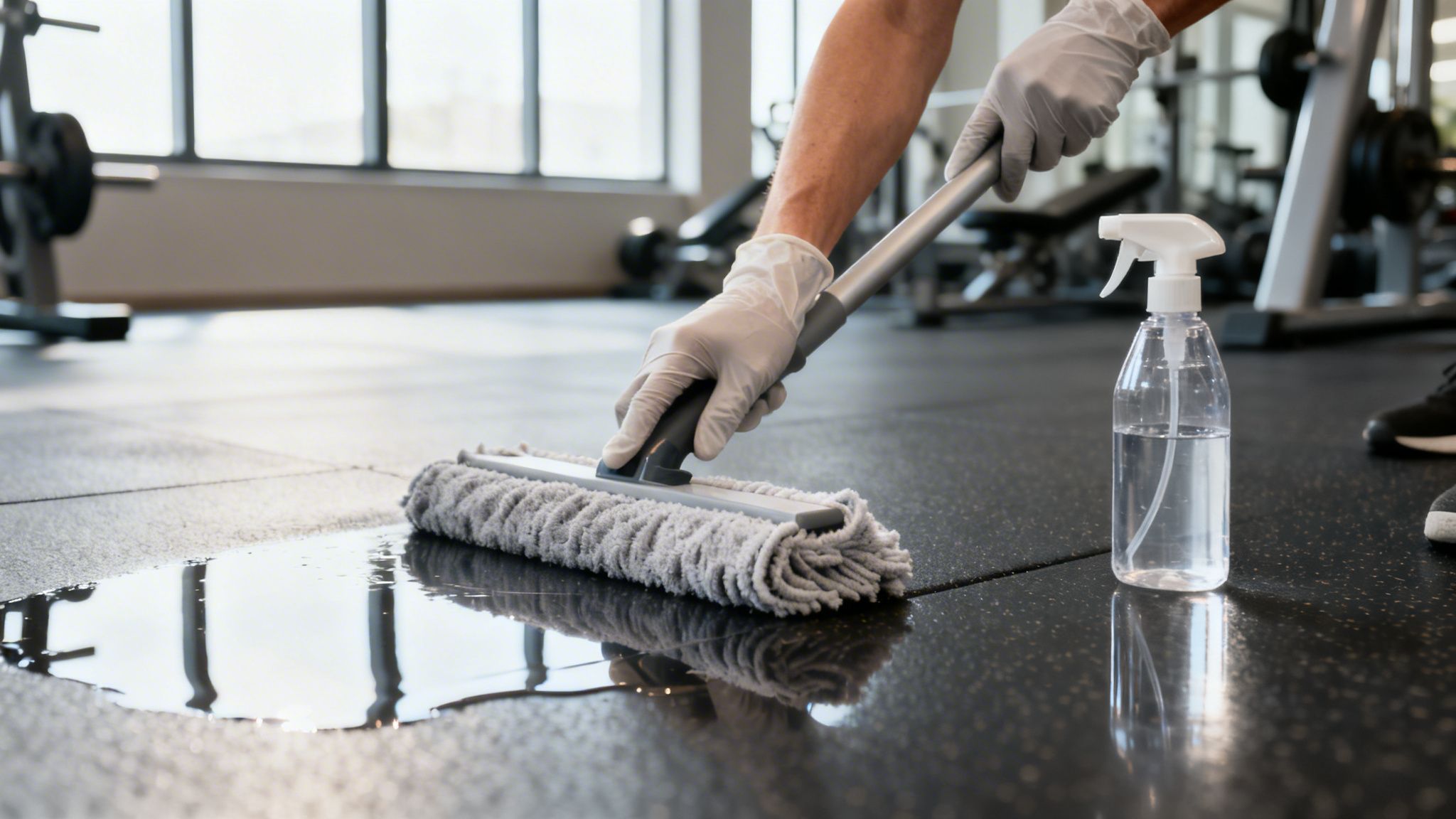
When you're choosing the best gym floor cleaner, it's easy to focus on what you can see—scuff marks, dirt, and dust. But the real goal isn't just a floor that looks clean. It’s about using an EPA-registered disinfectant that’s proven to kill the viruses and bacteria you can't see.
A shiny floor doesn't mean it's safe, and that makes your choice of cleaner one of the most important health decisions for your facility.
The Invisible Risk on Your Gym Floor
That polished gleam on your gym floor? It's hiding a lot more than you think. Every footprint, drop of sweat, and piece of shared equipment leaves behind an invisible trail of pathogens. A quick mopping might make it look clean, but the real threat is microbial.

Gyms are busy, high-touch spaces, which makes them perfect breeding grounds for germs. Viruses like Influenza can settle on floors from airborne droplets, while incredibly tough pathogens like Norovirus (the "stomach flu") and Hepatitis A Virus (HAV) spread easily from contaminated surfaces. Even the common cold, caused by rhinoviruses, can linger on floors and equipment.
The Science of Surface Transmission
Many viruses are surprisingly tough. They can survive for hours, or even days, on the non-porous surfaces common in gyms—like rubber, vinyl, and sealed hardwood. Think about it:
- Influenza A Virus (H1N1) can live on hard surfaces for up to 48 hours.
- Norovirus is notorious for surviving for days or even weeks, and it resists many common cleaning products.
- SARS-CoV-2 can stay viable on materials like plastic and stainless steel for several days.
This means every burpee, push-up, and stretch on the floor is a potential contact point with a virus. To really get a handle on this, you can check out our detailed guide on https://virusfaq.com/2025/09/08/how-long-do-viruses-live-on-surfaces/ and the factors that help them stick around.
The most important thing to remember is this: a floor that only looks clean gives a false sense of security. Real safety comes from breaking the chain of transmission with effective disinfection.
More Than Just a Chore
If you're still treating floor cleaning as just another task on the maintenance checklist, it's time for a rethink. It should be a core part of your public health strategy. The goal is to get past simple appearances and put a protocol in place that actively wipes out viral threats, including persistent pathogens like Hepatitis B Virus (HBV) and Herpes Simplex Virus 1 (HSV-1).
Effectively tackling these invisible dangers means understanding how to deal with serious pathogens, which is why resources on cleaning superbugs and infectious bacteria are so valuable.
Using the right gym floor cleaner with virucidal power isn't just about ticking a box. It's about protecting your members and staff. In this guide, we'll walk you through the practical steps to turn your cleaning routine into a powerful defense against viral spread.
Choosing the Right Disinfectant for Your Gym Floor
Picking a cleaner for your gym floor isn't just about getting a good shine. It’s a critical health and safety decision. If your cleaner can't kill serious pathogens like Influenza, Norovirus, or SARS-CoV-2, it's not doing its most important job. You need a product that truly disinfects, not just cleans.
It’s easy to get lost in the jargon on product labels. But knowing the difference between a cleaner, sanitizer, and disinfectant is the first step to making a smart choice.
- Cleaners are for removing dirt and grime. They get rid of some germs by physically lifting them off the surface, but they don’t kill them.
- Sanitizers knock down the number of bacteria to a level considered safe by public health standards. But here's the catch: they don't always kill viruses.
- Disinfectants are the real deal. These are chemicals formulated to destroy or inactivate both bacteria and viruses on hard, nonporous surfaces.
In a gym—a place with constant foot traffic and sweat—using a true disinfectant isn't optional. It’s how you actively kill the pathogens that threaten the health of your members and staff.
Decoding EPA Registration and List N
When you're looking at a disinfectant, the first thing to check for is an EPA registration number on the label. This isn't just a random string of numbers; it's your proof that the product has been tested and that the U.S. Environmental Protection Agency backs its claims. It means the product actually works.
For fighting specific viruses, especially new ones, the EPA created List N. This is your go-to resource for disinfectants proven effective against SARS-CoV-2, the virus that causes COVID-19. If a product is on List N, it means it has demonstrated power against a tough-to-kill virus, which gives you confidence it can handle a wide range of other viral threats.
A disinfectant’s appearance on the EPA's List N is the gold standard. It tells you the product is equipped to handle serious viral pathogens, giving you peace of mind during routine cleaning and outbreak situations.
Matching Active Ingredients to Your Needs
The "active ingredient" is the workhorse chemical in a disinfectant that actually kills the germs. Let’s take a look at the most common ones you'll see in gym floor cleaners and what they're best for.
Comparing Gym Floor Disinfectant Active Ingredients
The table below breaks down some of the most common active ingredients, their effectiveness, and which floors they are safest to use on.
| Active Ingredient | Effective Against | Best For Floor Types | Key Consideration |
|---|---|---|---|
| Quaternary Ammonium (Quats) | Bacteria, Enveloped Viruses (e.g., Influenza, SARS-CoV-2, Human Coronavirus) | Rubber, Vinyl, Sealed Concrete, Epoxy | A versatile workhorse for daily use. Some formulations struggle with non-enveloped viruses like norovirus. |
| Hydrogen Peroxide | Broad-Spectrum (Bacteria, Viruses, Fungi, Norovirus) | Vinyl, Tile, Sealed Concrete | Very effective but can be harsh on certain sensitive materials. Look for "accelerated" formulas. |
| Sodium Hypochlorite (Bleach) | Broad-Spectrum (Excellent against Norovirus, Feline Calicivirus) | Unfinished Concrete, Tile & Grout | Highly effective and cheap, but corrosive to metals and can damage or discolor rubber, wood, and vinyl. |
| Phenolic Compounds | Bacteria, Fungi, Tuberculosis | Concrete, some hard nonporous surfaces | Less common in modern floor cleaners due to potential for skin irritation and leaving a residue. |
One of the most reliable active ingredients for gym environments is Quaternary Ammonium Compounds, or "quats." They strike a great balance, offering strong performance against a broad range of pathogens while being compatible with most common gym flooring materials. For more advanced applications, you might want to look into using an electrostatic disinfectant sprayer to guarantee total surface coverage.
The industry has seen a massive shift toward more powerful cleaning since 2020. We've seen a huge rise in demand for concentrated, industrial-strength floor cleaners. For example, using neutral pH cleaners is absolutely vital for maintaining expensive rubber matting while still killing stubborn pathogens like norovirus, which is responsible for millions of illnesses each year. Concentrates also make financial sense, which is why so many facilities switched to them to cover large floor areas post-pandemic.
Protecting Your Flooring Investment
A powerful disinfectant shouldn't ruin your expensive floors. The pH level of a cleaner is a critical factor here. A pH-neutral cleaner, with a pH of around 7.0, is almost always your safest bet for common gym surfaces like rubber, vinyl, and sealed wood.
- Acidic cleaners (with a low pH) can eat away at floor finishes and sensitive materials.
- Alkaline cleaners (with a high pH) can be overly aggressive, leading to discoloration or breaking down the flooring material itself over time.
Specialty floors, especially hardwood courts, need their own specific protocols. It’s crucial to know how to disinfect wood floors safely and effectively to kill pathogens without destroying the wood's integrity. Always, always check the product label and your flooring manufacturer’s care guide to make sure they're compatible before you start mopping.
A Practical Protocol for a Virus-Free Floor
Knowing which gym floor cleaner to use is half the battle. Knowing how to use it correctly is what actually delivers a disinfected surface that protects your members. A quick mop-and-go just doesn't work against tough pathogens like Norovirus or Influenza A2/305/57 (H2N2).
To stop these invisible threats in their tracks, you need a repeatable, professional-grade protocol. This isn't just about looking clean; it’s about public health. A flawed process can do more harm than good, spreading germs around and creating a false sense of security. Let's walk through the essential steps to get it right.
Phase One: Prepping the Surface
Before a single drop of disinfectant hits the floor, you have to get rid of all the loose debris. Dust, dirt, hair, and chalk act like a shield, preventing your cleaner from reaching the viruses underneath. It’s like trying to paint a dusty wall—the paint simply won't stick.
- Dry Mopping: Start with a high-quality microfiber dust mop. Unlike old-school cotton mops that just push dirt around, microfiber actually traps and holds onto fine particles.
- Vacuuming: For larger spaces or textured rubber flooring, a commercial vacuum is your best friend. Just be sure to turn off the beater bar to avoid scratching the surface. This is especially great for sucking up chalk dust around lifting platforms.
- Scuff Mark Removal: Deal with ugly scuff marks from shoes before disinfecting. Here’s a pro tip: rub a clean tennis ball firmly over the mark. The gentle abrasion lifts the rubber residue without damaging the floor’s finish.
Skipping this prep work is non-negotiable. If you do, you're just wasting time and expensive disinfectant, as the active ingredients will be neutralized by all that grime before they can do their job.
This simple guide helps visualize the thought process for choosing and using a cleaner the right way.

Thinking in this order—check the label, match the pH, then disinfect—ensures you’re set up for success before you even fill the first mop bucket.
Phase Two: Dilution and Application
With a clean, prepped surface, it's time to mix your disinfectant. This is where a lot of well-meaning people go wrong. Using too little won't kill the viruses, but using too much can leave behind a hazardous, slippery residue and even damage your floors over time.
Always follow the manufacturer's dilution ratio on the label. This isn't a suggestion; it's a scientific formula designed for efficacy and safety. A common ratio like 1:256 means you need one part concentrate for every 256 parts water. Use a dedicated measuring cup or a dilution control system to nail the mixture every single time.
Professional cleaning is all about consistency. The two-bucket mop system is a simple but incredibly effective way to stop cross-contamination. One bucket holds your clean disinfectant solution, and the other is for rinsing your dirty mop. This one change prevents you from mopping germ-filled water right back onto the floor.
For larger gyms, an auto-scrubber is the gold standard. These machines lay down the cleaning solution, scrub the floor, and vacuum up the dirty water all in one pass. It’s the best way to get a consistent, thorough clean across a big area. The investment in proper equipment is a big reason the floor cleaning equipment market is such a massive industry.
Gym floors aren’t just slippery from sweat—they can be viral hotspots. The broader floor cleaning equipment market, essential for large-scale gym maintenance, was valued at USD 178 billion in 2025 and is projected to explode to USD 624.1 billion by 2035. New robotic and AI-driven cleaners are changing the game, cutting manual labor by 50% while ensuring consistent disinfection against viruses that can survive for 72 hours on floors. Most importantly, studies show that clean gym floors can slash respiratory infection risks among members by up to 40%. You can explore more data on the scale of this industry and its impact on public health.
Phase Three: Contact Time and Finishing
This last step is the most important—and the one people forget most often: contact time. Also called "dwell time," this is the amount of time a disinfectant must stay visibly wet on a surface to kill the germs listed on its label. If it dries too soon, the disinfection process stops dead.
The required contact time, which can range from 30 seconds to 10 minutes, will be printed clearly on the disinfectant’s label.
- Application: Be generous when you apply the solution. You need enough to ensure the surface won't evaporate dry before the dwell time is up.
- Ventilation: Good air circulation can speed up drying. To counteract this, work in smaller, manageable sections to make sure you’re meeting the required contact time everywhere.
- Final Rinse: Some disinfectants, especially those that aren’t pH-neutral, need a final rinse with clean water. This removes any residue that could become slippery or attract more dirt. Always check the label for rinsing instructions.
Once the contact time is met and any rinsing is complete, let the floor air dry completely before anyone walks on it. Don't forget to put out "Wet Floor" signs to keep everyone safe. For handling smaller spills between deep cleans, keeping a stash of powerful disinfecting wipes on hand is a great way to maintain hygiene without breaking out the mops.
Protecting Your People and Your Surfaces
Using a powerful, virus-killing disinfectant on your gym floors is a must, but it can’t come at the expense of your staff’s safety or your expensive flooring. An aggressive disinfectant can be just as aggressive on people and surfaces if you’re not careful. This is all about finding the right balance—wiping out pathogens without causing harm.
Getting this right isn't just about good policy. It's about protecting your team from chemical exposure and your facility from thousands of dollars in preventable damage.

Prioritizing Staff Safety With PPE
Your cleaning crew is on the front lines, handling concentrated chemicals that can be tough on skin, eyes, and lungs. Making sure they have—and use—the correct Personal Protective Equipment (PPE) is non-negotiable.
Here’s the absolute minimum they should be using:
- Gloves: Nitrile or rubber gloves are a must for preventing skin contact, both with concentrates and diluted solutions.
- Eye Protection: Safety glasses or goggles are critical. A small, accidental splash while mixing or pouring can cause serious eye damage.
- Proper Attire: Always wear closed-toe, slip-resistant shoes. Wet floors are an unavoidable part of the job.
Training is just as important as the gear itself. Your team needs to know the specific hazards of every product they use. For a more detailed breakdown, you can learn more about how to use personal protective equipment in our dedicated guide. And don't forget the basics, like putting out highly visible "Wet Floor" signs to prevent falls.
How to Match Your Cleaner to Your Floor Type
One of the costliest mistakes I see facility managers make is grabbing a one-size-fits-all cleaner. The wrong chemical can permanently discolor, warp, or crack your flooring, and it might even void the manufacturer's warranty.
Here's a quick rundown of what different floors need:
- Rubber Flooring: This is the standard for weight rooms, but it's sensitive. You must use a pH-neutral cleaner. Anything highly acidic or alkaline will make the rubber brittle and cause it to break down over time.
- Hardwood Courts: A classic basketball court finish needs a specialized, pH-neutral cleaner made for sealed wood. A harsh chemical will strip that protective sealant right off, leaving the wood exposed to moisture and damage.
- Vinyl Composite Tile (VCT): VCT is tough, but the wax finish that gives it a shine can be dulled or stripped by the wrong cleaner. Stick to neutral-pH formulas to keep it looking good.
- Artificial Turf: For indoor turf, always check what the manufacturer recommends. Most suggest a gentle, neutral cleaner followed by a good rinse to get rid of any residue.
The biggest mistake is assuming a product is safe just because it kills viruses. The very ingredients that make a disinfectant effective against pathogens like Human Immunodeficiency Virus Type 1 (HIV-1) can also make it destructive to certain materials. Always, always check for compatibility.
The Essential Pre-Cleaning Spot Test
Before you ever let a new gym floor cleaner loose on your entire facility, you need to do a spot test. This is a simple five-minute check that could save you from a catastrophic mistake.
Here’s how we do it:
- Find a small, out-of-the-way area to test, like under a heavy machine or in a storage closet corner.
- Mix and apply the cleaner exactly as you plan to use it. Follow the label’s instructions for dilution and, most importantly, contact time.
- Let it sit for the required time, then let the area dry completely.
- Once dry, get down and inspect it closely. Look for any changes at all—discoloration, a dull finish, stickiness, or any softening of the material.
If the test area looks exactly as it did before, you're good to go. This little bit of prep work is the best insurance policy you have against widespread floor damage. It's a fundamental step that protects your people, your surfaces, and your gym's reputation.
Daily Routine vs. Outbreak Response
Your cleaning plan shouldn't be a one-size-fits-all document. It needs to be a living playbook that adapts to what's happening on the ground. How you clean your floors on a slow weekday is, and should be, entirely different from how you’d tackle them during a local flu outbreak.
Knowing when to stick to the daily grind and when to flip the switch to emergency mode is what truly separates an average gym from one that’s serious about member safety. This dual approach helps you manage the everyday germ load while also being ready to act fast when a real threat—like a confirmed case of Bovine Viral Diarrhea Virus (BVDV) or Hepatitis C Virus (HCV)—walks through your doors.
The Rhythm of Routine Daily Disinfection
For day-to-day operations, your goal is simple: management and prevention. You’re not fighting a five-alarm fire; you’re keeping the embers from ever catching light by consistently reducing the germs left behind from sweat, shoes, and airborne droplets.
A solid daily protocol is all about efficiency and consistency.
- Hit the Hot Spots First: Don't waste time. Zero in on the areas that get the most traffic—the main walkways, group fitness rooms, stretching mats, and the floor around the free weight racks and cardio deck.
- The After-Hours Deep Clean: The best time for a full-floor disinfection is after you lock up for the night. This gives your disinfectant the uninterrupted contact time it needs to work and lets the floors dry completely, preventing slips and falls the next morning.
- Use the Right Gear: For bigger gyms, an auto-scrubber is a game-changer, cutting a multi-hour job down to a fraction of the time. In smaller spaces, a good old-fashioned two-bucket mop system with a neutral pH gym floor cleaner works just as well.
The real secret to a successful routine is making it dead simple. When your staff has an easy, repeatable process to follow every night, you’ll see compliance skyrocket and germ transmission plummet.
A strong biosecurity plan is built on preparedness. This isn't just about having enough floor cleaner concentrate on hand. It means stocking up on powerful disinfecting wipes for spot-cleaning equipment throughout the day and being ready for anything.
Shifting Gears for an Outbreak Response
Everything changes the moment you get a call that a member or employee with a confirmed contagious illness—like Duck Hepatitis B Virus (DHBV), Norovirus, or even Avian Influenza Virus (H5N1) —was in your facility. Your protocol has to shift instantly from routine maintenance to rapid eradication.
This is where your investment in a broad-spectrum, EPA-registered gym floor cleaner really pays off. Your response needs to ramp up immediately.
Expanding the Disinfection Zone
During an outbreak, you have to assume the virus is everywhere the infected person might have been. "High-traffic areas" no longer cuts it.
You need to expand your cleaning and disinfection to cover:
- Adjacent Areas: Think beyond the main floor. You need to hit the locker rooms, front entrance, hallways, and even the office space.
- Vertical Surfaces: Viruses don't just stay on the floor. A cough or a sneeze can aerosolize particles that land on walls, doors, and partitions. Clean everything up to at least six feet high.
- All Equipment: Every single piece of equipment in the contaminated zones needs a deep disinfection, not just a quick wipe-down.
Elevating Frequency and Intensity
In an outbreak scenario, cleaning once a day is dangerously insufficient. You have to increase your cleaning frequency dramatically to break the chain of transmission.
This might mean disinfecting the entire floor several times a day, especially during your busiest hours. You should also check if your disinfectant is effective against the specific pathogen you're dealing with. If it's a norovirus outbreak, for example, you need a product explicitly rated to kill it. Many standard disinfectants simply won't work on a tough, non-enveloped virus like that.
This is exactly why the market for specialized gym floor cleaners is exploding. It's projected to grow from USD 0.97 billion in 2026 to USD 1.71 billion by 2036. Gyms and fitness clubs are the biggest players, making up 54.0% of the market because they're on the front lines of preventing viral spread. As you can see from these insights on cleaning chemicals for fitness facilities, the right cleaning protocols can stop a viral transmission cycle in its tracks and make shared spaces dramatically safer.
Your Top Questions About Gym Floor Disinfection, Answered
Even with a solid cleaning plan, there are always lingering questions. It's natural. When you're dealing with member safety, getting the details right is what separates an effective protocol from just going through the motions.
Let’s clear up some of the most common points of confusion we hear from gym owners and managers.
How Often Should I Disinfect My Gym Floor?
This really comes down to one thing: foot traffic. A 24/7 commercial gym has a much different risk profile than a small, appointment-only training studio.
For most fitness centers, the goal should be daily disinfection of high-contact floor zones. Think about your busiest areas—the group fitness room, stretching mats, and the floor space around free weight racks and treadmills. These are your non-negotiables.
A full-floor disinfection might be an end-of-day task, but don't underestimate targeted cleaning. Keeping effective disinfecting wipes on hand lets your team quickly hit small, high-use spots between classes. It's a simple way to add another layer of protection right when you need it.
Using a professional gym floor cleaner concentrate makes this a lot easier. When a product is easy to dilute and apply, that daunting daily task becomes a fast, manageable part of your closing routine.
Can't I Just Use Bleach on My Gym Floor?
Absolutely not. While bleach is a beast against tough viruses like Norovirus, it's the wrong tool for this job and will cause expensive, irreversible damage to your facility.
Bleach is highly alkaline and will wreak havoc on your floors:
- It degrades pricey rubber flooring, making it brittle and causing it to crack over time.
- It can strip the finish right off hardwood courts, leaving the wood exposed to moisture damage.
- It causes permanent discoloration on vinyl and colored rubber surfaces.
Instead of reaching for a bottle of bleach, you need a pH-neutral, purpose-built gym floor cleaner. These formulas are engineered to kill a broad spectrum of pathogens without harming the specialized surfaces you’ve invested in. They protect both your members and your flooring.
What's the Biggest Mistake People Make?
Hands down, the single biggest mistake is ignoring the product label. Specifically, people mess up the dilution ratio and the contact time. It’s a common mindset to think "a little extra can't hurt" or that a quick spray-and-wipe is enough.
These two errors completely undermine your efforts.
- Wrong Dilution: Too much concentrate leaves a slippery, dangerous residue and can eat away at floor finishes. Too little, and the solution isn't strong enough to kill viruses like Influenza A (H1N1) or Herpes Simplex Virus 2 (HSV-2).
- Ignoring Contact Time: This is critical. If a disinfectant needs 10 minutes to work but dries on the surface in three, you haven't disinfected anything. The chemical reaction was cut short.
Following the label isn't a suggestion—it’s the science that makes the product work. Look for disinfectants with clear instructions to minimize these mistakes and ensure you're actually getting the job done.
Are "Green" Cleaners Effective Against Viruses?
This is a fantastic question, and the answer is all about using the right product for the right task. Many "green" or eco-friendly cleaners are excellent for what they're designed for: removing dirt, sweat, and grime.
However, killing viruses is a different ballgame. For a product to legally claim it's a virucide, it has to be tested and registered with the EPA. Most green cleaners are simply not registered disinfectants, so you can't rely on them to kill pathogens.
The best approach is to use both. Use your favorite green cleaner for general cleaning. But when it's time to disinfect—the specific step for killing viruses like Human Rotavirus or Rhinovirus Type 14 and Rhinovirus Type 39—you must switch to an EPA-registered product. It's not about one being better than the other; it’s about understanding their distinct roles in keeping your facility truly clean.
Leave a Reply