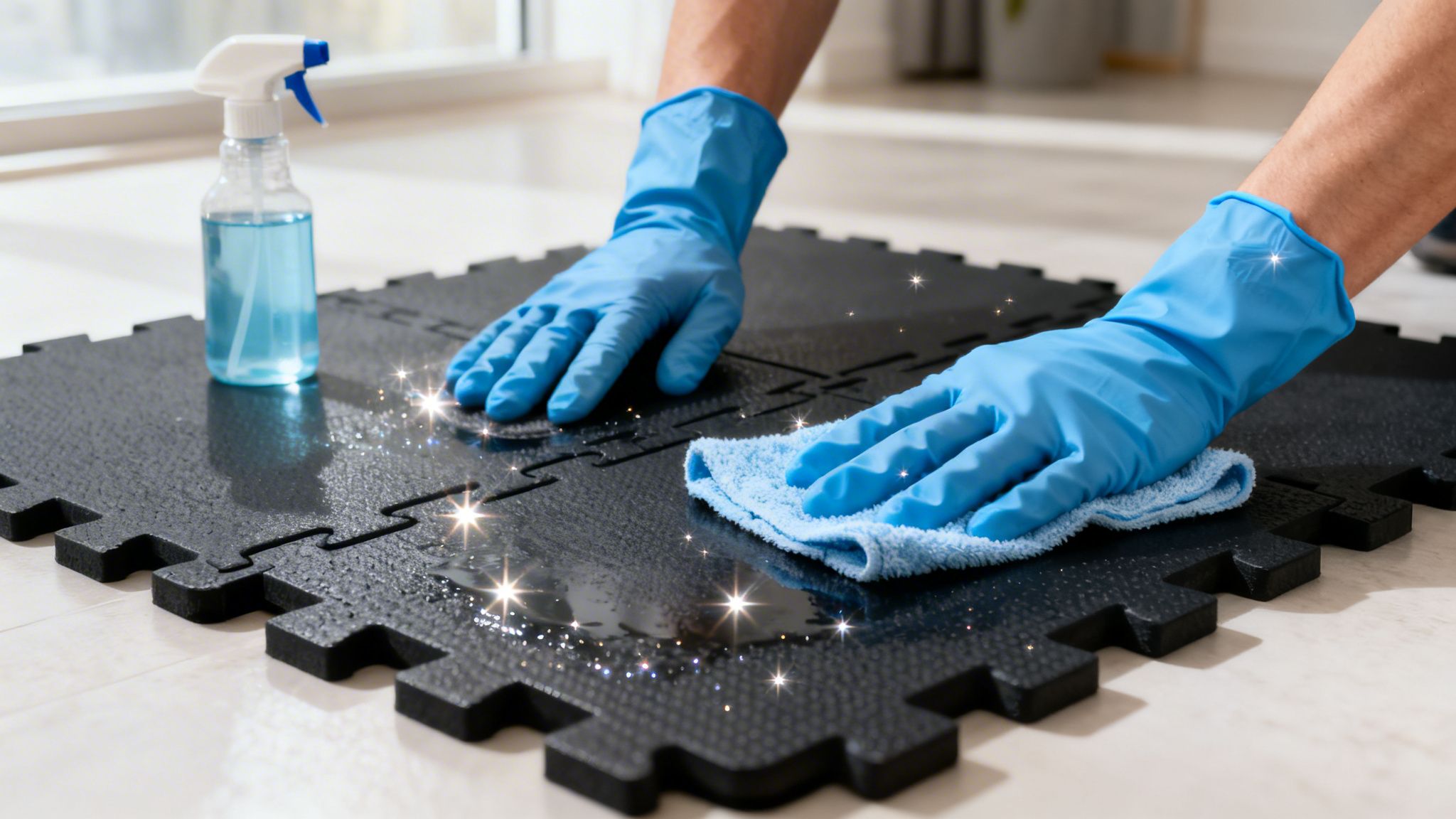
Cleaning rubber floors isn't just about making them look good. It's a two-step job: first, you use a neutral pH cleaner to tackle daily grime, and then you follow up with an EPA-approved disinfectant to kill dangerous viruses. This approach is the only way to protect both your flooring investment and the health of everyone who uses the space, especially in busy gyms, clinics, and schools.
Why You Can't Afford to Get Rubber Floor Cleaning Wrong

Let's get straight to it. Cleaning is your first line of defense against things you can't see. Rubber flooring is a popular choice for high-traffic places like gyms, healthcare facilities, and playrooms because its non-porous surface naturally resists moisture. This makes it harder for many germs to gain a foothold.
But that resistance has its limits. Without a solid cleaning routine, those same floors can become a hotspot for viruses, from the common Influenza A Virus (H1N1) to tough-to-kill pathogens like Norovirus. A quick mop-down might get rid of dirt you can see, but it does almost nothing to stop the microscopic threats that actually make people sick.
The Science Behind a Truly Clean Floor
There's real science to cleaning rubber floors effectively. It’s a core part of modern infection control. Because rubber is so durable, it can handle the frequent, tough disinfection protocols needed to keep a space safe—protocols that would wreck other types of flooring.
This is critical when you're up against viruses that can stick around for a while. Some pathogens are alarmingly good at surviving on surfaces, which makes regular disinfection an absolute must. In fact, you can learn more about how long viruses live on surfaces in our detailed guide, which really drives home why you need to disinfect, not just clean.
A proper disinfection protocol isn't just for show—it's a powerful public health tool. When done right, it can slash viral loads on surfaces by up to 99.9%, turning a floor from a potential transmission zone into a safe surface.
It's no surprise that the global market for rubber flooring is booming, growing from $12,539.2 million in 2021 to a projected $15,241.5 million by 2025. This growth is fueled by its proven performance in places where health and safety are the top priority.
It's About More Than Just Germs
Beyond fighting viruses, the right cleaning routine is what protects your financial investment. Using the wrong products, like harsh solvents or acidic cleaners, can do permanent damage. I’ve seen it happen.
- Fading and Discoloration: Aggressive chemicals can literally strip the color right out of your floor.
- Surface Breakdown: Abrasive cleaners and harsh chemicals can make the rubber brittle, leading to cracks over time.
- Dull, Sticky Finish: The wrong products often leave behind a residue that not only dulls the floor's appearance but also acts like a magnet for more dirt.
Ultimately, getting rubber floor cleaning right accomplishes two things at once. It creates a space that looks clean and professional, and more importantly, it makes it fundamentally safer for everyone. In the next sections, we'll dive into the exact steps and products you need to do just that.
Choosing Your Cleaning and Disinfecting Arsenal
Picking the right products for your rubber floors can feel like a chore, but it really comes down to a simple, two-part game plan. You need a gentle workhorse for everyday grime and a heavy-hitter for the invisible threats. These are two totally different jobs, and using the wrong product can either fail to kill viruses or, worse, ruin your floor.
Let's start with your daily cleaner. For routine mopping, a neutral pH cleaner is the only way to go. These are made to lift dirt without being too acidic or alkaline, which can slowly eat away at rubber. Think of it as the right soap for the job—safe, effective, and won't cause problems down the line.
It's tempting to grab a harsh, all-purpose cleaner to save time, but I've seen that backfire. It often leaves a sticky film that just attracts more dirt. Even worse, acidic or solvent-based chemicals can cause rubber to get brittle, discolored, and cracked, turning a durable investment into a mess.
Cleaners vs. Disinfectants: What's the Difference?
Knowing the difference between a cleaner and a disinfectant is the foundation of keeping a space truly hygienic. They do two separate but equally vital jobs.
- Cleaners: Their job is to get rid of dirt, spills, and other gunk on the surface. They lift grime so you can mop it away. This first step is crucial because it physically removes a lot of germs and clears the path for your disinfectant to work.
- Disinfectants: These are the chemicals that actually kill microorganisms like bacteria and viruses. To be called a disinfectant, a product has to meet specific government standards. But here's the catch: they don’t clean well, and dirt can actually block them from killing germs.
That’s exactly why the pros use a two-step process: clean first, then disinfect. You clear away the debris so the disinfectant can make direct contact with pathogens like Influenza A (H1N1) or SARS-CoV-2 and eliminate them.
Choosing a Disinfectant That Actually Works
When it's time to kill germs, your choice of chemical is everything. Not all disinfectants are the same, especially when you're up against different kinds of viruses. The biggest threats usually fall into two buckets: enveloped and non-enveloped viruses.
Enveloped viruses, like the Human Immunodeficiency Virus Type 1 (HIV-1) and Herpes Simplex Virus 1 (HSV-1), have a fatty outer layer that’s pretty easy for common disinfectants to dissolve. But non-enveloped viruses, such as Norovirus (Norwalk Virus) and Rhinovirus Type 14, don't have this weak spot, making them much harder to kill.
You'll want a disinfectant with active ingredients proven to take down a wide range of these pathogens.
When you're trying to figure out which disinfectant is right for you, it helps to compare your options side-by-side.
Disinfectant Selection Guide for Rubber Flooring
This table breaks down some of the most common disinfectants, what they’re good for, and how they play with rubber flooring.
| Disinfectant Type | Effective Against | Recommended Contact Time | Notes for Rubber Flooring |
|---|---|---|---|
| Quaternary Ammonium Compounds (Quats) | Enveloped viruses (Hepatitis C Virus, Human Coronavirus), some non-enveloped viruses | 10 minutes | Generally safe for rubber, but always do a final rinse to avoid a slippery residue. |
| Hydrogen Peroxide | Broad-spectrum (enveloped & non-enveloped viruses like Norovirus) | 1-5 minutes | An excellent choice. It's powerful and breaks down into just water and oxygen. |
| Hypochlorous Acid (Bleach) | Broad-spectrum, including tough non-enveloped viruses | 5-10 minutes | Very effective, but can be corrosive. Always use a diluted solution and rinse thoroughly. Our guide on using bleach for disinfection has more safety tips. |
| Alcohol (Isopropyl or Ethanol) | Enveloped viruses, some non-enveloped | 30 seconds – 1 minute | Best for small spots or wiping down equipment, not for mopping large floors. |
Remember to cross-reference your choice with your flooring manufacturer's guidelines to be absolutely sure you're using a compatible product.
The good news is that rubber is incredibly tough. In fact, studies on disinfection efficacy have shown rubber flooring can handle over 5,000 cleaning cycles with hydrogen peroxide disinfectants, achieving a 99.9% reduction in tough-to-kill viruses like norovirus. This resilience allows for the aggressive disinfection needed in high-traffic areas without breaking down the material. For more on material performance and trends, you can read the full research on the rubber flooring market.
Expert Tip: Always look for the EPA registration number on the product label and check what germs it's proven to kill. Most importantly, find the contact time (or "dwell time")—that's how long the surface needs to stay visibly wet for the disinfectant to do its job. If it dries too fast, you're not getting full disinfection.
If you prefer greener alternatives, there are some good options out there. When looking for eco-friendly products, you can explore natural floor cleaning solutions that use plant-based ingredients, but make sure you double-check their claims about killing viruses.
Finally, don't forget about pre-moistened disinfecting wipes. For small messes, like a spill in a daycare or wiping down a piece of gym equipment, they are perfect. They combine the cleaner and disinfectant in one easy step and deliver the right amount of solution, making them a smart tool for quick, on-the-spot virus control.
The Professional’s Guide to Deep Cleaning and Disinfection
This is where the rubber meets the road—literally. Let’s go through the exact process a seasoned pro would use to get a floor that isn't just visually clean, but genuinely safe from a viral standpoint. Following these steps protects your flooring investment and, more importantly, the people who use it.
First, Clear the Debris
Before a single drop of cleaner hits the floor, you have to get rid of all the loose dirt, dust, and grime. This is a non-negotiable first step. If you skip it, you're just making mud and giving viruses a place to hide. Your disinfectant can't work if it can't make direct contact with the surface.
A vacuum cleaner equipped with a HEPA filter is your best bet here, as it traps fine dust and allergens that a broom might just kick into the air. Just make sure to use an attachment without a beater brush to avoid scratching the rubber. A simple broom or a dry microfiber dust mop also works perfectly fine for gathering up debris.
The Two-Bucket Method for a Superior Clean
With the loose debris gone, it's time for the initial wash using your neutral pH cleaner. The goal is to lift away any caked-on grime or body oils that can block your disinfectant. I always recommend the two-bucket method; it's a small change in process that makes a world of difference.
- Bucket 1: This one gets your diluted neutral pH cleaning solution.
- Bucket 2: Fill this with clean, plain water for rinsing.
Here’s the process: Dip your mop in the cleaning solution, wring it out until it’s just damp, and clean a section of the floor. Now, here’s the key—before dipping back into your cleaner, rinse the dirty mop thoroughly in the plain water bucket. This simple action stops you from contaminating your cleaning solution and just spreading dirty water everywhere.
Pro Tip: Never, ever flood a rubber floor with water. Excess moisture can easily seep into the seams of interlocking tiles, creating a perfect breeding ground for mold and mildew. A damp mop is all you need for a fantastic clean.
This diagram shows the simple but effective workflow, from initial prep to the final disinfection step.

Following this sequence ensures that each step properly prepares the surface, making your final disinfection as effective as it can possibly be.
Disinfection and the Importance of Dwell Time
This is the most critical phase for eliminating viruses. Once the floor has been cleaned and is completely dry, you can apply your chosen EPA-registered disinfectant.
The real secret to killing germs is dwell time, also known as contact time. This is simply how long the disinfectant needs to stay visibly wet on the surface to kill the pathogens listed on its label. This can vary dramatically—from 30 seconds for some common viruses like Human Coronavirus to 10 minutes or more for tough-to-kill non-enveloped viruses like Norovirus.
If the surface dries before the required dwell time is up, you haven't actually disinfected it. You must reapply the product to keep it wet for the full duration. Trying to cut this step short is like stopping an antibiotic halfway through the course; you're not getting the job done. For larger spaces like commercial gyms or clinics, an auto-scrubber is a game-changer for applying disinfectant evenly and maintaining wetness.
Real-World Scenarios
Let's put this into practice in a couple of common settings.
Childcare Play Area: After a child has been out sick, you have to assume the floor is a high-risk zone. Vacuum all the debris first. Then, use the two-bucket method with a neutral cleaner. Finally, apply a disinfectant proven effective against common childhood illnesses like Human Rotavirus, making sure you hit that full dwell time before any kids are allowed back on the floor. For quick, spot-cleanups during the day, a good disinfecting wipe is an excellent tool to have on hand.
Post-Workout Gym Floor: Sweat, dropped water bottles, and heavy foot traffic make a gym floor a perfect place for viruses like Influenza to spread. At the end of the day, the protocol should be ironclad. First, a thorough sweep or vacuum. Next, run an auto-scrubber with a neutral cleaner to efficiently tackle the large area. Follow that up with a broad-spectrum disinfectant, like a hydrogen peroxide-based formula, which often has a fast contact time and is effective against the wide range of viruses you’d expect to find in a gym.
Tailoring Your Cleaning Strategy for Different Spaces
Cleaning a rubber floor isn't a one-size-fits-all job. The way you’d clean your home gym floor is completely different from the protocols required in a busy hospital or a daycare center. Getting it right means matching your cleaning strategy to the environment to effectively control viruses while protecting the floor itself.
Every space has its own unique risks, traffic levels, and expectations. A school needs powerful cleaners that are still safe for kids, while a commercial gym has to focus on speed and visible cleanliness to keep members happy and healthy. Let's walk through how to handle four common settings.
Home Gyms: Simple, Safe, and Consistent
In your personal workout space, consistency is more important than complexity. You don't need an arsenal of industrial chemicals, but a solid routine is crucial for handling sweat, germs, and general grime—especially if you have friends or family sharing the equipment.
- Quick Daily Wipe-Downs: After every workout, give the floor area a quick wipe with a disinfecting wipe. This is the easiest way to tackle fresh sweat and stop germs from setting up shop. Pay extra attention to the spots where you do floor exercises like push-ups or planks.
- Weekly Deep Clean: Once a week, set aside time for a more thorough cleaning. Start by vacuuming up any dust or debris with a soft brush attachment. Follow that with a damp mop using a simple neutral pH cleaner.
- Smart Disinfection: Unless someone in your house is sick, you probably don’t need to disinfect the entire floor every week. Just focus on disinfecting after an extra-sweaty session or if a friend with a cold stopped by for a workout. It’s a practical way to stay ahead of germs without overdoing it on the chemicals.
This simple rhythm keeps your gym hygienic without making your home feel like a sterile lab. Those quick daily wipe-downs are the real secret—they do most of the heavy lifting.
Commercial Fitness Centers: High-Traffic, High-Stakes
For a commercial gym, cleaning is a critical part of the business. It’s not just about public health; it's about earning and keeping member trust. The biggest challenge here is the sheer volume of people, sweat, and germs coming through the door all day, every day.
A solid gym floor cleaner protocol is simply non-negotiable. This means having a schedule for frequent cleaning throughout operating hours. Your staff needs to be trained to spot-clean high-traffic zones—like the free-weight area or the yoga studio floor between classes—on the fly. For a deeper dive, you can check out our guide on gym floor cleaners.
Once the doors close for the night, it’s time for a deep clean. This is where an auto-scrubber becomes your best friend, making quick work of large areas. The process should involve a two-step approach: first, a pass with a neutral pH cleaner to lift dirt, followed by an EPA-registered disinfectant to kill germs. Make sure the disinfectant is rated for common gym pathogens like the Avian Influenza Virus (H5N1) and tough-to-kill non-enveloped viruses like Norovirus.
Healthcare Settings: No Room for Error
In hospitals, clinics, and long-term care facilities, the stakes couldn't be higher. Rubber flooring is a popular choice for its durability and slip-resistance, but the cleaning protocol has to be absolutely perfect to prevent healthcare-associated infections (HAIs).
Here, cleaning is guided by strict infection control standards. This always means using a hospital-grade, EPA-registered disinfectant proven to kill a wide range of dangerous pathogens, including Hepatitis B Virus (HBV) and, where necessary, even resilient C. difficile spores.
Dwell time isn't just a suggestion—it's a rule. Staff are meticulously trained to make sure the floor stays wet for the full contact time required by the disinfectant, and this is often logged and verified. In a hospital, cleaning isn't a task; it's a core part of patient safety.
The industry-wide focus on creating safer healthcare environments is a big reason why the use of vulcanised rubber flooring is expected to reach 1.7 million tons by 2035. Its excellent slip resistance is especially vital in places like operating rooms, where preventing a fall can also prevent a potential viral exposure to pathogens like Bovine Viral Diarrhea Virus (BVDV). You can learn more about these rubber flooring market findings and its role in public health.
Schools and Daycares: Protecting Our Most Vulnerable
Cleaning rubber floors in schools and daycares brings a unique challenge: you need to knock out germs without leaving behind harsh chemical residues that could affect children. The products you use must be tough on common childhood illnesses like the cold-causing Rhinovirus Type 39 and Human Rotavirus, but gentle on little hands and lungs.
Public health experts have focused on this for years. In fact, some pilot programs in major U.S. school districts discovered that proper rubber floor maintenance can lead to a 15-20% drop in student absenteeism due to viral illnesses.
The best strategy usually involves a three-part system:
- End-of-Day Cleaning: Give the floors a thorough cleaning with a neutral pH cleaner after all the kids have gone home.
- Safe Disinfection: After cleaning, apply a disinfectant with a proven safety record. Products based on hydrogen peroxide or hypochlorous acid are excellent choices here.
- Final Rinse: Before kids arrive the next morning, do a final rinse with plain water to remove any lingering disinfectant residue.
Using child-safe disinfecting wipes for spot-cleaning spills and messes throughout the day is also a great way to immediately tackle germs and reduce the chances of them spreading.
Troubleshooting Common Problems and Long-Term Care

Even with the best cleaning routine, rubber floors can have their moments. From stubborn scuff marks that refuse to budge to a weirdly sticky film, knowing how to tackle these common issues is what separates a good maintenance plan from a great one. Don't worry, these problems are almost always fixable without causing damage.
The key is to resist the urge to grab an abrasive scrubber or a harsh chemical. A little patience and the right technique will protect your investment and keep it looking fantastic for years.
Solving Common Cleaning Headaches
Let's walk through some of the most frequent complaints I hear and how to solve them without damaging your floor.
- Getting Rid of Stubborn Scuff Marks: Before you break out the heavy-duty cleaners, try this old-school trick: grab a clean tennis ball and rub it firmly on the scuff mark. The felt is just abrasive enough to lift the mark without scratching the rubber. For tougher spots, a bit of your neutral pH cleaner on a microfiber cloth should do the job.
- Fixing That Sticky or Hazy Film: A sticky floor is the number one sign you're either using the wrong kind of cleaner, using way too much of it, or not rinsing thoroughly. The fix is simple but might take a pass or two. Just mop the floor with plain, clean water, making sure to rinse your mop head often to avoid spreading the residue around.
- Restoring a Dull, Lifeless Floor: Dullness is usually just a buildup of residue or fine dirt that regular mopping missed. After you’ve tackled any sticky film, a deep clean with a microfiber mop and a neutral pH solution will almost always bring back that natural sheen. In a gym or large commercial space, an auto-scrubber fitted with a soft nylon brush works wonders.
Smart Strategies for Long-Term Maintenance
Proactive care is always better than reactive cleaning. A few smart habits will dramatically extend the life of your floor and help it resist the buildup of dirt and germs.
The single most effective thing you can do is place high-quality walk-off mats at every entrance. These mats act as the first line of defense, trapping the vast majority of grit, dirt, and moisture before they ever get a chance to be ground into your rubber flooring.
A periodic deep clean is non-negotiable, especially in high-traffic gyms, schools, or healthcare facilities. I recommend a full restorative cleaning at least once or twice a year. This goes beyond daily mopping to scrub out any grime that has settled deep into the floor's pores, ensuring it stays truly clean and ready for proper disinfection.
The Role of Sealants and Moisture Control
People often ask me if they should seal their rubber floors. While some manufacturers do offer special sealants, they're not always necessary. A well-maintained, high-quality rubber floor looks great on its own.
But if you're considering it, here's the breakdown:
- The Upside: A sealant can add an extra buffer against tough stains and scuffs. It can also give the floor a uniform, higher-gloss look if that's what you're after.
- The Downside: It adds another layer of maintenance. That sealant will eventually need to be stripped and reapplied, which is a labor-intensive and costly job.
Finally, always be mindful of moisture. As part of your long-term care plan, checking out some general mold prevention tips is a smart move, especially in damp areas like locker rooms or basements. Always ensure the floor is completely dry after cleaning to stop moisture from creeping into the seams, which can cause serious problems down the road.
Common Questions About Caring for Rubber Floors
When it comes to keeping rubber floors clean and safe, a few questions pop up time and time again. Let's get them answered so you know you're protecting both your floor and the people who use it.
Can I Use a Steam Cleaner on My Rubber Floor?
This is probably the most common question I hear, and the answer is a hard no. It’s tempting to think steam is a great, chemical-free way to disinfect, but the high heat it produces is one of the worst things for a rubber floor.
That intense heat can make the rubber expand, warp, and eventually turn brittle. It also melts the adhesive holding your tiles or rolls in place, causing edges to lift and seams to pop open. Those gaps become perfect hiding spots for germs and moisture, completely undoing all your hard work.
The best approach is still the simplest: clean with a neutral pH cleaner, then follow up with a room-temperature, EPA-approved disinfectant. It’s tough on viruses like Influenza A2/305/57 Virus (H2N2) and Herpes Simplex Virus 2 (HSV-2) but won't damage the floor itself.
How Often Should I Disinfect My Home Gym Floor?
For a home gym, the right schedule is all about how you use the space. You don't need the daily deep-cleaning routine of a commercial facility unless there’s a good reason for it. It's a balance between hygiene and practicality.
Here’s a simple schedule that works for most people:
- After Every Workout: Do a quick spot clean. Grab a disinfecting wipe and hit the areas where you made contact with the floor—think where your hands were during push-ups or where sweat dripped. It only takes a minute and stops germs from building up.
- Weekly Cleaning: Once a week, give the floor a full cleaning. Sweep or vacuum up any debris, then mop with your neutral pH cleaner. This gets rid of the surface grime that makes a floor look and feel dirty.
- Targeted Disinfection: You don't need to disinfect the entire floor every week. Aim to do a full-floor disinfection every 1-2 weeks. You'll want to do it more often if someone at home is sick, you've had friends over to work out, or after an especially sweaty session.
What’s the Difference Between Cleaning and Disinfecting?
Getting this right is absolutely critical for stopping viruses. People often use the terms interchangeably, but they are two very different—and equally important—steps.
- Cleaning is about physically removing dirt, dust, and grime from the surface. You do this with a neutral pH cleaner, a mop, and water. This step is non-negotiable because germs and viruses love to hide under a layer of dirt.
- Disinfecting is the chemical step that actually kills pathogens like viruses and bacteria. But here's the catch: it only works on a surface that has already been cleaned. A disinfectant needs to make direct contact with a virus like Human Rotavirus or Feline Calicivirus to kill it.
Think of it this way: you clean for looks and to prep the surface, and you disinfect to kill the germs you can't see. If you skip the cleaning step, you’re just wasting disinfectant.
Are There Any Good Eco-Friendly Disinfectants for Rubber?
Absolutely. You don't have to choose between being environmentally conscious and being effective. The trick is to find products with active ingredients that are plant-based or break down into harmless elements, but that are still registered with the EPA for their ability to kill viruses.
Some of the best eco-friendly options out there include:
- Hydrogen Peroxide-Based Disinfectants: These are fantastic against a wide range of viruses, even tough-to-kill ones like Norovirus (Norwalk Virus). Their biggest selling point is that they decompose into simple water and oxygen, leaving zero toxic residue behind.
- Hypochlorous Acid: It might sound like bleach, but hypochlorous acid is a much gentler, non-toxic substance that's incredibly good at killing germs. It's trusted in healthcare and food service settings for its power and safety, even against pathogens like Duck Hepatitis B Virus (DHBV).
When you're looking at a "green" product, always flip it over and check the label. Make sure it's EPA-approved and lists the specific viruses you're trying to protect against. That's how you know you're getting something that’s both safe for the planet and effective for your health.
Leave a Reply