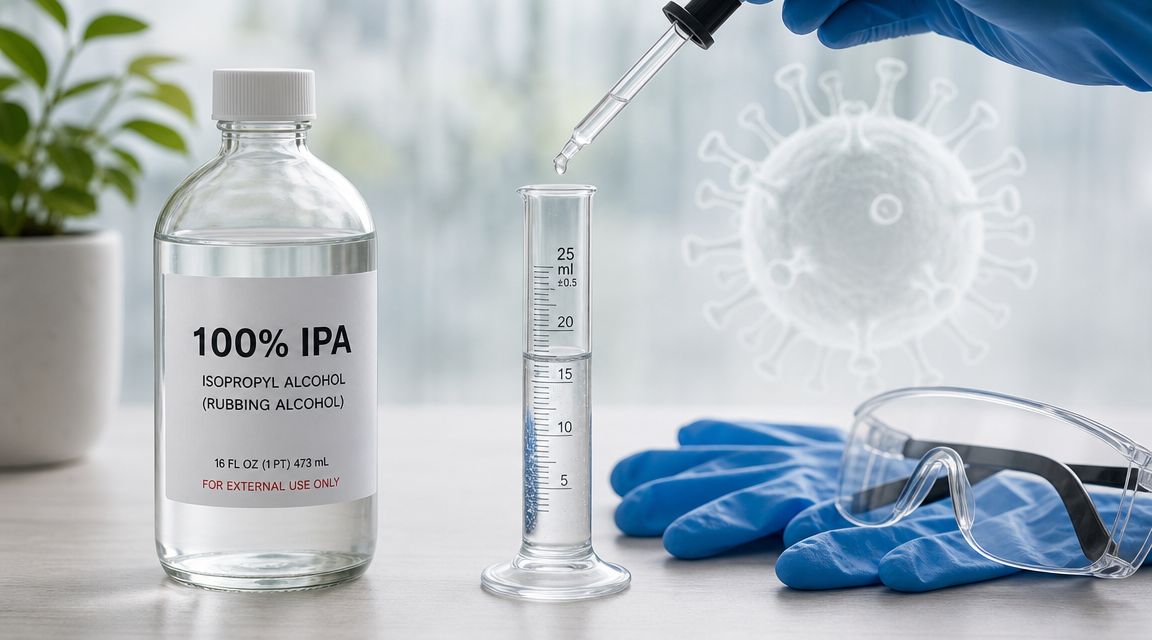
If a bottle says 100 rubbing alcohol, it usually means 100% isopropyl alcohol, not the common 70% rubbing alcohol found in many first-aid kits. For virus disinfection, that stronger product is often less effective than 70%, because pure alcohol evaporates too fast and the water in a 60% to 90% solution helps it stay in contact with microbes long enough to work.
That advice surprises people because it clashes with a very common instinct: stronger must be better. In chemistry, that isn't always true. A race car is faster than a delivery van, but it's the wrong tool for hauling groceries. 100 rubbing alcohol works the same way. It's excellent for certain technical jobs, but it's often the wrong choice for routine household disinfection.
A lot of confusion starts with the label. Some people use “rubbing alcohol” to mean any alcohol-based cleaner. Others assume “100” means “medical grade” or “extra powerful disinfectant.” Neither assumption is reliable. The number on the bottle changes how the liquid behaves on skin, on surfaces, and around viruses.
The safest way to think about it is simple. High-concentration isopropyl alcohol is more like a lab or electronics solvent. The familiar bottle in a medicine cabinet is usually formulated for a different purpose. Once you separate those two categories, the rest of the science gets much easier to understand.
Decoding the Label What Is 100 Rubbing Alcohol
When shoppers search for 100 rubbing alcohol, they're usually looking for the strongest version available. What they often find is not a standard first-aid product, but 100% isopropyl alcohol, also called IPA.
That distinction matters because “rubbing alcohol” is a product category, while isopropyl alcohol is a specific chemical. A bottle labeled 100% IPA is entirely alcohol, with no added water or denaturants, and that kind of product is commonly used for precision cleaning and residue removal rather than routine household disinfection, as shown in this 100% isopropanol product listing.
What most people have at home
The bottle in a typical home first-aid kit is usually a 70% isopropyl alcohol solution. That means it has water in it, and sometimes other ingredients depending on the brand and intended use.
Here's the practical difference:
| Product | What it usually means | Best-known use |
|---|---|---|
| 70% rubbing alcohol | Isopropyl alcohol diluted with water | First aid and routine disinfecting tasks |
| 100 rubbing alcohol | Essentially pure isopropyl alcohol | Precision cleaning, residue removal, electronics-related cleaning |
The confusion comes from the word “rubbing.” People hear it and think “skin-safe cleaner.” But a 100% IPA bottle may be sold for technical or industrial work, not for casual home use.
Practical rule: Don't judge alcohol by the front label alone. Read the percentage and the intended use.
Why the percentage matters so much
Water doesn't just dilute the alcohol. It changes how the liquid spreads, how quickly it evaporates, and how aggressively it strips oils from surfaces or skin.
That's why two bottles that both say “alcohol” can behave very differently:
- A diluted product may stay wet long enough to disinfect a countertop.
- A pure product may flash off so quickly that it acts more like a solvent than a disinfectant.
- A first-aid product may be designed with ordinary users in mind.
- A technical cleaning product may assume careful handling and very specific applications.
A better way to read the bottle
Before using any alcohol product, check three things:
The active ingredient
Is it isopropyl alcohol, or something else?The concentration
Is it a typical diluted rubbing alcohol, or is it near-pure IPA?The intended purpose
Does the label suggest first aid, surface cleaning, electronics, or industrial use?
That last point gets overlooked. A bottle can be chemically impressive and still be the wrong tool for wiping down a kitchen counter or cleaning your hands.
The Disinfection Paradox Why 70 Percent Alcohol Often Wins
The heart of the mystery is this: why would weaker alcohol disinfect better than pure alcohol? The answer is contact time and chemistry.
Public health guidance points to alcohol solutions in the 60% to 90% range for disinfection, with 70% commonly treated as the sweet spot. Pure alcohol can evaporate too quickly, while the water in a 70% solution helps it stay in contact with microbes long enough to work, as explained by Medical News Today's discussion of isopropyl alcohol versus rubbing alcohol.

Water is part of the mechanism
A useful analogy is cooking an egg. Heat changes the structure of the egg white proteins. Alcohol also disrupts proteins, but it needs enough time and the right conditions to do that thoroughly.
Water helps in two ways:
- It slows evaporation, so the surface stays wet longer.
- It supports deeper action, instead of letting the alcohol vanish almost immediately.
Pure alcohol is a bit like trying to clean a dirty pan with a paper towel that dries out the moment it touches the surface. It may hit fast, but it doesn't stay long enough to finish the job.
Why faster isn't better
People often equate fast drying with effective disinfection. Those are not the same thing.
For disinfection, the liquid has to remain on the surface long enough to interact with microbial structures. If it disappears too soon, the process can be incomplete. That's one reason pre-moistened products designed for germ control are often easier to use correctly than improvised alcohol applications. If you want a broader explanation of that difference, this guide on whether alcohol wipes kill germs is a helpful companion.
Water is not a contaminant in this context. It's part of what makes the disinfecting concentration work.
The stronger-is-better myth breaks down in real use
In a lab, concentration is just one variable. In a home, people add several more without realizing it:
- They use too little liquid.
- They wipe it away too quickly.
- They apply it to dusty or greasy surfaces.
- They assume the smell of alcohol means the job is done.
That's why 100 rubbing alcohol can be misleading. It sounds stronger, but strength alone doesn't decide whether a virus is inactivated. The liquid also has to spread well, stay wet, and match the task.
What this means for everyday cleaning
If your goal is disinfection, not residue removal, 70% alcohol is often the more practical choice. It gives you a margin of error that pure alcohol does not. You don't need to fight its evaporation quite as much, and you're using a concentration that aligns with established disinfection guidance.
If your goal is precision cleaning, that changes the answer. Removing oil from a phone component or cleaning residue from a connector is a different chemistry problem. In that case, higher-purity alcohol may make sense.
Those are two separate jobs. Trouble starts when people treat them as the same job.
Safe Handling of High-Concentration Alcohol
High-concentration isopropyl alcohol creates a strange risk pattern at home. Because it comes in a small consumer bottle, many people treat it like a routine cleaner. In practice, it behaves more like a lab solvent that happens to be sold at retail.

That distinction matters. Near-pure alcohol evaporates fast, releases a lot of vapor, and can ignite more easily than many people expect. The sharp smell is not proof that a surface is being disinfected well. It is often a sign that more solvent is in the air around you.
The health risk is broader than fire. Isopropyl alcohol can irritate skin, eyes, and the respiratory tract during ordinary use, especially in small bathrooms, laundry rooms, garages, and workshops. It is also poisonous if swallowed. Hazelden Betty Ford's review of rubbing alcohol poisoning explains why rubbing alcohol should never be treated like drinkable alcohol or left where a child, guest, or confused adult could mistake it for something else.
A good rule is simple. If you are handling 99 to 100 percent alcohol, work like you are handling a chemical, not a household convenience product.
Practical habits that lower the risk
- Use strong ventilation. Open windows or work in a space with active airflow so vapors do not build up around you.
- Keep it away from ignition sources. Pilot lights, hot tools, stovetops, cigarettes, and electrical sparks can all create danger.
- Pour only what you need. A larger puddle does not make the job safer or better. It mostly creates more vapor and more splash risk.
- Protect your eyes and skin. Gloves help with repeated contact, and eye protection helps if you are transferring or mixing it.
- Store it with intention. Keep the bottle closed, clearly labeled, and away from heat, direct sun, and cluttered utility shelves.
Storage deserves more attention than it usually gets. A bottle next to a dryer, under a sink with bleach, or on a high shelf above a warm appliance is a poor setup. For households or small facilities keeping larger volumes, Material Handling USA's safe storage solutions show what safer chemical storage looks like in practice.
This is also why many homemade alcohol projects go wrong. The chemistry is not mysterious, but the handling details matter more than people expect. If you are considering a DIY sanitizer or surface mix, this guide on how to make homemade hand sanitizer shows how quickly a simple idea turns into a measurement, storage, and safety problem.
Pure alcohol sounds stronger. In daily use, it often asks for more precision, more caution, and better ventilation than a typical household cleaning task allows.
That is a significant warning behind 100 rubbing alcohol. The concentration makes it feel powerful, but it also makes mistakes less forgiving. For many households, a tested, pre-formulated disinfecting wipe is the safer tool because the chemistry, concentration, and contact time have already been set for you.
How to Properly Dilute 99 Percent Alcohol
If you already own near-pure isopropyl alcohol and want a more practical disinfecting concentration, dilution is the logical next step. The chemistry is straightforward, but precision matters.
A common rule of thumb is 7 parts alcohol to 3 parts distilled water to make an approximately 70% solution from 99% alcohol. That ratio is simple enough for household use, but it still requires care. Small measuring errors, dirty containers, or tap water can all make the final mixture less reliable.

A practical way to mix it
Use distilled water, not tap water. Distilled water helps reduce mineral residue and keeps the mixture cleaner for surfaces and containers.
A simple workflow looks like this:
Choose a clean container
Use a bottle or measuring vessel that hasn't held another household chemical.Measure carefully
For a rough household batch, use the 7-to-3 ratio. Keep your measuring tool consistent.Combine slowly
Pour carefully to avoid splashing and fumes.Label the result
Write the contents clearly so nobody mistakes it for undiluted alcohol.
Where people make mistakes
Most dilution problems aren't math problems. They're handling problems.
- Eyeballing the mixture leads to inconsistent concentration.
- Using tap water may leave unwanted residue.
- Reusing an unlabeled spray bottle invites confusion later.
- Mixing more than you need creates extra storage and fire risk.
If you want a cleaner way to check ratios for custom volumes, our serial dilution calculator can help with the math. If you're thinking about hand-use mixtures rather than surface disinfection, this VirusFAQ guide on how you make homemade hand sanitizer is the better reference.
Why ready-made products still have an advantage
Diluting alcohol at home is possible. It's just easy to get wrong in quiet, ordinary ways. You may end up with the wrong concentration, poor labeling, or a bottle that gets stored carelessly.
That's one reason pre-formulated disinfecting products are often the safer household choice. They remove the measuring step, the labeling step, and much of the guesswork.
The Right and Wrong Ways to Use Alcohol on Viruses
Alcohol is useful against many viruses, but not all viruses are built the same way. For this reason, household advice often becomes too broad. “Use alcohol to kill viruses” sounds simple, but viral structure changes the answer.
Some viruses have a lipid envelope. Others do not. That distinction matters because noroviruses lack a lipid envelope and are resistant to many standard disinfection protocols, including alcohol-based sanitizers, which is why bleach-based cleaners or other EPA-registered disinfectants are needed for effective control, as explained in this VirusFAQ scientific article on norovirus disinfection efficacy.

When alcohol makes sense
Alcohol can be a practical option for some non-porous surfaces and some situations where a fast-drying disinfecting liquid is useful.
Good fits include:
- Small hard surfaces like metal handles, certain sealed counters, and similar non-porous items
- Electronics-adjacent cleaning tasks when the goal is removing residue and moisture is a concern
- Hand hygiene in limited situations when an appropriate alcohol-based product is being used and soap and water aren't available
That last point needs care. Hand sanitizer and surface disinfection are related, but they're not identical tasks.
When alcohol is the wrong tool
Alcohol has clear limits, and they matter most when people improvise.
- Norovirus concerns. Alcohol alone may not be enough.
- Large messy spills. Dirt, vomit, grease, or food residue can block contact.
- Porous materials like unfinished wood, fabric, and absorbent surfaces
- Broken skin or wounds where irritation and delayed healing are concerns
- Delicate finishes that may haze, strip, or discolor
For virus control in a real household, the best product is often the one tested for the surface and the organism, not the one with the highest alcohol number.
Why wipes often outperform DIY alcohol use
A pre-formulated disinfecting wipe solves several practical problems at once. It delivers a tested chemistry, a controlled amount of liquid, and a clear label about what the product is meant to do.
That matters most when people are tired, rushed, or cleaning after illness. In those moments, “close enough” chemistry often isn't close enough. If you're dealing with recurrent vomiting, outbreak cleanup, or high-risk settings, local professional help such as disinfecting services in Newmarket can also be useful.
A simple decision guide
| Situation | Better choice |
|---|---|
| Cleaning electronic residue | High-purity IPA used carefully |
| Routine hard-surface disinfection | Properly formulated disinfectant or appropriate alcohol product |
| Suspected norovirus cleanup | Bleach-based cleaner or other EPA-registered disinfectant |
| Large household outbreak cleanup | Tested disinfectant products, and sometimes professional service |
The key is matching the product to the virus and the surface. 100 rubbing alcohol sounds universal. It isn't.
FAQ Your Questions on Rubbing Alcohol Answered
Is isopropyl alcohol the same as ethanol
No. They are different chemicals with different safety profiles.
Isopropyl alcohol is used as a solvent and disinfectant. Ethanol is the kind of alcohol found in beverages, although many retail ethanol products are denatured and unsafe to drink. If a label says isopropyl alcohol, handle it as a poison. It is not a substitute for anything drinkable, and it is not a home remedy.
Can I use 100 rubbing alcohol on my phone or computer
Sometimes, but this is precision work, not general cleaning.
High-purity isopropyl alcohol is useful for removing oily residue and drying quickly on moisture-sensitive electronics. The tradeoff is that it can strip coatings, seep into openings if overapplied, and ignite easily, as noted earlier in the safety section. Use a small amount on an appropriate cloth or swab, keep the device powered off, and check the manufacturer's care instructions before touching screens, ports, or camera lenses.
Why is alcohol useful on hands but not always ideal for big surfaces
Coverage is the problem.
Your hands are small, curved, and cleaned with a product designed to stay in contact briefly while you rub it in. A kitchen counter or bathroom fixture is different. Large surfaces create more chances to miss patches, spread contamination from one area to another, or wipe the liquid away before it has done much work. That is one reason pre-formulated wipes and EPA-registered disinfectants often perform better in ordinary homes than a bottle of alcohol and a paper towel.
Can I use pure alcohol straight on skin
High-concentration alcohol is usually a poor choice for routine skin use.
Water helps alcohol disinfect more effectively, and it also slows evaporation enough to improve contact. Pure or near-pure alcohol flashes off fast and can be much harsher on skin. In practical terms, it behaves more like a lab solvent than a skin-care product. Products made for hands are usually balanced for that job. A bottle with the highest number on the label is not automatically the better option.
A concentration label tells you what is in the bottle. It does not tell you whether the product belongs on skin, wounds, or every household surface.
Is rubbing alcohol enough for every virus
No. The virus matters.
Alcohol usually works best against enveloped viruses, which have a fatty outer layer that alcohol can disrupt. Some non-enveloped viruses are harder to inactivate with alcohol alone. That is why product choice should start with the organism and the surface, not with the assumption that stronger alcohol solves every problem.
Should I mix rubbing alcohol with hydrogen peroxide
Do not treat them like ingredients for a stronger homemade disinfectant.
They are different tools with different strengths, limits, and safety issues. If you want a plain-language comparison, this guide on hydrogen peroxide versus rubbing alcohol for disinfection explains where each one fits and why mixing chemicals casually is a bad habit.
What's the smartest takeaway
Use 100 rubbing alcohol where high purity helps, such as removing residue from certain electronics or moisture-sensitive parts with careful technique.
For routine household virus control, the counterintuitive answer is usually the correct one. 70% alcohol often disinfects better than 99% to 100% alcohol, because water helps the chemistry work. And for many households, a tested disinfecting wipe is better still. It is simpler to use correctly, safer to store, and less dependent on getting the dilution, surface compatibility, and contact time exactly right.
If you want more plain-language guides on virus transmission, disinfectants, and what works in everyday settings, explore more educational articles at VirusFAQ.com.
Leave a Reply