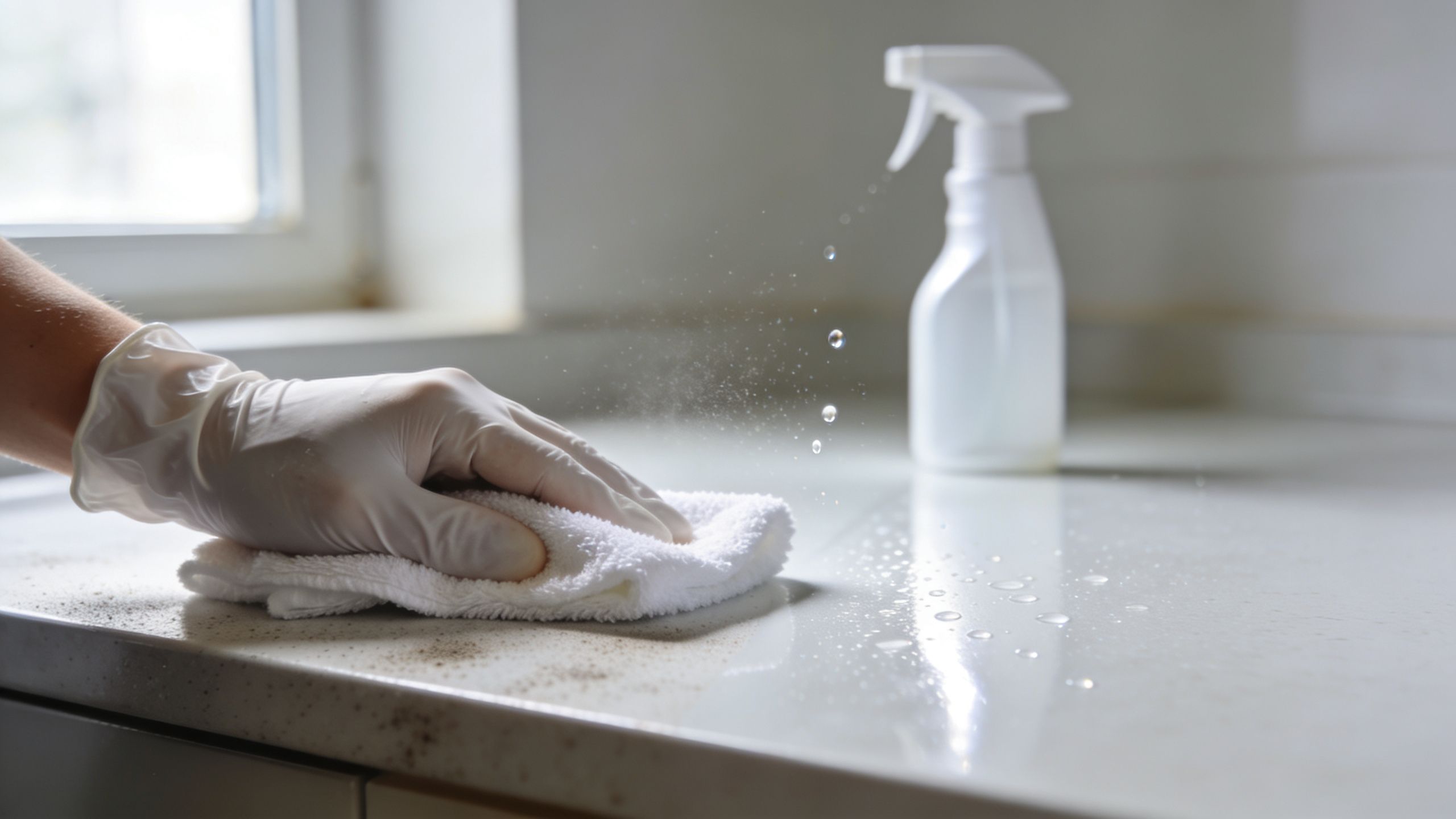
You're probably dealing with the same problem many facility managers, clinicians, teachers, and parents face every day. A surface needs to be ready for the next person quickly, but you also want to know you didn't just make it look clean. You want it cleaned and disinfected.
That's why the idea of a one step disinfectant cleaner is so appealing. One product. One application. Less confusion. Less time lost between tasks.
But this category only works as promised when people understand what the product is designed to do, what the label means, and where real-world use tends to fail. The difference between “used” and “used correctly” matters a lot in disinfection.
The Promise of Cleaning and Disinfecting in a Single Motion
At the end of a long shift, the promise sounds simple. Spray or wipe a surface once, remove light soil, and leave behind a disinfected hard surface that's safer for the next patient, student, customer, or family member.

A one step disinfectant cleaner is built for that exact job. It's meant to combine two actions in one application on hard, non-porous environmental surfaces. First, it helps remove light dirt or residue. Second, it applies an antimicrobial active ingredient intended to kill the organisms listed on the label.
That sounds straightforward. In practice, people often mix up cleaning, sanitizing, and disinfecting. Cleaning removes debris and soils. Disinfecting aims to kill specific pathogens according to label directions. A one-step product tries to bridge those tasks, but it doesn't erase the need for correct technique.
Why these products became so popular
Busy settings reward simple workflows. In a clinic exam room, school desk area, reception counter, gym check-in station, or home kitchen, staff and household users often don't have time for a long multi-product process between each use.
The appeal comes down to a few practical benefits:
- Less handling: You don't have to switch between separate cleaner and disinfectant products for light routine jobs.
- Fewer workflow errors: A simpler process is easier to teach and repeat.
- Faster room turnover: That matters in healthcare, transport, hospitality, and other shared environments.
Practical rule: One-step products are most useful when the surface has light soil and the user can keep the surface wet for the full label time.
Where people get confused
Many people assume “one step” means “works under all conditions.” It doesn't.
The claim makes the most sense in routine maintenance on counters, door hardware, bed rails, desktops, carts, and similar surfaces that aren't heavily soiled. If there's dried grime, body oils, food residue, or visible contamination, the job changes. At that point, a product may still be useful, but not in the simplified way the label headline suggests.
The smartest way to think about a one-step disinfectant cleaner is this: it's a professional shortcut with rules, not magic in a bottle.
Understanding the Chemistry of One-Step Formulas
A one-step formula works because it combines cleaning chemistry with disinfection chemistry. If you've ever used a two-in-one personal care product, the concept is familiar. One part helps lift and spread away residue. The other part does the microbial killing.
Two jobs in one formula
The cleaning part usually comes from ingredients that help loosen soils so they can be removed from a hard surface. The disinfecting part comes from an active ingredient that damages or inactivates microorganisms when the product stays wet long enough.
That combination is why choosing the formula matters. If you want a plain-language overview of choosing effective cleaning chemicals, that resource is useful for understanding how product chemistry affects day-to-day cleaning performance. For a broader primer on the difference between disinfection and antisepsis, VirusFAQ also has a background article on disinfection and antiseptic.
Common active ingredients
You'll see a few chemistry families appear often in this category:
Quaternary ammonium compounds
These are common in many hard-surface disinfectants. They're widely used in commercial settings because they fit routine environmental disinfection workflows well.Accelerated hydrogen peroxide
This category is notable because it pairs hydrogen peroxide with supporting ingredients that improve performance and usability.Hypochlorous acid
Some products use this chemistry for surface disinfection, though label details and use conditions still matter.
One helpful way to compare them is by asking practical questions rather than chemistry-heavy ones. What organisms are listed? How long must the surface stay wet? Is dilution required? Is the product ready to use?
A milestone that changed expectations
An important example came from accelerated hydrogen peroxide. In December 2020, Diversey announced that its AHP-based Oxivir Excel Wipe and Oxivir Excel Foam passed the EN 14476 virucidal test against SARS-CoV-2 in 15 seconds, and the company stated this was the first product to achieve that result in an EN-approved test. The same product line was positioned as a one-step cleaner and disinfectant, with the active ingredient breaking down into oxygen and water after use, as described in Diversey's Oxivir Excel announcement.
That matters because contact time often determines whether a product feels practical in a fast-turnover environment.
| Active Ingredient | Effective Against | Typical Contact Time | Key Advantage |
|---|---|---|---|
| Quaternary ammonium compounds | Depends on the specific label claims | Varies by product label | Common in routine hard-surface disinfection |
| Accelerated hydrogen peroxide | Broad antimicrobial coverage can be available on labeled products | Some products are designed for very fast action, while others require longer wet times | Can combine speed with one-step cleaning and disinfection |
| Hypochlorous acid | Depends on the specific label claims | Varies by product label | Often discussed for practical surface disinfection use |
Fast chemistry still needs correct use. A strong formulation can't compensate for poor coverage, the wrong surface, or ignored label directions.
How to Read Disinfectant Labels Like a Pro
The label is where the binding authority lives. Marketing language on the front of the package can be useful, but the legally meaningful details are in the registration and use directions.

Start with the EPA registration number
In the U.S., a disinfectant's authority comes from its EPA registration. The EPA states that only products on its official pathogen-specific lists are qualified for use against those pathogens, and a product's registration number is what you use to verify its primary registration and approved claims. That's why labels for products used against SARS-CoV-2 often highlight List N status, as explained in this summary of EPA registration and pathogen-specific claims.
If you manage a facility, train staff to look for the registration number first. It answers a basic question that branding alone can't answer. Is this a regulated disinfectant with approved claims, or just a cleaner marketed with disinfecting language?
Then find the contact time
After registration, the next line that matters is the contact time, sometimes called dwell time. This tells you how long the surface must remain visibly wet for the product to achieve the listed claim.
That's where many failures happen. People spray lightly, wipe dry immediately, or use too little product on a large surface. The job feels finished, but the label conditions weren't met.
Read the label in this order
Registration check
Confirm the EPA registration number and verify that the product is registered for disinfectant use.Pathogen claim
Check whether the pathogen you care about is covered by the label or relevant official list qualification.Surface type
Make sure the product is intended for the hard, non-porous surface you plan to treat.Use directions
Look for dilution instructions, whether rinsing is required in some settings, and the exact wet-contact time.Safety details
Review precautionary statements, storage instructions, and first aid information. If your team needs a refresher on hazard documentation, these Safety Space insights on bleach SDS help explain how safety data sheets support safe chemical handling.
A disinfectant label is not packaging decoration. It's the operating manual.
For readers comparing formats, VirusFAQ also has a practical guide to best disinfectant spray options and use considerations. That's especially helpful when deciding between sprays, foams, and wipes for routine environmental surfaces.
Best Practices for Safe and Effective Disinfection
Buying the right product is only the start. The outcome depends on how the product is applied, how much reaches the surface, and whether the surface stays wet long enough.

The application method matters
A professional one-step product can still fail in daily use if the method introduces too much guesswork. That's especially true with concentrates and bulk liquids.
For example, PREempt Concentrate Multi-Surface One-Step Disinfectant Cleaner uses 4.25% hydrogen peroxide and requires dilution at 8.0 oz per gallon (1:16) for one-step cleaner-disinfectant use, and surfaces must remain wet for 5 minutes to achieve the labeled disinfection claim, according to the PREempt concentrate sell sheet.
That single example teaches three big lessons:
- Dilution matters: Too weak, and the chemistry may not perform as labeled.
- Coverage matters: A thin mist may not keep the full surface wet.
- Time matters: Premature drying can interrupt the disinfection process.
A practical workflow that reduces failure
For most hard surfaces, this sequence works well:
- Read before use: Confirm the label claim, surface type, and contact time.
- Apply enough product: The surface should look evenly wet, not lightly speckled.
- Watch the clock: Don't wipe dry too soon unless the label directs that step after contact time.
- Use fresh materials: Don't spread old soil with a dirty cloth.
In environments where process control matters, people often prefer formats that reduce user variation. That's one reason pre-moistened wipes are attractive. The wipe already carries the intended solution, so there's less risk of mixing errors. It's also easier for staff to see whether the surface is wet.
Sprays versus wipes in the real world
Sprays can work well, especially on larger surfaces. But they ask more of the user. You have to mix correctly if it's a concentrate, apply enough liquid, distribute it evenly, and keep the surface wet for the full required time.
Pre-moistened wipes simplify several of those steps at once. They don't eliminate the need to read the label, but they can reduce common points of failure. In food-handling or mixed-use environments, process discipline matters just as much as the product itself. For managers reviewing broader hygiene systems, these food safety resources from Beacon Recruitment are useful background on structured control plans.
If you want a broader surface-care routine for homes or facilities, this VirusFAQ guide on how to disinfect surfaces can help turn product directions into a repeatable workflow.
If staff can't repeat the process correctly during a rushed shift, the written efficacy claim won't protect the surface on its own.
When One Step Is Not Enough
The phrase “one step” can encourage an unhelpful assumption. People hear it and think the product can power through any mess while also delivering full disinfection. That's not the safest way to use these products.

A key limitation often missed in marketing is that disinfectants require a clean surface to work well. For one-step products used on visibly dirty surfaces in settings like salons, gyms, or clinics, the presence of soil or body oils can reduce reliability. The “one-step” claim is most valid on hard, non-porous surfaces with low soil loads, as discussed in this overview of one-step disinfectant limitations on dirty surfaces.
What counts as too dirty
If you can see residue, smears, dried spills, grime buildup, or organic material, don't assume a one-pass disinfecting claim still applies in the same way. The product may contact the soil instead of the surface beneath it. That leaves microorganisms protected by the material sitting on top.
Examples include:
- Body fluid contamination: This needs deliberate removal before disinfection.
- Food residue: Grease and dried spills interfere with surface contact.
- Heavy touch buildup: Oils on gym equipment or shared electronics can reduce reliability.
- Old grime in corners or seams: Surface texture and residue make one-pass treatment less dependable.
The correct response
Use a two-step process when the surface is visibly soiled.
First, clean away the dirt with an appropriate cleaner or detergent. Then apply the disinfectant according to label directions on the now-clean surface. This isn't overkill. It's what restores the conditions the disinfectant needs to do its job.
Clean first when you can see the mess. Disinfect after the mess is gone.
This is one of the most important distinctions to teach staff. A one step disinfectant cleaner is a strong tool for routine maintenance. It isn't a substitute for judgment.
Frequently Asked Questions for Clinical and Public Use
Some of the hardest questions aren't about chemistry. They're about what to do at the sink, in the hallway, on the exam table, or at the kitchen counter when time is short and people want a clear answer.
Quick answers that prevent common mistakes
| Question | Answer |
|---|---|
| Can a one step disinfectant cleaner replace separate cleaning and disinfecting every time? | No. It works best on hard, non-porous surfaces with light soil. If the surface is visibly dirty, clean first and then disinfect. |
| Does “kills on contact” mean I can wipe immediately? | Don't assume that. Follow the label's wet-contact time. The surface usually has to remain visibly wet for the stated period. |
| Are wipes better than sprays? | Neither format is automatically better in all settings. Wipes can reduce mixing and application errors. Sprays may be useful for broader coverage on larger surfaces. |
| Is EPA registration really that important? | Yes. Registration is what supports the product's approved disinfectant claims in the U.S. |
| Can I use one product on every surface? | No. Check the label for the intended surface type and any restrictions. Hard, non-porous surfaces are the usual target. |
| If a product is strong against one virus, is it strong against all viruses? | Not automatically. Look at the product's approved claims and directions rather than assuming broad coverage from a single claim. |
Questions I hear from facilities most often
Facility managers often ask whether staff training or product choice matters more. In practice, both matter, but poor technique can ruin a good product faster than a good product can rescue poor technique.
Another common question is whether convenience products are “worth it.” From a public health standpoint, convenience matters when it improves compliance. A pre-moistened wipe that staff can use correctly every time may be more dependable in daily work than a liquid system that requires perfect mixing and timing but rarely gets either one right.
Questions from household users
Home users often wonder whether they're disinfecting too often or not enough. The better question is whether they're disinfecting at the right times and on the right surfaces. Focus on high-touch, shared hard surfaces and moments of increased risk, such as illness in the home or frequent guest use.
People also ask whether they should choose products based on scent, branding, or package claims alone. Don't. Choose based on the label, the surface, the practical wet time you can realistically achieve, and whether the format supports consistent use.
The best disinfection routine is the one people can perform correctly, repeatedly, and without guessing.
A one step disinfectant cleaner can be a smart part of that routine. It just works best when the user respects its limits, follows the label, and treats contact time as part of the disinfecting process rather than an optional extra.
If you're selecting products for routine virus prevention, focus on EPA-registered disinfectants, realistic contact times, and formats your team will use correctly. In many everyday settings, pre-moistened disinfecting wipes make that process easier by reducing dilution errors and helping users keep surfaces visibly wet long enough to match label directions.
Leave a Reply