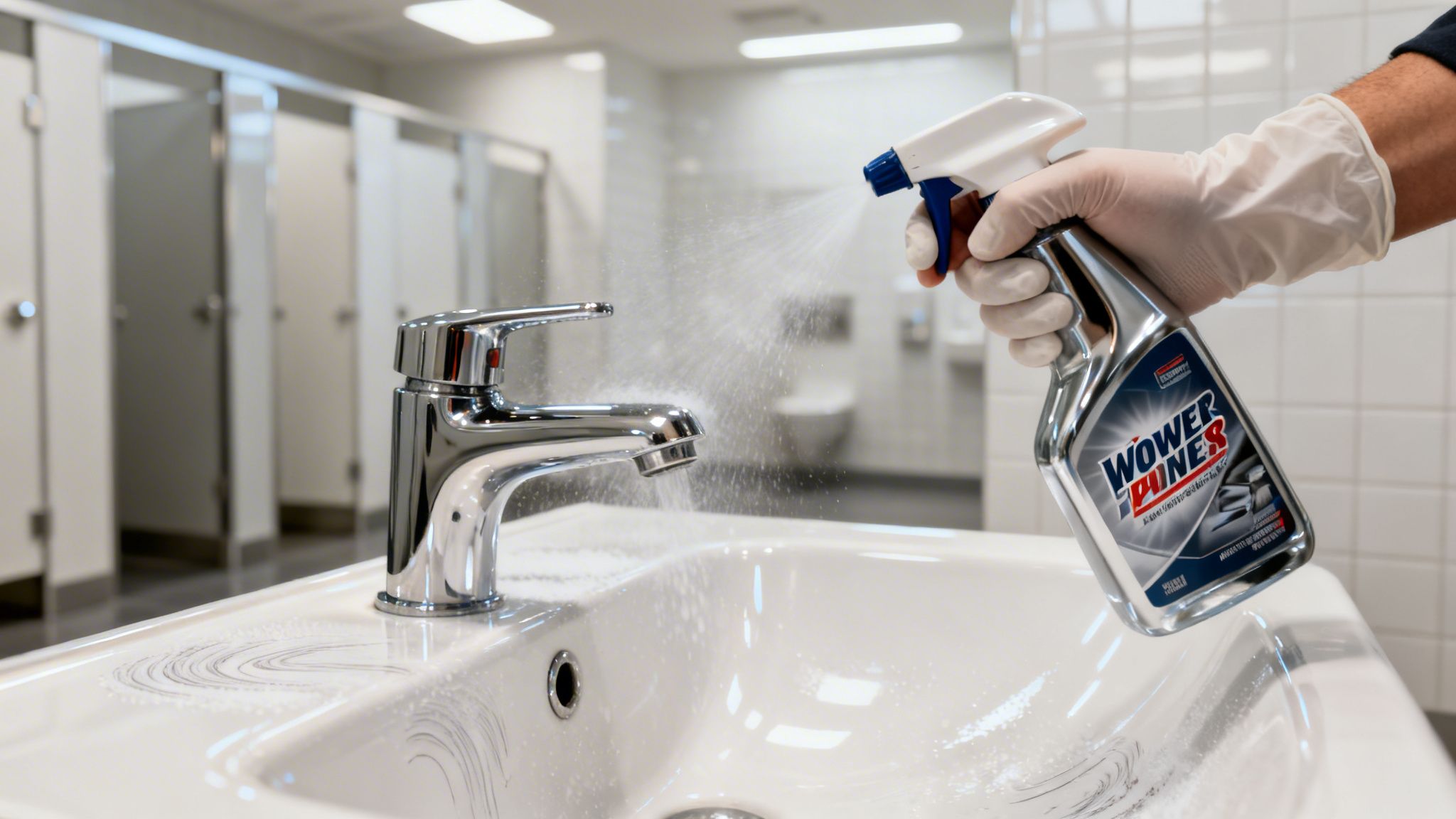
A commercial bathroom cleaner isn't just a souped-up version of what you use at home. It's a specialized disinfectant, formulated from the ground up for the unique challenges of high-traffic, high-risk public restrooms. These products have a dual mission: to cut through tough grime and neutralize the dangerous bacteria and viruses that can thrive in these environments.
The Hidden Battleground in Your Commercial Bathroom

Picture a packed airport restroom between flights, a school locker room after a big game, or the office bathroom at the peak of flu season. Every flush, every turn of a faucet handle, and every touch of a doorknob can spread invisible threats from one person to the next.
The surfaces we all touch—faucet handles, countertops, and flushers—become hotspots for microscopic pathogens. Tough viruses like Influenza A Virus (H1N1), SARS-CoV-2, and the notoriously resilient Norovirus can survive on these surfaces for hours or even days, just waiting for their next host.
This is where understanding the difference between "cleaning" and "disinfecting" becomes absolutely critical. It’s a concept every facility manager and cleaning professional needs to master to keep people safe.
Cleaning vs. Disinfecting
Think of cleaning as the first step: physically removing the visible dirt, grime, and other gunk from a surface. You’re using soap or detergent and water to scrub away the mess. This step is essential because all that grime (what we call "organic load") can act like a shield for viruses like Hepatitis B Virus (HBV) or SARS-Related Coronavirus 2 (SARS-CoV-2), making it much harder for disinfectants to reach them.
Disinfecting is the knockout punch. It’s the chemical process of actually killing the pathogens on the surface. A true commercial-grade cleaner does both, but the disinfecting step is what eliminates the invisible viral threat.
The real job of a commercial disinfectant isn't just to make a bathroom look clean. It's to make it hygienically safe by actively killing the viruses and bacteria that cause illness.
The Role of High-Touch Surfaces
The spread of viruses from contaminated surfaces, a process you can explore by learning about fomite transmission, is a major concern in public health. In any commercial bathroom, the list of these high-touch points, or "fomites," is long:
- Toilet flush handles and buttons
- Faucet taps and soap dispensers
- Door handles and locks
- Stall latches and partition walls
- Countertops and changing stations
Without frequent and proper disinfection, these surfaces form a chain of transmission that can fuel widespread illness. Choosing the right commercial bathroom cleaner—and using it correctly—is your best tool for breaking that chain. This guide will walk you through selecting the right products and putting protocols in place that turn a potential hotspot into a protected space.
Understanding the Science of Disinfection
To really win the fight against germs in a commercial restroom, you have to know your tools. A good commercial bathroom cleaner isn't just fancy soap; it's a chemical formula specifically designed to find, break down, and neutralize viruses at a microscopic level.
Different active ingredients work in different ways, like specialized tools in a toolbox. Some are perfect for a precise, targeted job, while others bring brute force to get rid of tougher threats. The science behind your cleaner determines its strategy and how well it will work against specific enemies, whether it's the Influenza A Virus (H1N1), SARS-CoV-2, or the notoriously tough Norovirus.
Quaternary Ammonium Compounds: The Everyday Defenders
One of the most common active ingredients you'll see on a label is a class of chemicals called Quaternary Ammonium Compounds, or “Quats.” Think of them as the everyday defenders in the viral world. Viruses like Influenza A Virus (H1N1), Human Coronavirus, and Herpes Simplex Virus 1 (HSV-1) are enveloped viruses—their genetic core is wrapped in a fragile, fatty outer layer.
Quats are designed to exploit this weakness. They chemically attack and dissolve this lipid envelope, causing the virus to literally fall apart and become harmless.
- How They Work: Quats have a positive charge that’s drawn to the negatively charged surface of a virus. This allows them to latch on, break through the envelope, and destroy the pathogen.
- Best Use Case: They're fantastic against a broad spectrum of enveloped viruses, which makes them a go-to for daily disinfection in offices, schools, and public spaces where common respiratory illnesses are the main concern.
Because they are less harsh than other disinfectants, Quat-based formulas are often used in products made for frequent cleaning, like ready-to-use disinfecting wipes. To see how other chemicals stack up, check out our guide on what kills viruses on surfaces.
Sodium Hypochlorite: The Heavy-Hitter for Tough Germs
When you’re up against a truly stubborn opponent, you need to bring in the heavy-hitter. That’s where Sodium Hypochlorite—the active ingredient in bleach—comes in. It’s a powerful oxidizer, meaning it chemically obliterates the proteins and genetic material of any virus it touches, envelope or not.
This makes it the perfect weapon against tough non-enveloped viruses like Human Rotavirus and Norovirus. These germs lack that fragile outer envelope, so gentler chemicals often can't do the job. The aggressive action of sodium hypochlorite ensures these hardy pathogens are completely destroyed.
Choosing the right "weapon" is essential. A cleaner effective against enveloped viruses may not be sufficient for non-enveloped threats like Norovirus, leaving your facility vulnerable despite your best cleaning efforts.
The need for powerful disinfection is clear when you look at the market. The toilet care products industry, where these cleaners play a huge role, is valued at USD 10.5 billion in 2025 and is expected to hit USD 14.2 billion by 2035. This growth shows a major focus on using what works; for example, we know a 0.1% sodium hypochlorite solution is highly effective against enveloped viruses like SARS-CoV-2.
Strict rules, like Germany's biocidal regulations, ensure that only proven products can make virucidal claims. In some tests, the right disinfectant has shown a 98% reduction in norovirus on surfaces. If you want to dive deeper into these trends, you can explore the full report on toilet care products. This data isn't just numbers—it confirms that selecting a verified, appropriate commercial bathroom cleaner is a critical decision for public health.
How to Read Disinfectant Labels for Real Virus Protection
Walking down the cleaning aisle can be a sensory overload. Every bottle seems to shout promises like "Kills 99.9% of Germs" or "Maximum Strength," but these marketing slogans don’t give you the full picture. To know if a commercial bathroom cleaner can actually stop specific viruses, you have to become an expert at reading the fine print.
The secret is to look past the flashy front label and find the government-backed proof. In the U.S., the Environmental Protection Agency (EPA) puts disinfectants through rigorous testing. The information on that label isn't just a suggestion—it's a legally binding contract between the manufacturer and the public, verifying what the product can do.
The EPA Registration Number
The single most important thing on any disinfectant label is the EPA Registration Number. You'll usually find it in small print on the back or side, looking something like "EPA Reg. No. 12345-67." This number is your guarantee that the product has been scientifically tested and proven effective when you follow the directions.
Think of the EPA registration number as the product's license to make a public health claim. Without it, a cleaner is just soap and water. With it, you have a verified tool for neutralizing viruses. If a product claims to disinfect but is missing this number, don’t trust it for virus protection in your facility.
Verifying Claims with EPA's List N
When public health emergencies arise, like the one involving SARS-CoV-2, the EPA compiles specific lists of approved products. The most famous of these is List N, which catalogs all disinfectants expected to be effective against SARS-CoV-2.
Here’s how to use it to check a commercial bathroom cleaner:
- Find the EPA Reg. No. on the product label.
- Navigate to the EPA's List N search tool online.
- Enter the first two parts of the registration number (for example, "12345-67") into the search bar.
- If the product pops up, it’s approved for use against SARS-CoV-2. The search results will also tell you the specific contact time required to kill the virus.
This simple check cuts through the marketing noise. It confirms your chosen product has the power to protect against specific viral threats, including Human Coronavirus, Influenza A Virus (H1N1), and others.
The Critical Role of Contact Time
Once you've confirmed a product is EPA-registered, the next mission-critical piece of information is the contact time, sometimes called dwell time. This is the exact amount of time a surface must remain visibly wet with the disinfectant to kill the listed pathogens.
Think of contact time like marinating a surface in disinfectant. If you wipe it away too soon, the active ingredients don't have enough time to penetrate and destroy the viruses, rendering your efforts useless.
Different viruses are tougher to kill than others, so they require different contact times. For instance, a product might only need 30 seconds to kill Influenza A Virus (H1N1) but a full 3 minutes to take out the resilient Norovirus. These times are listed right on the label for each virus. Ignoring this step is one of the most common—and critical—mistakes in any disinfection protocol.
So, how do you make sure your team gets it right every time? Many facilities lean on products built for simplicity. Pre-saturated disinfecting wipes, for example, are engineered to deliver the right amount of solution to keep a surface wet for the required contact time, taking all the guesswork out of the equation.
This ensures you’re not just cleaning, but truly disinfecting.
To bring it all together, understanding a disinfectant label is straightforward once you know where to look. We've broken down the key parts below.
Interpreting Commercial Disinfectant Labels
This table breaks down the key components of an EPA-approved disinfectant label, helping users quickly identify critical information for effective virus elimination.
| Label Component | What It Means | Why It's Critical for Virus Control |
|---|---|---|
| EPA Registration No. | The product's unique identification number, confirming it has been reviewed and approved by the EPA. | This is your non-negotiable proof of legitimacy. No number means no verified disinfecting power against viruses. |
| Active Ingredients | The chemical compounds responsible for killing pathogens (e.g., Quaternary Ammonium, Hydrogen Peroxide). | Different ingredients target different viruses. This helps you match the product to the specific pathogens you're concerned about. |
| List of Target Organisms | The specific bacteria, viruses, and fungi the product is proven to kill when used as directed. | "Kills 99.9% of germs" is vague. This list tells you if it kills your target, like Norovirus, Influenza A, or SARS-CoV-2. |
| Contact Time (Dwell Time) | The minimum time the surface must stay visibly wet to achieve disinfection. | Wiping a surface dry too soon means the disinfectant hasn't worked. Adhering to contact time is essential for viral kill claims to be true. |
| Directions for Use | Step-by-step instructions for application, including pre-cleaning, dilution ratios (if any), and application methods. | Following these instructions ensures both safety and efficacy. Deviating from them can render the product ineffective or even create hazards. |
By mastering these three elements—the EPA number, the specific virucidal claims, and the all-important contact time—you can confidently choose a commercial bathroom cleaner that delivers genuine protection, not just empty promises.
The Correct Protocol for Bathroom Disinfection
Having the right commercial bathroom cleaner is a great start, but it's only half the job. If you’re not using it correctly, you’re not actually neutralizing the viral threats you’re trying to eliminate.
Proper disinfection is a specific, multi-step process. It goes way beyond a quick spray-and-wipe. From prepping the surface to respecting contact times, every step is designed to give the disinfectant’s active ingredients the chance to do their work and make your facility safer.
The Critical Pre-Cleaning Phase
Before you even think about disinfecting, you have to pre-clean. Think of it like trying to paint a dusty wall—if you don't wipe it down first, the paint won't stick. The same goes for disinfectants.
Bathroom surfaces are covered in what we call soil load—a mix of dirt, soap scum, and other organic matter. This grime acts like a shield, physically blocking disinfectants from reaching the viruses hiding underneath. If you try to disinfect a dirty surface, you're just wasting time and product.
- Start with an all-purpose cleaner or detergent to cut through the visible grime on countertops, sinks, and toilets.
- Wipe everything down thoroughly. You want to remove any residue that could get in the way of the disinfectant.
- Focus on buildup spots. Pay close attention to the areas around drains or behind faucets where gunk and germs love to hide.
Only when a surface is visibly clean can you actually move on to disinfecting. Skipping this pre-cleaning step makes even the best disinfectants useless.
This flowchart shows you how to find the most critical information on any disinfectant label in just a few seconds.

The big takeaway here is simple: check the EPA number, understand the virucidal claims, and know the specific contact time. Those three things tell you if you have the right product for the job.
Application and Dwell Time on High-Touch Surfaces
Once your surfaces are clean, it’s time to apply your commercial bathroom cleaner. You’ll want to focus your efforts on the high-touch surfaces, since these are the main transfer points for viruses. Think faucet handles, toilet flushers, door locks, stall latches, and soap dispensers.
The biggest mistake people make here is the classic "spray and wipe." Spraying a disinfectant and immediately wiping it away accomplishes almost nothing. It gives the active ingredients zero time to work and creates a dangerous false sense of security.
To effectively kill viruses, the surface must remain visibly wet for the entire contact time listed on the product label. This isn't a suggestion—it's a requirement.
That time can be anywhere from 30 seconds for common viruses like Influenza A Virus (H1N1) to 5 minutes or more for tougher pathogens like Norovirus.
This is where pre-saturated disinfecting wipes really shine. They’re designed to deliver the right amount of solution to keep a surface wet long enough to meet that crucial contact time, taking the guesswork out of the equation. Plus, using a fresh wipe for each area helps prevent cross-contamination. You can learn about other advanced application methods in our guide to electrostatic disinfectant sprayers.
The global focus on hygiene has caused a massive boom in this space. The commercial cleaning products market was valued at USD 120.6 billion in 2024 and is projected to hit USD 253.2 billion by 2034. This growth is directly tied to a better understanding of proper disinfection protocols. For example, in healthcare settings, using the right application method has been shown to reduce Norovirus on porcelain by up to 99%—proof that these protocols are a vital defense against viral spread.
Of course, different surfaces have different needs. To do the job right, you also need to understand the material you're working with, which is why guides on tasks like cleaning cement tiles are so useful. By combining smart pre-cleaning, correct application, and strict adherence to contact times, you can turn your disinfection plan into a real-world public health defense.
When it comes to picking a commercial bathroom cleaner, the real question isn't "how strong is it?" but "is it the right kind of strong for the job?" Not all viruses are created equal. Your choice of disinfectant needs to be a strategic one, aimed squarely at the specific germs you’re trying to eliminate.
This is where a little bit of virus science goes a long way in the real world. Viruses generally fall into two categories based on how they're built, and that structure determines just how tough they are to kill.

Enveloped Viruses: The Easy Targets
Think of common bugs like Influenza A Virus (H1N1) and the entire family of Coronaviruses (including SARS-CoV-2). These are what scientists call enveloped viruses. The easiest way to picture one is as a sensitive message tucked inside a flimsy, fatty envelope.
That "envelope" is a soft lipid membrane that, while protecting the virus, is also its biggest weakness. The active ingredients in many go-to commercial cleaners, like quaternary ammonium compounds (Quats), are designed to dissolve this fatty layer. Once the envelope is gone, the virus falls apart.
Non-Enveloped Viruses: The Tough Opponents
Then you have the really stubborn ones. Non-enveloped viruses like Norovirus, Rotavirus, and Rhinovirus (the common cold) are the bruisers of the microbial world. They are far more resilient because they don't have that fragile, fatty envelope to attack.
Think of a non-enveloped virus as a message carved directly into a rock. There’s no soft outer layer to tear open, so you need a much more powerful tool to break it down.
This is exactly why a cleaner that works wonders against the flu might be completely useless during a Norovirus outbreak. To take down these tougher viruses, you have to bring out the heavy hitters—cleaners with more aggressive active ingredients like hydrogen peroxide or sodium hypochlorite (bleach) that can chemically destroy the virus’s core.
Matching the Right Cleaner to the Right Virus (and Surface)
Once you know what kind of virus you’re up against, picking the right active ingredient becomes much clearer. The table below breaks down which chemicals are effective against the two main types of viruses found in commercial bathrooms.
Active Ingredient Efficacy Against Key Viruses
| Active Ingredient | Effective Against Enveloped Viruses (e.g., Influenza, SARS-CoV-2) | Effective Against Non-Enveloped Viruses (e.g., Norovirus, Rotavirus) | Best For Surfaces |
|---|---|---|---|
| Quaternary Ammonium (Quats) | Excellent – Dissolves the lipid envelope. | Poor to Moderate – Most standard Quats are not effective. | Most non-porous surfaces like laminate, sealed stone, and plastics. Good for daily use. |
| Hydrogen Peroxide (Accelerated) | Excellent | Good to Excellent – Attacks the virus's core protein structure. | A wide variety, including sensitive metals and plastics. Less harsh than bleach. |
| Sodium Hypochlorite (Bleach) | Excellent | Excellent – A powerful oxidizer that destroys the virus. | Hard, non-porous surfaces like porcelain toilets, ceramic tile, and concrete. |
| Alcohol (Ethanol/Isopropanol) | Excellent | Poor to Moderate – Not reliable against Norovirus. | Small surfaces, electronics, and stainless steel. Evaporates quickly. |
As you can see, there's no single "best" cleaner for every situation. A Quat-based product is perfect for everyday cleaning, but you’ll need a bleach or hydrogen peroxide-based disinfectant when you’re dealing with a confirmed Norovirus case.
But there’s one more piece to the puzzle: the surface itself.
An aggressive bleach solution that’s perfect for a porcelain toilet can permanently damage a stainless steel faucet or discolor a laminate partition. This is why a truly effective cleaning plan often requires more than one product.
- For daily disinfection, a Quat-based cleaner is a solid workhorse for most surfaces, handling common enveloped viruses with ease.
- For outbreak response, especially with Norovirus, you must switch to a product proven to kill non-enveloped viruses, even if it requires more careful handling.
- For sensitive materials or areas with poor airflow, a hydrogen peroxide-based cleaner offers broad-spectrum power without the harsh fumes or corrosive effects of bleach.
A complete cleaning protocol also means looking beyond the obvious surfaces. For instance, porous grout between floor tiles can be a hotspot for germs and moisture. Learning how to clean grout lines properly is a crucial step in any deep cleaning routine.
By understanding the difference between viruses and matching the right commercial cleaner to both the germ and the surface, you elevate your cleaning from a simple chore to expert-level disinfection.
Common Questions About Bathroom Disinfection
Even when you have a solid plan, the real world always throws a few curveballs. Putting disinfection theory into practice brings up questions about frequency, product choice, and safety. Let's tackle some of the most common questions we hear from facility managers and cleaning staff trying to get it right.
How Often Should a Commercial Bathroom Be Disinfected?
There's no magic number here. The right frequency comes down to one thing: foot traffic. A quiet office bathroom just doesn't have the same needs as a chaotic airport restroom.
For extremely high-traffic zones—think airports, transit stations, or stadiums—high-touch surfaces need attention every one to two hours. We're talking about faucet handles, flushers, door locks, and stall latches. With that many people cycling through, the potential for contamination is constant.
In a more typical medium-traffic setting like an office building or a retail store, disinfecting those same spots two to three times a day is a great baseline. A smart approach is to hit them during peak times, like mid-morning, after the lunch rush, and before closing up.
The core principle is simple: match your disinfection frequency to the traffic volume. The more people, the more you need to break the chain of transmission.
To keep things in check between those scheduled cleanings, having the right tools on hand makes all the difference. A container of pre-saturated disinfecting wipes is perfect for quick spot-cleaning. A fast wipe-down of a doorknob after a busy spell can dramatically lower the viral load and keep your facility safer throughout the day.
Can I Use Household Cleaners in a Commercial Setting?
It’s tempting to just grab a bottle of household cleaner off the store shelf, but that's a huge mistake for a commercial space. While some home products might have disinfectant properties, a commercial bathroom cleaner is built for the tough demands of a public facility.
The differences are pretty stark:
- Formulation Strength: Commercial products are highly concentrated. They’re designed to power through the heavy soil loads and mineral deposits you only find in high-use restrooms. A household cleaner just won't cut it for the pre-cleaning step, which is critical for disinfection to work.
- Broader Virucidal Claims: Commercial disinfectants go through intense EPA testing to prove they kill a wider range of dangerous germs, especially tough-to-kill viruses like Norovirus and Human Rotavirus. These are rampant in public spaces but aren't always the focus for household brands.
- Liability and Compliance: Using a product that isn’t EPA-registered for commercial use is a major liability risk. If an outbreak happens, you’ll need to prove you used the right, verified products as part of your due diligence.
Bottom line: stick with products explicitly labeled for commercial or institutional use. It’s the only way to be sure you’re getting the protection you need and meeting professional standards.
What Is the Biggest Disinfection Mistake People Make?
Hands down, the most common and critical error is ignoring the product's contact time. So many people fall into the "spray-and-wipe" habit, thinking they’re cleaning and disinfecting in one quick motion. That single mistake makes the disinfectant almost completely useless.
Active ingredients, whether it’s Quats or hydrogen peroxide, need time to work their magic—to break down and destroy the virus. Wiping the surface dry before that time is up is like pulling a cake out of the oven after only two minutes. You haven’t given the process time to work.
To kill viruses, the surface must remain visibly wet for the entire time listed on the label. If it says 3 minutes for Norovirus, that surface needs to look wet for all 180 seconds.
This is exactly why pre-saturated disinfecting wipes are so popular in professional settings. They’re engineered to lay down a specific amount of disinfectant solution, making sure the surface stays wet long enough to meet the contact time without any guesswork. Training your staff on this one concept will have the biggest impact on your entire cleaning program.
Are 'Green' Cleaners Effective Against Viruses Like Norovirus?
With everyone looking for more environmentally friendly options, "green" cleaners are everywhere. But "green" is a marketing term, not a scientific one. It doesn't automatically mean the product is a good disinfectant.
Some green cleaners are absolutely effective virus-killers, but you have to check them just like you would any other commercial bathroom cleaner.
Here’s your checklist:
- Look for an EPA Registration Number: This is non-negotiable. If any product claims to disinfect, it must have an EPA number on the label. This is your proof that it passed the required tests.
- Read the Virucidal Claims: The label has to list the specific viruses it’s proven to kill, like Influenza A Virus (H1N1) or SARS-Related Coronavirus 2. Never assume it kills tough viruses like Norovirus unless you see it stated explicitly.
- Identify the Active Ingredient: Many modern, effective, and eco-friendly disinfectants use active ingredients like hydrogen peroxide, citric acid, or thymol. These are known for their cleaning power and are often less harsh than older chemicals like bleach.
The guiding principle never changes: base your decision on proven performance, not marketing buzzwords. A great commercial bathroom cleaner—whether it's labeled "green" or not—is one that's EPA-registered and used exactly as the label directs.
Leave a Reply