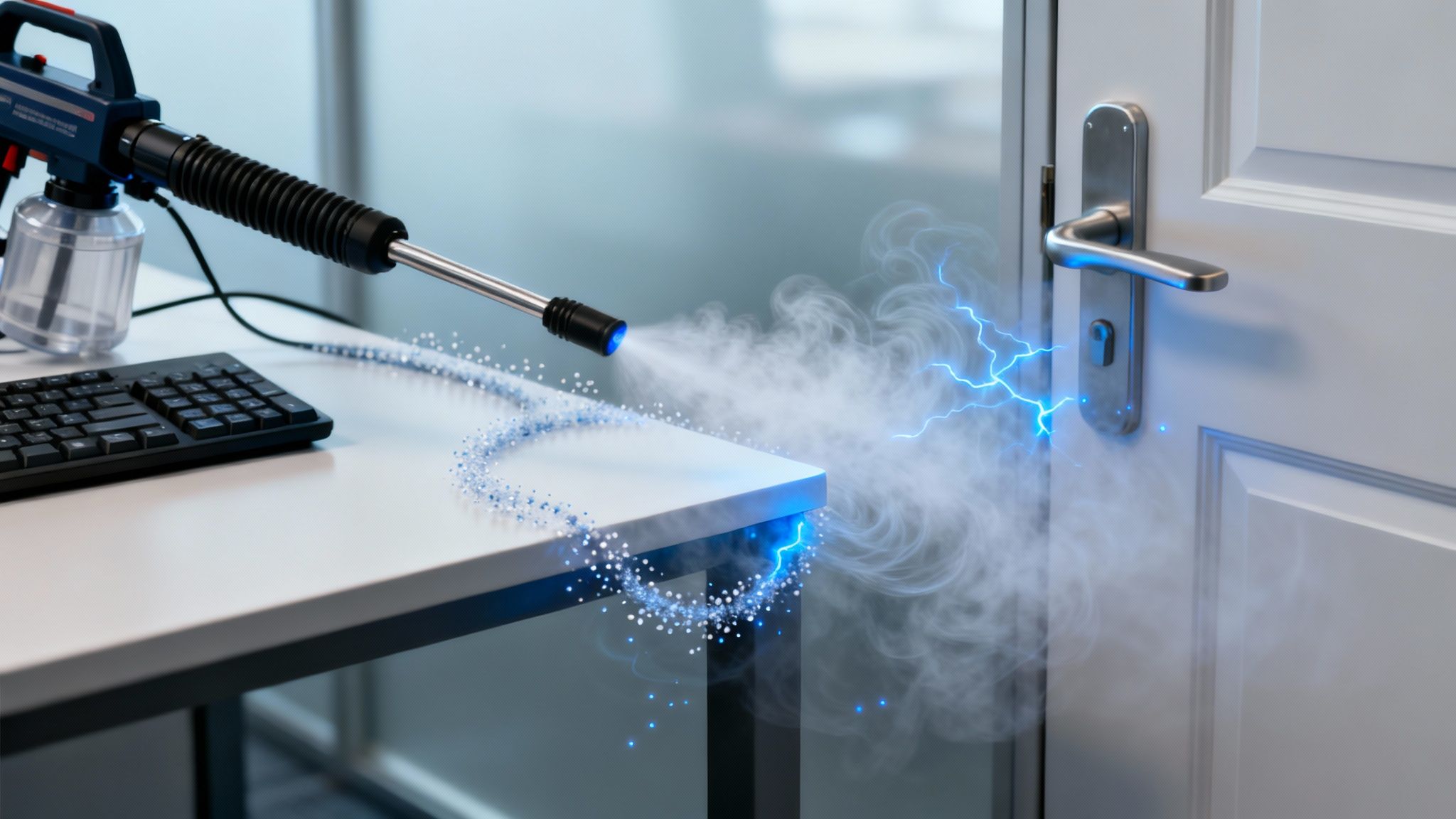
Electrostatic disinfectant sprayers are a game-changer, using a smart bit of science—an electrical charge—to make disinfectants do their job better. Instead of just spraying and hoping for the best, this tech makes the cleaning solution actively grab onto surfaces. The result is a far more complete, uniform coat of protection against germs. For quick, targeted cleaning of high-touch areas, disinfecting wipes remain an excellent and convenient option.
The Next Generation of Surface Disinfection

In a world that’s more health-aware than ever, we’re seeing the real limits of old-school cleaning. Just wiping or spraying a surface often gives you patchy coverage, leaving microscopic hiding spots where viruses and bacteria can hang out. Germs like Influenza A Virus (H1N1) and Norovirus (a small non-enveloped virus) can easily survive on tricky, hard-to-reach spots or oddly shaped objects, creating a constant risk of someone getting sick.
This is exactly the problem electrostatic sprayers were built to solve. They’re a huge leap forward in infection control, blowing past the hit-or-miss nature of trigger sprays and some manual methods. The magic isn't just in spraying at a surface; it's about making sure the disinfectant wraps all the way around it.
Moving Beyond Manual Cleaning
Let's be honest—traditional cleaning is only as good as the person doing it. Technique varies, thoroughness wavers, and missed spots are practically guaranteed, especially on complex equipment, the legs of a chair, or the underside of a desk. While disinfecting wipes are perfect for quick, high-touch surface cleaning, an electrostatic sprayer takes a lot of that human error out of the picture for large-scale applications.
By giving the disinfectant mist a positive electrical charge, the sprayer makes every droplet act like a tiny magnet. These charged droplets are actively drawn to surfaces, which are naturally neutral or negatively charged. This attraction is so strong that it pulls the mist into crevices and even onto the back of objects, creating a consistent, 360-degree film. It's a much smarter and more reliable way to disinfect large areas.
For facility managers and public health pros, this technology is a breath of fresh air. It delivers:
- Total Coverage: It hits all those nooks and crannies that manual cleaning almost always misses.
- Serious Speed: You can disinfect large spaces up to 75% faster than with old-school methods.
- Less Waste: It uses less chemical solution to get a better result, which is good for your budget and the environment.
A Powerful Partnership for Protection
It's crucial to remember that an electrostatic sprayer, as advanced as it is, is really just a sophisticated delivery system. Its power to knock out specific viruses, like SARS-Related Coronavirus 2 (SARS-CoV-2) or Rhinovirus (the common cold), comes down to the disinfectant liquid you put inside it. To get the best results, you need to pair the sprayer with a high-quality, EPA-approved disinfectant that's been formulated for electrostatic use.
Electrostatic disinfectant sprayers are one of the most effective practical safe workplace solutions out there today. By ensuring disinfectants coat every surface correctly and completely, they help create genuinely healthier environments for everyone.
This guide will break down the science behind these devices and show you how they work in the real world. While these sprayers offer incredible surface coverage, they're just one piece of a complete cleaning strategy. Complementing their use with targeted disinfecting wipes for frequently touched surfaces like doorknobs and light switches creates a comprehensive defense.
How Sprayers Get You a 360-Degree Clean
Ever tried to spray paint a chair? You end up with drips, missed spots, and a messy, uneven coat. Conventional trigger sprayers and foggers have the same problem when disinfecting—they only hit what's directly in front of them, leaving plenty of hiding spots for germs.
Electrostatic disinfectant sprayers solve this issue by using a basic law of physics: opposites attract. The technology works like a magnet, making sure the disinfectant finds its way to every nook, cranny, and crevice.
The Science Behind the "Magnetic" Pull
Inside every electrostatic sprayer, there's a tiny electrode. As the disinfectant liquid flows past it, the electrode zaps each droplet with a powerful positive electrical charge. What comes out of the nozzle is a fine, positively charged mist.
Now, think about the surfaces in a room—desks, chairs, doorknobs, and computers. Most of them have a neutral or slightly negative charge. Just like the opposite ends of two magnets snapping together, those positively charged disinfectant droplets are pulled directly toward these surfaces.
This "magnetic" attraction is what makes the whole system work. Instead of just drifting down with gravity, the droplets are actively yanked out of the air and onto their targets with surprising force.
Creating the Wraparound Effect
The pull is so strong that the mist doesn't just settle on top of an object. The droplets will literally change direction mid-air to find a surface, wrapping completely around it to cover the back and undersides. This is called the "wraparound effect," and it’s the key to a true 360-degree clean.
Take a doorknob, for example. A normal spray bottle only coats the front. An electrostatic sprayer covers the front, the back, and even the small connecting shaft with a perfect, uniform layer of disinfectant. This ensures that viruses like Influenza A (H1N1) or SARS-CoV-2 have nowhere left to hide.
This process is a huge leap forward in infection control. By using electrical voltage to charge disinfectant particles, electrostatic sprayers make sure the disinfectant sticks to surfaces far more effectively than any gravity-based method ever could.
The benefits are pretty clear:
- Total Coverage: It takes the guesswork out of cleaning, hitting all the spots you’d normally miss with just a cloth.
- More Efficient: The targeted attraction means less disinfectant gets wasted floating in the air. This can lead to a 45% decrease in chemical costs and helps get the job done up to 75% faster.
- Better Adhesion: The charged droplets create a thin, even coat that sticks to surfaces and dries quickly without pooling.
Traditional vs. Electrostatic: What’s the Real Difference?
To really see the contrast, let's put them side-by-side. A standard trigger sprayer shoots out big, wet droplets that fall randomly, leaving puddles and plenty of missed spots. While disinfecting wipes are excellent for flat tables and high-touch points, they aren't practical for covering every surface in a large, complex room.
Electrostatic sprayers, on the other hand, deliver a fine mist that’s actively guided to its target. The whole process is touchless, which cuts down on cross-contamination and lets the disinfectant do its work undisturbed.
Of course, the sprayer is only half the equation. For the best results, you need to pair it with the right disinfectant. You can learn more about powerful and safe options like Hypochlorous acid for cleaning in our full guide. This complete approach is why electrostatic technology has become a go-to for modern hygiene protocols—it delivers a level of clean that older methods just can't match.
Choosing the Right Sprayer for Your Space
Picking the right electrostatic disinfectant sprayer isn't a simple, one-size-fits-all situation. The best tool for the job really comes down to the size and layout of your space. Making the right choice from the start means you’ll get that wall-to-wall, 360-degree coverage the technology is known for—instead of ending up with a machine that’s either too weak for the job or complete overkill.
Think of it like this: electrostatic technology gives disinfectant droplets a positive charge, so they actively seek out and cling to negatively charged surfaces. That's the secret sauce.
This is a huge leap from traditional sprayers, which just blast liquid in a straight line and miss anything out of sight. That magnetic-like attraction is exactly why it’s so important to match the sprayer type to your environment to get a truly effective clean.
Breaking Down the Main Sprayer Types
Electrostatic sprayers come in three main flavors, each built for a different scale of work. The trick is to find the sweet spot between portability, how much disinfectant it can hold, and the total square footage you need to cover.
To help you figure out what’s best for your needs, here’s a quick comparison of the three main sprayer models. Each one is designed for a specific type of job, from quick touch-ups to massive, all-day projects.
Comparing Electrostatic Sprayer Models
| Sprayer Type | Ideal Use Case | Key Advantage | Common Environments |
|---|---|---|---|
| Handheld | Quick, targeted disinfection of high-touch objects | Maximum portability and maneuverability | Offices, vehicle interiors, classrooms, medical exam rooms |
| Backpack | Medium to large areas with complex layouts | Excellent balance of capacity and operator freedom | School hallways, gyms, locker rooms, healthcare facilities |
| Cart-Based | Massive, open-concept commercial venues | Uninterrupted runtime and largest tank capacity | Airports, convention centers, warehouses, stadiums |
Choosing the right model from this list is the first step. Handheld units are perfect for precision work, backpack sprayers are the versatile workhorses, and cart-based systems are the heavy hitters for the biggest jobs out there.
Key Factors to Consider Before You Buy
Once you’ve settled on a type, it’s time to dig into the specs. A few key features will make all the difference in how the sprayer actually performs on the job.
When selecting a sprayer, think about it as choosing the right tool for a specific job. You wouldn't use a small hammer for a demolition project, and similarly, you shouldn't use a handheld sprayer for a stadium. Matching the tool to the task is fundamental for success.
Here are the non-negotiables to look at:
- Corded vs. Cordless Power: Cordless is king for freedom of movement, especially in spaces without many outlets. Just be ready to manage battery life. Corded units give you all-day power but will keep you tethered to the wall.
- Battery Runtime: For any cordless model, check the runtime and how long it takes to recharge. Will one battery get you through the entire job, or should you invest in a spare?
- Tank Capacity: More capacity means fewer stops to refill, but it also means more weight to carry. A small tank is fine for spot treatments, but you’ll want a much larger one for disinfecting entire buildings.
- Droplet Size (Microns): Most sprayers produce droplets in the 40-110 micron range. Finer droplets—on the lower end of that scale—create a more even, wraparound coat and dry faster, which is a big deal for sensitive electronics and fabrics.
Ultimately, the perfect electrostatic disinfectant sprayer is the one that fits your space and your workflow. For everyday spot-cleaning and smaller jobs, quality disinfecting wipes provide an effective, convenient solution that perfectly complements a broader disinfection strategy.
Putting Sprayers to the Test: Real-World Impact

The real measure of any technology isn't how it works in a lab, but how it performs out in the field. When you see electrostatic sprayers being used in high-stakes environments—places where health and safety are non-negotiable—their value becomes crystal clear. From sterile hospital rooms to busy school hallways, these tools are fast becoming a cornerstone of modern hygiene.
What makes them so effective is that they directly solve the biggest challenge in disinfection: getting complete coverage, and getting it done fast. By wrapping complex objects in a uniform coat of disinfectant, sprayers help facilities knock down the microbial load on every surface. This protects people from a whole host of pathogens, from Herpes Simplex Virus Type 1 (HSV-1) to SARS-CoV-2.
Safeguarding Patients in Healthcare
Hospitals and clinics are ground zero in the war against infection. Healthcare-associated infections (HAIs) are a serious threat to patient recovery and put a massive strain on our medical system. While traditional cleaning methods are still vital, they can easily miss dangerous pathogens lurking on bed rails, medical equipment, and other high-touch surfaces.
This is exactly where electrostatic disinfectant sprayers come in. When a patient is discharged, cleaning crews can disinfect the entire room quickly and thoroughly. That electrically charged mist clings to every single surface—from the legs of the IV stand to the tiny call button—making sure the disinfectant eliminates lingering threats like Hepatitis B Virus (HBV) and Hepatitis C Virus (HCV).
The results are tangible and they matter:
- Faster Room Turnaround: A patient room can be fully disinfected in a fraction of the time, letting hospitals admit new patients more efficiently.
- Enhanced Patient Safety: Comprehensive disinfection helps break the chain of infection, reducing the risk of HAIs for everyone, especially the most vulnerable.
- Improved Staff Confidence: Medical staff can do their jobs with more peace of mind, knowing their environment has been treated to the highest standard.
Creating Healthier Schools
Schools are naturally dynamic places. Kids and staff are in constant contact, which unfortunately makes classrooms, cafeterias, and gyms perfect breeding grounds for viruses like Rhinovirus or Avian Influenza Virus (H5N1). For custodial staff, keeping these spaces safe is a monumental task.
Electrostatic technology offers a genuinely practical solution. With a backpack sprayer, a single person can cover an entire classroom in just a few minutes, hitting desks, chairs, lockers, and even playground equipment with unmatched thoroughness. That speed is a game-changer for daily sanitation routines, especially during flu season.
By providing a more complete and uniform application of disinfectant, electrostatic technology helps create a demonstrably healthier space for learning and growth. This isn't just about cleaning; it's about building confidence and ensuring continuity of education.
For schools, this translates directly to fewer sick days for both students and teachers, which means a more stable and effective learning environment for everyone.
Protecting Travelers in Transit
The sheer volume of people moving through airports, train stations, and buses makes them high-risk zones for spreading viruses. Trying to disinfect these large, complex spaces with old-school methods is both incredibly time-consuming and often ineffective.
Electrostatic sprayers have become an essential tool for public transit authorities. Their ability to quickly coat rows of seats, handrails, luggage bins, and security trays provides a powerful layer of protection against pathogens like Norovirus. The speed is key—application is often 75% faster than traditional methods—which is vital for minimizing downtime and keeping services on schedule.
In the hospitality world, from hotels to restaurants, this technology gives guests visible proof of a commitment to hygiene, boosting their confidence. The outcome is a stronger reputation and a safer experience for everyone, proving just how valuable electrostatic disinfectant sprayers are in protecting public health.
Why Advanced Disinfection is Suddenly Everywhere
If you've noticed a major shift in how we talk about cleaning and safety, you're not imagining things. The rise of technologies like electrostatic disinfectant sprayers is a direct answer to a new reality: we've moved from simply cleaning for appearances to proactively disinfecting for health. This isn't just a temporary trend; it's a permanent change in our expectations for safe public and private spaces.
The recent global health crisis threw a spotlight on just how quickly germs can spread, forcing everyone to rethink their cleaning methods. It challenged old protocols and pushed organizations to find better, more efficient ways to keep people safe. If you're curious about this shift, there's a great deal of information on understanding cleaning misconceptions in a post-pandemic world. This new awareness is exactly why advanced technologies have gone from a "nice-to-have" to a "must-have."
A Market That Grew Out of Necessity
The demand for better disinfection isn't just anecdotal—the market data shows a massive spike in the adoption of electrostatic technology. Facilities are no longer just wiping down surfaces; they're on a mission to eliminate pathogens, and that requires specialized tools.
This isn't limited to one or two industries, either. The need for better infection control is universal.
- Healthcare: Fighting tirelessly against healthcare-associated infections (HAIs) to keep patients safe.
- Education: Protecting students and staff in classrooms and common areas from viruses like Influenza A (H1N1) and Rhinovirus Type 14.
- Transportation: Safeguarding millions of travelers in high-traffic airports, train stations, and bus terminals.
- Hospitality: Rebuilding guest confidence by delivering a new, verifiable standard of cleanliness.
The widespread adoption makes it clear: electrostatic disinfectant sprayers aren't a niche gadget. They're now a fundamental part of keeping operations running safely and smoothly.
The Numbers Tell the Real Story
The financial investment in this technology is staggering. The global market for electrostatic disinfectant sprayers has exploded, with its valuation climbing rapidly. In 2024, the market was already valued at around USD 351.2 million, a figure that proves just how serious organizations are about upgrading their sanitation game.
And it's not slowing down. Market forecasts predict this strong growth will continue, with some analysts estimating the market will hit USD 791.0 million by 2031. Other, earlier projections even suggested it could reach USD 1.9 billion by 2025. You can learn more about these market projections and see what’s fueling this incredible demand.
These numbers confirm that electrostatic technology is far from a fleeting trend. It represents a long-term investment in public health and safety, driven by a collective understanding that we can't afford to ignore the threat of infectious diseases.
When you look at the data, the picture is crystal clear. Electrostatic sprayers have become an essential tool in a world that rightly demands a higher standard of hygiene. Integrating them into daily cleaning routines is a powerful statement—a commitment to protecting our shared spaces from viruses like Bovine Viral Diarrhea Virus (BVDV) and Human Rotavirus, making them as safe as they can possibly be.
Common Questions Answered
When you're looking into new technology like electrostatic sprayers, you're bound to have some questions. To help you get the full picture, here are some clear, straightforward answers about how these systems work in the real world.
Are Electrostatic Sprayers Safe to Use Around People and Electronics?
Yes, they are—as long as you follow the manufacturer's instructions to the letter. The mist these sprayers produce is incredibly fine and dries very quickly, which is why it's generally safe for standard office electronics. That said, safety always comes first.
Anyone operating the equipment must wear the right personal protective equipment (PPE). More importantly, spraying should only happen in well-ventilated areas when no one else is around. Always wait for the disinfectant’s required dwell time to pass and for surfaces to dry completely before letting people back into the space.
What Kind of Disinfectants Can I Use?
This is a big one: you can only use disinfectant solutions that are approved for electrostatic application by both the EPA (or your local equivalent) and the sprayer’s manufacturer. Pouring unapproved chemicals into the machine can wreck its internal parts, void your warranty, and even create serious safety risks.
For a comprehensive approach, especially for high-touch spots or specific germs like the Human Coronavirus, you can pair electrostatic spraying with approved disinfecting wipes. This one-two punch ensures every critical surface gets the attention it needs.
How Well Do They Work Against Viruses Like Influenza or SARS-CoV-2?
Think of the sprayer as a highly efficient delivery system. Its power against specific germs depends entirely on the liquid you put inside it. When you fill the sprayer with an EPA-registered disinfectant that is proven to kill viruses like Influenza A Virus (H1N1) or SARS-CoV-2, the technology makes sure that chemical lands on every single surface you're aiming at.
This complete, 360-degree coverage is the key. It allows the disinfectant to make full contact with the surface for its entire required dwell time, letting it do its job and neutralize pathogens on the front, back, and sides of an object.
Do Electrostatic Sprayers Replace Normal Cleaning?
Absolutely not. Electrostatic disinfection is the final step that comes after regular cleaning. You have to clean surfaces of all visible dirt, dust, and grime first. If you skip this, all that soil acts like a shield, blocking the disinfectant from ever reaching the germs underneath.
The most effective approach is always a two-step process. First, you clean. Use traditional methods and disinfecting wipes to get rid of all the physical debris. Second, you disinfect. Follow up with the electrostatic sprayer to thoroughly sanitize the now-clean surface.
This method ensures you get the full benefit of both your cleaning efforts and your investment in disinfection technology. And it's an investment more and more facilities are making. The market for electrostatic sprayers is seeing steady growth, with forecasts showing a compound annual growth rate (CAGR) between 7.0% and 14%. This points to a permanent shift toward higher standards in public health. You can discover more about these market trends and what’s behind the growing demand.
Leave a Reply