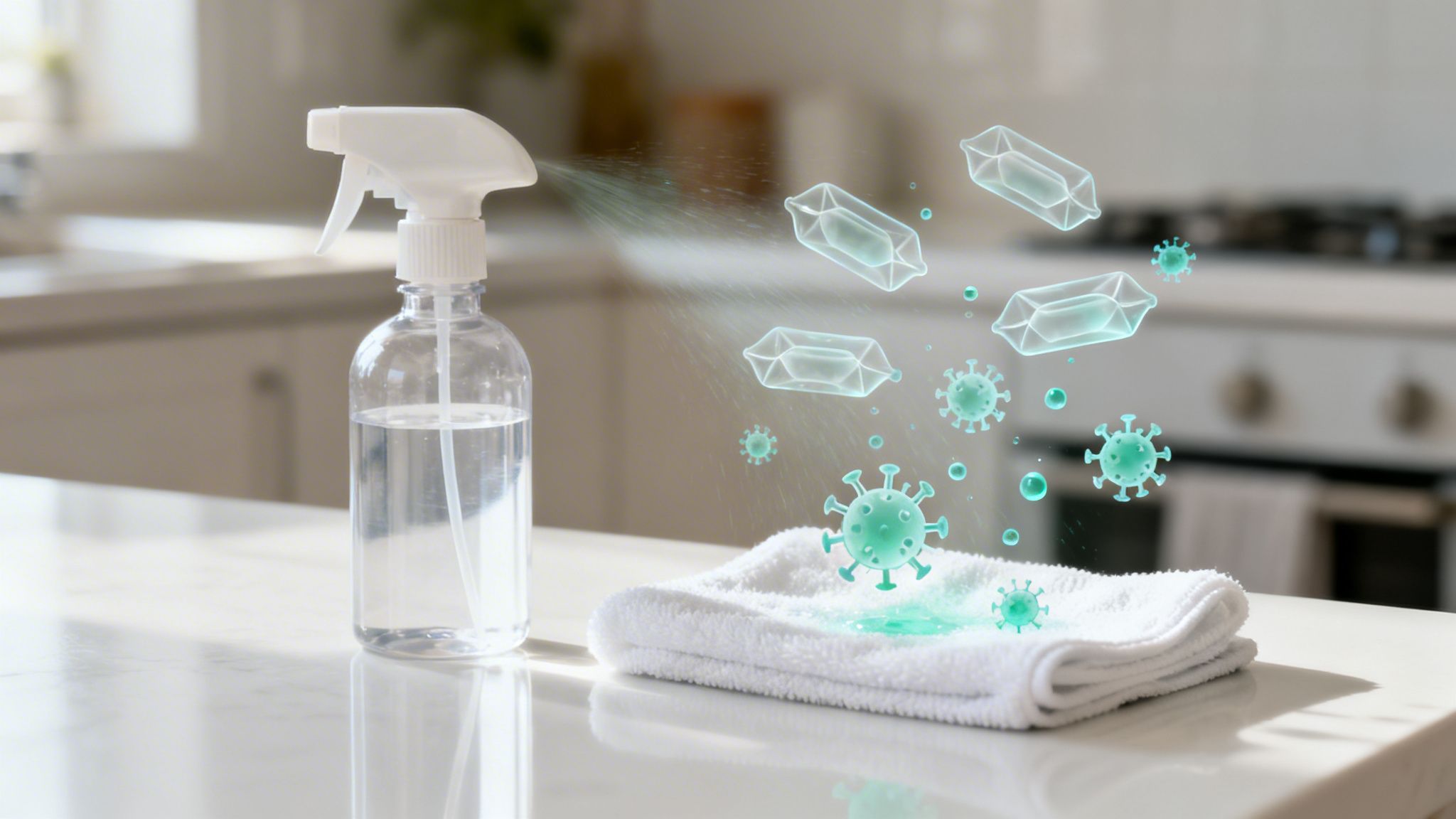
The good news is that the flu virus is a bit of a lightweight. It’s surprisingly vulnerable to many common disinfectants you probably already have. Things like EPA-registered products, solutions with at least 70% alcohol, diluted household bleach, or hydrogen peroxide can all knock it out effectively. These agents work by attacking the virus's fragile outer shell, destroying it on contact and stopping it in its tracks.
How Disinfectants Actually Defeat the Flu Virus

When you're dealing with an invisible enemy like the flu, it helps to know its weakness. The key to answering "what kills the flu virus on surfaces?" is understanding its basic biology. Influenza is an enveloped virus, which means it's wrapped in a delicate outer layer made of lipids (fats).
Think of this envelope like a soap bubble. It's incredibly fragile and easy to break. Disinfectants are designed to "pop" that bubble. Once that fatty envelope is destroyed, the virus's internal parts are exposed and it can no longer infect your cells. It’s rendered completely harmless.
To make it easier to see what works, here’s a quick rundown of effective disinfectants, their ideal concentrations, and the time they need to work their magic.
Effective Disinfectants for Killing Influenza Virus
| Disinfectant Type | Effective Concentration | Typical Contact Time |
|---|---|---|
| Ethanol or Isopropyl Alcohol | 70% or higher | 30 seconds to 1 minute |
| Sodium Hypochlorite (Bleach) | 0.1% (approx. 1:50 dilution) | 1 to 10 minutes |
| Hydrogen Peroxide | 0.5% or higher | 1 to 5 minutes |
| Quaternary Ammonium Compounds | Varies by product | 1 to 10 minutes |
| Phenolic Compounds | Varies by product | 10 minutes |
This table gives you a great starting point, but always remember to check the specific product label. The manufacturer's instructions are your best guide for ensuring you're completely inactivating the virus.
Why Contact Time is Everything
Here’s where a lot of people go wrong. Simply spraying and wiping isn't enough to kill the virus. For any disinfectant to work, it has to stay on the surface for a specific period known as contact time (or dwell time). This is the minimum amount of time the surface must remain visibly wet to ensure all the flu viruses are destroyed.
A classic mistake is to spray a disinfectant and immediately wipe it dry. When you do that, you're removing the very thing that's supposed to be killing the germs before it has a chance to work. You might as well be using plain water.
Always check the product label for the recommended contact time. It can be anywhere from 30 seconds to 10 minutes. This one small step turns a quick wipe-down into a genuine disinfection, making sure you’re actually eliminating the threat. This is why having ready-to-use disinfecting wipes is so effective—they are pre-saturated to stay wet long enough to work correctly.
How Long Does the Flu Virus Survive on Surfaces, Anyway?
The need for proper disinfection really hits home when you realize just how long the flu virus can stick around. Think about a doorknob, a remote control, or a countertop that someone with the flu just touched. How long does that threat linger?
Studies have shown that both influenza A and B viruses can survive for a shocking 24 to 48 hours on hard, non-porous surfaces like stainless steel and plastic. The virus doesn't fare as well on softer materials, typically surviving for less than 8 to 12 hours on things like cloth, paper, or tissues. You can dig into the specifics in this landmark research about influenza virus survival on different materials.
This persistence is exactly why focusing your cleaning efforts on high-touch hard surfaces is so critical during flu season.
Understanding Your Invisible Enemy: The Flu Virus
To win the battle against the flu on surfaces, you first have to know your opponent. The influenza virus isn't some indestructible superbug; it actually has a pretty significant weak spot.

Like its cousins, Human Immunodeficiency Virus Type 1 (HIV-1), Hepatitis B Virus (HBV), and Herpes Simplex Virus 1 (HSV-1), influenza is an enveloped virus. Think of it as a delicate piece of genetic material wrapped in a protective outer layer made of lipids—basically, a greasy bubble.
This lipid envelope is both the virus's armor and its Achilles' heel. It keeps the virus safe as it travels between people, but it's also incredibly fragile. The best way to picture it is as a delicate soap bubble. Pop the bubble, and what's inside is rendered harmless.
The right disinfectants are designed to be the pin that pops that bubble. When a proper cleaning agent hits the influenza virus, it dissolves that fatty outer layer almost instantly. Once the envelope is destroyed, the virus is neutralized. It simply can't infect you anymore.
The Virus Survival Guide: Environment Matters
The flu virus doesn't last forever on a countertop. Its survival clock is ticking, and several environmental factors can either speed it up or slow it down. Knowing these helps explain why flu season hits when it does.
Here’s what makes a difference:
- Temperature: Influenza is a big fan of the cold. It stays stable and infectious for much longer in cool, dry conditions.
- Humidity: The virus loves dry air. Low humidity (below 50%) helps it hang around longer, both in the air and on surfaces. In humid environments, the droplets carrying the virus get heavy, fall faster, and the virus itself breaks down more quickly.
- Sunlight (UV Radiation): Sunshine is a natural-born virus killer. The UV radiation from the sun shreds the virus's genetic material and shatters its structure, drastically cutting its lifespan on outdoor surfaces.
This is exactly why a cool, dry kitchen counter can be a flu virus hotspot for hours, while a sunny park bench becomes hostile territory for the virus in a very short time. Our indoor environments are often the perfect little havens for the flu to wait for its next victim.
Surface Type Is a Decisive Factor
Beyond the environment, the type of surface the virus lands on is absolutely critical. This is probably one of the most important things to understand, as it dictates your entire cleaning strategy.
Surfaces fall into two main camps:
- Non-Porous Surfaces: These are the hard, smooth materials—stainless steel, plastic, glass, and sealed countertops. They don't absorb moisture, so the virus just sits right on top, remaining a threat for a surprisingly long time—often 24 to 48 hours. These are the true danger zones for transmission.
- Porous Surfaces: Think fabrics, paper, untreated wood, and cardboard. These materials soak up moisture, which traps the virus and tears apart its delicate envelope. On porous surfaces, the flu virus is usually a goner in less than 12 hours.
By understanding that the flu virus thrives on cool, dry, hard surfaces, you can transform your cleaning from a random chore into a targeted, effective strategy. You're no longer just wiping things down; you are actively dismantling the virus's life support system.
This basic knowledge is a game-changer. It helps you focus your efforts on the high-risk zones—the doorknobs, light switches, keyboards, and phones—where the virus has its best shot at survival and finding its way to you.
Your Arsenal of Virus-Killing Chemical Agents
Knowing the flu virus has a weak spot is one thing, but knowing how to hit it is another. To really knock this invisible threat out of your home or office, you need the right tools. That means turning to specific chemical agents that are proven to dismantle enveloped viruses like influenza. Not all cleaners are created equal, and when your health is on the line, picking the right disinfectant is everything.
The easiest way to know you've got a winner? Look for products registered with the Environmental Protection Agency (EPA). An EPA registration number on the label is your guarantee that the product has been scientifically tested and proven to kill the germs it claims to, including Influenza A. It takes all the guesswork out of the equation.
Alcohol: The Fast-Acting Virus Disruptor
One of the most common and effective weapons against the flu virus is plain old alcohol—specifically ethanol and isopropanol. The key, however, is the concentration. It needs to be at least 70% to be reliably effective. Anything weaker just won't cut it.
Alcohol works through a process called denaturation. Think of the virus's protective lipid envelope as a delicate, precisely folded protein structure. Alcohol hits it and forces that structure to unfold and completely fall apart, sort of like how cooking turns a clear, liquid egg white into a solid, opaque mass. Once that protective shell is destroyed, the virus is neutralized almost instantly. This is exactly why alcohol-based hand sanitizers and disinfecting wipes are so popular—they work fast and get the job done.
Hydrogen Peroxide: The Oxidizing Powerhouse
Another powerful tool is hydrogen peroxide. You probably know it as a first-aid staple for cuts and scrapes, but it's also a serious virucide. Formulations of Accelerated Hydrogen Peroxide (AHP) are especially potent and are used all the time in hospitals. For everyday household use, you’ll want a concentration of 0.5% or higher to effectively kill the flu virus.
Hydrogen peroxide works by oxidation. It chemically "steals" electrons from the virus’s outer envelope, triggering a chain reaction that rips its structure apart at the molecular level. It’s a full-on chemical assault that leaves the virus unable to function or infect anyone.
The key takeaway is that different chemicals attack the virus in unique ways. Whether it's the denaturing power of alcohol or the oxidizing force of hydrogen peroxide, the end result is the same: a destroyed viral envelope and a neutralized threat.
Quaternary Ammonium Compounds: The Persistent Protector
If you read the label on many common disinfectant sprays and wipes, you'll likely see names like benzalkonium chloride. These are Quaternary Ammonium Compounds, or "quats" for short. Quats are a type of surfactant that attaches to the virus's lipid envelope and essentially dissolves its protective layer.
One of the big advantages of quats is their residual effect. They can keep working on a surface for a short while after you've wiped it down, inhibiting new microbial growth. This makes them a fantastic choice for those high-touch surfaces that seem to get re-contaminated just minutes after you clean them.
For a deeper dive into comprehensive solutions for unseen threats, it’s worth understanding how professionals apply these same principles on a larger scale with antimicrobial treatment.
Comparing Common Disinfectants for Flu Virus Inactivation
With several options available, it helps to see how they stack up. This table breaks down the most common household disinfectants, how they work, and where they shine.
| Disinfectant | How It Works | Best For | Safety Notes |
|---|---|---|---|
| Alcohol (70%+) | Denatures proteins, dissolving the lipid envelope. | Hard non-porous surfaces, electronics (when applied to a cloth first). | Highly flammable; use in well-ventilated areas. |
| Hydrogen Peroxide (0.5%+) | Oxidizes and destroys the viral envelope. | Countertops, bathroom surfaces, and general household disinfection. | Can discolor some fabrics and surfaces; check label. |
| Quats | Binds to and disrupts the lipid envelope. | Floors, walls, and furniture; provides some residual action. | Can cause skin irritation; follow safety instructions. |
| Sodium Hypochlorite (Bleach) | Strong oxidizer that rapidly destroys viral components. | Hard, non-porous surfaces like kitchen and bathroom counters. | Corrosive; never mix with ammonia. Requires good ventilation. |
Ultimately, choosing the right disinfectant means you can stop the flu virus in its tracks in just minutes, rather than letting it linger for days.
The Unbeatable Convenience of Disinfecting Wipes
While you can mix your own cleaning solutions, you just can't beat the convenience and reliability of ready-to-use disinfecting wipes. They come pre-saturated with the perfect concentration of disinfectant, so there’s no measuring and no risk of a mixing error. You're guaranteed a solution that’s strong enough to kill the virus every single time.
Their real power, though, is how easy they make it to be consistent. Keeping a container of wipes in the kitchen, bathroom, and by your desk makes it effortless to quickly wipe down doorknobs, light switches, keyboards, and remote controls throughout the day. This simple habit can make a huge difference in breaking the chain of transmission, especially when someone in the house is sick.
Why The Flu Hangs Around Longer on Certain Surfaces
Ever wonder why a stainless steel doorknob is a bigger flu risk than a fabric curtain? The answer is all about the surface itself. Not all materials are the same in the eyes of a virus, and knowing the difference is key to cleaning effectively.
The main distinction comes down to two types of surfaces: non-porous and porous. Each one creates a totally different environment for the influenza virus, which directly affects how long it can survive and stay infectious.
The Perfect Havens: Non-Porous Surfaces
Non-porous surfaces are the hard, smooth materials we touch all day long. Think of things like plastic, metal, glass, and sealed countertops. These materials don't absorb moisture at all.
When a droplet carrying the flu virus lands on a non-porous surface, it just sits there. The virus is left exposed on top, its delicate lipid envelope safe and sound, just waiting for the next person to come along. This creates the perfect setup for survival, letting the virus remain a threat for 24 to 48 hours or even longer. You can dive deeper into how long viruses last on different materials in our detailed guide on the topic: how long do viruses live on surfaces.
This long survival time turns these surfaces into viral hotspots.
Think of a non-porous surface like a glass slide in a lab. It provides a stable, non-absorbent platform that preserves the virus, keeping it ready to infect for a surprisingly long time. This is exactly why disinfecting these areas is non-negotiable during flu season.
The Unforgiving Terrain: Porous Surfaces
On the other hand, porous surfaces are things like fabric, untreated wood, paper, and carpet. These materials are absorbent, acting more like a sponge.
When a virus-filled droplet lands on a porous surface, the material immediately starts wicking the moisture away. This process works directly against the virus, pulling apart its fragile lipid envelope and essentially drying it out. Trapped inside the fibers, the virus quickly becomes non-infectious, usually in less than 12 hours.
While porous surfaces can still hold germs, they are far less likely to be a major source of flu transmission compared to their non-porous cousins. The material's very nature helps neutralize the threat for you.
Identifying Your Home and Office Hotspots
Understanding the difference between porous and non-porous helps you focus your cleaning where it counts. You don’t need to bleach your curtains, but you absolutely need to hit the hard surfaces people touch constantly.
Here are the biggest non-porous hotspots that need your attention:
- Doorknobs and Cabinet Handles: Touched by almost everyone, all day long.
- Light Switches: Often the first and last thing touched when entering or leaving a room.
- Countertops and Tabletops: Where food is prepped and personal items are dropped.
- Faucets and Toilet Handles: Major transmission points in any bathroom.
- Electronics: Keyboards, mice, remote controls, and especially your smartphone.
Even something as simple as paper money can be a problem. Research has shown that influenza viruses can survive on banknotes for days. In a 2008 study, one sample was still infectious after a shocking 12 days on a banknote. You can read more about how the flu virus survives on money in the study itself.
By recognizing these high-risk surfaces, you can move from just general cleaning to a smart, targeted disinfection strategy. This is where a versatile tool like a disinfecting wipe really shines. It lets you quickly and effectively neutralize the virus right where it loves to hang out, breaking the chain of transmission and keeping your space safer.
A Practical Guide to Effective Disinfection Technique
Having the right chemical in your hands is only half the battle. To actually kill the flu virus lingering on surfaces, how you clean is just as important as what you use. A good technique is what turns a simple wipe-down into a powerful defense against getting sick.
Most people make the same mistake: they see a dirty countertop, spray it with disinfectant, and immediately wipe it clean. Unfortunately, this often does little more than smear the germs around. For a disinfectant to truly work, it needs a clean slate.
The Critical Two-Step Process: Clean First
The golden rule of killing viruses is a simple, two-step method: clean, then disinfect. Think of everyday dirt, grime, and food spills as a shield that germs can hide behind. If you spray disinfectant directly onto a soiled surface, the chemical has to fight through that layer of gunk before it can even get to the virus.
This initial cleaning step is absolutely non-negotiable for success.
- Step 1: Clean. Start by washing the surface with regular soap and water or an all-purpose cleaner. Use a cloth or paper towel to physically scrub away all visible dirt, crumbs, and sticky spots. This action alone gets rid of a huge number of germs.
- Step 2: Disinfect. Once the surface is visibly clean, you can apply your EPA-registered disinfectant. Now, the chemical has a clear path to the flu viruses, allowing it to break down their protective outer layers without anything getting in the way.
Following this order ensures you're not wasting your disinfectant or, worse, giving viruses a place to hide in plain sight.
Mastering Contact Time: The Secret to Success
After you've cleaned the surface, the next crucial step is respecting the contact time, sometimes called "dwell time." This is simply the amount of time a surface must stay visibly wet with the disinfectant to guarantee all the viruses are killed.
Spraying and immediately wiping is one of the most common disinfecting mistakes—it just doesn't give the chemical enough time to do its job.
Every disinfectant product has a specific contact time printed on its label, which can be anywhere from 30 seconds to 10 minutes. For you to be confident a surface is truly disinfected, it needs to look wet for that entire duration.
This is especially important when you consider how easily viruses travel from one surface to another.

As you can see, germs can easily move from fabrics to hard surfaces and then to the high-touch points we all share, like doorknobs. This is how cross-contamination happens so fast, and it reinforces why a methodical approach is so vital.
Your Disinfection Checklist
To make this process foolproof, don't just clean at random. Move through a room with a clear plan to make sure you hit all the high-risk areas where germs love to hang out.
- Gather Your Supplies: Before you start, get your cleaner, disinfectant (sprays or wipes), gloves, and paper towels or clean cloths ready to go.
- Work from Top to Bottom: Always start with higher surfaces like countertops and tables before moving to floors. This prevents you from knocking dirt onto areas you've already cleaned.
- Focus on High-Touch Hotspots: Pay extra attention to doorknobs, light switches, faucet handles, remote controls, keyboards, and phones. These are the germ highways in any home or office.
- Clean, Then Disinfect: Never skip the first step. Always follow the two-step process on every single surface.
- Respect the Contact Time: After spraying the disinfectant, set a timer or just let the surface air dry. Don't wipe it away until the required dwell time has passed.
While this guide covers what you need for everyday flu disinfection, severe viral contamination may require professional-grade solutions. Understanding how a Biohazard Remediation Company approaches these situations can offer insight into advanced techniques. And for those who prefer a DIY approach, learning to mix a proper disinfectant bleach solution is a great next step.
When you combine the right product with the right technique, you create a powerful barrier against the flu.
Oops! Common Disinfection Mistakes and How to Sidestep Them
Knowing which chemicals knock out the flu virus is half the battle. But if your technique is off, you might as well be spraying water. Even the right disinfectant is useless if you don't use it correctly.
Let's walk through a few common blunders that can undermine all your hard work, ensuring you're actually protecting your space and not just going through the motions.
One of the biggest mistakes is trying to clean an entire room with a single disinfecting wipe. Think of a wipe like a tiny sponge—it can only hold so much germ-killing liquid and pick up so much grime. Once it’s dry or dirty, it stops disinfecting and starts acting like a taxi service for germs, shuttling them from a doorknob straight to your keyboard. For larger areas, always grab a fresh wipe.
Another classic error? Ignoring the product label. That fine print is your instruction manual. It tells you the contact time—how long the surface needs to stay wet to actually kill the virus. If you spray and immediately wipe, you're not giving the disinfectant enough time to do its job.
Safety First: Handle with Care
Powerful chemicals demand respect. While disinfectants are your best friends in the fight against flu, they can be hazardous if handled carelessly. A few simple precautions are non-negotiable.
Always stick to these essential safety rules:
- Let the Fresh Air In: Crack a window or flip on a fan when you’re disinfecting, especially with anything bleach-based. This simple step keeps strong fumes from building up and irritating your lungs.
- Glove Up: Many disinfectants can be rough on your skin. A good pair of reusable or disposable gloves creates a necessary barrier between you and the chemicals.
- Never Play Chemist: This is the golden rule. Never, ever mix bleach with ammonia-based cleaners. The combination creates toxic chloramine gas, a dangerous chemical that can cause serious respiratory damage. Just use one product at a time, exactly as the label directs.
Kicking Counterproductive Cleaning Habits
Beyond the immediate safety risks, some habits just make your cleaning efforts pointless. Dialing in these details ensures you’re truly eliminating the influenza virus, not just giving it a free ride around your home.
A huge oversight is using expired products. Just like milk, disinfectants have a shelf life. Over time, their active ingredients break down and lose their punch. That old bottle of cleaner lurking under your sink might not be killing any viruses at all. Always check the date.
By dodging these simple mistakes, you can disinfect with total confidence. Reading the label, using fresh products, protecting yourself, and using tools like wipes correctly will transform your cleaning routine into a truly effective flu-fighting strategy.
Common Questions About Killing the Flu Virus
When it comes to flu season, knowing exactly what works to kill the virus on surfaces can feel overwhelming. Let's clear up some of the most common questions and get you on the right track to a flu-free home.
Do Natural Cleaners Like Vinegar Actually Work on the Flu Virus?
While vinegar and essential oils are fantastic for everyday grime, they simply aren’t up to the task of killing influenza. Think of the flu virus as being wrapped in a protective fatty layer, or a "lipid envelope." Natural cleaners just can't break through it.
To really knock out the flu, you need a disinfectant with ingredients proven to destroy that envelope. We're talking about things like alcohol, hydrogen peroxide, or the quaternary ammonium compounds you'll find in products registered with the EPA.
What’s the Real Difference Between Sanitizing and Disinfecting?
People use these words interchangeably all the time, but in the world of virus-fighting, they mean two very different things. Getting it right is key.
- Sanitizing is about reducing the number of germs to a safer level. It lowers the risk of getting sick but doesn't wipe everything out. A good example is hand sanitizer—it's great in a pinch but not a substitute for a deep clean.
- Disinfecting is the heavy hitter. It’s a chemical process that kills virtually all viruses and bacteria on a surface, including tough ones like influenza.
When you're dealing with the flu, your goal is always to disinfect. You want to completely neutralize the threat, not just knock it back a bit.
How Often Should I Be Disinfecting During Flu Season?
The right frequency really depends on what’s happening in your home. If everyone is healthy, a daily wipe-down of the "hotspots" is a smart, preventative move during peak flu season. This means doorknobs, light switches, faucets, remotes, phones, and kitchen counters.
But if someone in your house gets sick? It's time to ramp things up. Disinfecting those high-touch surfaces several times a day can make a huge difference in stopping the virus from spreading to everyone else. This is where disinfecting wipes become your best friend—they make it easy to quickly and effectively hit those critical spots throughout the day. Consistency here is what breaks the chain of transmission and keeps the rest of the household healthy.
Leave a Reply