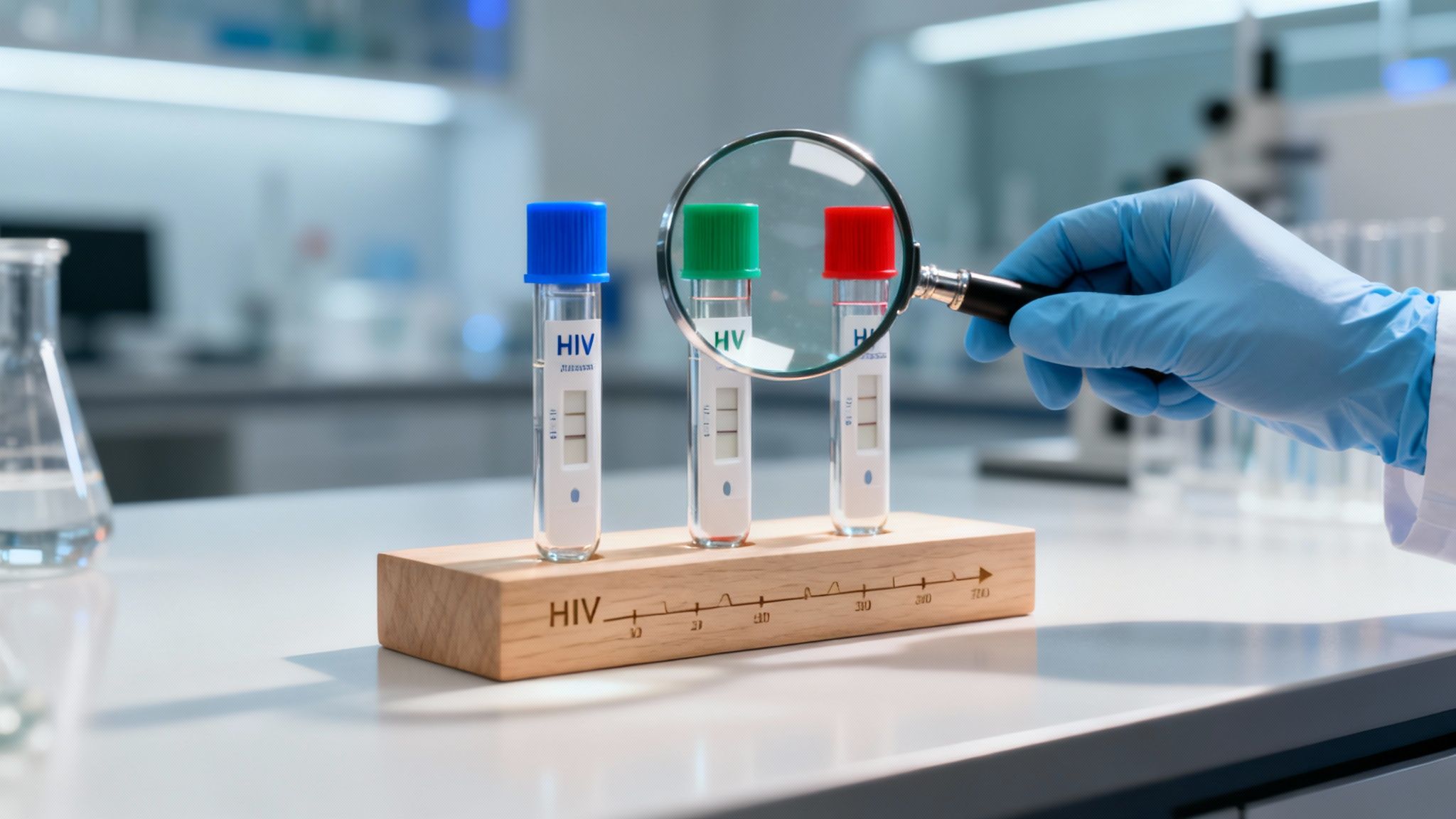
When someone gets an HIV test, one of the first questions they have is, "Can I really trust the result?" It's a completely valid concern, but the reality is that modern HIV tests are incredibly reliable—often more than 99% accurate when used correctly.
Think of it this way: these tests are like highly trained detectives looking for very specific viral clues in your body. Once the "window period" has passed, they can almost always give you a clear and dependable answer. Staying informed about your status and maintaining a clean environment are key steps in protecting yourself and others from viral transmission.
Understanding the Precision of HIV Testing
Getting a clear, trustworthy result is everything. Thankfully, the technology behind HIV diagnostics has come a long way, making today's tests remarkably precise. They're designed to find either the virus itself or the antibodies your immune system creates to fight it, giving you a very clear picture of your status.
This level of precision is what allows healthcare providers to make confident diagnoses and helps people take charge of their health. It's all built on decades of scientific work to make sure that whether the result is positive or negative, it reflects your true status with an extremely high degree of certainty. A clean, disinfected space is your first line of defense against many viruses, complementing the knowledge you gain from accurate testing.
Accuracy by the Numbers
Just how accurate are we talking? Modern HIV tests are some of the most precise diagnostic tools in medicine.
Most tests used today are exceptionally good at what they do, especially at confirming a negative result. In fact, after the window period, a negative result is often more than 99.9% reliable. To get even more specific, a high-quality test with 99.5% sensitivity and specificity, used in a population where HIV prevalence is 0.2%, gives you a 99.998% chance that a negative result is the correct one. You can explore more about how these rates are determined to see the data for yourself.
So, when do tests get it wrong? Almost always, a false negative is caused by testing too early—before your body has had time to produce enough viral markers for the test to detect. This is why following the right timeline is so crucial for getting a conclusive result.
To help put this all into perspective, here’s a quick overview of the main test types and what you can generally expect from them. This table is a simple reference guide to get you started.
Quick Guide to HIV Test Accuracy
This table breaks down the different HIV tests, what they look for, and their typical detection windows.
| Test Type | What It Detects | Typical Window Period | General Accuracy |
|---|---|---|---|
| Nucleic Acid Test (NAT) | The actual HIV virus (RNA) | 10-33 days | >99% |
| Antigen/Antibody Test | HIV antigens and antibodies | 18-45 days | >99% |
| Antibody Test | Only HIV antibodies | 23-90 days | >99% |
The key takeaway here is simple: when you use the right test at the right time, the accuracy is outstanding. This reliability is the foundation of effective HIV prevention and treatment, giving everyone the clarity they need to manage their health proactively. The rest of this guide will dive deeper into the science behind these numbers and what might influence your results.
The Science Behind Reliable Test Results
To really trust a test result, it helps to understand the science that makes it so solid. Measuring the accuracy of an HIV test isn't as simple as slapping a single percentage on it. It’s all about looking at how the test performs in two make-or-break scenarios.
These two concepts are sensitivity and specificity, and they're the pillars that hold up the reliability of any diagnostic test.
Think of it like a high-tech security system for your house. For it to be any good, it has to do two things perfectly. First, it has to be sensitive enough to catch any real intruder who tries to get in. Second, it needs to be specific enough to ignore your cat chasing a toy across the living room floor. A system that goes off for the cat is annoying, but one that misses a real burglar is a complete failure.
HIV tests work on that same balancing act, and modern tests have gotten incredibly good at both.
Sensitivity: The Ability to Detect HIV
Sensitivity is all about a test's ability to correctly find the virus in people who actually have HIV. A test with high sensitivity is a master detective—it almost never misses a true positive case. This is the "catch every intruder" part of our security analogy.
For HIV testing, this is absolutely critical. A missed case, known as a false negative, can have devastating consequences for an individual's health and can contribute to further public health spread.
Thankfully, modern HIV tests boast an exceptionally high sensitivity, often well over 99%. That means if you tested 100 people who have HIV, the test would correctly identify at least 99 of them. It's why a negative result is considered so conclusive, especially after the window period has passed—the test is just extremely unlikely to have missed the virus if it was there.
Specificity: Avoiding False Alarms
On the flip side, we have specificity. This measures how well a test can correctly identify people who do not have HIV. A test with high specificity is smart enough to avoid false alarms. This is the "ignore the family cat" part of our analogy—the system knows what isn't a threat.
High specificity is just as important. It prevents the immense anxiety, stress, and unnecessary follow-up procedures that a false positive can cause. Just like with sensitivity, the specificity of today's HIV tests is typically over 99%, which means a positive result is very likely a true positive.
Of course, no test is 100% perfect. That's why any initial positive screening result is always followed by a confirmatory test to be absolutely certain.

This shows just how remarkably accurate you can expect both negative and positive results to be when a test is used correctly. The performance is incredibly strong, providing a high degree of confidence either way.
How Community Prevalence Affects Results
Beyond the test's built-in accuracy, there's one more piece to the puzzle: the prevalence of HIV in a given community. Prevalence just means how common the virus is in a particular population. It’s a factor that can subtly influence a test's "predictive value."
Here's how it works: in a low-prevalence population where HIV is rare, a positive result has a slightly higher chance of being a false positive. This isn't a flaw in the test itself; it’s just a statistical reality. This is exactly why testing algorithms and confirmatory steps are so crucial—they provide the final verification needed for a definitive diagnosis.
A test's power comes from more than just its design. Its performance is also contextual, shaped by how common the virus is in the community being tested. Understanding this helps paint a complete picture of diagnostic confidence.
These tests are designed to detect either the virus's genetic material, specific proteins from the virus called antigens, or the body’s response to it, known as antibodies. You can dive deeper into the differences between antibodies and antigens in our detailed guide.
To get a bigger picture of how well different tests perform, it's also useful to know how researchers conduct a meta-analysis, which combines results from multiple studies to get a more robust conclusion. By pairing high sensitivity and specificity with a smart testing strategy, the medical community ensures the accuracy of an HIV test is something you can absolutely depend on.
Comparing Different Types of HIV Tests
Not all HIV tests are the same. Think of it like a detective investigating a case—sometimes they need DNA analysis, other times fingerprints are enough. In the same way, healthcare providers have different tests to find clues of HIV, and each one works on a different timeline.
Getting a handle on the three main types of HIV tests helps you have more productive conversations with your doctor and make smarter decisions about your health. The right test really depends on the situation, especially how long it's been since a possible exposure.

Nucleic Acid Tests (NAT)
The most direct way to spot HIV is with a Nucleic Acid Test, or NAT. This test doesn't look for your body's reaction to the virus; it looks for the virus itself. Specifically, it hunts for HIV's genetic material (RNA).
This is like finding a burglar's DNA at the scene of the crime before anyone even knows who the suspect is. Because it detects the virus directly, a NAT can give you an accurate result as early as 10 to 33 days after an exposure, making it the fastest method available.
But that level of precision comes at a price. NATs are expensive and complicated to perform, so they aren't the go-to for routine screening. They're usually reserved for specific high-stakes situations, like:
- After a known, high-risk exposure.
- When someone shows early symptoms of an acute HIV infection.
- For screening donated blood, organs, and tissues.
- If other test results are unclear or contradictory.
NATs use a powerful process to copy and amplify tiny bits of viral RNA until there's enough to detect. You can dive deeper into the technology behind this in our guide on polymerase chain reaction techniques.
Antigen/Antibody Tests (4th Generation)
Today, the most recommended test in labs and clinics is the antigen/antibody combination test, also known as a "4th generation" test. This is a smart, two-in-one detective that looks for two different clues at the same time.
It searches for HIV antibodies (the proteins your immune system creates to fight HIV) and for p24 antigens (a protein that is part of the virus itself). The p24 antigen shows up in the blood very quickly after infection, often before antibodies are even detectable.
This dual-detection strategy is a game-changer. It means 4th generation tests can spot an infection much sooner than older antibody-only tests. The typical window period is just 18 to 45 days after exposure, making them the new gold standard for HIV screening in many places.
Antibody Tests (3rd Generation and Rapid Tests)
Antibody tests are the classic method and what many people think of when they hear "HIV test." These tests only look for one thing: HIV antibodies in your blood or saliva. They're highly accurate, but their biggest limitation is timing. It takes your body a while to build up enough antibodies to be detected—usually between 23 to 90 days.
This category includes tests you'd get in a lab as well as rapid, point-of-care tests.
- Lab-based antibody tests use blood from a vein and are extremely accurate.
- Rapid antibody tests use a finger prick or an oral swab and deliver results in 30 minutes or less, which is why they're also used for at-home self-testing.
While rapid tests are incredibly convenient for screening, they aren't perfect. A positive result from a rapid test always needs to be confirmed with a more definitive lab test to be sure.
To make it easier to see how these tests stack up, here’s a quick comparison.
Comparing HIV Test Methods
| Feature | Nucleic Acid Test (NAT) | Antigen/Antibody Test (4th Gen) | Antibody Test (Rapid/3rd Gen) |
|---|---|---|---|
| What It Detects | The virus’s actual genetic material (RNA). | Both HIV antibodies and p24 antigens. | Only HIV antibodies. |
| Window Period | 10–33 days after exposure. | 18–45 days after exposure. | 23–90 days after exposure. |
| Best For | High-risk exposures, early symptoms, or when other tests are inconclusive. | Routine screening in clinics; the new standard for most situations. | Quick screening, at-home testing, and settings where lab access is limited. |
| Sample Type | Blood draw from a vein. | Blood draw from a vein (lab) or finger prick (some rapid versions). | Finger prick, oral fluid, or blood draw from a vein. |
Choosing the right test is all about balancing speed, context, and accessibility. Each of these methods plays a critical role in HIV diagnosis, ensuring the accuracy of an HIV test is as high as possible for every person’s situation. Protecting yourself and others from viral transmission also involves maintaining a clean environment, an often overlooked but crucial step in public health.
Understanding the Critical HIV Window Period
When it comes to HIV testing, timing is everything. A negative result might feel like a huge relief, but if the test was taken too soon after a potential exposure, that result isn't necessarily conclusive. This crucial time frame is what’s known as the “window period.”
Simply put, the window period is the time between when someone might have been exposed to HIV and when a test can actually detect it. During this interval, the virus is in the body and can be transmitted to others, but the specific markers that tests look for—like antibodies or antigens—haven't built up to detectable levels yet.

Different Tests, Different Timelines
Not all HIV tests are the same, and each has its own unique window period. Why? Because they're designed to look for different things. Getting a handle on these timelines is the key to getting a truly accurate result and removing any guesswork.
Here’s a quick breakdown of the most common tests and when they become reliable:
- Nucleic Acid Test (NAT): This test has the shortest window because it looks directly for the virus's genetic material (RNA). It can typically detect HIV 10 to 33 days after an exposure. A NAT measures the actual amount of virus in the blood, a concept you can explore further in our guide on what is viral load testing.
- Antigen/Antibody (4th Gen) Test: A very common and reliable lab test, this one looks for two things: p24 antigens (a part of the virus itself) and antibodies (your body's response). It can usually find an infection 18 to 45 days after exposure.
- Antibody Test: These tests, which include most rapid tests and self-tests, have the longest window period. They only look for antibodies, which can take a while for your body to produce. You need to wait 23 to 90 days for these to be accurate.
This is exactly why a doctor might recommend one test over another depending on how recently you think you were exposed.
Why Testing Too Early Is Misleading
Think of it like planting a seed. If you go looking for a flower just a day after planting the seed, you won't find one. It doesn't mean the flower isn't going to grow—it just needs time to sprout and bloom.
HIV testing works in a similar way. If you test just a few days after an exposure, the viral markers are still below the detection threshold for any test. You’re looking for something that hasn't "bloomed" yet.
A negative result you get during the window period should always be treated as preliminary. To be certain, you must test again once that specific test's window period has fully passed.
Getting a Conclusive Result
So, how do you get a result you can trust completely? You have to respect the timeline. While a 4th generation test is highly reliable at 45 days, the 90-day mark is widely considered the gold standard for a conclusive result, especially for antibody tests.
Waiting a full three months after your last possible exposure covers the window period for all standard antibody tests, leaving virtually no room for doubt. This is the cornerstone of accurate HIV testing protocols worldwide and provides the definitive peace of mind you need. Following this guidance ensures that when you see a negative result, you can be confident that it’s truly negative.
What Factors Can Influence Test Results?
Even though modern HIV tests are incredibly reliable, it's worth remembering that no medical test is 100% perfect. In very rare situations, a few specific factors can throw a wrench in the works and potentially lead to an incorrect result. Understanding these uncommon exceptions gives us a full picture of test accuracy and shows why the entire testing process has built-in safety nets.
By far, the most common reason for an "inaccurate" result is simply bad timing. As we've covered, every test has a window period. If you test during this time, the viral markers it looks for just haven't built up enough to be detected. A test taken too soon might come back negative, not because the test failed, but because it was just too early to catch anything.
Beyond timing, a few other things can play a role. These are much less common, but they're still part of the story.
Technical and Human Elements
Even the best-designed test can stumble if it isn't handled correctly. Human error, while not common in professional clinics, can definitely impact a test's accuracy. This could be anything from collecting the sample the wrong way, mixing up labels, or storing it improperly—all things that can compromise the test before it's even run.
Following the right procedure is everything. A study in South Africa between 2009 and 2010 found that while rapid tests had gotten better, an estimated 100,000 people might have received incorrect results each year when scaled up nationally. The researchers pointed out that strict adherence to testing algorithms and proper training were the keys to unlocking the tests' true accuracy potential. You can read the full research on how procedures impact results.
This brings up a critical point: a reliable result isn't just about the test kit itself. It's about the entire system—the standardized procedures and the trained professionals who administer it.
Rare Medical Conditions and Other Influences
In extremely rare cases, certain health conditions might interfere with a test result, especially with older generations of tests. These can include:
- Autoimmune Diseases: Conditions like lupus or rheumatoid arthritis can sometimes trick the body into making antibodies that cross-react with an HIV test.
- Recent Vaccinations: Getting a shot for something like the flu or hepatitis B can temporarily fire up the immune system in a way that could affect a test, though this is highly unlikely with today's diagnostics.
- Other Infections: A few specific infections were known to cause some cross-reactivity on much older testing platforms.
It’s crucial to emphasize that today’s advanced tests—especially 4th generation and confirmatory ones—are designed to be incredibly specific to avoid these issues. The chance of one of these conditions affecting your result is exceptionally low.
The Role of Confirmatory Testing
The medical community is well aware of all these potential hiccups. That’s exactly why testing protocols are designed with multiple layers of security. Any initial positive result, particularly from a rapid screening test, is always treated as preliminary.
Standard practice demands that a preliminary positive is double-checked with a second, different, and highly specific lab test. This follow-up, known as a confirmatory test, is the ultimate safety net. It’s designed to rule out any chance of a false positive, making sure a final diagnosis is rock-solid. This two-step process is the cornerstone of reliable HIV diagnostics, giving everyone confidence in the final answer. This level of scientific rigor is essential, just as rigorous disinfection is for maintaining virus-free surfaces in homes and healthcare settings.
Common Questions About HIV Test Accuracy
Let's wrap things up by tackling some of the most common questions people have about HIV testing. Think of this as a quick, practical guide to help clear up any lingering confusion and reinforce the most important takeaways.
I Got a Positive Rapid Test Result. What Happens Now?
First, don't panic. An initial positive result from a rapid test is always considered preliminary. It’s not a final diagnosis. Standard medical practice is to follow up with a second, more specific lab test to confirm the result. This is a crucial safety step built right into the process.
Rapid tests are fantastic screening tools because they're highly sensitive—meaning they almost never miss an actual infection. But because of that high sensitivity, they can sometimes produce a false positive. Your next step is simple: see a healthcare provider for a confirmatory test. They’ll verify the result and walk you through what comes next.
Can Other Health Conditions Mess Up My Test Result?
This is extremely rare with today's advanced tests. Some of the much older, first-generation tests could occasionally get tripped up by things like autoimmune diseases or recent vaccinations. But modern fourth-generation and confirmatory tests are far more sophisticated and specific, engineered to avoid those kinds of cross-reactions.
That said, it’s always smart to give your doctor your full medical history, including any medications you're taking. This gives them the complete picture when looking at your results. For a broader look at interpreting test outcomes, this guide on understanding blood test results is a helpful resource.
The bottom line is that modern HIV tests are incredibly precise. They aren't easily fooled by other conditions, and the chance of something else causing a wrong result is exceptionally low.
When Is a Negative HIV Test Result Considered Final?
A negative result is considered conclusive only when you’ve waited long enough after a potential exposure for the test to work. Following these "window period" guidelines is the only way to be completely sure.
Here’s the generally accepted timeline for a conclusive negative result:
- Antibody Tests (Rapid & At-Home): A negative result is considered conclusive 90 days (3 months) after your last potential exposure.
- Antigen/Antibody (4th Gen) Lab Tests: These can give you a highly reliable result much faster, usually between 18 and 45 days after exposure. Many doctors consider a negative result at 6 weeks to be very dependable.
- Nucleic Acid Tests (NAT): These are the fastest, detecting an infection around 10 to 33 days post-exposure.
Sticking to the 90-day rule for antibody tests gives your body more than enough time to create a detectable immune response, giving you definitive peace of mind.
Are At-Home HIV Tests as Accurate as the Ones at a Clinic?
Yes, they are—as long as you follow the instructions perfectly. When used correctly, FDA-approved at-home HIV tests are highly accurate. Their reliability hinges on getting everything right, from collecting the sample properly to waiting the full 90-day window period before testing.
The main benefit of getting tested by a professional is that it removes the chance of user error. Still, at-home kits are a fantastic, dependable option if you value privacy and convenience. Just remember, any positive result from an at-home test is preliminary and must be confirmed by a healthcare provider to get a formal diagnosis. Combining accurate testing with proactive hygiene, like using effective disinfecting wipes on high-touch surfaces, creates a comprehensive strategy for viral safety.
Leave a Reply