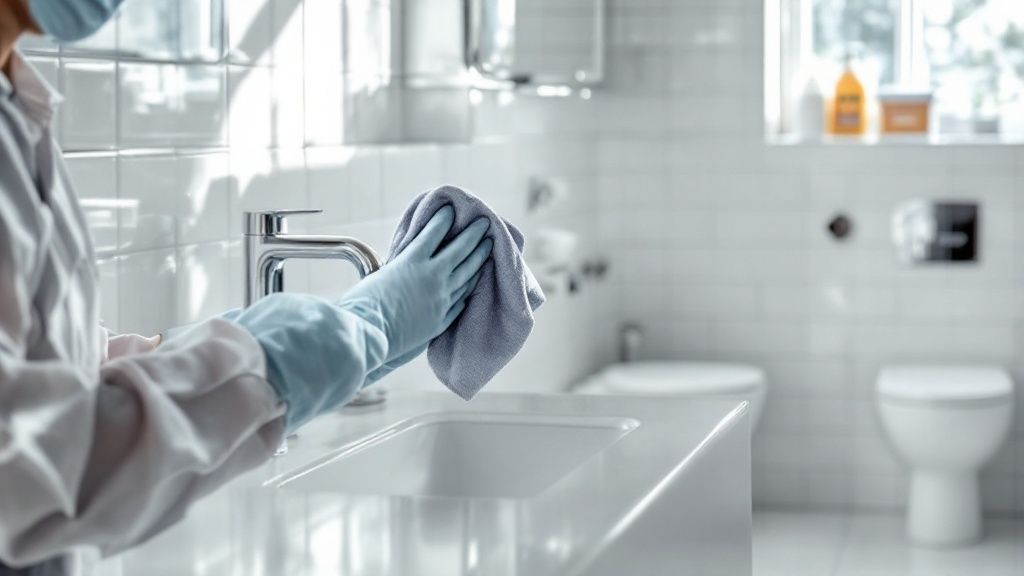
A seemingly minor detail, the state of a public restroom speaks volumes about a business. It’s often the first—and sometimes last—impression you make.
To truly clean public bathrooms is about much more than just a quick wipe-down. It demands a strategic approach to eliminate the invisible viral threats lurking on surfaces and create a space that feels genuinely safe and welcoming. This isn't just about appearances; it’s about protecting public health and, in turn, safeguarding your reputation and bottom line.
Why a Clean Restroom Is Your Greatest Asset
Let's be honest: a public restroom is a direct reflection of a business's standards and how much it respects its customers. These are confined, high-traffic spaces where the risks of viral transmission skyrocket. Common pathogens find an ideal breeding ground on the very surfaces everyone has to touch.
Think about the journey of a single virus. An infected person uses the restroom, and in an instant, tiny particles containing Norovirus (Norwalk Virus) or SARS-Related Coronavirus 2 (SARS-CoV-2) can settle on:
- Stall door latches
- Toilet flush handles
- Sink faucets
- Soap and paper towel dispensers

Suddenly, these hotspots become transmission points, turning a simple restroom visit into a potential source of a community outbreak. Viruses like the non-enveloped Human Rotavirus and Norovirus are notoriously tough, capable of surviving on surfaces for days. This makes a meticulous cleaning protocol—especially one using effective disinfecting wipes—not just good practice, but a frontline defense in public health.
The Business Cost of a Dirty Bathroom
The link between restroom cleanliness and business performance is undeniable. A dirty or poorly maintained restroom will actively drive customers away, eroding brand loyalty and hitting your revenue where it hurts.
When people encounter a dirty bathroom, it leaves a lasting negative impression that often overshadows an otherwise positive experience. This isn't just a hunch; the data backs it up.
Consumer perception data from the United States underscores the critical importance of clean public restrooms to business success. According to one extensive survey, 84% of Americans say that an unclean or poorly stocked restroom negatively impacts a business's image.
It gets worse. A staggering 75% of respondents said they would hesitate or completely avoid returning to a business after a single bad restroom experience.
But here’s the flip side: 71% of people reported they are more likely to revisit and spend more money at businesses with clean, well-maintained restrooms. You can explore more insights from the 2025 Healthy Handwashing Survey™ to see the full picture.
The reality is clear: investing in high-quality cleaning isn't just an expense—it’s an essential investment in customer retention and business growth. A pristine restroom signals care, builds trust, and keeps people coming back.
Assembling Your Virus-Fighting Toolkit
Walking into a cleaning job unprepared is a recipe for failure, especially when your goal is to eliminate microscopic viral threats. To truly clean public bathrooms effectively, you need more than just a bucket and a mop. Building the right toolkit, centered around quality disinfecting wipes and solutions, is your first, non-negotiable step toward ensuring a space is not just visually clean but genuinely disinfected and safe.

It all starts with protecting yourself. Think of Personal Protective Equipment (PPE) as your professional uniform. You wouldn't step onto a construction site without a hard hat, and you shouldn't handle potent cleaning chemicals or touch contaminated surfaces without the right gear. It's not optional; it's essential.
Prioritizing Personal Protective Equipment
Your safety comes first, always. Before you even think about grabbing a disinfectant spray, you need to be properly geared up. This isn't about being overly cautious—it's about smart, professional-grade safety.
- Gloves: Always wear disposable, non-porous gloves. They’re your primary shield against chemical irritation and direct contact with nasty pathogens like Hepatitis B Virus (HBV) and Herpes Simplex Virus 2 (HSV-2).
- Masks: A well-fitting mask is crucial. When you're spraying and scrubbing, you can kick up aerosolized droplets containing viruses like Rhinovirus Type 14, and you definitely don't want to be breathing those in.
- Eye Protection: Safety glasses or goggles are a must. An accidental splash of disinfectant to the eyes can cause serious, lasting damage. It's a simple precaution that can save your sight.
Differentiating Cleaners from Disinfectants
Here's something I see people get wrong all the time: not all cleaning products are created equal. A basic cleaner might make a countertop look clean by removing dirt, but it won’t do anything to kill viruses like Influenza A Virus (H1N1) or the notoriously tough Norovirus. This distinction is absolutely critical for public health.
For a surface to be considered disinfected, the product used must be registered with the Environmental Protection Agency (EPA). These products have been scientifically proven to kill specific pathogens, providing a level of assurance that standard soaps and detergents simply cannot offer.
Always look for an EPA registration number on the product label. It’s your guarantee that the product has met federal standards for effectiveness. When you're choosing a disinfectant, pay close attention to its "kill claims"—the specific viruses it is certified to eliminate.
To help you choose the right product, here's a quick reference table.
Choosing Disinfectants for Common Bathroom Viruses
| Virus Type | Example Viruses | Recommended Disinfectant Type | Key Ingredient to Look For |
|---|---|---|---|
| Enveloped Viruses | Influenza A Virus (H1N1), Coronaviruses (including SARS-CoV-2), Herpes Simplex Virus 1 (HSV-1) | Quaternary Ammonium Compounds (Quats), Alcohol-based | Benzalkonium Chloride, Ethanol |
| Large Non-Enveloped Viruses | Adenovirus, Human Rotavirus | Peroxygen Compounds, Phenolics | Hydrogen Peroxide, Phenol |
| Small Non-Enveloped Viruses | Norovirus (Norwalk Virus), Rhinovirus Type 39 | Sodium Hypochlorite (Bleach), Peroxygen Compounds | Sodium Hypochlorite, Accelerated Hydrogen Peroxide (AHP) |
Understanding this table helps you match your disinfectant to the specific threats you're likely to encounter, ensuring you're not just cleaning, but truly making the space safer.
Of course, the right chemicals are only half the battle. You need the right tools, too.
Microfiber cloths, for example, are vastly superior to old cotton rags because they are engineered to trap and hold microscopic particles instead of just smearing them around. However, for maximum convenience and safety, high-quality disinfecting wipes are often the best choice for high-touch surfaces. A well-organized cleaning cart is also a game-changer, keeping everything from disinfectant sprays and extra paper towels to disinfectant solutions that include bleach right at your fingertips. Being prepared means you can work efficiently and get the job done right.
A Top-Down Strategy for Deep Cleaning
Anyone who’s spent time cleaning professionally knows that gravity can be your best friend or your worst enemy. If you clean a toilet before wiping down the counter above it, you’re just making more work for yourself. That's why the top-down strategy isn't just a "best practice"—it's the only way to clean public bathrooms without re-contaminating surfaces you just sanitized.
The logic is simple: start high and work your way down. This method ensures that all the dust, stray droplets, and other debris fall onto surfaces you haven't cleaned yet. It’s a methodical approach that guarantees you're systematically clearing pathogens from every level of the room.
Begin Above Eye Level
First things first, tackle the high-up, often-forgotten spots. These areas are magnets for dust and airborne particles that eventually settle everywhere else.
- Vents and Ceiling Fixtures: Grab a duster with an extension pole and get to work on air vents, light fixtures, and the corners of the ceiling. This simple step doesn't just clean; it helps improve the room's overall air quality.
- Tops of Stall Walls and Mirrors: Don't skip the tops of the partitions or the frames around the mirrors. They're out of sight for most people, but they collect a surprising amount of dust that can carry viral particles.
Once you’ve cleared the highest points, you can move down to the surfaces people interact with daily. This is where you'll focus on mirrors, dispensers, and countertops, making sure to leave them with a streak-free, disinfected finish.
This visual guide breaks down the core phases of an effective cleaning workflow, from initial assessment to final touches.

As the infographic shows, a systematic flow that puts disinfection first is key. The top-down approach is the foundation of that system.
The Secret to True Disinfection: Dwell Time
Now, let's talk about the single most critical concept in killing viruses: dwell time. This is the amount of time a disinfectant needs to stay visibly wet on a surface to actually kill the pathogens listed on its label. Wiping it off too early is one of the biggest mistakes I see people make.
Think about it this way: you're trying to take out a tough virus like Hepatitis B Virus (HBV). You spray the counter, but if you wipe it dry immediately, you’ve basically just smeared the germs around. The disinfectant never got the 3 to 10 minutes of contact time it needed to penetrate the virus's outer layer and neutralize it.
To truly disinfect, you have to let the product do its job. Apply your EPA-registered disinfectant to countertops, sinks, and other hard surfaces, and then walk away. Go empty the trash or restock supplies while the chemical works.
For daily cleaning, this is pretty straightforward. But what about a messier situation, like after a big event? In that case, you need a two-step approach. First, you have to pre-clean the surfaces with a general cleaner to get rid of all the visible grime. Heavy soil can act like a shield, preventing the disinfectant from reaching germs underneath.
Once the surface is physically clean, then you apply your disinfectant and let it sit for its full dwell time. This ensures you're sanitizing a clean slate, which lets the disinfectant work at full strength. High-quality disinfecting wipes can make this easier since they're pre-saturated with enough solution to keep the surface wet for the required time. For a deeper look at the science behind this, check out our comprehensive guide to cleaning and disinfecting best practices. It's this methodical approach that makes a surface not just look clean, but be microbiologically safe.
Targeting High-Touch Hotspots
When you think about cleaning a public bathroom, toilets and sinks are probably the first things that come to mind. But honestly, they’re only part of the story.
The real battle against viruses happens on the dozens of small, frequently-touched surfaces that act like superhighways for germs. These are the high-touch hotspots where someone deposits a virus like Avian Influenza Virus (H5N1) and the next person picks it up.
A restroom can look sparkling clean but still be a breeding ground for viruses if these critical points are missed. Think about it—Rhinovirus, the bug behind the common cold, can jump from a hand to a doorknob and onto the next person without anyone even noticing. This is why you need an almost forensic-level of detail in your cleaning routine.
Your High-Touch Cleaning Checklist
To truly get a space clean, you have to think like a user. Walk through their entire journey in your mind, from the second they push the door open to the moment they leave. What did they touch?
Your mental map of these hotspots should always include:
- Entrance and Exit Doorknobs: These are the first and last things everyone touches. Don’t forget both sides.
- Stall Latches and Locks: A classic hotspot. People touch these right before and after using the toilet.
- Toilet Flush Handles or Buttons: This is easily one of the most contaminated surfaces in any public space.
- Dispensers: Soap, paper towels, toilet paper—if it dispenses something, it gets touched constantly.
- Sink Faucets and Taps: People touch these with dirty hands right before washing them.
- Baby Changing Stations: These surfaces need extra care to protect our most vulnerable users.
- Trash Receptacle Lids: Those push-flaps or lids on trash cans are handled more than you’d think.
Skipping even one of these can completely undermine all your hard work.
The Right Technique for Tricky Areas
Now, how you clean these surfaces is just as important as what you clean. Wiping everything down with the same cloth is a guaranteed way to spread germs from a toilet flusher straight to a doorknob.
This is where single-use disinfecting wipes become your best friend.
By using a fresh wipe for each distinct area, you know you’re applying a clean, properly saturated disinfectant every single time. For instance, use one wipe for the stall latch and flusher, then toss it. Grab a new one for the sink faucets, and another for the exit doorknob. It's a simple change in habit that completely cuts off the risk of cross-contamination.
This attention to detail is what separates a restroom that looks clean from one that is genuinely disinfected and safer for everyone. A meticulous approach to high-touch points, made easy with disinfecting wipes, is how you directly break the chain of viral transmission.
The science backs this up. Many viruses can hang around for hours or even days on hard, non-porous surfaces like stainless steel and plastic. We cover this in-depth in our guide on how long viruses live on surfaces, which really drives home why this kind of targeted, frequent disinfection is a must. When you focus your energy on these hotspots, you’re not just cleaning—you’re actively reducing the risk of illness for every single person who walks through that door.
Restocking and Final Inspection
After all the heavy-duty disinfecting is done, the real work of creating a truly clean public bathroom comes down to the details. This is the last leg of the race, and it’s what separates a space that’s just sanitary from one that’s actually welcoming and ready for the next person. It all starts with the floors.
You've got to mop your way out. Seriously. Always start in the farthest corner of the restroom and work backward toward the door. It’s a simple trick, but it guarantees you won’t leave a trail of footprints on the very floor you just cleaned. It keeps the surface pristine while it dries.
Making Sure the Restroom is Stocked and Ready
While the floors are drying, it’s time to shift gears to restocking. Nothing screams "neglected" louder than an empty soap dispenser or a jammed paper towel holder. It's more than just a minor hassle—it's a roadblock to proper hygiene and one of the most common complaints you'll ever get. A bathroom isn't really clean if people can’t even wash their hands.
Run through a quick mental checklist every single time:
- Soap Dispensers: Are they full? Do they actually work? Give the pump a press to be sure.
- Paper Towels: Refill them all the way. A half-empty dispenser just means you'll be back sooner.
- Toilet Paper: Every stall needs at least one full roll, plus a backup. No exceptions.
- Trash Liners: Swap out every single liner for a fresh one.
This part is fast but absolutely critical. It shows you’re thinking about the next person who walks in, which is the whole point of maintaining a high standard of care.
Your final walkthrough is your last line of defense. It's your chance to see the room through a visitor's eyes and catch anything you might have missed before you call it a day.
This last look-over is non-negotiable but only takes a second. Scan for any smudges on the mirrors, check for any lingering smells, and give the main door handle one last wipe with a fresh disinfecting wipe. That final touch ensures the room isn't just safe—it’s polished, professional, and leaves a great impression on everyone who uses it.
The Bigger Picture on Public Restroom Access
The techniques and tools we use to keep restrooms clean are a huge part of the puzzle, but it’s just as important to see the bigger picture. When we talk about how to clean public bathrooms, we're not just discussing soap and disinfectant; we're touching on much larger issues like public health, city planning, and community support. The availability—or lack thereof—of clean facilities impacts everyone, from tourists and families to the most vulnerable people in our communities.

A truly "good" public restroom is more than just clean. It’s also easy to find and consistently maintained. Things like showing up on mapping apps, having clear signage, and offering reliable hours of operation all make a massive difference. When all these elements come together, a public restroom stops being a simple convenience and becomes what it truly is: essential public health infrastructure.
Why Access and Cleanliness Are Linked
It turns out that the number of available restrooms has a direct effect on public sanitation. The United States, for example, has a relatively low number of public facilities, with an average of only 8 facilities per 100,000 citizens.
The states that do it right—like Wyoming, Montana, and Hawaii—stand out. They combine a higher density of restrooms with better, more accessible information on digital maps. And in those top-ranking states, cleanliness is clearly a priority. About 84% of publicly reviewed restrooms score more than four stars, with users praising them for being well-maintained. You can read the full research on restroom availability and cleanliness to see all the details.
The data paints a clear picture: where public restrooms are treated as a priority, they are also kept cleaner. This should be a huge motivator, reinforcing the idea that your hard work is part of a much larger system that supports community well-being.
By maintaining high standards, you are not just cleaning a room; you are contributing to a healthier, more equitable public space. Your work elevates the standard of care and proves that accessible, clean facilities are achievable and essential.
At the end of the day, the high standards laid out in this guide are about more than just stopping viruses from spreading. They are about upholding dignity, supporting community health, and making sure our public spaces are truly welcoming and functional for every single person.
Got Questions About Public Restroom Cleaning? We Have Answers.
Even with a solid plan, questions always come up in the real world of public sanitation. Let's dig into some of the most common ones I hear from cleaning teams and facility managers to make sure these best practices really stick.
How Often Should a Busy Public Bathroom Be Deep Cleaned?
For a high-traffic restroom—think airports, busy malls, or sports venues—a full, top-to-bottom deep clean is a daily necessity. This is the big one, where every surface gets scrubbed down.
But that’s not enough for the germ hotspots. High-touch surfaces like door handles, faucets, and flushers need to be hit much more often. To effectively stop the spread of viruses like Influenza A Virus (H1N1) or the dreaded Norovirus (Norwalk Virus), you should be disinfecting these points every one to two hours. This constant vigilance, plus keeping supplies stocked, is what separates a truly clean bathroom from one that just looks clean.
What Is the Biggest Mistake in Restroom Cleaning?
Hands down, the single biggest mistake I see crews make is ignoring dwell time. It’s so tempting to just spray and wipe, but that quick motion renders your disinfectant almost useless.
Most EPA-registered disinfectants need to keep a surface visibly wet for a specific amount of time—usually somewhere between 3 to 10 minutes—to actually kill viruses and bacteria. When you skip that step, you're just moving germs around, not eliminating them. You're leaving dangerous pathogens like Hepatitis C Virus (HCV) and Human Rotavirus right where you found them.
Are Disinfecting Wipes as Good as Sprays?
Yes, absolutely—as long as you use them correctly. Disinfecting wipes are fantastic for quick, targeted cleaning, especially on those high-touch points. Their biggest advantage is that they come pre-saturated with the perfect amount of disinfectant, which takes all the guesswork out of dwell time and ensures maximum efficacy against viruses like Feline Calicivirus, a common surrogate for Norovirus in testing.
They are perfect for a quick, frequent wipe-down of stall latches, sink taps, and push plates on doors. For larger areas like floors or entire walls, a liquid disinfectant spray is just more practical and efficient. The trick is to use a wipe that's rated to kill a broad spectrum of viruses and—this is crucial—to grab a fresh one for each new surface to avoid cross-contamination.
This focus on proper hygiene is more than just good practice; it's part of a massive global health challenge. As of 2022, only 57% of the world's population had access to safely managed sanitation services. Poor sanitation is a direct pipeline for disease, which underscores just how critical every properly cleaned facility is. You can learn more about global sanitation efforts and their impact on public health from the World Health Organization.
Leave a Reply