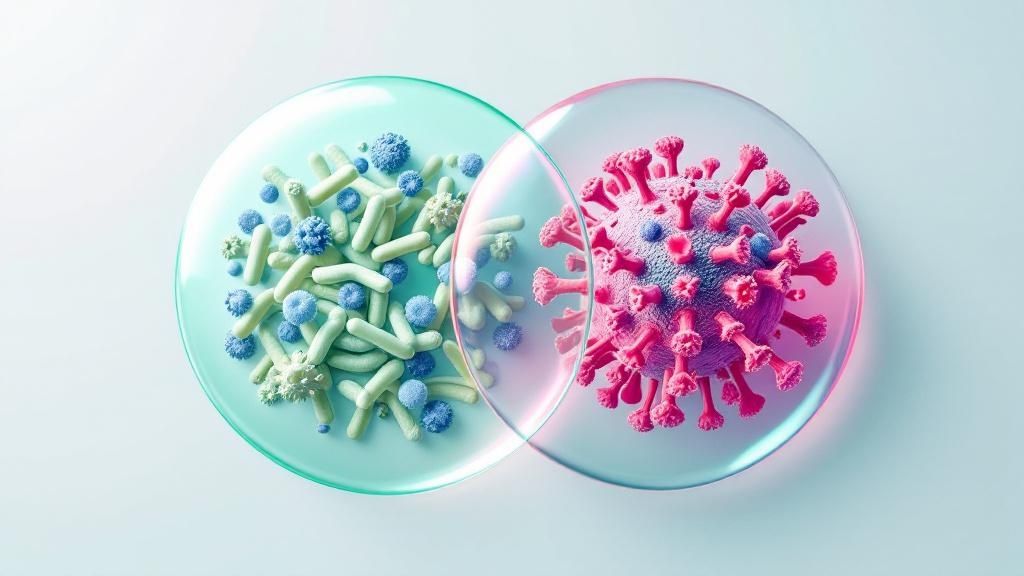
When people talk about getting sick, the words "bacteria" and "virus" get thrown around a lot, often as if they’re the same thing. But in reality, they're worlds apart. The most critical difference is simple: bacteria are living, single-celled organisms that can reproduce all on their own, while viruses are non-living particles that need to hijack a living cell to multiply.
Think of it like this: bacteria are tiny, self-sufficient life forms, while viruses are more like microscopic pirates that can't do anything without a ship to command.
Visualizing Key Microbial Differences
Although we often lump them together as "germs," how bacteria and viruses operate couldn't be more different. Their unique biology dictates everything—how they spread, the sickness they cause, and, most importantly, how we fight them. Getting a handle on these distinctions is the first step toward keeping our homes and workplaces healthy.
This infographic breaks down their main differences in a super-clear way, focusing on their structure, genetic material, and how they make copies of themselves.

As the diagram shows, even though both carry genetic instructions, their fundamental nature as either a living cell or a non-living particle creates a massive biological divide.
Quick Comparison Bacteria vs Virus
For a quick side-by-side look, this table sums up the essential traits that set bacteria and viruses apart. It’s a handy reference for understanding everything from their size to how we treat the infections they cause.
| Characteristic | Bacteria | Viruses |
|---|---|---|
| Living Status | Living, single-celled organism | Non-living particle |
| Size | Larger (micrometers) | Much smaller (nanometers) |
| Reproduction | Independent cell division | Requires a host cell to replicate |
| Treatment | Antibiotics | Antivirals and vaccines |
| Genetic Material | DNA | DNA or RNA |
This breakdown really highlights why you can't treat a viral infection with an antibiotic—it's like trying to sink a ghost ship with a cannonball. The targets just aren't the same.
A Closer Look at Bacteria: The Living Microbes
Bacteria are fascinating, complex, single-celled organisms. You can find them thriving in just about every corner of the planet, from the most extreme deep-sea vents all the way to the human gut. Unlike viruses, bacteria are fully alive. They come equipped with all the cellular machinery they need to grow, produce energy, and reproduce entirely on their own.
This self-sufficiency is what truly sets them apart from viruses.
Because they are independent, bacteria have evolved into an incredible diversity of forms. They can be spheres (cocci), rods (bacilli), or even spirals, with each shape perfectly adapted to its specific environment. Their metabolisms are just as varied, allowing them to chow down on a huge range of organic and inorganic stuff for fuel.
The Two Faces of Bacteria
It's easy to think of bacteria as just "germs," but that's only half the story. Most bacteria are either harmless or incredibly important for life as we know it. The beneficial bacteria in our digestive system, for instance, are essential for breaking down food and even producing critical vitamins. They're a cornerstone of a healthy internal ecosystem.
But then there's the other side: pathogenic bacteria. These are the troublemakers behind illnesses like strep throat, food poisoning, and nasty urinary tract infections. When these harmful bacteria invade the body, they multiply fast, can release toxins, and throw our normal bodily functions into chaos, leading to a full-blown infection.
The impact of these pathogenic bacteria is staggering. A 2019 report revealed that bacterial infections were linked to an estimated 7.7 million deaths across the globe, making up 13.6% of all deaths that year. This places them as the second leading cause of death worldwide. What’s more, over half of those fatalities were caused by just five types of bacteria, including common names like Staphylococcus aureus and Escherichia coli. You can read the full, eye-opening report from The Lancet.
Understanding this distinction is key: our goal isn’t to eliminate all bacteria, but to control the spread of the specific types that cause harm.
Because bacteria are living cells with their own distinct structures—like a cell wall—they present a clear target for antibiotics. These drugs are designed to attack specific parts of the bacterial cell, which is why they work so well. It's also why treatments for bacterial and viral infections are fundamentally different and can't be swapped. For a deeper dive into these crucial distinctions, check out our guide on the difference between a virus and bacteria.
Decoding Viruses: The Cellular Hijackers
Viruses are the ultimate moochers of the microbial world, operating in a weird gray zone between living and non-living things. Their design is shockingly simple: a bit of genetic material—either DNA or RNA—tucked inside a protein shell called a capsid. Some viruses, like Influenza A or SARS-CoV-2, even sport an extra outer layer of fat, known as an envelope.
Unlike bacteria, viruses don’t have any of the gear needed to keep themselves alive. They can’t grow, they can’t make their own energy, and they certainly can’t reproduce on their own. This one limitation dictates their entire existence.
Think of a virus as a set of hijacking instructions. To make copies of itself, it has to break into a living host cell and take over, turning that cell into a mindless virus-making factory.
This whole takeover process is ruthlessly efficient. A virus latches onto a host cell, injects its genetic blueprint, and commands the cell's own equipment to start churning out viral parts. These new parts then assemble themselves into thousands of fresh virus particles, which burst out and go on to infect the next cell, starting the cycle all over again.
The Impact of Viral Pathogens
This parasitic strategy is what makes viruses such formidable pathogens. They're tiny, which helps them spread easily, and they multiply so fast that they can quickly overwhelm a host's defenses and cause widespread illness.
Diseases caused by viruses—like Influenza, HIV-1, and SARS-CoV-2—are behind some of the biggest global health crises we’ve ever seen. While bacteria are responsible for a greater number of total infections, the damage done by major viruses is staggering. In 2019 alone, HIV/AIDS affected roughly 52.1 million people and was tied to almost 4.89 million deaths worldwide. That year, the total burden from viral diseases made up about 25.3% of all disability-adjusted life years from infectious diseases. You can dig into more of this data in a 2019 global burden of viral diseases analysis.
This is exactly why getting a handle on viral biology is so important. The fact that they aren't truly alive and rely on our own cells to replicate makes them a completely different kind of threat than bacteria.
Exploring the Common Ground Between Bacteria and Viruses

It’s easy to focus on what makes bacteria and viruses different, but the middle of a bacteria and virus venn diagram is where the real confusion starts. This is where we see why both of these microscopic threats are taken so seriously.
Their biggest shared trait? The ability to cause infectious diseases in pretty much everything alive—people, animals, and even plants. Both are microscopic invaders that can get inside a host and completely throw off its normal functions.
Both bacteria and viruses also carry their own genetic blueprints—DNA or RNA—which act as the instruction manual for making more of themselves. This is a critical detail because it allows both microbes to evolve and adapt. Over time, that means they can develop resistance to our treatments or figure out new ways to sneak past the immune system.
Key Shared Characteristics
This common ground gets even clearer when you look at how they get from one person to another. Both can spread through a handful of familiar pathways:
- Airborne Transmission, when someone coughs or sneezes, sending out tiny respiratory droplets.
- Direct Contact with a person who's already infected.
- Contaminated Surfaces, where these microbes can just hang out until an unsuspecting person picks them up.
This overlap in how they spread is exactly why good hygiene works so well against both. A single act, like using a disinfecting wipe on a doorknob, can knock out both bacterial and viral threats and break the chain of infection.
Understanding these similarities makes it clear why certain safety precautions are recommended for just about everything. To dig deeper into how these two microbes stack up, you can learn more about the difference between bacteria and viruses in our more detailed guide.
How We Fight Back: Treatment and Prevention
The way we treat bacterial and viral infections is worlds apart, a direct result of their fundamental differences. Since bacteria are complete, living cells with their own machinery—like cell walls—we can target them with antibiotics. These drugs are designed to disrupt critical bacterial functions, either stopping them from multiplying or killing them outright.
Viruses are a whole different ballgame. They’re basically hijackers with no cellular parts of their own, which means antibiotics have absolutely nothing to attack. To fight a virus, we need antiviral drugs. These work by throwing a wrench into the viral replication cycle, perhaps by blocking a virus like Norovirus from getting inside a host cell or stopping HIV-1 from making copies of itself.
The Looming Threat of Resistance
Here’s a critical distinction: bacteria can fight back. The overuse and misuse of antibiotics has given bacteria a crash course in evolution, allowing them to develop defenses against the very drugs we rely on. This has created a terrifying global health crisis known as antimicrobial resistance (AMR).
The scale of this problem is staggering. In 2019 alone, bacterial AMR was directly responsible for an estimated 1.27 million deaths worldwide and was a factor in nearly 5 million more. The numbers are getting worse; some studies show that 42% of E. coli strains are already resistant to common antibiotics. You can read more in the World Health Organization's report on antimicrobial resistance.
This is precisely why it's so important to use antibiotics only when they're truly needed. Taking them for a viral illness like the common cold, caused by Rhinoviruses, does nothing for your sickness but gives bacteria another opportunity to defeat our best medicines.
The First Line of Defense: Prevention
While treatments are highly specific, our best prevention strategies often work against both. Vaccines are a game-changer, training our immune systems to spot and neutralize specific pathogens like Streptococcus pneumoniae bacteria or the Hepatitis B Virus (HBV) before they can ever make us sick. Our guide to common virus infections covers many diseases that are now easily preventable thanks to vaccines.
But the most powerful and universal defense is much simpler: good hygiene. Both bacteria and viruses can linger on surfaces and spread through touch, making basic cleaning habits incredibly effective. Consistent handwashing is key, but so is routine disinfection. Wiping down high-touch surfaces with effective disinfecting wipes breaks the chain of transmission for a huge range of germs, giving you a proactive shield against both bacterial and viral threats.
Taking Action: Simple Steps for Everyday Protection
So, we've covered the "what" and "why." Now let's get into the "how." When it comes to protecting yourself, the best defense is a good offense—and that means targeting the common ground where bacteria and viruses spread.
While the treatments for bacterial and viral infections are worlds apart, your first line of defense is universal. It all comes down to breaking the chain of transmission before these microbes ever get a chance to make you sick. This approach is so effective because it works whether you're up against a bacterium like E. coli or a virus like Influenza A Virus (H1N1). Simple habits like diligent handwashing and staying up-to-date on your vaccines are always your best bet.
Make Surface Disinfection a Daily Habit
Beyond washing your hands, one of the most powerful things you can do is disinfect the surfaces you touch every single day. Both bacteria and viruses like SARS-CoV-2 and Human Rotavirus can linger on high-touch spots like doorknobs, light switches, and countertops for hours—sometimes even days.
These common areas are basically superhighways for germs. By wiping them out before they can catch a ride on your hands, you shut down their main route of transmission from one person to the next.
This is where a good disinfecting wipe becomes your most valuable player. Look for broad-spectrum wipes formulated to kill a wide range of both bacteria and viruses. Using them regularly in your home and at work is a simple but incredibly effective way to keep your environment—and everyone in it—healthier.
Got Questions? We’ve Got Answers.
As we wrap up, let's tackle a few common questions that pop up when talking about bacteria and viruses.
Can a virus actually turn into a bacterium?
Nope, not a chance. Viruses and bacteria are on completely different evolutionary tracks. Think of it this way: bacteria are tiny, single-celled living organisms that can reproduce on their own, while viruses are more like tiny biological pirates—non-living particles that need to hijack a host cell to make copies of themselves.
So why won’t antibiotics do anything for my cold?
Because your common cold is caused by a virus (usually a Rhinovirus), and antibiotics are strictly anti-bacterial. These drugs are designed to target specific parts of a bacterium, like its cell wall. Since viruses don't have a cell wall or any of the other structures antibiotics go after, the medicine has nothing to attack. Taking them for a cold is not only useless but also contributes to the serious problem of antibiotic resistance.
Are all bacteria bad for you?
Far from it. Most bacteria are either harmless or incredibly helpful. In fact, you couldn't live without them. The bacteria in your gut, for example, are essential for digesting food and keeping your immune system in fighting shape. It’s a perfect illustration of the difference between beneficial microbes and the pathogenic ones that make us sick.
Do disinfecting wipes work on both bacteria and viruses?
Yes, most broad-spectrum disinfecting wipes are formulated to kill both. These products contain active ingredients that are proven to destroy or inactivate a wide variety of microbes on surfaces, including many enveloped viruses like Influenza and non-enveloped viruses like Norovirus. For the best results, always read the product label to see which specific germs it’s effective against and make sure you follow the instructions for surface contact time—that's how long the surface needs to stay visibly wet to do its job.
Leave a Reply