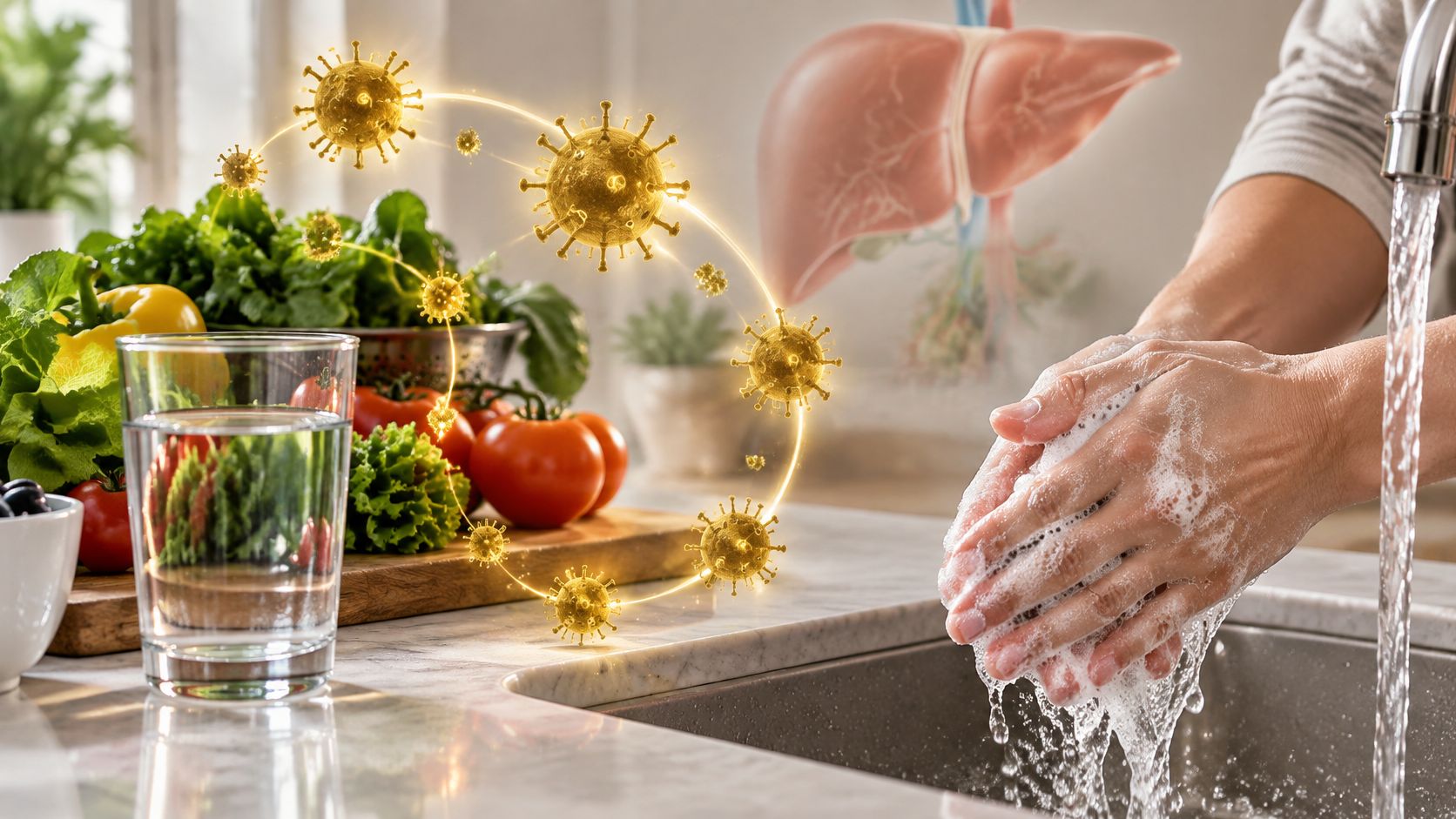
You're making lunch, wiping a kitchen counter, or helping a child after a toilet visit. None of those activities seems connected to a liver infection. Yet hepatitis A can spread when a tiny amount of infected stool gets onto a hand, food item, or object and eventually reaches someone's mouth.
Understanding hepatitis A transmission routes means following that journey, not treating every shared space as dangerous. Each transfer gives you a place to interrupt it, through handwashing, safer food and water, appropriate cleaning, or vaccination.
The Routes Hepatitis A Uses to Spread
Hepatitis A spreads primarily through the fecal-oral route, meaning someone swallows microscopic amounts of stool containing hepatitis A virus, or HAV. That doesn't require visible dirt or an obvious sanitation failure.
The foundational pathways are direct person-to-person contact and indirect exposure through contaminated food or water, as described in the CDC's hepatitis outbreak guidance. Close household, caregiving, and sexual contact can create opportunities for transmission, but proximity alone isn't the mechanism.
Think of the virus as a parcel. In most transmission chains, contaminated hands, objects, food, or water carry the parcel, and someone's mouth is the delivery address. The routes differ in how that parcel travels.
Hepatitis A transmission routes at a glance
| Route | How the virus reaches a new host | Typical setting | Relative importance |
|---|---|---|---|
| Person-to-person (fecal-oral) | Stool-contaminated hands, objects, or food reach the mouth | Households, childcare, close social networks | Major |
| Foodborne | An infected food handler or contaminated produce, shellfish, or frozen food introduces virus | Restaurants, imported food, catering | Major in outbreaks |
| Waterborne | Sewage-contaminated water is swallowed or used for washing or irrigation | Areas with poor sanitation or water treatment | Major globally |
| Sexual (oral-anal contact) | Fecal material transfers during oral-anal contact | Sexual networks involving fecal exposure | Documented, uncommon |
| Injection drug use and transfusion | Infected blood enters through shared equipment or blood products | Injection drug use, transfusion | Rare |
| Respiratory droplets | Not a normal route | Not applicable | Not a dominant route |
Respiratory droplets aren't a normal hepatitis A transmission route. Someone coughing nearby isn't the typical exposure to investigate. The more useful questions concern toilet hygiene, food preparation, caregiving, sexual practices involving fecal exposure, and known contact with a case.
The term hepatitis describes liver inflammation, not a single transmission pattern. Our explanation of hepatitis E transmission offers a useful comparison without implying that all hepatitis viruses spread alike.
Control point: Ask how infectious material could reach the mouth, rather than assuming every kind of contact carries the same risk.
At home, you can control handwashing, food-handling habits, and cleaning of shared facilities. Safe harvesting, reliable drinking-water treatment, food recalls, and coordinated outbreak response require suppliers, utilities, and public-health services.
Why Stool Drives Every Route and When Infection Spreads
Hepatitis A is a small, non-enveloped virus that replicates in the liver and leaves the body in stool. “Non-enveloped” means it lacks the outer fatty membrane found on some other viruses. That structure matters when choosing cleaning methods, because a product effective against enveloped viruses isn't automatically suitable for HAV.
The difficult part is timing. An infected person can release large amounts of virus before recognizing that anything is wrong, rather like a bag leaking before its owner notices the hole.
The CDC surveillance manual states that stool shedding typically begins two to three weeks before symptoms and continues for about one week after onset, with peak infectivity during approximately the two weeks before jaundice or raised liver enzymes.
Infectious period around symptom onset
The phases below summarize that CDC timeline; they're a guide for assessment, not a way to calculate an individual's clearance date.
| Phase | Timing relative to symptoms | Infectiousness | Practical implication |
|---|---|---|---|
| Early shedding | Two to three weeks before onset | High virus concentration in stool | Spread can occur before anyone appears sick |
| Peak infectivity | About two weeks before jaundice or raised liver enzymes | Highest | Outbreaks can expand before a case is identified |
| Late shedding | About one week after onset | Generally declining | Maintain strict hygiene and follow clinical guidance |
This sequence explains how contamination can move outward before anyone thinks to investigate an infection.

Why feeling well isn't a reliable safety check
A parent may prepare sandwiches, a carer may assist someone with toileting, and a food worker may plate ready-to-eat meals without knowing they're infectious. Their normal activities create opportunities for exposure unless routine hygiene interrupts transfer.
This isn't a reason to suspect everyone who handles food. It's a reason to make prevention routine rather than waiting for a visible sign of illness.
The infectious timeline also changes contact tracing. Starting a contact list on the day of diagnosis misses earlier encounters when transmission may have been more likely.
If someone in a shared setting develops jaundice, dark urine, or pale stools, arrange clinical assessment promptly. Record the symptom-onset date and help the clinician or public-health team reconstruct earlier contacts, food-handling duties, and caregiving activities. Don't assume the person became infectious only when their eyes turned yellow.
Close Contact in Homes, Childcare and Social Networks
Say an infected resident in shared housing uses the bathroom and then prepares a communal snack without washing their hands properly. In this hypothetical example, two housemates become infected; one later handles ready-to-eat food at work. Investigators may first notice customers becoming ill, even though the chain began in a household.
The important detail isn't that the residents lived near each other. It's that contaminated hands connected toilet use with food that other people swallowed.
Childcare creates similar opportunities through diaper changes, shared sinks, and toys that children put in their mouths. A carer helping an infected adult also needs to keep toileting tasks separate from meal preparation.

Shared objects need a contamination pathway
A cup, towel, or bathroom handle isn't inherently infectious because someone with hepatitis A used it. It becomes relevant when infectious stool contaminates it and another person transfers that material to their mouth or food.
That distinction prevents unnecessary fear. Sitting beside someone, talking with them, or occupying the same room doesn't ordinarily provide that pathway.
- During personal care, wash hands after helping with toileting and before touching clean supplies.
- Around shared meals, keep bathroom-cleaning tasks separate from food preparation.
- In childcare, remove mouthed or visibly soiled toys from circulation for appropriate cleaning.
Networks explain who becomes exposed
A 2026 study in the Journal of Viral Hepatitis reported person-to-person hepatitis A outbreaks in 37 U.S. states during 2016–2023. Recent U.S. outbreaks have involved people who use drugs, people experiencing homelessness, and men who have sex with men.
Those descriptions identify affected networks, not biological traits that cause infection. Access to toilets, handwashing facilities, stable housing, vaccination, and healthcare helps explain opportunities for transmission. Specific behaviors and circumstances matter more than identity.
When a case is confirmed, prepare a private list of people who shared toilets, meals, bedding, caregiving, sexual contact, or drug equipment during the relevant infectious period. Give that list to the public-health team for assessment. Being listed doesn't mean someone was infected, and sharing bedding alone doesn't establish a transmission route.
How Outbreaks Start
Food and water can carry HAV over long distances without anyone seeing contamination. Sewage may reach irrigation water, a processing facility may use unsafe wash water, or an infected handler may touch food after cooking.
A food item moves from farm to plate like a relay baton. A contaminated handoff can affect a batch, and later refrigeration or freezing doesn't necessarily correct the problem.
U.S. surveillance figures described in CDC outbreak guidance show reported cases rising from 1,562 in 2012 to 1,781 in 2013, with the increase attributed to an outbreak linked to pomegranate arils imported from Turkey; cases also rose from 1,390 in 2015 to 2,007 in 2016, largely because of outbreaks associated with contaminated imported foods.
Follow the handoffs
Contamination can begin before a food reaches a kitchen. Shellfish may be exposed in sewage-contaminated harvesting waters, while produce may encounter unsafe irrigation or washing water.
The CDC Yellow Book states that freezing doesn't reliably inactivate HAV and that heating above 85 °C for one minute inactivates it. Those are virus-inactivation conditions, not a substitute for food-specific cooking instructions or an approved water-treatment procedure.

Food and water vehicles and their limits
| Vehicle | How contamination happens | Survival or heat limit | Control point |
|---|---|---|---|
| Ready-to-eat produce | Contaminated irrigation or wash water, or handling | Rinsing doesn't reliably eliminate contamination | Safe water and handler hygiene |
| Shellfish | Harvesting from sewage-contaminated water | Undercooked shellfish can carry virus | Approved sourcing and full cooking |
| Frozen foods and ice | Contamination before freezing | Freezing isn't a reliable inactivation step | Safe sourcing, not reliance on freezing |
| Cooked or processed foods | An infected handler contaminates food after cooking | Adequate heating can inactivate virus, but later handling can recontaminate food | Validated heat checks and no bare-hand contact with ready-to-eat food |
| Drinking water | Sewage contamination or inadequate treatment | Use validated drinking-water treatment, not an assumed food-heating rule | Treatment and sanitation |
The specific rinsing experiment discussed under daily prevention concerns transfer from hands to lettuce, not a guarantee about washing contaminated produce. Rinsing remains a food-preparation step, but it shouldn't be treated as a rescue method for recalled food.
When an outbreak is linked to a food, investigate the handoffs before blaming the crop alone.
For consumers, the practical response is to follow recall instructions and check the exact product, lot, and distribution details. For investigators, the question is where contamination entered and whether anyone handled the food afterward.
Hands, Surfaces and Daily Prevention
- Wash with soap and water after toilet use, after diaper changes, and before preparing food. The aim is to remove contamination before your hands touch something someone will eat.
- Keep anyone with suspected or confirmed hepatitis A away from food preparation for others until a clinician or public-health service advises that it's safe to return.
- Choose treated drinking water and fully cooked shellfish. Preventing sewage exposure at the source is more dependable than trying to correct it at the table.
- Clean shared surfaces first, then use a disinfectant with a label claim appropriate for HAV or the relevant non-enveloped viruses. Keep the surface wet for the stated contact time.
- Review vaccination before travel or when advised. Vaccination protects the person rather than relying entirely on perfect hygiene at every encounter.
- After a known exposure, seek prompt advice about post-exposure prophylaxis. Cleaning the room doesn't replace preventive medical care for someone already exposed.
Why an ordinary-looking toy can matter
A toddler touches a contaminated changing-area surface, picks up a toy, and puts it in their mouth. Another child later mouths the same toy. The object has become a carrier, even though it may look clean.
Australian public-health guidance reports that HAV can remain infectious for at least one month at room temperature on environmental surfaces and at least four hours on hands; it also describes simple water rinsing reducing transfer from hands to lettuce by only 10- to 100-fold, rather than necessarily eliminating it.
Those findings explain why a quick splash under the tap isn't the same as thorough handwashing. They also show why a surface can remain relevant after the original contamination event.
For a broader household explanation of contamination and cleaning, the Gmaids guide to germs and viruses provides useful context. HAV-specific product instructions still determine whether a disinfectant is suitable for this task.
Choose cleaning products by the label claim
Cleaning removes soil; disinfection targets remaining infectious material. Wiping visible dirt away is important because organic material can interfere with disinfection.
If you buy disinfecting wipes, check the actual virus claim, approved surface types, and wet contact time. A convenient package or an antibacterial claim doesn't establish effectiveness against hepatitis A.
Use enough wipes to keep the surface wet as directed, and don't carry a visibly soiled wipe from a toilet to a kitchen counter. Never use surface disinfectants on skin or food. Food-contact surfaces may require a rinse after disinfection, according to the label.
Our comparison of hand sanitizer and soap and water explains the distinction between hand-cleaning methods. Don't rely on alcohol gel alone for HAV prevention, especially after toileting or diaper changes.
Put the routine where people need it
Household checklist
- Bathroom supplies: Keep soap, clean drying materials, and suitable cleaning products available.
- Touch points: Include toilet handles, taps, changing areas, and frequently handled objects.
- Task separation: Finish toileting care and wash hands before returning to food preparation.
Food-business checklist
- Worker assessment: Make it easy for staff to report symptoms or a confirmed exposure.
- Ready-to-eat food: Prevent bare-hand contact and separate clean utensils from soiled equipment.
- Documented controls: Check sourcing, water safety, cleaning procedures, and employee clearance requirements.
Avoid the shortcut: Neither a produce rinse nor a bottle of hand gel replaces a complete prevention routine.
Blood, Sexual Contact and Injection Use
Fecal-oral transmission doesn't mean sex or blood can never transmit hepatitis A. It means the usual mechanism differs from infections that primarily spread through blood or genital fluids.
Ordinary intercourse isn't automatically a hepatitis A exposure. Oral-anal contact, contaminated fingers moving to the mouth, or other activities involving microscopic fecal material can provide a route for ingestion.
The World Health Organization's hepatitis A fact sheet describes sexual exposure involving fecal contact and uncommon bloodborne transmission; HAV concentrations in serum are several orders of magnitude lower than in feces, although parenteral transmission has been documented through injection drug use and transfusion.

Separate the behavior from the identity
A person's sexual orientation doesn't explain how virus entered their body. The useful questions concern specific practices, a partner's infection status, vaccination, and whether fecal contamination could have reached the mouth.
Likewise, hepatitis A in someone who injects drugs doesn't prove that a needle transmitted it. Shared living conditions, limited sanitation, contaminated hands, and close contacts may also contribute. Investigators shouldn't assign a route merely because someone belongs to an affected population.
- Sexual-health conversations should address oral-anal contact and hand-to-mouth transfer without judgment.
- Injection-safety conversations should address shared equipment while also checking sanitation and vaccination needs.
- Partner notification should follow clinical or public-health advice, with privacy respected.
For someone also seeking help with heroin use, Addiction Resource Center's heroin recovery guide from Addiction Resource Center LLC offers a separate recovery resource. Recovery support and hepatitis exposure assessment serve different needs, and a person may benefit from both.
Don't investigate only the most obvious exposure
Standard bloodborne-pathogen precautions remain important, but they don't address most HAV transmission. Prevention also needs safe toilets, accessible handwashing, appropriate environmental cleaning, and vaccination.
An exposure assessment may include household contact, childcare, food handling, drinking water, shellfish, oral-anal contact, and injection equipment. Asking broadly avoids overlooking a common exposure while focusing on a less likely one.
After sexual contact with a known case or a concerning drug-equipment exposure, contact a clinician or public-health service about preventive vaccination. Be clear about what happened and whether your prior immunity is known. You don't need to identify the exact route yourself before seeking advice.
Decide Whether an Exposure Needs Vaccination or Testing
If you've had household contact with a confirmed case, eaten an implicated outbreak food, shared drug equipment, or had sexual contact with a known case, act this week rather than waiting for symptoms. Call a clinician or public-health service promptly.
WHO technical guidance emphasizes rapid post-exposure vaccination, ideally within two weeks of exposure. Don't delay that call while trying to find old vaccination records or arrange testing yourself.
What testing can answer
A clinician may use antibody testing to assess prior immunity when your history is uncertain. IgM antibody testing helps identify acute infection when the clinical picture suggests hepatitis A; it isn't interchangeable with a test for established immunity.
A 2025 retrospective study published through PubMed Central found that 142 of 656 tested patients, or 22%, were hepatitis A IgM-positive between November 2022 and October 2024. That describes the study's tested patients, not your personal probability after an exposure.
Diagnosed cases are reported to public-health authorities according to local requirements. Those teams assess contacts and investigate possible shared sources. If you're curious about vaccine design, our explanation of inactivated vaccines provides background, but it shouldn't postpone care.
Bring a usable exposure history
- Dates: Record possible exposure dates and when symptoms began.
- Travel and food: Note destinations, implicated products, and shared meals.
- Work and care: Mention food handling, childcare, and caregiving.
- Close contacts: Describe relevant sexual contact or shared drug equipment privately.
- Immunity records: Bring any available vaccination or previous test results.
Our Contact page accepts questions or feedback about viruses and our content, and we welcome collaboration and discussion. It isn't a substitute for time-sensitive medical assessment.
If an exposure fits one of these categories, call your clinician or local public-health service today and ask whether you need post-exposure prevention. For everyday preparation, stock soap and choose any disinfecting wipes by their relevant virus claim and contact-time instructions, not marketing alone. Keep medical prevention, handwashing, and appropriate surface care working together.
Leave a Reply