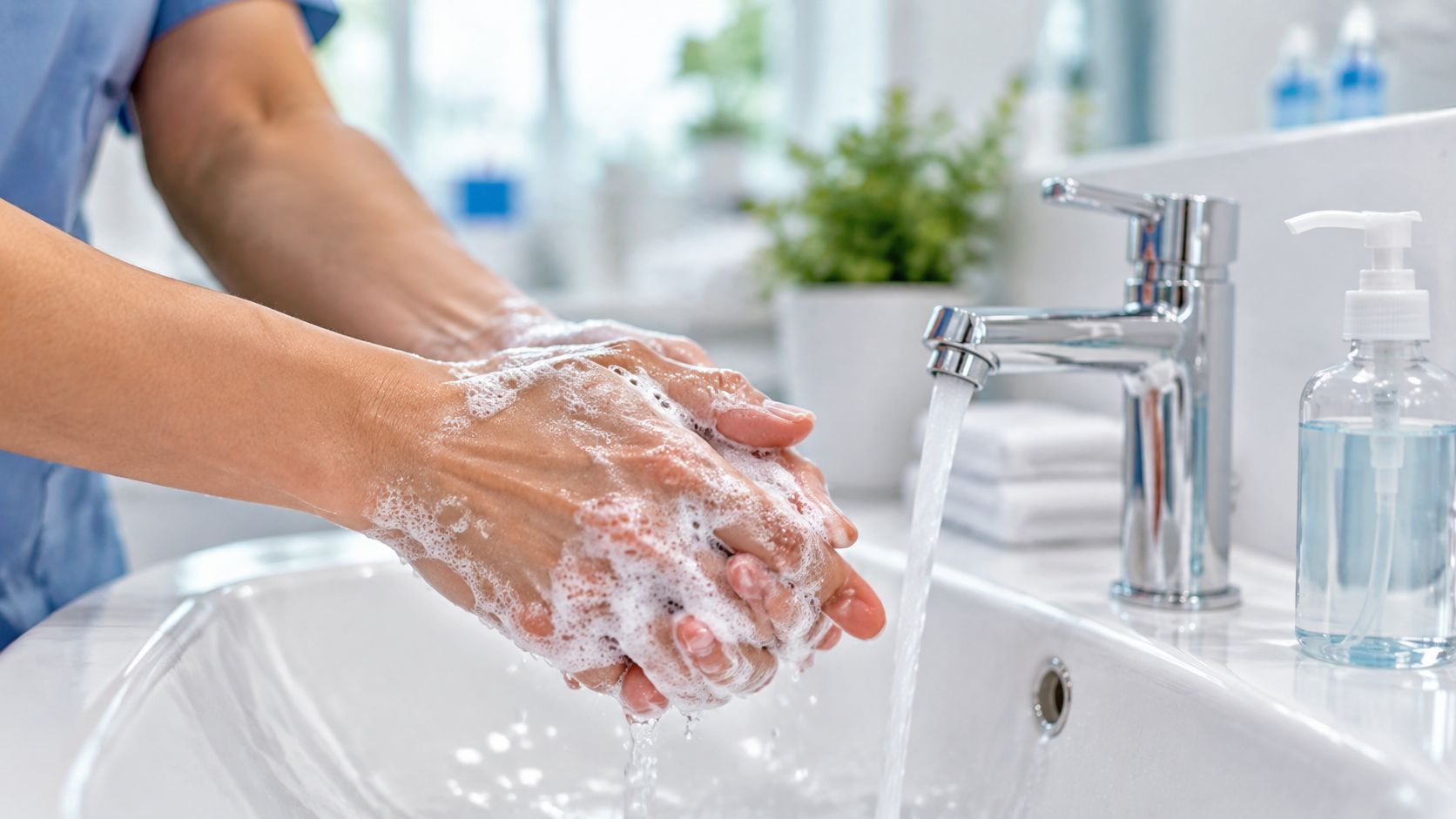
The World Health Organization's key facts and figures on hand hygiene state that appropriate hand hygiene can prevent up to 50% of avoidable infections acquired during healthcare delivery. That is a striking return from soap, water, or alcohol. It's also why poor access matters as much as poor technique.
Most hand hygiene facts stop at a generic message. Wash more often. That advice isn't wrong, but it doesn't tell you which method fits which virus. Enveloped viruses such as influenza, human coronaviruses, and herpes simplex viruses have a lipid outer layer that alcohol can disrupt. Non-enveloped viruses such as norovirus, rotavirus, and rhinoviruses lack that layer. They can tolerate alcohol better, so friction, rinsing, and surface disinfection matter more.
That distinction changes daily decisions. Clean hands after a train ride are one problem. Hands after cleaning up vomit from a child with suspected norovirus are another. A shared keyboard, a bed rail, and a bathroom tap also need different handling, because hands pick up what surfaces keep.
The list below tests each fact against that practical question. What are you trying to stop, where are your hands, and what's within reach? You'll see where alcohol rub is fast and sufficient, where soap and water are required, and where disinfecting wipes belong as the surface half of the same routine.
1. Alcohol-Based Hand Rub Works Within Seconds When Used Correctly
Alcohol-based hand rub, or ABHR, works by denaturing proteins and disrupting lipid membranes. That's why it's effective against many bacteria and enveloped viruses on visibly clean hands. The CDC guide to hand sanitizer facts states that sanitizer should contain at least 60% alcohol when soap and water aren't available, and that products containing 60–95% alcohol are generally more effective than lower-concentration or non-alcohol products.
Technique determines whether that chemistry gets time to work. The WHO handrub procedure specifies a palmful to cover all surfaces, rubbed for 20 to 30 seconds until dry, including backs of hands, interlaced fingers, thumbs, and fingertips.
Make the Seconds Count
- Use enough product: Keep every surface wet for the full rubbing time, not just your palms.
- Cover the missed zones: Fingertips, thumbs, and between fingers touch faces and handles most.
- Know the switch point: Choose soap and water for visibly dirty hands or after caring for someone with diarrhea.
Hospitals in the WHO Clean Care is Safer Care programme place dispensers at bed spaces and room entrances because proximity drives use.

2. Handwashing With Soap and Water for at Least 20 Seconds
Say you've handled raw meat, changed a diaper, or used the toilet. Your hands may carry soil, grease, and microbes that alcohol can't reliably clear. Soap acts as a surfactant, lifting that material from skin so running water can rinse it away.
The CDC handwashing procedure sets five steps: wet hands with clean running water, apply soap and lather backs of hands, between fingers and under nails, scrub for at least 20 seconds, rinse, and dry with a clean towel or air dryer. The timing cue is humming “Happy Birthday” twice.
Friction isn't decoration. It reaches nail edges and finger webs where a quick rinse leaves residue. For a visual walk-through, see our step-by-step guide to proper hand washing technique.
Practical rule: If you can see or feel soil on your hands, don't negotiate with sanitizer. Wash, rinse, and dry.
Schools and food services build rules around this sequence because it's teachable and repeatable before meals and food handling.

3. Ignaz Semmelweis Proved That Handwashing Prevents Deaths
Ignaz Semmelweis worked in Vienna maternity clinics where women died from puerperal fever after childbirth. He noticed a pattern. Physicians moved between cadavers and delivering mothers, while midwives didn't follow the same path. Mortality differed between clinics.
He required handwashing with chlorinated lime solution before deliveries. Deaths fell sharply. The result mattered because it linked something invisible on hands to a visible outcome, even before germ theory was widely accepted.
His colleagues resisted. The intervention implied doctors themselves carried harm, which was professionally uncomfortable. That resistance still explains a modern pattern: people accept hygiene in principle, then resist audits, reminders, or workflow changes that make lapses visible.
Use the History Well
- Teach the sequence: Show staff the observation, the intervention, and the outcome, not just a poster slogan.
- Connect to today's ward: A maternity nurse moving between patients faces the same transfer problem, with better products and clearer evidence.
Semmelweis isn't just a namesake for infection control. He's a warning that evidence alone doesn't change practice if systems and culture push back.
4. WHO's Five Moments for Hand Hygiene Define When Hands Must Be Cleaned
“Wash often” is too vague to audit in a hospital. The WHO Five Moments turn timing into observable actions: before patient contact, before an aseptic task, after body fluid exposure risk, after patient contact, and after contact with patient surroundings.
That last moment catches people out. You may not touch the patient, but you adjust a bed rail, chart, or curtain. Your hands still enter the patient's microbial environment. Our guide to hand hygiene in healthcare settings places those moments in ward workflow.
Infrastructure decides whether the framework is realistic. A global survey of 3,206 healthcare facilities across 90 countries found a median Hand Hygiene Self-Assessment Framework score of 350 points, an intermediate level, and only 51.3% of facilities with observation data recorded more than 60% compliance.
- Post at decision points: Put Five Moments prompts by dispensers, sinks, and room entrances.
- Audit the moment, not intention: Observe whether the action happened when the indication occurred.
5. Hand Hygiene Compliance in Healthcare Is Consistently Imperfect
In a WHO evaluation across eight pilot sites, pooled compliance rose from 39.6% to 56.9% after an average three-month multimodal intervention, while alcohol-based hand-rub use rose from 49.1% to 70.6% of hand-hygiene actions.
Even after that gain, more than four in ten opportunities were missed. The Five Moments define when hands must be cleaned. They do not put alcohol rub at the bedside. A nurse answers a call bell, checks a line, helps a colleague, and documents care. Each transition creates an indication, and each empty dispenser creates a missed action.
The WHO bundle combined product access, education, reminders, monitoring, feedback, and safety culture. The bundle matters. Feedback cannot compensate for an empty dispenser.
Fix the System Around the Person
- Place alcohol-based hand rub at point of care: Staff should not hunt for product between tasks.
- Give feedback without blame: Show ward-level trends quickly so teams can correct workflow.
- Track refills: An empty dispenser is a compliance failure before any worker arrives.
6. Handwashing Reduces Diarrheal Illness, but Evidence for Respiratory Infection Is More Mixed
Handwashing has its clearest community effect where fecal to oral transmission drives illness. The CDC summary of handwashing facts and statistics reports that community handwashing education reduces diarrheal illness by 23–40% and respiratory illnesses, such as colds, by 16–21%.
That difference makes biological sense. Diarrheal pathogens often travel directly from hands to food and mouths. Respiratory viruses also spread through air and close contact, so clean hands help but don't control every route.
Children show the stakes clearly. Improved handwashing reduces school absenteeism from gastrointestinal illness, and soap can interrupt infections that hit young children hardest.
Don't oversell handwashing as a stand-alone shield against every cold. Pair it with ventilation, staying home when ill, and coughing into your elbow.
For a classroom, the highest-value routine is simple. Wash after toilet use, before eating, and after coughing or handling tissues. Consistency beats occasional deep cleaning.
7. Norovirus Requires Soap and Water Rather Than Alcohol Alone
Norovirus is the test case that exposes generic advice. It's non-enveloped, so it lacks the lipid membrane alcohol disrupts most easily. After caring for someone who's vomiting or has diarrhea, ABHR alone isn't the prudent choice.
Wash with soap and water. Friction and rinsing physically remove virus particles from skin. Then address the room, because vomit and stool contaminate taps, flush handles, light switches, and toilet seats.
A Norovirus Cleanup Sequence
- Wash first and last: Clean hands after toilet contact, cleanup, laundry handling, and glove removal.
- Treat high-touch surfaces: Use EPA-registered disinfecting wipes that list norovirus on the label.
- Honor contact time: Keep the surface wet for the full time the label states, using more wipes if it dries early.
- Exclude ill food handlers: Don't let a recovering person prepare shared food too soon under local guidance.
Cruise ships, care homes, and schools control outbreaks by combining handwashing, surface disinfection, and exclusion. One measure alone leaves the chain intact.

8. Disinfectant Contact Time Determines Whether Surfaces Are Truly Disinfected
A wipe passed quickly over a desk may remove visible dirt without disinfecting it. Contact time, sometimes called dwell time, is how long a surface must stay visibly wet for the product to inactivate listed organisms. If the liquid evaporates early, the job isn't finished.
Read the label organism by organism. A wipe effective against enveloped influenza or coronaviruses may need longer wet time, or a different formulation, for norovirus or other non-enveloped viruses. Don't assume one claim covers all viruses on VirusFAQ.com, from rhinoviruses to hepatitis viruses.
Say a school office shares phones and keyboards. A practical routine assigns one fresh disinfecting wipe per device cluster, keeps surfaces wet for the label time, and lets them air dry before use.
- Use enough wipes: Re-wet with a fresh wipe rather than spreading a drying wipe farther.
- Work clean to dirty: Start with lower-risk surfaces, then move to toilet handles or waste areas.
- Stock where hands land: Keep wipes near shared equipment, changing tables, and reception counters.
9. Antibacterial Soap Is Not Better Than Plain Soap for Routine Handwashing
Plain soap is the better default for routine household washing. Surfactant action, friction, rinsing, and drying lift soil and microbes off the skin. That mechanical sequence is what a normal wash contributes.
An antibacterial label does not improve the result for the virus you are trying to stop. The ingredient claim points at bacteria. Routine virus control on hands still depends on coverage, scrub time, and timing.
Healthcare settings use specific antiseptic formulations for defined tasks and skin preparation. At home, buying an antibacterial soap can distract from those three variables.
A closer look at antibacterial soap versus regular soap sets out where each product belongs. For broader myth checking, quick science explanations for curious learners can help separate marketing language from mechanism.
- Choose plain soap daily: Pick a product your household will use consistently without skin irritation.
- Reserve antiseptics for guidance: Follow clinical or outbreak instructions rather than upgrading every sink.
10. Drying Hands Properly Reduces Bacterial Transfer
Washing ends at the towel, not the tap. Wet hands transfer microbes to door handles, phones, and food more readily than dry hands. Drying also adds friction, which helps remove organisms loosened during washing.
Paper towels are common in hospitals and food facilities because they're single use and absorbent. Air dryers can work when you stay until hands are fully dry, but people often leave early with damp fingers. That's the weak point.
Say you wash in a shared workplace bathroom. Dry palms, backs, between fingers, and under rings. Then use a clean paper towel, where available, to turn off a manual faucet and open the door.
Don't Undo the Wash
- Dry completely: Focus on finger webs and thumbs, which stay damp longest.
- Avoid shared damp towels at home: Launder hand towels frequently, especially during illness.
- Replace empty dispensers: A sink without towels encourages wiping hands on clothing.
11. Frequent Face Touching Creates Routes for Infection
Hands become dangerous when they deliver microbes to eyes, nose, or mouth. People touch their faces out of habit while reading, driving, adjusting glasses, or using phones. You rarely notice the movement until you try to stop it.
That route matters for respiratory viruses and for organisms picked up from shared surfaces. It also explains why timing beats total daily washes. Cleaning hands right after a commute and before eating interrupts a likely transfer. Washing an hour later, after you've rubbed your eyes, doesn't rewind exposure.
You won't eliminate face touching through willpower. Change the environment instead.
- Create a clean-hands trigger: Sanitize when you sit at your desk, enter home, or sit down to eat.
- Keep tissues within reach: Use one for coughs and nose blowing, bin it, then clean hands.
- Clean the phone thoughtfully: Follow the device maker's guidance, since phones move between hands and face constantly.
12. Hand Hygiene Remains Necessary When Wearing Gloves
Gloves aren't a substitute for clean hands. They can tear, leak at cuffs, and contaminate skin during removal. A gloved hand that touches a toilet handle, then a food tray, transfers contamination just like bare skin.
Perform hand hygiene before putting gloves on and immediately after taking them off. Change gloves between patients, between dirty and clean tasks on the same person, and after damage. Don't wash or sanitize disposable gloves for reuse.
Say a caregiver helps with toileting, removes gloves, and reaches for medication. That removal moment is high risk. Peel gloves away from skin, discard them, then wash or use ABHR based on soil and pathogen risk.
Gloves protect during a task. Hand hygiene protects at every transition before and after that task.
Food handlers face the same rule. Gloves don't permit skipping handwashing after restroom use, waste handling, or touching hair and face.

13. Frequent Hand Hygiene Can Damage Skin, and Regular Care Helps
Sore hands change behavior. Repeated washing and alcohol exposure strip skin oils, causing dryness, cracks, and dermatitis. Broken skin is uncomfortable, can harbor microbes, and gives staff a reason to shorten or skip hygiene.
That isn't mainly a knowledge failure. A 2025 review of 28 studies across six continents identified interconnected barriers including behavioral and organizational problems, inconvenient or unavailable supplies, and negative social influence. Skin irritation belongs in that system view.
Programs that supply compatible lotion beside ABHR treat skin care as infection prevention, not cosmetics. Occupational health teams should hear early reports before cracking becomes chronic.
- Moisturize during breaks: Use fragrance-free products if you're sensitive, and apply after washing when time allows.
- Don't use scalding water: Comfortable water supports compliance and avoids added irritation.
- Report persistent dermatitis: Product substitution or treatment may be needed, especially for healthcare and cleaning staff.
14. Hand Hygiene Is Part of Broader Protection Against Emerging Viruses
During the SARS-CoV-2 pandemic, hand hygiene sat beside ventilation, vaccination, respiratory etiquette, testing, and staying home when ill. That layering wasn't bureaucratic excess. Each measure covers a route the others miss.
ABHR helps against many enveloped viruses on clean hands, including coronaviruses and influenza. It doesn't ventilate a crowded room. Ventilation doesn't remove norovirus from a bathroom tap. Disinfecting wipes don't replace washing after toilet use. The routine works because each tool has a defined job.
Schools that reopened with entrance dispensers, scheduled handwashing, cleaning of shared materials, and better air flow applied that logic. Households can do the same at smaller scale.
- Match tool to route: Hands, air, surfaces, and close contact need separate controls.
- Keep supplies visible: Put ABHR by entrances and disinfecting wipes near shared surfaces.
- Update during outbreaks: Shift toward soap and water when diarrheal or non-enveloped viruses circulate.
How Hand Hygiene Methods Compare Across Key Facts
| Item | Best For | Norovirus Coverage | Main Limitation |
|---|---|---|---|
| Alcohol-Based Hand Rub Works Within Seconds When Used Correctly | Fast hand hygiene on clean hands | Less reliable; not a substitute for soap and water | Does not remove visible soil |
| Handwashing With Soap and Water for at Least 20 Seconds | Removing microbes, soil, and resistant pathogens | Effective when done thoroughly | Requires water and drying materials |
| Ignaz Semmelweis Proved That Handwashing Prevents Deaths | Teaching the history of infection control | Historical evidence; not a specific norovirus method | Early work lacked modern microbiological understanding |
| WHO's Five Moments for Hand Hygiene Define When Hands Must Be Cleaned | Guiding hand hygiene in healthcare | Supports prevention when paired with appropriate handwashing | Requires training and consistent compliance |
| Hand Hygiene Compliance in Healthcare Is Consistently Imperfect | Identifying gaps and improving healthcare practices | Depends on staff following appropriate hygiene guidance | Observed compliance may be overstated |
| Handwashing Reduces Diarrheal Illness, but Evidence for Respiratory Infection Is More Mixed | Reducing diarrheal illness | Supports prevention of enteric illness | Evidence varies by setting and adherence |
| Norovirus Requires Soap and Water Rather Than Alcohol Alone | Hand hygiene after norovirus exposure | Soap and water remove particles mechanically | Alcohol rub alone may leave viral particles |
| Disinfectant Contact Time Determines Whether Surfaces Are Truly Disinfected | Disinfecting contaminated, high-touch surfaces | Depends on the product's norovirus label claim | Surfaces must stay wet for the full label contact time |
| Antibacterial Soap Is Not Better Than Plain Soap for Routine Handwashing | Routine handwashing with plain soap | Plain soap and water are appropriate | Marketing claims can cause confusion |
| Drying Hands Properly Reduces Bacterial Transfer | Completing handwashing and reducing transfer | Indirect support; does not remove norovirus by itself | Paper towels create waste |
| Frequent Face Touching Creates Routes for Infection | Reducing self-inoculation from contaminated hands | Indirect support; hand hygiene helps reduce risk | Face-touching habits are difficult to change |
| Hand Hygiene Remains Necessary When Wearing Gloves | Preventing contamination during glove use | Supports prevention when combined with handwashing | Gloves can create a false sense of security |
| Frequent Hand Hygiene Can Damage Skin, and Regular Care Helps | Protecting skin during frequent hand hygiene | Helps sustain hygiene practices; not direct virus control | Products may irritate sensitive skin |
| Hand Hygiene Is Part of Broader Protection Against Emerging Viruses | Layered infection prevention | One supporting measure; use soap and water after norovirus exposure | Does not prevent airborne transmission alone |
Turn These Facts Into a Routine That Holds Up
Start with the virus and the situation, not the product in your hand. That's the useful shift behind these hand hygiene facts. If your hands are visibly clean and you're moving through routine public or clinical contact, ABHR is fast, portable, and effective against many enveloped viruses and bacteria. Use enough to cover every surface, rub until dry, and don't wipe the product off early.
If hands are dirty, greasy, or exposed to vomit, stool, or suspected norovirus, choose soap and water. Scrub backs, palms, finger webs, thumbs, fingertips, and under nails. Rinse under running water and dry completely. Drying isn't an optional finish, because damp hands transfer microbes and make the next surface contact count against you.
Build the Surface Half of the Routine
Hands don't stay clean in a contaminated environment. They touch taps, phones, rails, keyboards, toys, and door handles, then return to faces and food. Keep EPA-registered disinfecting wipes where those contacts happen, check that the label lists the organism you care about, and keep each surface wet for the full contact time. Use a fresh wipe when one dries or becomes visibly soiled.
That habit is especially valuable during gastrointestinal illness at home. Wash after bathroom help and cleanup. Disinfect flush handles, taps, toilet seats, light switches, and changing surfaces. Launder contaminated fabrics carefully, and keep the ill person from preparing shared food while guidance says exclusion is needed.
Make Compliance Easy for Real People
People skip steps when sinks are far, dispensers are empty, skin hurts, or colleagues treat hygiene as optional. Fix those barriers directly. Place ABHR at entrances, bedsides, desks, and diaper-changing areas. Keep plain soap and towels stocked. Provide moisturizer for frequent washers. Give feedback in healthcare settings without turning every lapse into blame.
Gloves need the same discipline. Clean hands before donning and after removal, change gloves between tasks, and never let gloved hands wander from dirty to clean work. In schools and offices, tie hand cleaning to events people already recognize: arrival, toilet use, before eating, after coughing, and after shared equipment.
VirusFAQ.com can support the next decision when you need virus-specific detail. Our Education articles give clear, simple explanations of what a virus is and how it infects people, with practical tips for staying safe and cleaning effectively. Our Science articles cover disinfection strategies, virus-host interactions, environmental factors, and real-world applications of virus control for advanced readers. Use the level that fits your role, whether you're teaching a child, auditing a ward, or checking why a non-enveloped virus changes product choice.
Your routine doesn't need to be elaborate. It needs to be matched, stocked, and repeatable on a tired day. ABHR for routine clean hands. Soap and water for soil and norovirus risk. Thorough drying and skin care so you'll keep doing it. Disinfecting wipes, used for their full wet contact time, for the surfaces your clean hands are about to touch.
Choose one high-traffic spot today, at home, school, or work, and stock it properly with soap or ABHR for hands and disinfecting wipes whose labels match your likely risks. Then read the VirusFAQ.com guide for the virus circulating in your setting, set the contact-time rule where everyone can see it, and make clean hands the default before food, faces, and patient care.
Leave a Reply