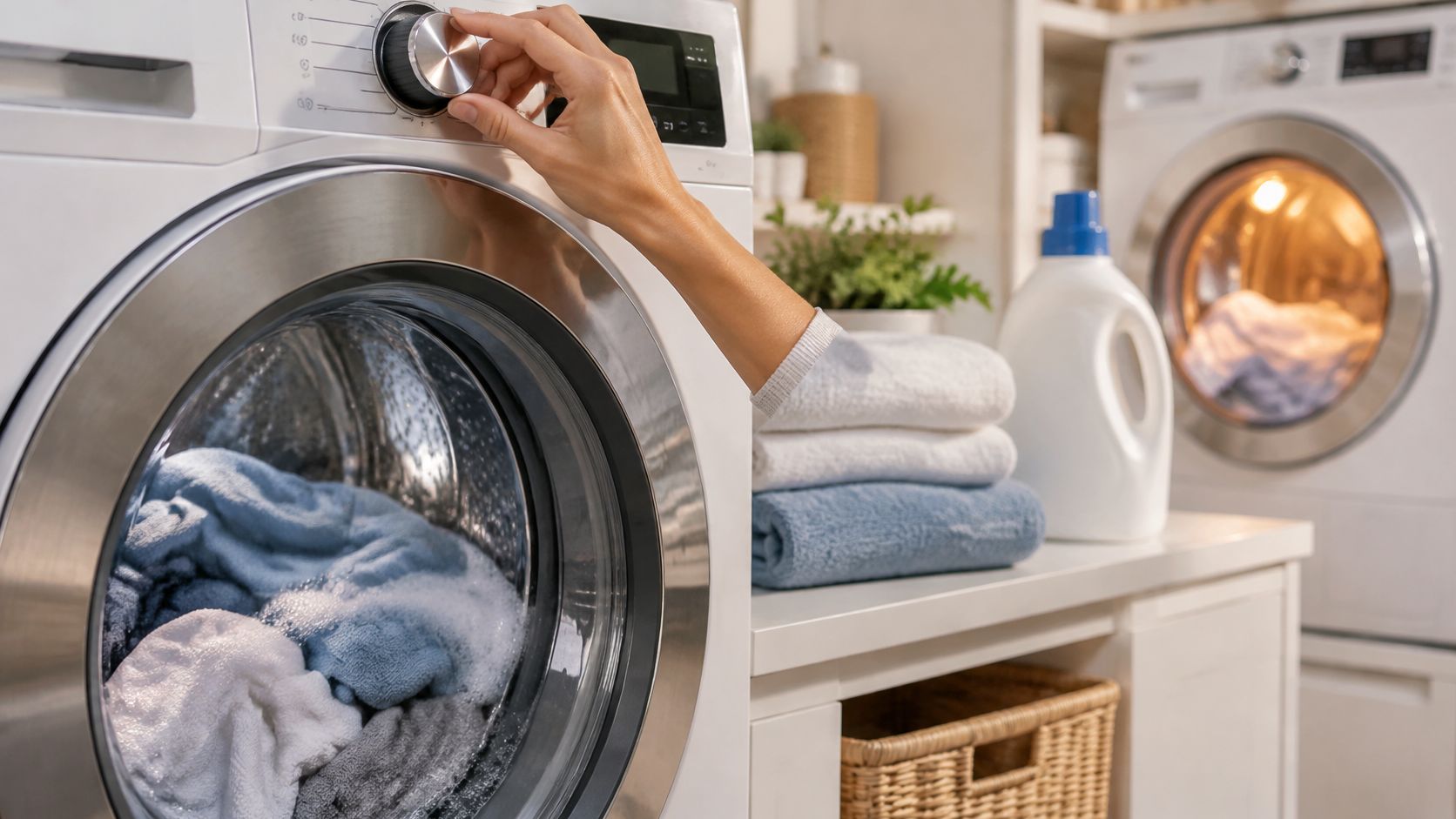
Someone at home has a cold or flu, the bedding needs changing, and the laundry basket is overflowing. You want to reduce germs without bleaching colors, damaging stretchy fabrics, or buying an additive that doesn't do what you expect. How to disinfect clothes without bleach starts with matching detergent, heat, and drying to the contamination, rather than treating every load as the same problem.
Bleach-Free Settings at a Glance
Bleach-free settings by load type
| Load | Water setting | Detergent and cycle | Drying | Target virus group |
|---|---|---|---|---|
| Routine clothing and bedding after a cold or flu | 60°C if the label allows, otherwise the warmest safe setting | Regular detergent, full normal cycle | Full hot dryer cycle or thorough air-dry | Enveloped respiratory viruses |
| Synthetics and delicates | 30–40°C or the label maximum | Regular detergent, full cycle | Low-heat tumble, then fully dry | Enveloped viruses |
| Cold-wash-only household | 20°C | Regular detergent, full cycle | Full dryer cycle, within the fabric's heat limit | Enveloped viruses, reduced more than 4 log10 in the cited review |
| Laundry soiled with vomit or stool | Hot water, maximum cycle length | Regular detergent, longest cycle | Highest heat dryer setting the fabric permits | Norovirus and non-enveloped viruses |
The temperature settings above are practical choices, not promises that every household cycle disinfects every garment. A 2021 laundering risk-assessment review reported more than 4 log10 reduction, at least 99.99%, for enveloped viruses washed at 20°C with detergent, and more than 4 log10 reduction of SARS-CoV-2 after 20 minutes at 60°C. Those findings support using detergent and the warmest fabric-safe wash, but they don't establish a universal setting for all viruses.
Choose the row before choosing an additive
For ordinary pajamas, pillowcases, and washable bedding after a respiratory illness, start with the care label. Select the hottest permitted setting, measure the detergent correctly, and run a complete cycle. There's usually no reason to begin by improvising a disinfectant mixture.
Synthetics need more restraint. A polyester sports shirt may tolerate only a mild wash and low dryer heat, so turning everything to maximum can ruin the garment without establishing a validated disinfection process. Fabric safety still applies when someone is sick.
A cold-wash-only household can still reduce the risk associated with enveloped respiratory viruses. Use detergent rather than water alone, and finish with complete drying. Don't interpret that option as permission to wash stomach-bug contamination the same way.
Practical rule: Use the strongest complete process the garment safely tolerates, not the strongest chemical you can find.
Understand what the settings mean
A wash-temperature label does not indicate how long the fabric remains at that temperature. Likewise, a drying program is not a guaranteed virus-killing treatment just because its name includes hot or hygiene. Laboratory results involve defined organisms, exposure times, and test conditions.
Machine drying provides an additional barrier because both heat and duration matter. Thorough air-drying is a fabric-compatible option for routine loads, but it isn't interchangeable with high-temperature machine drying when contamination is unusually hazardous.
The routine rows are useful for everyday illness laundry. Vomit and stool require a more cautious approach, including careful handling before the washer starts.
How to Run a Bleach-Free Disinfecting Wash
Build the routine around removing contamination, avoiding transfer, and finishing the drying process. Extra detergent or an unusually fragrant additive can't compensate for poor handling.

Work from dirty handling to clean storage
Sort without shaking. Keep heavily soiled items apart, and collect laundry from a sick household member into a manageable load. Separation is especially useful when items need different handling or a more intensive cycle.
Pre-treat visible soil with detergent. Remove gross contamination carefully, then work a fabric-compatible detergent into remaining stains according to its directions. Don't aggressively brush or shake contaminated material around the laundry area.
Leave room for movement. Load the drum loosely rather than packing it solid, and respect the machine's capacity for that fabric type. Clothes need contact with wash water and space to move; a compressed bundle won't wash evenly.
Select the warmest permitted wash and an appropriate full-length cycle. For higher-risk washable items, choose the longest suitable program rather than an express wash. Don't override a wool, silk, or technical-fabric care label just to select a hotter setting.
Dose and place detergent correctly. Use the designated dispenser for liquid or powder when your machine requires it; put pods where their packaging directs, typically in the drum rather than the drawer. Our guide to bulk laundry pods provides additional context for that detergent format.
Transfer the load promptly. Move washed items directly into a clean basket or the dryer rather than leaving them wet overnight. Avoid putting clean, wet clothing on the surface that held the dirty load.
Finish drying thoroughly. Use a full hot dryer cycle when the fabric permits, checking thick seams, towel edges, and folded areas before unloading. For routine items that can't tolerate tumble drying, hang them with space around each piece, in direct sun where appropriate, until fully dry.
Store only dry items. Let warm laundry settle briefly, then check for damp patches before folding. A dry outer surface can conceal moisture inside a bundled sheet or thick waistband.
The drying step has measurable value beyond making clothing comfortable to wear. A 2014 textile-hygiene study found that washing at 60°C or 70°C reduced bacterial counts by 3–5 log10 CFU, while subsequent tumble drying added 3–4 log10 CFU reduction, producing the same final hygiene result at both wash temperatures without added biocides. Those are bacterial results, not proof of identical reductions for every virus.
Handle specialist fabrics differently
Padded equipment, protective gear, and bulky sportswear may not tolerate a standard hot wash. For help interpreting those practical constraints, CleanOnline's hockey equipment cleaning guide, from CleanOnline, North York's Premium Dry Cleaners, is a useful companion for equipment care rather than evidence of virus-specific disinfection.
Don't confuse a water-only rinse with detergent laundering. CDC household cleaning guidance emphasizes detergent, the recommended water setting, and complete drying; low-temperature water by itself isn't a validated disinfecting process.
Before putting the load away, check for damp areas and sour odor. Neither smell nor appearance proves disinfection, but persistent dampness or odor warrants checking the wash routine rather than masking it with fragrance.
Virus Type and Contamination Decide How Hard to Wash
Is cold detergent washing enough? For routine clothing exposed to enveloped respiratory viruses, a complete detergent wash followed by thorough drying can provide appropriate household hygiene. For norovirus-contaminated laundry, that mild approach isn't a reliable substitute for more intensive handling and laundering.

The envelope changes the problem
An enveloped virus has an outer lipid membrane that detergent can disrupt. Non-enveloped viruses lack that vulnerable outer layer, so a successful approach against an enveloped respiratory virus doesn't automatically establish protection against an enteric virus.
Our guide to how long viruses live on surfaces explores why persistence also depends on the virus and its surroundings. A contaminated fabric isn't equivalent to a clean laboratory surface, particularly when body fluids are present.
The wider virology picture includes Human Immunodeficiency Virus Type 1 (HIV-1), Influenza A Virus (H1N1), Influenza A2/305/57 Virus (H2N2), Avian Influenza Virus (H5N1), Hepatitis B Virus (HBV), Hepatitis C Virus (HCV), Duck Hepatitis B Virus (DHBV), Bovine Viral Diarrhea Virus (BVDV), SARS-Related Coronavirus 2 (SARS-CoV-2), Human Coronavirus, Herpes Simplex Virus 1 (HSV-1), and Herpes Simplex Virus 2 (HSV-2). These names aren't an interchangeable list of laundry test organisms.
The distinction between large non-enveloped viruses, including Human Rotavirus, and small non-enveloped viruses, including Feline Calicivirus, Norovirus (Norwalk Virus), Rhinovirus Type 14, and Rhinovirus Type 39, also matters when reading product claims. A label naming one test virus doesn't mean the product has been tested against everything in either group.
When vomit or feces changes the decision
For laundry contaminated with norovirus-containing vomit or feces, follow the CDC's norovirus prevention guidance:
- Remove the items promptly, handling them gently without shaking.
- Wear rubber or disposable gloves before touching contaminated material.
- Wash with detergent and hot water, using the maximum available cycle length.
- Machine-dry at the highest heat setting, while checking whether the item can tolerate that treatment.
The CDC's separate 1,000–5,000 ppm chlorine solution recommendation concerns contaminated surfaces, not a recipe to pour over clothing. Don't transfer surface-disinfection concentrations to a washing machine.
A laundry method suitable for a cold isn't automatically suitable for a stomach bug.
Vinegar and essential oils aren't validated replacements for this process. Quaternary-ammonium fabric additives also shouldn't be assumed to cover every relevant virus.
For extensive blood or stool contamination, or an item that can't tolerate the necessary treatment, arrange professional assessment before transport. Describe the contamination explicitly so the cleaner can determine whether safe handling is possible; ordinary dry cleaning isn't an automatic guarantee of pathogen-specific disinfection.
What the Evidence Supports
A detergent can clean clothing without proving that it disinfects it. The evidence depends on the virus, product, and wash conditions tested.
Add-ons and alternatives compared
| Option | Evidence | Fabric caution | Verdict |
|---|---|---|---|
| Heavy-duty laundry detergent at 30°C | Three tested detergents inactivated enveloped vaccinia virus in a 2025 textile study | Follow the care label and detergent instructions | Strong base for enveloped viruses under the tested conditions |
| Activated-oxygen sanitizing detergent at 30–40°C | Some products carry claims against non-enveloped viruses; whether a claim applies depends on the organism and conditions the label specifies | Check the product's fabric-use restrictions | Consider only when the product's organism claim matches the risk |
| 3% hydrogen peroxide in the main wash | Consumer Reports' 2024 review described more than 99.9999% bacterial growth reduction in a cited study; that result doesn't establish virus efficacy | No discoloring or significant tensile-strength loss reported in that study | Bacterial evidence only |
| Quaternary-ammonium fabric additive | A textile-virology review cautions that these aren't universal virucidal substitutes | Use only on fabrics and in cycles permitted by the product label | Not validated for all viruses |
| Vinegar or essential oils | No validated virus-specific laundering evidence established here | Acidity, oils, and fragrance may be unsuitable for fabrics or equipment | Don't rely on them for disinfection |
| Steam | No quantified clothing-disinfection result established here | Sufficient heat must reach the fabric without damaging it | Unquantified for clothing |
| UV light | No quantified clothing-disinfection result established here | Light reaches exposed surfaces, not hidden folds or seams | Unquantified for clothing |
An oxygen-based stain remover may improve appearance without carrying instructions for inactivating a virus. Check the product label for the target organism and use conditions. Words such as “oxygen,” “hygiene,” or “antibacterial” alone do not establish effectiveness against norovirus.
The hydrogen-peroxide finding concerns bacteria, not viruses. Concentration alone also does not define a laundry treatment: the amount added, final dilution, contact time, and wash conditions all matter. A bacterial result cannot supply a safe antiviral dosing instruction.
Read the claim before buying the product
For a laundry sanitizer, check:
- Target organism. Look for a virus claim that matches the organism, not just antibacterial wording.
- Application stage. A main-wash treatment and a rinse additive aren't interchangeable.
- Required conditions. Follow the specified dose, temperature, contact time, and load instructions.
- Fabric compatibility. Check restrictions for wool, silk, elastic, dyes, and protective finishes.
Heat claims need both temperature and exposure time. How temperature affects virus inactivation provides context for interpreting them.
A quick pass with a garment steamer does not establish sustained treatment throughout thick fabric. UV light cannot affect areas it does not reach, including hidden folds and seams. Without a validated clothing-specific procedure, neither should replace a suitable wash-and-dry process.
Keeping Your Washer and Dryer from Spreading Germs
A 2025 healthcare-textile study found that 3 of 6 tested laundry machines, or 50%, failed to reach and maintain 60°C ± 4°C for 10 minutes, and disinfection wasn't achieved despite detergent. That small healthcare-machine sample doesn't describe every home washer, but it demonstrates why a temperature selection isn't proof of actual thermal performance.

Keep dirty and clean contact points separate
A wash can move contamination away from one item without necessarily inactivating everything. Wet fabric, the drum, a laundry basket, and your hands can become transfer points if you handle them as though washing guarantees sterility.
CDC healthcare laundry guidance distinguishes hygienically clean textiles from sterile textiles and recognizes drying and ironing as additional microbiocidal processes. At home, the useful lesson is to protect the washed load from avoidable recontamination.
Use a simple equipment routine:
- Avoid overloading. Respect the capacity for bulky bedding as well as the machine's general load limit.
- Transfer wet laundry promptly. Have a clean basket ready before unloading.
- Let the drum dry. Leave the door and accessible drawer open between uses when safe, keeping children and pets away.
- Run the maintenance program. As a practical monthly reminder, schedule an empty hot cleaning cycle with a compatible washer cleaner, adjusting to the manufacturer's recommended interval.
- Clear the lint filter after every load. Keep airflow unobstructed and follow the dryer's instructions for vent maintenance.
- Clean touchpoints between contaminated loads. Wipe compatible door-seal surfaces, drawer handles, and controls with a disinfecting wipe whose label covers the intended use.
Use wipes on the machine, not the clothes
Remove visible dirt before disinfecting, and keep the surface wet for the wipe's labeled contact time. Check appliance compatibility first, particularly for rubber seals, coatings, and electronic controls; some parts require detergent cleaning and rinsing rather than a disinfectant.
Don't put surface-disinfecting wipes in the drum or dryer. They aren't laundry sanitizers, and their surface-use directions don't establish safe treatment of clothing.
Equipment check: If the washer isn't heating properly, arrange service rather than trusting the program name.
A hot dryer can add protection, but it isn't a guaranteed rescue for inadequately washed, heavily contaminated fabric. Keep high-risk illness laundry out of a machine with a suspected heating fault and use a suitable alternative until the problem is resolved.
Choose the Next Load and Run It
You don't need to turn every basket of clothes into a laboratory decontamination exercise. You do need to recognize when ordinary laundry becomes a higher-risk task and when the fabric prevents you from using the treatment you'd prefer.
Make tonight's decision by answering these questions in order.
What is on the fabric?
Routine exposure after a cold or flu belongs in the ordinary household-hygiene category. A used pillowcase and a sweatshirt worn while coughing don't automatically need a specialist additive.
Vomit, stool, or substantial blood contamination calls for more cautious handling. Wear gloves, avoid shaking the items, and don't casually add them to a mild mixed load. Blood exposure also deserves case-specific advice rather than assuming a respiratory-virus laundry method applies.
What does the care label permit?
For a durable respiratory-illness load that tolerates a hot wash, select regular detergent and a full cycle. You don't need to add vinegar, essential oils, and peroxide in the hope that combining products will compensate for uncertainty.
For synthetics and delicates, stay within the label's mild or cold setting and drying restrictions. If high-risk contamination conflicts with those restrictions, choose an appropriately labeled laundry treatment or professional assessment rather than knowingly ruining the item.
A cold-wash-only machine remains an option for routine enveloped-virus exposure when you use detergent and finish drying properly. It isn't the default choice for norovirus-contaminated linens.
Can you complete the drying process?
Check that the dryer setting suits the garment and that thick areas will finish dry. If an item can only air-dry, arrange enough space for complete drying instead of draping wet layers together over a chair.
For heavily contaminated items, an inability to use the necessary wash or dryer heat changes the plan. Extensive contamination or incompatible fabric is a reason to seek suitable professional handling, not to settle for a quick cold cycle.
- Ordinary respiratory load: Choose a complete, fabric-safe wash-and-dry process.
- High-risk body-fluid contamination: Use the more protective handling route.
- Uncertain fabric or equipment: Resolve the limitation before starting.
The aim is hygienically clean laundry, not a sterile garment. Our Education articles emphasize practical tips for staying safe, cleaning effectively, and recognizing common risks, including knowing when a familiar household routine isn't enough.
Choose the next load now. Check its care labels, run it on the hottest allowed suitable cycle with detergent, dry it fully, and leave the washer door open afterward when it's safe to do so. Keep compatible disinfecting wipes beside the machine for contaminated touchpoints, using their labeled wet contact time rather than a quick swipe.
Leave a Reply