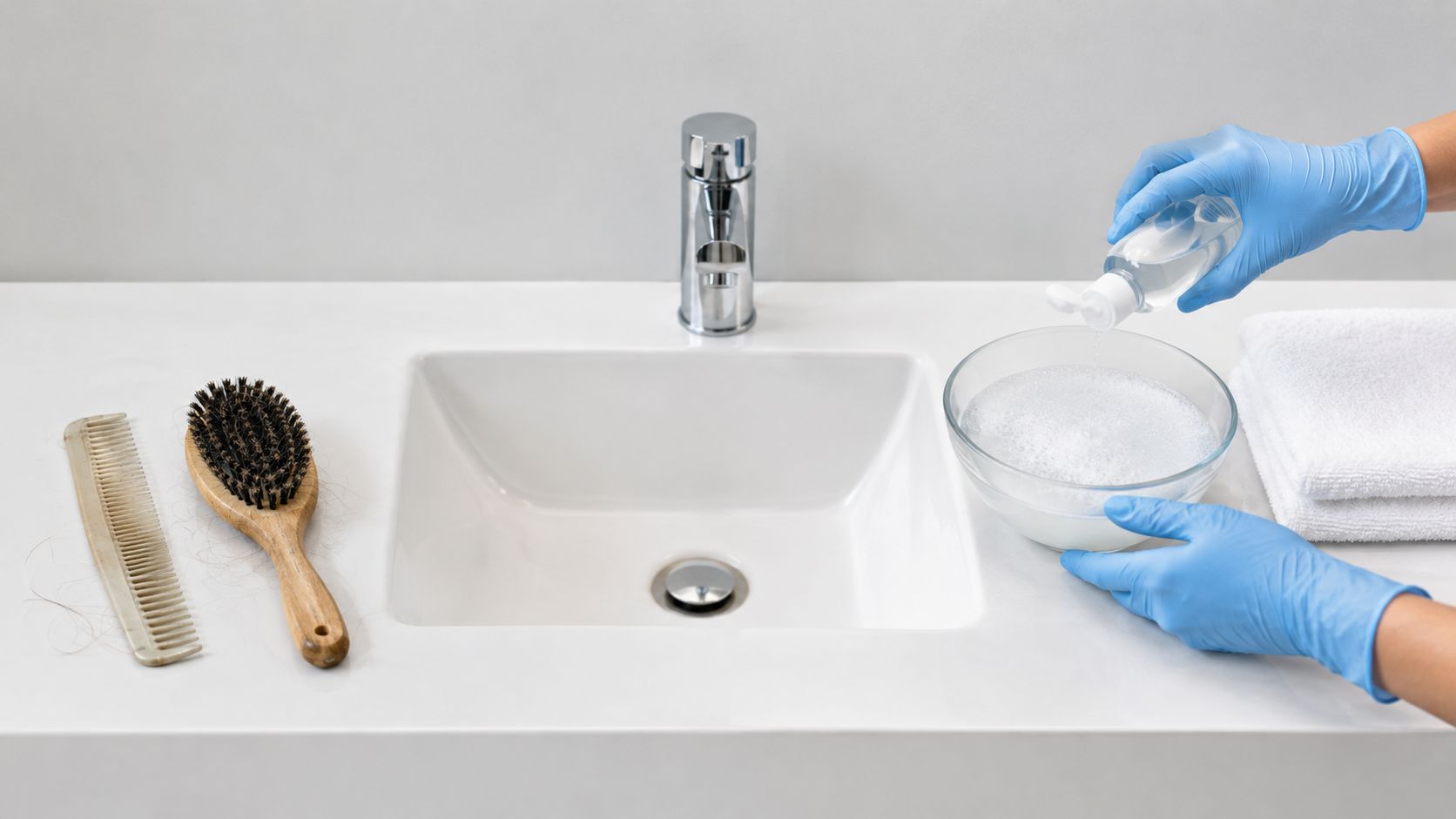
You pull a brush from the bathroom drawer and notice more than loose hair. There's scalp oil caught near the bristles, styling residue on the handle, and perhaps a nagging question: is rinsing it enough, or could it carry something infectious? The answer depends on the tool's material, the type of exposure, and whether you're cleaning away debris or actually disinfecting the surface.
Learning how to disinfect combs and brushes safely starts with one distinction. Cleaning removes soil. Disinfection uses an appropriate method to inactivate microorganisms after the surface is clean. Treating those steps as interchangeable can leave a tool visibly tidy but inadequately treated.
Understanding Viral Risks on Grooming Tools
A family member leaves a comb beside the sink after using it, and someone else picks it up minutes later. The risk depends on what contacted the tool, who will use it next, and whether the tool is made from a material that can tolerate treatment. Hair, scalp oil, skin debris, and styling residue can carry microorganisms, while a shared comb or brush can act as a fomite, an object that transfers infectious agents between people.
Norovirus deserves attention because it is a non-enveloped virus and a leading cause of acute gastroenteritis globally. Its structure helps it persist on environmental surfaces and resist some standard low-level detergents, according to public-health guidance for hairdressers and barbers. A tool that looks clean may still require disinfection, but that does not mean every household brush needs the harshest available chemical.

Sharing changes the decision
A brush used by one healthy person for routine grooming presents a different situation from a tool shared within a household or used repeatedly on salon clients. CDC guidance advises against sharing combs and brushes because hair and scalp contact can transfer organisms or infestations. If a tool has touched broken skin, visible blood, heavy skin debris, or the hair of someone with suspected lice, rinsing alone is inadequate.
The same risk-based reasoning applies to SARS-CoV-2, bacteria, and fungi found on grooming equipment. A 2025 study of hair-salon tools detected organisms including Staphylococcus aureus, Streptococcus, Bacillus, Escherichia coli, Pseudomonas, Aspergillus, Trichophyton, and Candida. Hair brushes had the highest contamination among the examined tools, according to the published study. Detection does not prove transmission, but it supports cleaning between users.
Viral persistence also varies by pathogen and surface, as explained in how long viruses live on surfaces. Material determines which cleaning method is safe, while chemical disinfection requires the correct contact time. Do not share grooming tools, and disinfect them when exposure or repeated use makes that necessary.
The Two-Stage Cleaning and Disinfection Process
Disinfection works poorly through a layer of hair, oil, dead skin, or styling product. Organic debris can shield microorganisms from the chemical, so applying disinfectant to a dirty brush may treat the residue more than the surface underneath. Public-health guidance therefore treats the process as two connected stages, cleaning first and chemical disinfection second.

Stage one removes what you can see
Start by pulling out every strand of hair. Use your fingers, a pointed comb, or a small cleaning brush to reach the base of the bristles and the spaces between comb teeth. If residue is sticky, loosen it under warm running water before scrubbing.
Wash the tool with warm water and detergent, paying attention to the bristle pad, teeth, underside, and handle junctions. Rubbing matters because water alone may loosen debris without removing the film that protects microorganisms. Rinse until no detergent or loosened residue remains.
Practical rule: If you can still see hair, oil, or product buildup, the tool isn't ready for disinfection.
Stage two treats the clean surface
Once the tool is clean, select a disinfectant whose label permits use on that material and specifies the organism claims you need. Hard plastic and metal are generally easier to treat than wood, fabric, foam, glued components, or electrical parts. The label controls the dilution, application method, required wet contact time, and whether rinsing is necessary.
The difference between sanitizing and cleaning matters here because a quick wash and a disinfecting treatment don't make the same claim. Cleaning reduces soil and contamination. Disinfection aims to destroy or irreversibly inactivate specified microorganisms on an inanimate surface, and EPA notes that disinfectants don't necessarily destroy bacterial spores.
After treatment, rinse only when the product label requires it. Then allow the tool to air-dry completely before storing or using it. Damp storage can support microbial survival or regrowth and can damage materials over time.
Disinfecting Hard and Nonporous Combs
A plastic or metal comb used on one person can carry hair, oil, product residue, and microorganisms to the next. Smooth, nonporous surfaces are generally easier to disinfect than wood, fabric, foam, glued parts, or electrical components. Inspect the comb first. Cracks, peeling coatings, and loose glued sections can trap residue or make chemical treatment unsafe.
Prepare the comb
- Remove hair and residue. Pull out trapped strands, then scrub between the teeth with warm water and detergent.
- Rinse thoroughly. Remaining soap and debris can dilute or block the disinfectant.
- Check compatibility. Confirm that the product label permits use on the comb's material and lists the organism claim you need.
- Protect yourself. Wear gloves, ventilate the area, and never mix bleach with ammonia or another cleaner.
New Zealand public-health guidance lists immersion options including a 70% alcohol solution or a 0.5% bleach solution, prepared as 5 milliliters of household bleach per 1 liter of water. These are separate methods, not interchangeable strengths. Follow the product directions and consider how the comb's material may react. The New Zealand hairdresser and barber guidance cited earlier also recommends cleaning tools after each client.
Keep the surface wet
Contact time, or dwell time, is the period the disinfectant must remain on the surface to achieve its labeled performance. The CDC explains that the surface must stay visibly wet throughout the entire time specified on the product label.
A spray or wipe therefore needs more than quick application. Wiping the comb immediately can leave it looking clean while shortening the required exposure. If the label specifies a wet interval and the surface dries before that interval ends, reapply enough product to keep the surface visibly wet, following the label.
Treat every part
Use immersion only when the label and manufacturer allow it. Otherwise, apply the disinfectant to every accessible area, including the teeth, spine, underside, handle edges, and small junctions. A saturated-looking main surface does not prove that narrow gaps received enough product.
After the contact time ends, follow the label's instructions about rinsing. Place the comb on a clean surface and let it dry fully before storage or use. Damp storage can preserve microbial survival and damage materials over time. Chemical surface disinfectants are intended for inanimate objects, so do not apply them directly to hair, skin, or the scalp.
Using Heat for Lice Prevention
Heat can be useful when the specific concern is head lice, but it shouldn't be presented as a universal substitute for viral disinfection. The Alabama Department of Public Health recommends soaking combs and brushes in water at least 130°F (54.4°C) for 5–10 minutes to control head lice, as stated in its head-lice guidance.

Use water, not an oven
The benchmark calls for soaking in hot water. It doesn't mean putting a brush or comb in an oven, where heat can warp plastic, damage adhesives, ignite materials, or create a burn hazard. Use a thermometer because ordinary warm tap water may not reach the target, while excessively hot water can deform the tool or injure the person handling it.
Remove hair and visible residue first. Completely submerge the item so water reaches the comb teeth and the base of dense bristles. Maintain the required temperature and exposure interval, then lift the tool with tongs and place it on a clean surface to dry completely.
Heat for lice is a targeted method. It isn't automatically a broad-spectrum treatment for viruses, bacteria, or fungi.
A virucidal claim requires a disinfectant labeled for the target organism and surface. Heat treatment aimed at lice doesn't establish equivalent activity against SARS-CoV-2, norovirus, hepatitis viruses, or other pathogens. Likewise, a chemical disinfectant labeled for a surface doesn't make it safe to apply to a person's hair or scalp.
Avoid sharing combs and brushes, even after a heat treatment. If the tool is made from wood, contains a cushion, or has electrical components, water exposure may damage it. In that case, follow the material-specific approach below or replace the tool if reliable treatment isn't possible. For additional context on heat-based methods, see thermal disinfection.
Cleaning Porous, Wooden, and Electric Brushes
A brush with untreated wood, fabric, foam, a cushion, glued bristles, or electrical parts cannot automatically follow the hard-plastic comb routine. EPA classifies absorbent materials such as untreated wood, fabric, and foam as porous, and products approved for hard, nonporous surfaces shouldn't be assumed suitable for them, as explained in its surface classification guidance.
Start with construction
Remove every strand of hair and wipe away visible oil or product buildup. Use a small amount of compatible detergent solution on a cloth or soft brush, concentrating on accessible surfaces rather than flooding the tool. Keep wooden handles, cushions, seams, adhesives, batteries, switches, and motor housings as dry as the manufacturer requires.
For an electric brush, unplug it and let it cool before cleaning. Apply cleaner to a cloth, not directly into vents or controls. Wipe the bristles and outer housing, then use a compatible disinfectant on reachable hard surfaces only if the label permits that application. Never submerge an electrically powered brush unless the manufacturer explicitly allows it.
A wooden or cushioned brush may look clean after wiping, yet porous areas can absorb moisture and disinfectant unevenly. That makes it difficult to confirm complete contact and can leave residues inside the material. If the brush is cracked, shedding bristles, separating at glued joints, or retaining persistent contamination, replacement is safer than forcing an unsuitable immersion method.
Match the tool to the workflow
Professional users who need replaceable, nonporous tools can compare construction and maintenance requirements when evaluating salon brushes from Conde Professional. The relevant question is not just whether a brush looks sturdy. It's whether its materials and manufacturer instructions support the cleaning and disinfection process required between users.
For a mixed-material brush, separate what can be treated from what cannot. Clean the accessible hard components, keep sensitive sections dry, maintain ventilation, and follow the disinfectant label. Don't rely on ultraviolet light as a replacement for approved disinfection. Kentucky regulations explicitly state that UV light isn't an acceptable substitute for approved disinfection of nonporous implements.
If you can't remove debris, wet the relevant surfaces adequately, or verify compatibility and contact time, retire the brush. A damaged tool can retain contamination and may expose users to leftover chemicals, splinters, loose parts, or electrical hazards.
Best Practices for Home and Salon Use
A brush used by one person needs a consistent routine. A salon tool needs a controlled process because it moves between clients. Clean and disinfect nonporous reusable combs and brushes between every client, following the product label for dilution and contact time.
The salon-tool contamination study makes this between-client rule practical rather than optional. See the study of salon-tool contamination. Keep in mind that lice-focused heat treatment is not the same as broad viral disinfection. Use heat only for the targeted purpose it can address, and use a compatible disinfectant when labeled chemical contact time is required.
Use this decision framework:
- Routine personal use: Remove hair, wash with warm water and detergent, rinse, and dry completely.
- Sharing or suspected exposure: Clean first. Then apply a compatible labeled disinfectant, or use the specified heat method when lice are the concern.
- Professional service: Process each reusable nonporous tool between clients. Store clean tools separately from used ones.
- Sensitive construction: Wipe reachable surfaces, keep electrical and porous parts dry, and replace the item if reliable treatment is not possible.
Wear gloves for chemical disinfection, ventilate the area, and prepare solutions exactly as directed. Never mix bleach with ammonia or other cleaners. Store tools only after they are fully dry.
For further evidence-based guidance on viruses, environmental transmission, and prevention, visit VirusFAQ.com. Match the method to the material and exposure, then apply it consistently in shared and professional workflows.
Leave a Reply