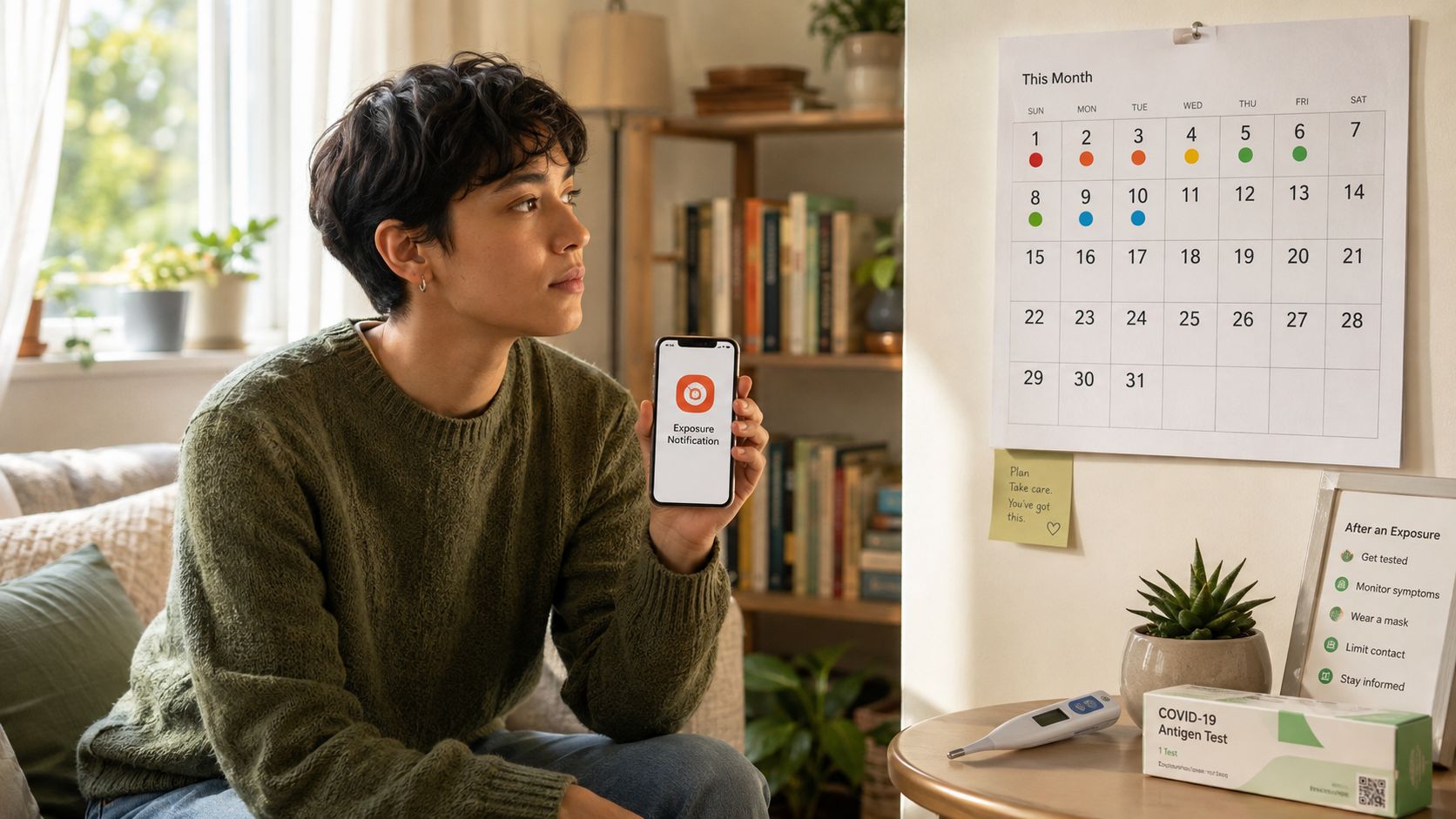
You get a message from your child's school about a confirmed COVID-19 case at lunch. Or a coworker tells you they developed symptoms after yesterday's long meeting. Within seconds, ordinary questions become urgent: Should I leave work? Should I test now? Do I need to separate from my family?
The answer depends on more than the fact that contact occurred. Exposure doesn't automatically mean infection, and a test taken too soon may not settle the question. The practical decision is when to isolate after exposure, when to mask and monitor instead, and what to do if symptoms appear before testing gives you a clear answer.
The guidance below focuses on the timing logic behind public-health advice, especially for COVID-19, while showing where influenza and norovirus follow different rules.
The Moment You Realize You Were Exposed
Maya learns about the school exposure while she's at work. Her child sat near a classmate at lunch, and the school has reported that the classmate tested positive. Maya's first instinct is to pick up her child, cancel the rest of the day, and keep everyone in the house apart.
That reaction is understandable, but it mixes several different questions together. A meaningful exposure can involve close contact within six feet for at least 15 minutes, shared indoor air, or direct respiratory droplets, yet exposure alone doesn't establish that transmission occurred. The date and circumstances of the last contact matter because they determine when symptoms or a positive test are most likely to emerge.
What to do immediately
Start by recording the last time you had close contact with the person who may have been infectious. If contact continued, use the last contact rather than the first contact as the reference point. This is particularly important in households, where people may share sleeping, eating, or caregiving spaces.
Then ask three practical questions:
- Do you have symptoms now? Fever, cough, sore throat, body aches, fatigue, vomiting, or diarrhea should change the plan immediately.
- Was the contact ongoing or one-time? A single meeting and repeated household contact create different timelines.
- Could you protect someone vulnerable? A person with serious health risks may need more distance, cleaner air, and earlier clinical advice.
If you're already ill, stay home and avoid close contact while arranging testing or medical advice. If you feel well, don't assume you must either carry on normally or enter complete isolation without considering the exposure date and current guidance.
Practical rule: The first 24 hours are mainly for identifying the last exposure, checking symptoms, reducing avoidable contact, and choosing the correct testing date.
The important window usually extends beyond the day you receive the notification. Public-health guidance moved from a default 14-day quarantine after exposure to shorter, test-based approaches because officials were trying to cover the period when infection could become apparent and onward transmission could begin. WHO's early guidance recommended quarantining contacts for 14 days from the last exposure (WHO quarantine guidance). Later approaches emphasized masking, testing, and symptom monitoring over the first several days rather than treating every exposure as confirmed infection.
Isolation, Quarantine, and Exposure Monitoring Explained
Public-health language becomes confusing because isolation, quarantine, and exposure monitoring are not interchangeable.
Isolation applies when you're sick or have a confirmed infection. You reduce contact with other people because there's evidence you may be contagious. Quarantine traditionally meant staying apart after an exposure while waiting to see whether illness developed. Exposure monitoring is a more flexible approach. You remain alert for symptoms, test at the recommended time, and use precautions without automatically treating exposure as infection.
An airline analogy helps. Isolation is being grounded because a confirmed problem requires action. Quarantine is a precautionary hold while the crew checks whether a risk has developed. Exposure monitoring is keeping your seatbelt on, watching for turbulence, and following the crew's instructions if conditions change.
For a clear discussion of the terminology, see this guide to the difference between isolation and quarantine.
Counting the days correctly
The timeline convention is simple:
- Day 0 is the day of the last exposure.
- Day 1 is the first full day after that exposure.
Suppose your last contact happened on Monday at 2 p.m. Monday is day 0. Tuesday is day 1, Wednesday is day 2, Thursday is day 3, Friday is day 4, and Saturday is day 5.
That convention prevents a common mistake. Someone exposed late on Monday shouldn't count Monday as a full day of monitoring, because only part of the day passed after contact. The same rule applies when exposure occurs at night or when several contacts happen over several days.

If symptoms appear at any point, stop treating the situation as routine exposure monitoring. Isolate immediately, stay away from others, and test or contact a clinician according to the illness involved. A person who feels well after exposure may use masking and testing to reduce risk, but a person who becomes symptomatic needs a more protective response.
Why the First 5 to 10 Days Matter Most
The body doesn't produce detectable virus immediately after every exposure. A person can feel normal while an infection is developing, and a test taken very soon after contact may not detect it. That's why the question of when to isolate after exposure is tied to the incubation period, the time between exposure and symptom onset.
For COVID-19, public-health guidance used a broad possible incubation range of 2 to 14 days, with a median of 3 to 5 days. Influenza generally has an incubation period of 1 to 4 days, while norovirus can produce symptoms within 12 to 48 hours. These figures come from the supplied research brief and should be treated as general biological ranges, not guarantees for an individual.
The infectious window changes the decision
Respiratory viruses may spread before a person recognizes that they're sick. The relevant pattern is often described as a viral-load curve. Viral levels rise, reach a period of greater infectiousness, and then decline, but the timing varies by virus and person.
That creates two different decisions. Before symptoms, an exposed person may need masking, testing, and monitoring. Once symptoms appear or infection is confirmed, isolation becomes more important because the probability of transmission is no longer merely hypothetical.
| Virus | Typical Incubation | Peak Infectious Window | Policy Isolation Anchor |
|---|---|---|---|
| SARS-CoV-2 | 2 to 14 days, median 3 to 5 days | Often around symptom onset and the early illness period | Exposure precautions through day 10, with testing around day 5 |
| Influenza | 1 to 4 days | Around the early symptomatic period | Stay home until fever has been gone for at least 24 hours without fever-reducing medicine |
| Norovirus | 12 to 48 hours | During vomiting and diarrhea, with contamination risk after symptoms | Continue precautions after vomiting and diarrhea stop, following applicable guidance |
The policy anchors of day 5 and day 10 are practical tools, not universal biological deadlines. Day 5 gives testing a better chance to detect an infection than an immediate test, while day 10 extends precautions across a longer post-exposure period. CDC guidance describes masking indoors and testing at least 5 days after exposure, with day 0 as the last exposure and day 1 as the first full day afterward (CDC exposure guidance).
For a deeper explanation of the biological concept, read about the incubation period. The key lesson is straightforward: a negative result early in the timeline doesn't erase the exposure.
Your Day-by-Day Action Plan After Exposure
A useful plan begins with the last contact, not with the moment you receive the notification. If the last exposure was Monday at 2 p.m., Monday is day 0 and Tuesday is day 1.
Days 0 through 5
On day 0, write down the exposure time, check whether you have symptoms, and avoid unnecessary close contact with people at higher risk. If you can improve airflow or choose an outdoor setting instead of a crowded indoor one, do so.
From day 1 through day 5, monitor for fever, cough, sore throat, body aches, fatigue, vomiting, and diarrhea. Wear a high-quality mask in indoor public spaces and around household members when close contact can't be avoided. The CDC has described masking indoors for 10 days after exposure and testing at least 5 days after exposure, or sooner if symptoms develop (CDC respiratory-virus exposure summary).
Test on day 5 under the relevant COVID-19 guidance. If symptoms appear before day 5, isolate immediately and test rather than waiting for the scheduled date. A positive result means you should follow the applicable isolation guidance, not treat the test as permission to resume normal contact.
Days 6 through 10
A negative test on day 5 can support a decision to ease some restrictions when you're symptom-free, but it isn't a universal guarantee that infection is impossible. Continue masking through day 10, especially near vulnerable household members, and respond promptly if symptoms begin later.
If you're ill and sleep becomes difficult, practical advice on step-by-step sick sleep strategies may help you rest while limiting contact with others.

The timeline is designed to reduce risk while acknowledging that exposure isn't the same as infection. If a later test becomes positive or symptoms develop after an earlier negative result, begin isolation at that point and follow current local guidance.
How Vaccination and Prior Infection Change the Rules
Immune status can alter the post-exposure response, but it doesn't make symptoms or testing irrelevant. Earlier CDC guidance stated that people who were fully vaccinated and boosted didn't need to quarantine after exposure, but should wear a mask for 10 days and test around 3 to 5 days after exposure (CDC vaccination and quarantine update).
The logic was a tradeoff. Vaccination reduced the likelihood that exposure would lead to transmission requiring immediate quarantine, while masking and testing still addressed the possibility of infection. People who weren't vaccinated or recently boosted were previously advised to quarantine for 5 days, then use strict masking for another 5 days.
Immune protection isn't a permanent exemption
Prior infection can provide protection, but it doesn't guarantee that a new exposure won't lead to infection. Protection can vary with the virus involved, the time since the immune event, and the person's health. The number of vaccine doses alone doesn't tell you how much protection an individual has at a particular moment.
People with significant immune compromise need individualized medical advice. Organ transplant recipients, people receiving chemotherapy, and others whose immune response may be weakened shouldn't assume that a negative rapid antigen test rules out infection. A clinician may recommend more cautious separation or laboratory testing based on the exposure and symptoms.
| Immune Status | Quarantine Required? | Testing Recommendation | Mask Through Day 10 |
|---|---|---|---|
| Fully vaccinated and boosted under earlier CDC guidance | Not required after exposure | Test around 3 to 5 days after exposure | Yes |
| Not vaccinated or not recently boosted under earlier CDC guidance | 5 days | Test according to current guidance | Yes, for another 5 days |
| Prior infection | Depends on current guidance and timing | Test at the recommended interval | Use precautions when advised |
| Immunocompromised | Seek individualized clinical advice | A clinician may recommend PCR or other testing | Use a cautious approach |
Current recommendations can change as variants, vaccines, and surveillance information change. VirusFAQ.com's discussion of natural immunity versus vaccination provides additional context for comparing those forms of protection.
Different Viruses, Different Timelines
There isn't one universal answer to when to isolate after exposure. The right response depends on the virus, the symptoms, the testing method, and the public-health guidance that applies to that infection.
For COVID-19, earlier CDC guidance used 5 days of staying home after exposure followed by 5 additional days of strict masking, with testing around day 5. Later guidance emphasized wearing a high-quality mask indoors and testing on day 5, while people who develop symptoms should isolate immediately (archived CDC exposure guidance).
Influenza follows a symptom-based rule rather than a standard exposure quarantine. CDC flu guidance says people with influenza-like illness should stay home until at least 24 hours after fever ends without fever-reducing medicine (CDC influenza exclusion guidance). Flu often begins abruptly, with fever, aches, and exhaustion appearing together, although symptoms can overlap with COVID-19.
Norovirus behaves differently again. Sudden vomiting and diarrhea are the dominant clues, and careful handwashing with soap matters more than relying on alcohol-based hand sanitizer. Because contamination can continue after symptoms stop, people should follow local or clinical advice about remaining away from food preparation, school, work, and close contact after recovery.
| Virus | Incubation Period | Isolation Duration | Exit Criteria |
|---|---|---|---|
| SARS-CoV-2 | 2 to 14 days, median 3 to 5 days | Follow current guidance, with exposure precautions often extending through day 10 | Symptoms improving, testing and masking according to current guidance |
| Influenza | 1 to 4 days | Stay home while acutely ill | Fever-free for at least 24 hours without fever-reducing medicine and improving overall |
| Norovirus | 12 to 48 hours | Remain away while vomiting or diarrhea continue and follow applicable post-symptom guidance | Vomiting and diarrhea have stopped, with careful hand hygiene afterward |
Respiratory infections call for masking, ventilation, and distance. Norovirus control depends heavily on soap-and-water handwashing, surface cleaning, and keeping sick people away from food handling.
When Full Isolation Is Not Realistic
A separate bedroom sounds simple until the exposed person is caring for a young child, sharing one room with relatives, or living in crowded housing. Some households can't create complete separation, and telling people to “isolate” may leave them without a workable plan.
The better goal is layered risk reduction. Use as many protections as the home allows, prioritize people at higher risk, and remember that precautions reduce transmission but don't replace staying home when someone is sick or has a confirmed infection.
Start with the highest-impact changes
Use a separate bedroom and bathroom when available. Improve ventilation, open windows when practical, use cleaner indoor air, and avoid sharing cups, utensils, towels, and other frequently handled items. Keep close interactions brief and avoid communal meals or recreational activities while infection is possible.
If separation can't happen, wear a well-fitting, high-filtration mask during close contact. Assign one primary caregiver where feasible, rather than exposing every household member to repeated contact. Everyone should wash hands regularly and monitor for new respiratory or gastrointestinal symptoms.
- Protect vulnerable people: Minimize contact with older adults and people whose health conditions increase the consequences of infection.
- Reduce shared air: Choose outdoor communication or increase airflow indoors when possible.
- Clean thoughtfully: Wipe high-touch surfaces without using aggressive spraying that could create unnecessary aerosol exposure.
- Limit food contact: Avoid preparing food for others while infectious, especially when vomiting or diarrhea are present.

Household exposure can continue if the exposed person remains in close contact with the source of infection. In that situation, record each relevant contact and ask a clinician or local health authority how to count the monitoring period.
Seek urgent medical care for severe breathing difficulty, confusion, chest pain, dehydration, or rapidly worsening symptoms. Masks, ventilation, and hand hygiene are useful layers, but they aren't substitutes for medical assessment when someone is deteriorating.
A Simple Checklist for the Next Exposure
A calm checklist helps prevent two common errors, testing so early that a negative result falsely reassures you, and waiting too long after symptoms begin.
- Identify the virus: Determine whether the concern involves COVID-19, influenza, norovirus, or another infection, because isolation rules differ.
- Record the last contact: Write down the date and time of the last close exposure. For COVID-19 guidance, exposure day is day 0 and the first full day afterward is day 1.
- Monitor symptoms: Check for fever, cough, sore throat, fatigue, vomiting, diarrhea, body aches, or other new symptoms.
- Test at the right time: Follow the recommended testing interval instead of assuming an immediate negative result excludes infection. Test promptly if symptoms develop and repeat testing when current guidance advises.
- Protect other people: If symptoms appear or infection is confirmed, isolate, avoid close contact, improve ventilation, and use respiratory etiquette. Take extra care around vulnerable household members.
- Return carefully: Resume work, school, or social activities only when symptoms are improving overall and you've been free of fever for at least 24 hours without fever-reducing medication, consistent with CDC respiratory-virus guidance (CDC precautions when sick). After returning, use added precautions such as masking, cleaner air, hygiene, distancing, or testing for 5 additional days when that guidance applies.
Keep a short record of exposure dates, test results, and symptom onset. That record helps you explain the situation to household members, an employer, a school, or a healthcare professional without relying on memory.
Vaccination, previous infection, and a negative test can all inform the decision, but none should be treated as the only factor. The safest approach combines the exposure date, symptoms, testing timing, the virus involved, and the risk of exposing someone else.
If you've recently had a close contact, write down the last exposure date today, check your symptoms, and follow the current guidance for the suspected virus. Share this guide with the people in your household, and use VirusFAQ.com to review reliable information about transmission, testing, prevention, and other viruses before making your next decision.
Leave a Reply