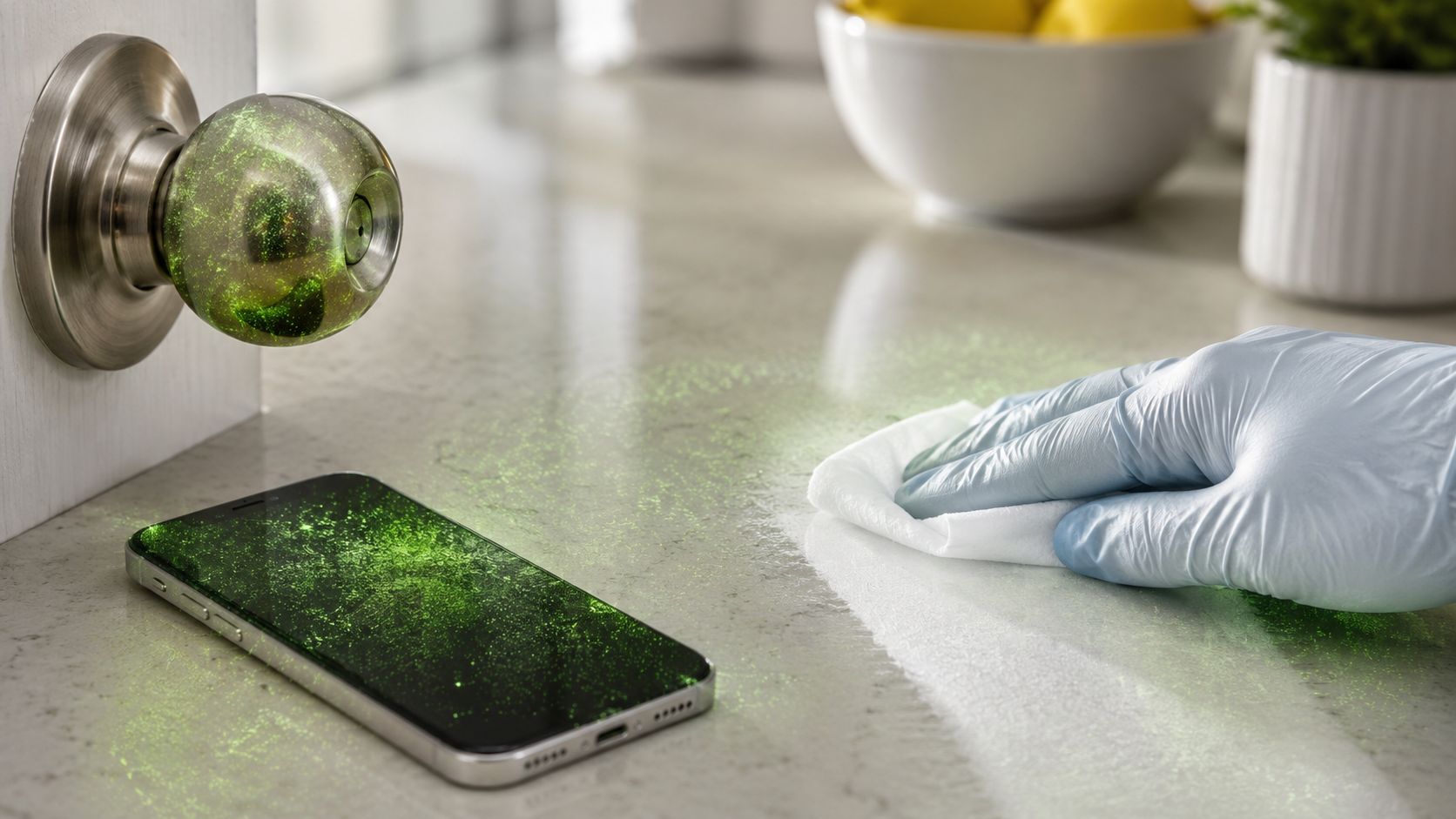
A single episode of vomiting or diarrhea can leave virus behind on the surfaces people touch every day, and those surfaces can keep spreading illness after symptoms fade. That is what makes norovirus so disruptive in homes, schools, care facilities, and food settings.
Many people picture norovirus as a short burst of stomach illness linked to cruise ships. In reality, it often behaves more like a contamination problem that keeps circulating through bathrooms, kitchens, shared equipment, and high-touch objects. A tap handle, phone screen, toy, or counter can look clean and still carry infectious particles.
Norovirus is hard to remove because it is a small, non-enveloped virus. In simple terms, it lacks the fragile outer coating that many common cleaners damage easily. It behaves more like a sealed bead than a soap bubble. If cleaning only lifts dirt without using a disinfectant proven to inactivate norovirus, enough virus may remain to infect the next person who touches the surface.
That is why ordinary wiping often falls short. Effective control depends on cleaning away visible soil first, then using the right disinfecting method and product for the surface and setting. This matters in any shared environment, especially where food is handled and cross-contact can spread contamination quickly, including work guided by food safety for NZ hospitality.
The Hidden Threat on Everyday Surfaces
A parent cleans the bathroom sink after a child vomits. A nurse wipes down a bedside table between patient contacts. A food worker sprays a prep counter and moves on. All three may feel they've dealt with the problem, but norovirus survival on surfaces changes the risk calculation.
This virus spreads efficiently because it doesn't need much help from the environment. A contaminated hand touches a faucet handle. Someone else touches that handle, then their mouth or food. In busy settings, those contact chains multiply fast. That's one reason prevention in kitchens and shared spaces depends on disciplined surface hygiene and strong food handling practices, including practical guidance on food safety for NZ hospitality.
Why everyday objects matter
Hard surfaces get most of the attention, but the danger starts with ordinary routines:
- Shared touchpoints: Door handles, phones, railings, taps, fridge handles, and tablet screens get frequent hand contact.
- Hidden contamination: A surface can look spotless while still holding infectious virus.
- Repeated transfer: One contaminated object can seed many other surfaces over the course of a day.
Practical rule: If a surface sits near vomiting, diarrhea, diaper changes, or food preparation, assume ordinary cleaning may not be enough.
Why this catches people off guard
People often expect viruses to die quickly once they dry out. Norovirus breaks that mental model. It's built to tolerate drying better than many people realize, and that's why “I wiped it down already” often isn't the reassuring statement it sounds like.
For worried parents, the key point is simple. A child's toy, bathroom flush handle, or kitchen counter can stay risky longer than your instincts suggest. For healthcare workers, the message is even sharper. If a room has been contaminated, the room may still pose a transmission risk well after visible mess is gone unless the right disinfectant was used correctly.
The Science of a Super Survivor Virus
Norovirus is a non-enveloped virus. That phrase sounds technical, but the idea is straightforward. Some viruses have a fatty outer membrane that's relatively fragile. Norovirus doesn't. It relies on a sturdy protein shell, often called a capsid, to protect its genetic material.
A useful analogy is this. An enveloped virus is a device in soft packaging. Norovirus is more like a small object inside a hard case. Dry air, routine cleaners, and common sanitizers can damage the soft package more easily. The hard case is much tougher.

Why alcohol often falls short
The most important practical consequence is this: the non-enveloped structure of norovirus lacks a lipid membrane, rendering it resistant to alcohol-based sanitizers and desiccation. When present, an organic load like from vomit or feces provides a protein shield that further protects the virus from disinfectants and drying out, as described in this surface survival review.
That's why hand sanitizer and routine spray-and-wipe habits can fail. Alcohol works well against many microbes people worry about day to day, but norovirus is a different kind of opponent.
The protein shield problem
Organic matter confuses many readers because they assume disinfectant should “cut through” anything. In practice, vomit or stool residue can act like a protective layer over viral particles. Think of mud covering a stain before you try to clean it. If the mud stays in place, your cleaner can't reliably reach what's underneath.
That's also why pre-cleaning matters. Visible mess isn't just unpleasant. It blocks disinfectant action.
- Drying doesn't solve it: Norovirus tolerates drying better than many people expect.
- Alcohol isn't a shortcut: If the product relies mainly on alcohol, don't assume it's enough.
- Organic residue changes the game: A contaminated surface may need two separate actions, cleaning first and disinfecting second.
A surface can be visibly dry and still microbiologically dangerous.
Why this matters in real settings
In homes, this explains why outbreaks seem to “circle back” after everyone thought the bug had moved through. In healthcare, it helps explain why environmental services protocols have to be stricter after vomiting or diarrhea events. In schools and childcare, it's why toys, bathroom fixtures, and shared electronics deserve more attention than a quick wipe with a general-purpose cleaner.
How Long Norovirus Lasts on Different Surfaces
A contaminated countertop can stay risky far longer than many people expect. In healthcare guidance reviewed by the CDC, norovirus and closely studied surrogates remained on dry environmental surfaces for days to weeks under room-temperature conditions, and some studies found persistence on hard surfaces for even longer periods depending on the material and test method (CDC evidence review).
That matters because a surface does not need to look dirty to act like a relay point. A dry door handle, bedside rail, light switch, or faucet can keep passing contamination from one hand to the next if the virus has not been removed and inactivated.
A quick reference table
| Surface or environment | What the evidence shows |
|---|---|
| Hard, nonporous surfaces | Studies reviewed by the CDC found survival on materials such as stainless steel, ceramic, and laminate for days to weeks at room temperature. Some laboratory findings extended longer under controlled conditions. |
| Dried environmental surfaces | Persistence in a dried state has been documented for multiple weeks, which helps explain why a surface can look clean but still spread infection. |
| Stainless steel | Laboratory work found survival for at least several days under both refrigerated and room-temperature conditions. |
| Carpet and soft flooring | Virus can remain present for days, and routine vacuuming does not reliably solve the problem. |
| Water | Infectious virus has persisted for long periods in water, including groundwater in outbreak-related research. |
| Refrigerated and frozen foods | Cold storage slows spoilage, not necessarily viral risk. Studies reviewed by the CDC found persistence in refrigerated foods for days and in frozen settings for much longer. |
Hard surfaces are only part of the problem
Counters and toilet handles get attention because people clean them more often. Shared objects often create the more confusing exposure path. Phones, remote controls, cart handles, bed rails, call buttons, toys, and fabric-covered seating can all take part in transmission if they are touched before the right disinfectant has enough contact time.
Food-contact transfer adds another layer. The CDC review found that virus transfer from contaminated surfaces to foods varied widely by food type and conditions, which helps explain why outbreak investigations often trace spread back to small handling errors rather than one dramatic hygiene failure.
Why persistence turns into spread
Norovirus survives well enough that touch becomes the multiplier. In the CDC-reviewed studies, contaminated fingertips moved virus from one surface to another in a substantial share of contact events. A useful comparison is glitter on your hands after a craft project. You may wipe one spot, but a small amount keeps showing up on the next object you touch.
That is why standard spray-and-wipe habits often fall short. If the product is not proven to work against norovirus, if the surface is wiped dry too quickly, or if porous materials are treated like smooth counters, contamination can remain in place.
For a broader comparison with other pathogens in homes, schools, and care settings, see this guide on how long viruses live on surfaces.
Key Factors That Influence Virus Persistence
A contaminated surface doesn't behave the same way in every room. Temperature, moisture, sunlight, material type, and residue all affect how long virus remains a practical threat.

Organic matter changes everything
The most important factor is often the one people most want to clean up quickly and forget. Vomit, stool, and food residue can physically shield virus from a disinfectant. If that residue stays on the surface, your product may never reach the virus effectively.
In practice, that means a bathroom floor after a vomiting episode is not just “dirty.” It is chemically harder to disinfect.
Material and micro-environment matter
A stainless steel rail, plush carpet, touchscreen, and vinyl seat don't interact with contamination in the same way. Some surfaces keep material on top where it can transfer easily. Others absorb or trap it in tiny spaces. Neither is automatically safe.
A few real-world patterns help:
- Cooler, darker places: These often preserve contamination longer than bright, sunlit areas.
- Moisture and residue: Residual grime can help virus persist and frustrate disinfection.
- High-touch repetition: Even if the amount on a surface gradually falls, repeated touching keeps the transmission chain alive.
What to remember: Risk isn't just about how long the virus exists. It's about whether people keep touching the surface before proper cleaning and disinfection happen.
Why routine cleaning can mislead you
Cleaning and disinfecting are not the same task. Soap or detergent may remove dirt and some contamination, which is useful. But if the product isn't active against norovirus, the surface may look better while still posing a hazard.
That's where workers in healthcare, childcare, and food service get tripped up. A room can smell clean, shine under the light, and still be part of an outbreak. The key variable isn't appearance. It's whether the method matched the biology of the virus.
Challenging Common Myths About Norovirus Survival
Several myths make norovirus harder to control because they sound sensible on the surface. The problem is that norovirus does not behave like a fragile germ that fades away after a quick wipe or a few hours of drying. It behaves more like glitter in a house with kids. You may stop seeing it, but it keeps turning up on the things people touch most.
Myth one and two, dry or porous surfaces become safe quickly
Dryness and soft materials do not guarantee safety. As noted earlier, researchers have detected Human Norovirus for up to 30 days on both non-porous plastic and porous seat leather, which challenges two common assumptions at once: that drying quickly makes a surface low risk, and that porous materials reliably inactivate the virus faster.
That matters in everyday settings because contamination does not stay neatly contained on a bathroom sink or kitchen counter. It can persist on surfaces people overlook or clean lightly, including:
- Phones and tablets
- Vehicle seats and seat belts
- Remote controls and touchscreens
- Waiting room and break room chairs
A surface can feel dry and still carry risk. A porous surface can hide contamination in tiny spaces that are harder to clean thoroughly.
Myth three, “antimicrobial” surfaces do the hard work for you
Labels such as antimicrobial, hygienic, or easy-clean can create false confidence. Those features may help with maintenance, but they do not replace a disinfectant proven to work against norovirus.
A helpful way to picture it is this. The surface is the floor, not the cleanup crew. A material may make dirt easier to remove, yet the virus can still remain if the product used on it is not active against a hardy non-enveloped virus. That is one reason outbreaks can continue in childcare centers, clinics, kitchens, and homes that look clean.
Myth four, any disinfectant spray will solve the problem
This myth causes real trouble because it leads people to use products designed for everyday grime instead of outbreak-level disinfection. Norovirus has no lipid envelope, which makes it harder to disrupt than many viruses people are used to hearing about. In practical terms, the chemistry that works for one pathogen may do very little here.
For parents, food handlers, and environmental services staff, the takeaway is simple. Product labels matter. Active ingredients matter. Contact time matters. If you are comparing options, this guide to the best disinfectants for norovirus helps explain what to look for.
Food settings need extra caution because hands, utensils, handles, and prep areas can connect contamination points quickly. Safe workflow still matters alongside disinfection, especially when teams are trying to prevent cross contamination.
The biggest myth of all is that visible cleanliness equals safety. With norovirus, a shiny surface can still be part of the transmission chain if the wrong product or method was used.
Proven Disinfection Methods That Actually Kill Norovirus
If you remember one technical point, make it this one. Effective disinfection requires sodium hypochlorite at a concentration of 1,000 to 5,000 ppm, as alcohol-based hand sanitizers and quaternary ammonium compounds are insufficient. Pre-cleaning is mandatory because organic material can neutralize the chlorine's activity, based on this peer-reviewed review of norovirus inactivation.
That statement explains why standard cleaning often fails. People use the wrong chemistry, skip pre-cleaning, or don't leave the disinfectant on the surface long enough.

What works better than routine wiping
For contaminated hard surfaces, bleach-based disinfection is the clearest evidence-based option in the data above. Pre-clean first to remove visible organic matter. Then apply a product that can deliver the right active ingredient at an effective concentration.
For many households and workplaces, that's where labeled disinfecting wipes and ready-to-use disinfectants become practical. They reduce guesswork, help with consistent application, and make it easier to treat high-touch surfaces quickly during a stressful cleanup.
What to stop relying on
A lot of people reach for whatever is close at hand. That's understandable, but risky.
- Alcohol-based hand sanitizers: Useful in some contexts, but not reliable for killing norovirus on contaminated surfaces.
- Quaternary ammonium compounds: Performance is insufficient in the evidence above when norovirus is the target.
- Light cleaning only: Removing visible dirt without following with a true disinfectant can leave viable virus behind.
The goal isn't to make the surface smell clean. The goal is to make it microbiologically safer.
A practical cleanup sequence
When someone has vomited or had diarrhea nearby, the order matters:
- Remove visible contamination first. Wear appropriate protection and physically clear the mess.
- Clean the surface. Use soap or detergent and water so residue doesn't block the disinfectant.
- Disinfect with a proven product. Bleach-based options are strongly supported by the evidence above. If you use a commercial disinfectant or wipe, choose one specifically labeled for norovirus and follow the label exactly.
- Cover nearby touchpoints too. Faucet handles, flush handles, door knobs, light switches, phones, rails, and nearby counters often get missed.
Food settings need extra discipline because hands, utensils, and surfaces cross paths so easily. For kitchen teams, this guide on how to prevent cross contamination is a useful companion to outbreak cleanup practices.
If you're comparing products, this roundup of the best disinfectant for norovirus can help you evaluate labels, active ingredients, and practical use cases.
Why wipes can make sense
A good disinfecting wipe isn't magic. It's a delivery format. The advantage is consistency. In a busy home, clinic, classroom, or staff room, wipes make it easier to treat small high-touch zones fast and correctly. That matters when the alternative is a vague spray, an unknown dilution, or a towel that spreads contamination from one object to another.
The right wipe still has to be labeled appropriately and used according to instructions. But when people need a fast, repeatable way to disinfect phones, handles, rails, tray tables, counters, and other touchpoints, wipes often fit the reality of how cleaning happens.
Frequently Asked Questions About Norovirus
Can I use hand sanitizer to protect myself from norovirus on surfaces
Not as your main defense. Alcohol-based sanitizer isn't reliable enough against norovirus for contaminated surfaces, and it shouldn't replace proper handwashing after bathroom use, cleanup, or food handling. Use soap and water for hands whenever possible, and use a disinfectant labeled for norovirus on the surface itself.
Is norovirus airborne after someone vomits
Vomiting can spread contamination beyond the obvious splash zone. In practical terms, nearby surfaces should be treated as potentially contaminated. Focus on careful cleanup, pre-cleaning, and disinfection of surrounding touchpoints, not just the visible mess.
How do scientists test for norovirus on surfaces
Researchers typically recover material from surfaces and then look for evidence of the virus in controlled studies. Depending on the study design, they may measure infectivity or detect viral material left on the surface. That's why you'll sometimes see a distinction between “detected” and “confirmed infectious” in technical discussions.
What household surfaces deserve priority after someone gets sick
Start with bathroom fixtures, sink handles, flush handles, light switches, counters, door handles, phones, tablets, remote controls, refrigerator handles, and any nearby food preparation area. If soft furnishings or carpet were exposed, treat them seriously too.
How long should I stay cautious after the symptoms are gone
Stay alert beyond the obvious illness window. Surface risk doesn't end just because the person feels better. If you also want a plain-language guide to illness duration and recovery expectations, see this article on how long norovirus lasts.
What's the biggest mistake people make
They confuse cleaning with disinfecting. The second biggest mistake is using a product that isn't proven to work against norovirus.
Norovirus is hard to kill, but it isn't impossible to control. The winning approach is straightforward. Remove organic matter, use a proven disinfectant, pay attention to high-touch surfaces, and don't rely on products that only work against easier targets. For more evidence-based virus guides and practical cleanup advice, visit VirusFAQ.com.
Leave a Reply