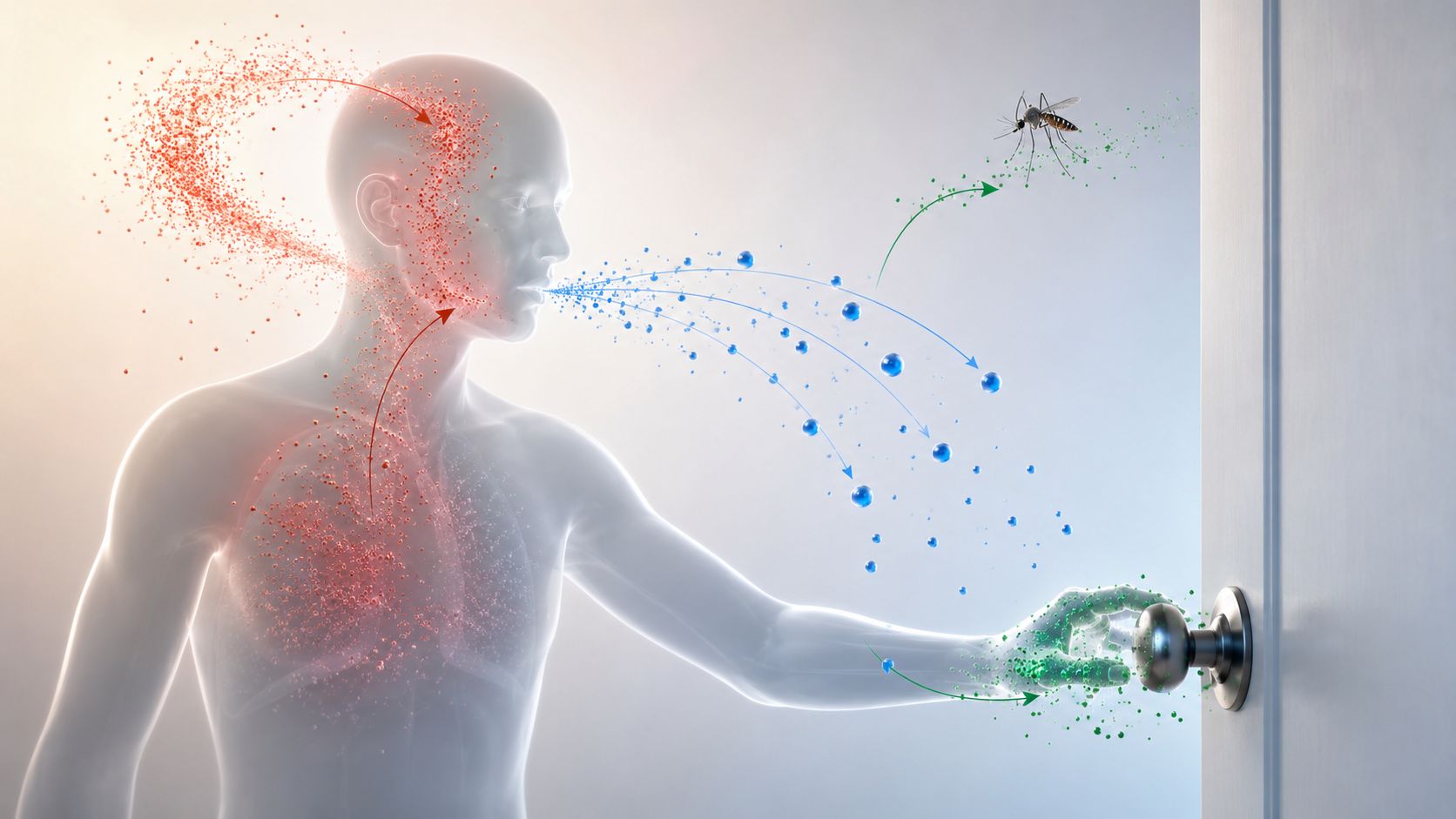
You skip the seat next to the coworker who's coughing. You wash your hands before lunch. You don't share a water bottle, a fork, or a phone. Then a couple of days later your throat feels raw, your nose starts running, and you're left with the question almost everyone asks at some point: How did the virus get to me anyway?
That question matters because viruses don't rely on a single path. They move through the world using several routes, and some of those routes are far less obvious than people think. A sneeze can matter. A conversation can matter. A doorknob can matter. So can the stale indoor air in a room that seemed perfectly safe.
For readers trying to understand viruses as different as HIV-1, Influenza A Virus (H1N1), Influenza A2/305/57 Virus (H2N2), Avian Influenza Virus (H5N1), Hepatitis B Virus (HBV), Hepatitis C Virus (HCV), Duck Hepatitis B Virus (DHBV), Bovine Viral Diarrhea Virus (BVDV), SARS-Related Coronavirus 2 (SARS-CoV-2), Human Coronavirus, Herpes Simplex Virus 1 (HSV-1), Herpes Simplex Virus 2 (HSV-2), Human Rotavirus, Feline Calicivirus, Norovirus (Norwalk Virus), Rhinovirus Type 14, and Rhinovirus Type 39, the key is to stop thinking in slogans and start thinking in mechanisms.
Some viruses spread mainly through the air. Some rely on blood or sexual contact. Some persist on surfaces long enough to create opportunities later. And some do more than one of these at once.
The Invisible Journey of a Virus
A virus has a simple goal. It has to leave one host, survive the trip, and reach the right cells in the next host.
That sounds straightforward, but it helps explain why transmission can feel so unpredictable. You might avoid the obvious exposure, like the person coughing in a meeting, yet still inhale lingering particles in a conference room later. You might never touch your face in public, then grab a contaminated keyboard and stir particles back into the air without realizing it.
Why the trip matters
Viruses aren't alive in the same way cells are, but they're highly effective packages of genetic material. Their success depends on movement. If they can't get from one body to another, transmission stops.
The route changes the risk. A respiratory virus such as Influenza A Virus (H1N1) or SARS-CoV-2 behaves differently from a bloodborne virus such as HBV or HCV. A hardy non-enveloped virus such as Norovirus or Feline Calicivirus creates different environmental problems from many enveloped viruses.
Practical rule: If you want to understand how viruses spread, ask three questions. How do they leave the body, how do they travel, and how do they enter the next one?
Why people get confused
Public health advice often gets simplified into one-liners. “Stay away from sick people.” “Wash your hands.” “Cover your cough.” All of that helps, but each message only describes one layer of a larger system.
That's why people sometimes feel betrayed by their own caution. They followed one rule, but the virus used another route.
The Six Main Highways for Viral Transmission
When I teach viral transmission, I compare the routes to different kinds of travel. Some viruses move like a short spray from a hose. Others drift more like smoke. Others hitch a ride on hands, food, insects, or bodily fluids.
Airborne and droplet spread
Respiratory viruses often travel in droplets and aerosols. Droplets are the larger particles. Aerosols are the smaller ones.
Respiratory viruses spread via droplets of about 100 micrometres and aerosols of about 5 micrometres, with droplets tending to land on mucous membranes and aerosols staying suspended longer for inhalation at greater distances, according to this explanation of respiratory spread. That's why distance helps more against droplets, while masks and ventilation matter more for aerosols.
If you want a deeper primer focused on this distinction, VirusFAQ's guide to what droplet transmission means in practice is a useful companion.
Contact, vectors, and vertical transmission
Direct contact means person-to-person transfer through touch, kissing, sexual contact, or exchange of body fluids. Indirect contact means a fomite, which is a contaminated object or surface such as a phone, rail, faucet handle, or countertop.
Some viruses also move through vectors, usually insects or arthropods. Others spread vertically, meaning from mother to child during pregnancy, birth, or shortly after delivery.
For readers interested in non-respiratory exposure routes, especially those involving blood and body fluids, this overview of understanding bloodborne pathogen risks gives solid practical context.
Viral Transmission Routes at a Glance
| Transmission Route | Mechanism | Example Viruses | Primary Prevention |
|---|---|---|---|
| Airborne aerosol | Small particles remain in air and are inhaled | SARS-CoV-2, Human Coronavirus, Influenza A Virus (H1N1) | Ventilation, masking, cleaner indoor air |
| Droplet | Larger expelled particles land on eyes, nose, or mouth nearby | Influenza A Virus (H1N1), Human Coronavirus | Distance, masks, covering coughs |
| Direct contact | Skin, mucosal, sexual, or fluid contact between people | HSV-1, HSV-2, HIV-1, HBV | Barrier protection, avoiding contact when symptomatic, screening |
| Indirect contact or fomite | Touching contaminated objects or surfaces, then self-inoculating | Norovirus, Feline Calicivirus, Rhinovirus Type 14 | Handwashing, disinfection of high-touch surfaces |
| Vector-borne | Transmission through biting insects or other vectors | Some animal and human viruses use this route | Vector control, protective clothing, environmental management |
| Vertical | Mother-to-child transmission during pregnancy, birth, or early life exposure | HBV, HCV, HIV-1 | Screening, clinical management, preventive care |
Air and surfaces aren't competing explanations. In many real settings, they work together.
Why Some Viruses Spread Faster Than Others
A crowded office can hold one infected person, yet only some coworkers get exposed enough to become infected. The difference often comes down to a chain of small factors lining up at once. How much virus the person is shedding. How well that virus survives in the room. Which surfaces people share. How easily the virus attaches to the next person's cells.

The virus sets the baseline
Some viruses are fragile once they leave the body. Others tolerate drying, lingering on hands, fabrics, or hard surfaces long enough to find the next host. That difference helps explain why norovirus can tear through a building while other viruses fade quickly outside a person.
Timing matters just as much. A virus spreads faster when people release it before they feel ill, because they keep talking, working, commuting, and sharing indoor space as usual. For respiratory infections, presymptomatic and asymptomatic transmission can keep spread going even when sick people stay home, a pattern described by the CDC overview of how COVID-19 spreads. Symptom checks can still help, but they miss part of the transmission window.
The host determines how easy entry is
Viruses do not infect every cell they touch. They need the right receptor, which works like a lock that fits a particular key. If the fit is poor, infection is inefficient. If the fit improves, the virus can establish infection with fewer obstacles.
SARS-CoV-2 shows this clearly. Viral spread depends on host cells expressing specific surface receptors, and variants with stronger binding to the ACE2 receptor can show up to a 2 to 4-fold increase in infectivity, as described in this review of receptor binding and viral entry. In practical terms, a tighter grip on the cell raises the odds that exposure turns into infection.
Influenza adds another layer. Small genetic changes can alter how well the virus evades existing immunity and continues circulating through a population. This explanation of what antigenic drift means for flu evolution connects those gradual changes to recurring waves of transmission.
The environment decides whether opportunities multiply
A virus may be biologically capable of spreading, yet still fail to move efficiently if the setting works against it. Ventilation, humidity, crowding, cleaning practices, and time indoors all shape the final risk.
Surface conditions matter more than many people realize. Organic residue can protect some viruses from drying or from disinfectants that are used poorly. High-touch objects such as phones, keyboards, touchscreens, and door handles can become temporary storage points for infectious material. Then normal activity such as walking past, wiping a desk, or handling an object can help move that material again. That process does not replace airborne spread or fomite spread. It helps connect them.
Behavior sits inside this environmental picture too. Long conversations at close range, shared equipment, and enclosed rooms create repeated chances for exposure. A fast-spreading virus is often one that fits ordinary routines very well.
Three questions to ask in any setting
- What virus is involved? An enveloped respiratory virus and a hardy non-enveloped virus create different risks in air and on surfaces.
- Who is present? Someone may be shedding virus before noticing any symptoms.
- What is the setting allowing? Stale air, crowding, and contaminated high-touch surfaces give transmission more chances to continue.
The Hidden Link Between Surfaces and Air
A person coughs in a room, droplets settle onto a desk, and an hour later someone slides a laptop aside to sit down. The air may seem calm, but some of what landed can be stirred up again. That hidden step is one reason transmission does not stay neatly separated into “surface” versus “air.”

What viral resuspension means
Viral resuspension is the process by which viral material that has settled onto a surface gets pushed back into the air as fine particles. The mechanism is simple: touch, wiping, vibration, fabric movement, or airflow can disturb a contaminated surface and re-aerosolize some of what was resting there. As explained in the ASM article on how viruses spread indoors, a contaminated keyboard is not only a contact hazard. It can also release particles back into the air when used.
That makes a surface less like storage and more like a temporary transfer station. A countertop, touchscreen, or door handle can collect virus during shedding, hold it for a period that depends on the virus and the material, and then contribute to a new round of airborne exposure when disturbed.
If you want the practical side of persistence, this guide on how long viruses live on surfaces adds useful context.
Why this gets overlooked
Public advice often treats fomite transmission as a hand-to-face problem only. That pathway is real, but it is not the whole story. Disturbing a contaminated object can create a second route, especially indoors where ventilation is poor and particles have more time to linger.
A useful analogy is chalk dust on a classroom eraser. Even after the dust has settled, one clap or swipe can send part of it back into the air. Viral particles do not behave exactly like chalk, but the comparison helps explain why a “settled” surface is not always finished causing risk.
This matters most in places full of repeated contact and repeated motion: shared desks, check-in kiosks, school tables, elevator buttons, bed rails, and keyboards.
Why high-touch cleaning matters
Surface disinfection does more than reduce direct contact transmission. It can lower the amount of viral material available to be picked up by hands, transferred to mucous membranes, or resuspended into the air later.
That is why high-touch cleaning has a larger role than appearance alone would suggest. A cleaned faucet handle or keyboard is one fewer site where viral shedding from one person can be redistributed by the next. For viruses that persist relatively well in the environment, including norovirus and some rhinoviruses, that extra step can close a gap between fomite control and air control that people often miss.
Ventilation and masks address what is already in the air. Surface disinfection helps reduce what may return to it.
Interrupting Transmission From All Angles
A family cleans the kitchen counter after someone has been sick, then gathers for dinner in a closed room. The obvious risk feels handled because the surface looks clean. The less obvious question is whether enough viral material is still circulating by hands, by air, or by particles stirred back up from nearby objects. Good prevention starts by assuming a virus can use more than one route.

The most useful model is layered defense. Public health often uses the Swiss cheese analogy. Each slice has holes, but stacked slices block far more paths than any single slice on its own. A mask reduces inhalation and exhalation of infectious particles. Handwashing reduces transfer from contaminated objects to the eyes, nose, or mouth. Surface disinfection lowers the amount of virus available for touch transmission and for later resuspension into room air.
Personal habits that still matter
Handwashing works through simple mechanics. Soap helps lift contamination off the skin, and rinsing carries it away. That matters after contact with phones, sink handles, payment screens, shared pens, gym equipment, and other high-touch fomites.
Masks also belong in a practical prevention plan for respiratory spread. They reduce the number of particles released into the air and the number breathed in, especially indoors where people share air for long periods.
Staying home while sick matters for the same reason. Viral shedding drops out of shared spaces when the infected person is not there.
Shape the environment, not just your behavior
Rooms have their own biology and physics. Ventilation changes how long suspended particles remain concentrated. Humidity can affect how respiratory particles behave. Surface cleaning changes how much virus remains available to hands, objects, and motion in the room.
This is why surface disinfection deserves more attention than it usually gets. People often treat it as a cosmetic task or as backup for hand hygiene. In reality, it can interrupt a hidden chain. A contaminated desk, keyboard, rail, or bedside table can seed hands first, then faces, but it can also contribute particles back into the air when touched, wiped, or disturbed. Viral resuspension connects fomite control and airborne control more tightly than many readers expect.
Some viruses persist in the environment better than others, as noted earlier. That persistence gives transmission more chances to continue through shared objects and repeated disturbance of surfaces.
A layered prevention checklist
- Wash hands after shared contact points. Focus on moments that matter, such as after using touchscreens, door handles, carts, railings, or gym equipment.
- Improve indoor air. Open windows when feasible, use filtration, and avoid spending long periods in stagnant air.
- Disinfect high-touch surfaces on purpose. Prioritize objects that are touched often and moved often, because both contact and motion can redistribute viral material.
- Stay home when you are sick. Fewer exposures mean fewer opportunities for viral shedding to reach other people.
- Use vaccines where available. They lower susceptibility and can reduce the intensity of transmission chains.
Key judgment: Transmission control works best when several partial protections cover one another's blind spots.
Match the intervention to the route
Control measures work best when they match the virus's path. Aerosol-heavy risk calls for cleaner air, masking, and shorter time in crowded indoor spaces. Surface-heavy risk calls for hand hygiene and routine disinfection of high-touch objects. Bloodborne risk calls for barrier precautions, sterile technique, and safe handling of sharps. Foodborne and fecal-oral spread require strict sanitation, careful food handling, and handwashing at the right times.
Clear communication helps people apply the right tool to the right route. Teams improving how they explain these distinctions in health and science content may find value in VarsaAI's medcomms innovations.
Debunking Common Myths About Viral Spread
Some myths survive because they contain a sliver of truth. They just leave out the part that matters most.
Myth one: Large droplets are the main indoor risk
This idea is outdated in many indoor situations. Evidence indicates that airborne aerosols dominate respiratory virus transmission at indoor distances up to 2 meters, while large droplets are the primary mode only at a very close range of about 0.2 to 0.5 meters, according to this analysis in Science.
That doesn't make distance useless. It means distance alone isn't enough in a poorly ventilated room.
Myth two: If a surface looks clean, it isn't part of the problem
Viruses don't announce themselves. A glossy conference table, a stainless steel fridge handle, or a spotless shared keyboard can still play a role in transmission. The hidden issue isn't only direct hand-to-face transfer. As discussed earlier, contaminated surfaces can also contribute to resuspension.
Myth three: Hand sanitizer solves every hand hygiene problem
Hand sanitizer is useful, but “useful” isn't the same as universal. Some viruses, especially hardy non-enveloped viruses, can force you to think more carefully about when soap, water, and surface disinfection matter most.
That's one reason good science communication matters. Teams trying to improve how they explain complex biomedical topics may find value in VarsaAI's medcomms innovations, especially when translating technical mechanisms into language that non-specialists can use.
Myth four: You'll always know who is contagious
You won't. People can spread virus before they feel ill, and some never feel ill at all. Transmission often happens during ordinary interactions that don't look dramatic.
The most misleading exposure is the one that seems harmless at the time.
Your Action Plan for a Safer Environment
The best response to viral spread isn't paranoia. It's pattern recognition.
Start with the route. If you're dealing with a respiratory virus such as SARS-CoV-2, Human Coronavirus, or Influenza A Virus (H1N1), think about air first. If you're concerned about Norovirus, Feline Calicivirus, or Human Rotavirus, pay special attention to hands, surfaces, and sanitation. If the virus is bloodborne, such as HIV-1, HBV, or HCV, focus on exposure to blood and body fluids, sterile technique, and barrier protection.
Three habits to keep
- Know the likely pathway. Different viruses move in different ways, so prevention has to match the mechanism.
- Layer your defenses. Ventilation, masks, handwashing, vaccination, staying home when sick, and thoughtful cleaning work best together.
- Treat surfaces as active participants. They don't just collect contamination. In some settings, they can feed it back into the air.
For organizations that want a stronger operational approach, formal contamination control training can help translate these principles into daily routines for labs, healthcare settings, production spaces, and shared facilities.
Knowledge provides an advantage. When you understand how viruses spread, you stop relying on guesswork and start shaping the environment around you.
If you want more clear, evidence-based explainers on viral transmission, disinfection, and specific viruses from HIV-1 to Norovirus to Rhinovirus Type 39, visit VirusFAQ.com.
Leave a Reply