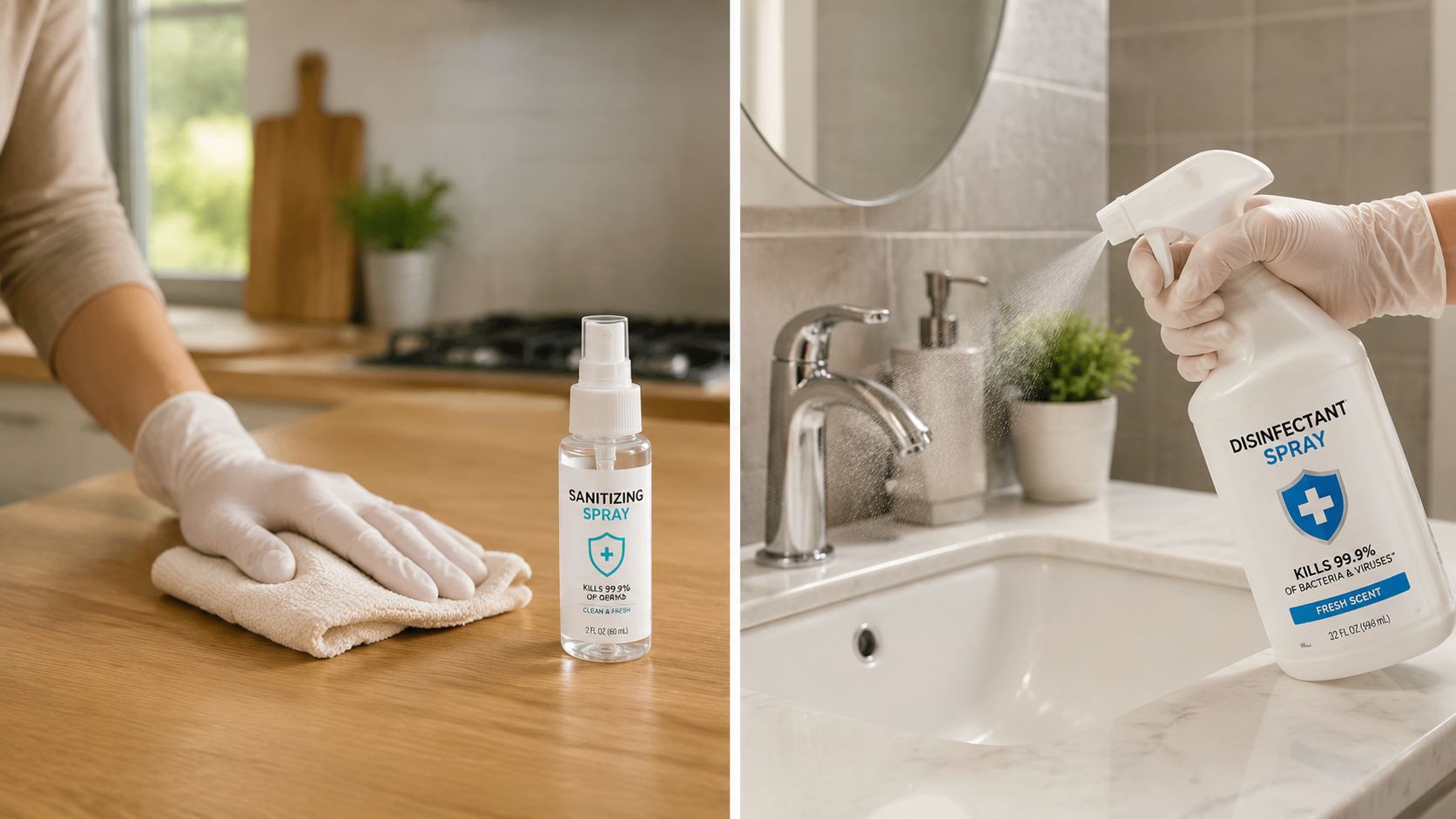
You're probably deciding between two products that look almost identical. One label says it sanitizes. Another says it disinfects. Both promise a cleaner home, a safer kitchen, or a fresher bathroom. It sounds like a wording choice. It isn't.
The difference between sanitizing and disinfecting matters most when viruses are part of the risk. That's where people get tripped up. A surface can be sanitized and still not be treated for viral contamination. If someone in your home has a stomach bug, if you're wiping down a bathroom, or if you're cleaning up after coughs and sneezes, that distinction matters.
VirusFAQ.com covers viruses ranging from Human Immunodeficiency Virus Type 1 (HIV-1) and Influenza A Virus (H1N1) to Norovirus (Norwalk Virus), SARS-Related Coronavirus 2 (SARS-CoV-2), Human Coronavirus, Rhinovirus Type 14, Rhinovirus Type 39, Herpes Simplex Virus 1 (HSV-1), Herpes Simplex Virus 2 (HSV-2), Hepatitis B Virus (HBV), Hepatitis C Virus (HCV), Avian Influenza Virus (H5N1), Influenza A2/305/57 Virus (H2N2), Duck Hepatitis B Virus (DHBV), Bovine Viral Diarrhea Virus (BVDV), Human Rotavirus, Feline Calicivirus, and broader categories such as Virus Large Non-Enveloped and Viruses Small Non-Enveloped. Across all of those topics, one prevention lesson keeps showing up: if the concern is viral spread on surfaces, sanitizing and disinfecting are not interchangeable.
The Critical Choice Beyond the Cleaning Aisle
You're in the cleaning aisle, reading bottles in small print. A green cleaner says it sanitizes. A yellow bottle says it disinfects. You're tired, your kid was sick yesterday, and you just want the right answer.

The sanitizer-virus gap causes real trouble. Many people hear “sanitized” and assume “safe from viruses.” That assumption can leave the highest-risk surfaces under-treated.
One detail should reset how you read those labels. A 2024 FDA report on norovirus outbreaks linked 32% to improper surface treatment where sanitization was used instead of disinfection on high-risk food-contact surfaces, a point highlighted in Lowe's explanation of sanitizing versus disinfecting. Norovirus spreads easily, survives on surfaces, and doesn't care whether a countertop looks spotless.
Why people misread the labels
Part of the confusion comes from everyday language. In casual conversation, sanitize sounds stronger than it is. People use it to mean “deep clean” or “make germ-free.” In public health terms, that's not what the word guarantees.
A shiny kitchen island can still carry infectious material. A wiped-down bathroom sink can still pose a risk after someone has vomited or had diarrhea. A daycare toy can smell clean and still be the wrong kind of clean for an outbreak.
Sanitized does not automatically mean virus-safe.
Where this goes wrong in real life
The mistake often happens in familiar places:
- Kitchen counters: Someone uses a food-safe sanitizer after prepping dinner and assumes the surface is covered for every germ risk.
- Bathrooms: A person uses a quick sanitizing wipe after illness instead of a product intended to tackle viral contamination.
- Shared touch points: Desks, phones, doorknobs, and remote controls get a fast wipe for freshness, not the slower, label-directed treatment needed for disinfection.
The good news is that this isn't complicated once you know what to look for. You don't need a chemistry degree. You need to understand what each word legally and practically means.
Official Definitions Sanitizing and Disinfecting
The cleanest way to understand the difference between sanitizing and disinfecting is to ignore the marketing language and start with the regulatory definitions.
The Environmental Protection Agency draws a clear line between the two. According to EPA guidance on cleaning, sanitizing, and disinfecting, surface disinfectant products are subject to more rigorous testing requirements and must clear a higher bar for effectiveness than surface sanitizing products, as disinfectants must demonstrate efficacy against both bacteria and viruses while sanitizers are only registered to kill bacteria and are not intended to kill viruses.
Key distinction: Sanitizers are for bacteria. Disinfectants are tested and registered for bacteria and viruses.
That sentence does most of the work. If your concern is foodborne bacteria on a prep surface during normal use, sanitizing may fit the task. If your concern is a viral pathogen on a hard surface, you need a disinfectant that is labeled for that use.
What sanitizing means in practice
Sanitizing lowers bacterial contamination to a public-health standard considered acceptable. It's a reduction standard. It's not a promise that all harmful microbes are gone, and it's not a viral claim.
That's why sanitizing has an important place in routine hygiene but a limited place in virus control. It's useful, but it isn't universal.
For readers who want the companion concept clarified, VirusFAQ also has a plain-language explainer on the difference between sanitizing and cleaning. Cleaning removes dirt and residue. Sanitizing works on bacterial reduction after that first step.
What disinfecting means in practice
Disinfecting is a stronger public-health claim. A disinfectant has to show that it can kill or inactivate listed pathogens under defined conditions. That includes viruses when the label makes those claims.
In healthcare settings and during viral outbreaks, this is the standard that matters. If a product isn't intended to kill viruses, it shouldn't be treated as a virus-control tool.
A label-reading shortcut
When you're comparing products, ask one question first: Is my concern bacteria, or could this surface carry viruses?
If the answer includes viruses, a sanitizer is the wrong endpoint. You may still clean first. You may still sanitize in some food-service workflows. But the virus-specific protection comes from disinfection, not from the word “sanitized.”
A Scientific Comparison Efficacy and Mechanism
At the microscopic level, sanitizing and disinfecting are doing different jobs. One lowers microbial counts to a target standard. The other aims to kill or inactivate a broader set of pathogens, including viruses, when used exactly as directed.
A useful analogy is a light switch versus a dimmer. Sanitizing turns the dial down. Disinfecting is closer to switching the threat off, at least for the pathogens named on the label and only when the instructions are followed.
| Feature | Sanitizing | Disinfecting |
|---|---|---|
| Primary target | Bacteria | Bacteria and viruses |
| Regulatory role | Reduction to a public-health standard | Higher-level pathogen control |
| Typical use | Routine hygiene, especially food-contact workflows | Illness-related cleanup, bathrooms, shared touch points |
| Speed and strength | Lower concentration, shorter contact period | Stronger concentration, longer dwell time |
| Viral protection | Not the right tool for it | The appropriate surface protocol when viral control is needed |
What the numbers mean
Technical benchmarks summarized by Hillyard's discussion of cleaning, sanitizing, and disinfection state that disinfecting kills nearly 100% of germs including bacteria and viruses on surfaces, whereas sanitizing reduces germ counts to 99.9% bacterial reduction levels judged safe by public health standards but does not address viruses or fungi. The same source notes that disinfecting solutions generally require stronger concentrations and longer contact times, typically 3 to 10 minutes depending on the product.
That's a lot of jargon, so let's translate it.
If a sanitizer reduces bacteria to 99.9%, that sounds absolute, but it's still a reduction standard for bacteria. It doesn't mean virus control. It also doesn't mean every microorganism is gone. Numbers can sound stronger than they function.
By contrast, disinfecting is built around broader kill claims and tighter performance requirements for named pathogens.

Log reduction without the headache
People often freeze when they hear terms like 3-log or 5-log reduction. The simplest way to think about a log reduction is this: each step is a tenfold drop.
- A 3-log reduction means cutting the microbial count by a thousandfold.
- A 5-log reduction means cutting it by a hundred-thousandfold.
That's why log language matters. It tells you how much the microbial burden drops, not just whether a surface looks cleaner.
For a broader primer on how pathogen-killing methods fit together, see VirusFAQ's overview of disinfection and antiseptic methods.
Dwell time is where users often fail
Most product failures in homes don't happen because the product is useless. They happen because the user wipes the surface dry too soon.
Practical rule: If the label requires the surface to stay wet, drying it early cuts the process short.
That's what dwell time means. It's the length of time the disinfectant has to remain visibly wet on the surface to do its job. If the label says several minutes and the surface dries in one, the disinfection step hasn't been completed.
This is especially relevant when you're thinking about viruses such as HSV-1, Influenza A Virus (H1N1), or Human Coronavirus on hard, high-touch surfaces. The chemistry only works if the contact time is real, not assumed.
When to Use Each Method Practical Scenarios
Knowing the definitions is useful. Deciding what to do on a Tuesday night in your own house is more useful. The right choice depends on the surface, the recent activity, and whether viruses are part of the risk.

In the kitchen
You chopped vegetables on the counter, wiped away crumbs, and want the surface ready for the next task. In a routine setting like that, sanitizing can make sense for bacterial control on food-contact surfaces.
Food-service standards are precise about that bacterial target. Foodbuy's explanation of cleaning, sanitizing, and disinfecting notes that food-contact sanitizers must achieve a 5-log reduction, or 99.999%, in bacterial count to meet public health codes, and that this threshold does not apply to viral reduction since sanitizers are ineffective against viruses and fungi entirely.
That last part changes the decision. If the kitchen surface may have been contaminated by an ill person, or if the concern includes a virus such as Norovirus (Norwalk Virus), sanitizing alone isn't enough. Clean first, then disinfect with an appropriate product for hard, non-porous surfaces.
After a sick family member uses the bathroom
This is a disinfection scenario. Bathrooms collect moisture, splashes, and high-touch points. If someone in the home has vomiting, diarrhea, a cold, flu-like symptoms, or a confirmed viral illness, surfaces such as faucets, toilet handles, flush buttons, counters, and light switches need disinfection.
That includes concern for viruses such as SARS-CoV-2, Human Rotavirus, and common cold viruses like Rhinovirus Type 14 or Rhinovirus Type 39. In this setting, “good enough” cleaning is the wrong standard.
If bodily fluids are involved, routine housecleaning may not be appropriate at all. In those situations, specialized help such as Marion County biohazard cleanup services can be the safer option because the work may require containment, protective equipment, and regulated disposal practices.
If illness is in the room, think disinfection first and speed second.
In an office or shared workspace
A keyboard, phone, desk edge, conference table, and doorknob don't usually need the same approach every hour of the day. For general tidiness, routine cleaning may be enough. For shared high-touch surfaces during cold and flu season, disinfection is the better fit.
People tend to underreact when risks feel invisible. No one sees a virus on a mouse or a break-room fridge handle. But shared contact surfaces are exactly where a disinfectant earns its keep.
If you want a room-by-room routine for everyday use, VirusFAQ has a practical guide on how to sanitize your home. Use it for baseline hygiene. Use disinfection when the scenario shifts from general cleanliness to probable viral contamination.
A fast decision rule
Here's the simplest household rule set:
- Choose sanitizing for routine bacterial control on appropriate food-contact surfaces after normal prep.
- Choose disinfecting for bathrooms, shared touch points, illness cleanup, and any situation where viral transmission is a concern.
- Clean first if dirt, grease, or visible residue is present. Germ-killing products work better on surfaces that aren't coated with soil.
Choosing Products and Ensuring Safe Use
A good product only works if you choose the right one and use it the way the label requires. Most mistakes happen before the chemistry even starts. People grab the wrong product type, skip the label, or wipe the surface dry too quickly.

What to check on the label
Start with the product identity, not the fragrance or branding.
- Look for disinfecting language: If you need virus control, the label should identify the product as a disinfectant, not just a sanitizer.
- Check the directions for use: The label tells you whether pre-cleaning is required, how long the surface must stay wet, and whether the surface should be rinsed afterward.
- Match the surface type: Hard, non-porous surfaces are the usual target for most disinfecting claims. Delicate materials, electronics, and food-contact items may need special handling.
A lot of households prefer disinfecting wipes for a simple reason. They reduce measuring errors and make it easier to spread enough solution across small surfaces like remotes, handles, counters, and phones. That convenience matters because under-wetting is one of the most common user mistakes.
Why wipes are often the practical choice
Sprays can work well, but they depend heavily on technique. You need enough liquid to keep the surface wet for the full label time. On vertical or textured surfaces, that can be harder than people expect.
Disinfecting wipes solve a few practical problems at once:
- They arrive pre-saturated.
- They're easy to use on high-touch objects.
- They make repeat passes simple when a longer wet contact time is needed.
That doesn't mean every wipe is automatically a disinfectant. Some wipes sanitize. Some disinfect. The label still decides.
Safety matters too
Use gloves when the label calls for them. Keep rooms ventilated if the product instructions recommend it. Never mix chemicals unless the manufacturer explicitly allows it. And keep products away from children except during supervised use.
In workplaces, schools, clinics, or larger facilities, product management becomes its own safety task. Teams that handle multiple chemicals often use systems to create and manage chemical registers so staff can track products, hazards, and handling requirements in one place. That kind of organization prevents the very common problem of people using a product without understanding what it's designed to do.
The best disinfectant on the shelf fails if the surface doesn't stay wet for the required time.
Myths and Frequently Asked Questions
A few myths keep this topic confusing. Most of them come from treating all “germ-killing” language as equivalent.
If a surface is sanitized, isn't it safe from viruses?
No. Clorox's explanation of cleaning, sanitizing, and disinfecting states that EPA-approved sanitizers are explicitly restricted to claims against bacteria only and carry no regulatory claims for killing viruses, whereas EPA-registered disinfectants have validated claims against both bacteria and viruses. That means sanitizing alone does not reduce viral transmission risk on surfaces.
If I clean until it shines, have I disinfected it?
Not necessarily. A surface can look immaculate and still not be disinfected. Cleaning removes dirt and residue. Disinfecting depends on the product type and on correct contact time.
Are sanitizing hand wipes the same as disinfecting surface wipes?
No. Hand products and surface products are designed for different uses, ingredients, and directions. Never assume a wipe for skin does the same job as a wipe intended for countertops or bathroom fixtures.
Can I use heat or steam instead of a chemical product?
Sometimes sanitizing can be done physically with high heat or steam on certain materials, but that doesn't make it a substitute for viral surface disinfection in the situations that call for EPA-registered disinfectants. If viruses are the concern, use a product intended for that job on the surface you're treating.
Do I need to disinfect everything all the time?
No. Constant disinfection of every object in a healthy household usually isn't necessary. Save it for the places and moments that justify it: illness, bathrooms, shared touch points, and surfaces with likely viral contamination.
What's the simplest takeaway?
If the goal is everyday cleanliness, cleaning and sanitizing may be enough for many routine tasks. If the goal is reducing virus risk on surfaces, disinfection is the step that matters.
The safest habit is simple. Clean first when a surface is dirty. Sanitize for routine bacterial control where appropriate. Disinfect when viruses may be involved. If you want the easiest path to doing that consistently, keep a reliable disinfecting wipe product on hand for bathrooms, doorknobs, counters, remotes, phones, and other high-touch surfaces where speed and correct wet coverage matter most.
Leave a Reply