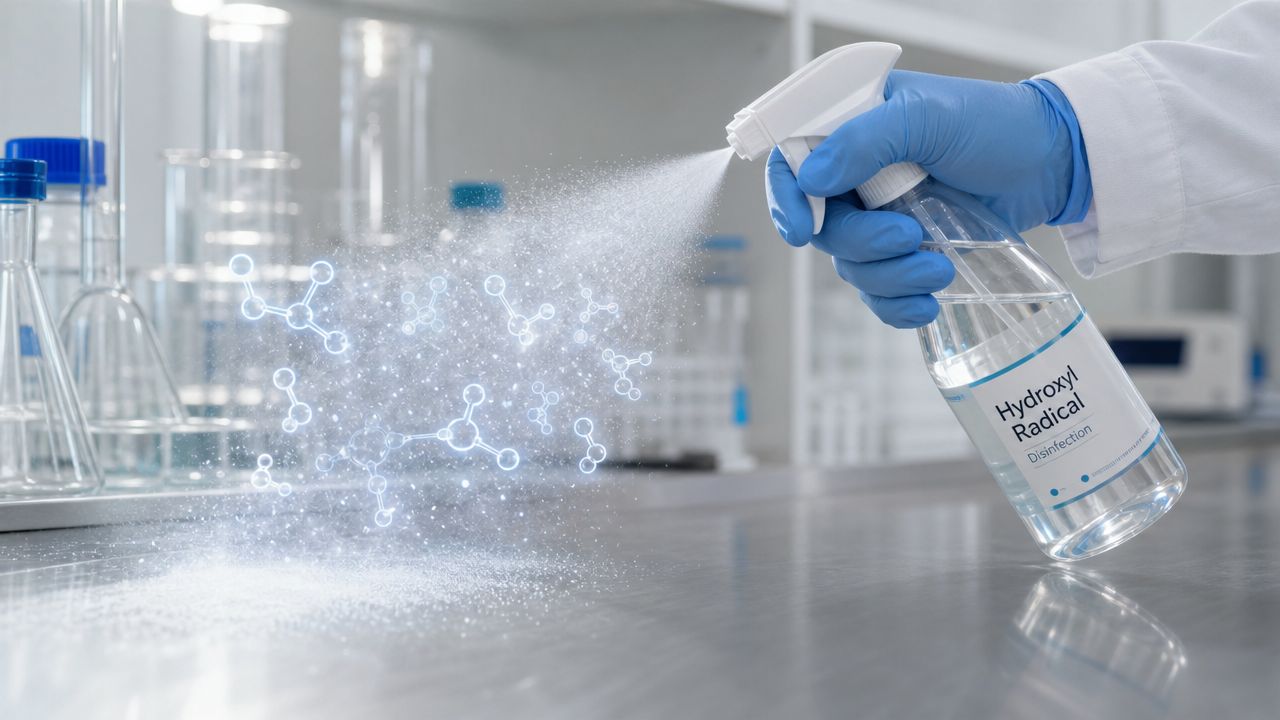
You've probably done this before. Someone in the house comes home sniffling, you grab a spray bottle or a brown pharmacy bottle of hydrogen peroxide, and you wipe the kitchen counter, faucet, and maybe the doorknob for good measure. It feels sensible. It may even fizz a little. But that doesn't automatically mean you've disinfected anything.
That gap between cleaning and hydrogen peroxide disinfection is where most confusion starts. People know hydrogen peroxide is “good for germs,” yet many don't know which concentration matters, how long a surface has to stay wet, or why one peroxide product works fast while another barely keeps up with a tough virus.
That matters whether you're trying to interrupt spread of Rhinovirus Type 14, Rhinovirus Type 39, Human Rotavirus, Norovirus (Norwalk virus), SARS-CoV-2, Human Coronavirus, Influenza A Virus (H1N1), Influenza A2/305/57 Virus (H2N2), Avian Influenza Virus (H5N1), Hepatitis B Virus (HBV), Hepatitis C Virus (HCV), Duck Hepatitis B Virus (DHBV), Bovine Viral Diarrhea Virus (BVDV), HSV-1, HSV-2, or other viral families people often group as small non-enveloped viruses and large non-enveloped viruses. Different viruses tolerate environmental stress differently. The product in your hand has to match the job.
Is Your Disinfectant Actually Working?
A parent wipes a counter after a child with a cold sets down a lunchbox. A nurse disinfects a bedside rail between patients. A teacher cleans a shared desk after a student coughs through class. In all three cases, the same question applies. Did the product stay wet long enough, at the right concentration, on the right surface?

Hydrogen peroxide has a reputation problem. Many people think of it as the bottle that bubbles on cuts, or as a general cleaner that “probably helps.” In reality, it can be a serious disinfectant, but only when you use it like a disinfectant instead of like a quick wipe-down.
The mistake most people make
The most common error is speed. People spray, swipe, and dry the surface almost immediately. That removes grime, but disinfection depends on contact time, which means the surface has to remain visibly wet long enough for the chemistry to do its work.
A second mistake is product choice. Household peroxide, professional peroxide wipes, accelerated formulas, and vaporized systems are not interchangeable. If you're comparing options for everyday sanitation supplies, the EcoQuest Purifiers sanitation collection is the kind of place where the format difference becomes obvious. Sprays, wipes, and specialty products aren't just packaging choices. They change how easy it is to reach and maintain the right wet time.
Practical rule: If a surface dries too fast, the disinfectant may never finish the job.
If you want a broader primer on what kills viruses on hard surfaces, this guide on what kills viruses on surfaces gives useful context before you compare active ingredients.
The Science of How Hydrogen Peroxide Kills Viruses
Hydrogen peroxide works because it's an oxidizing agent. Think of oxidation as a kind of chemical wear-and-tear. Not rust in the everyday sense, but the same idea at a tiny scale. The compound reacts with vulnerable parts of microbes and viruses and damages them so they can't function.

What happens on the surface
Once hydrogen peroxide contacts a contaminated surface, it can generate highly reactive particles, especially the hydroxyl radical (•OH). These radicals attack nearby biological material. For a virus, that means damage to structural proteins, genetic material, and, when present, the fatty outer envelope.
That's why peroxide can act broadly across many different organisms. It doesn't need to “recognize” a virus the way an immune system does. It chemically damages what the virus is made of.
Why vapor systems are different
In healthcare sterilization, hydrogen peroxide can also be delivered as vapor. According to the CDC, hydrogen peroxide vapor sterilization achieves a high level of microbial kill by generating reactive hydroxyl (•OH) free radicals that irreversibly disrupt essential cell components like lipids, proteins, and DNA. This low-temperature process is compatible with over 95% of medical devices, including heat-sensitive materials, and is recognized by the FDA as an “Established Category A” sterilization method (CDC guidance on hydrogen peroxide gas plasma and vapor systems).
That compatibility matters in real settings. A steam sterilizer can damage some devices. Vaporized hydrogen peroxide can reach complex equipment without exposing it to high heat.
Why enveloped viruses are usually easier
Viruses with a lipid envelope have an outer layer that oxidation can disrupt relatively easily. When that membrane is damaged, the virus often loses its ability to attach to and enter cells. That's why peroxide often performs better against enveloped viruses than against sturdier non-enveloped viruses.
On a practical level, hydrogen peroxide doesn't “wash viruses away.” It chemically disables them.
Virus-Killing Power A Comprehensive Breakdown
If you want to understand hydrogen peroxide disinfection, start with one distinction: enveloped vs non-enveloped viruses.
Enveloped viruses include many pathogens people worry about in homes and clinics, such as HIV-1, Influenza A Virus (H1N1), Influenza A2/305/57 Virus (H2N2), Avian Influenza Virus (H5N1), HBV, HCV, DHBV, BVDV, SARS-CoV-2, Human Coronavirus, HSV-1, and HSV-2. Their outer lipid layer is a weak point.
Non-enveloped viruses, including Human Rotavirus, Feline Calicivirus, Norovirus, and Rhinoviruses, are often harder to inactivate because they don't carry that fragile outer membrane. That doesn't mean peroxide can't work. It means formulation and wet time matter more.
What we know from direct evidence
A standard household example is rhinovirus. A 3% concentration of hydrogen peroxide is an effective household disinfectant that inactivates rhinovirus within exactly eight minutes, as summarized with CDC-backed information in this rhinovirus and hydrogen peroxide review.
That matters because rhinoviruses are common, persistent, and easy to underestimate. If someone wipes a surface dry after thirty seconds, they're nowhere near the contact time that evidence supports for that use case.
For tougher non-enveloped viruses, vapor systems show stronger performance in controlled settings. Hydrogen peroxide vapor achieved complete inactivation of poliovirus, rotavirus, adenovirus, and murine norovirus on stainless steel carriers, with reduction of infectious particles greater than 4 log(10), and it also showed a >2 log(10) reduction for influenza A virus on the same surfaces (study on vaporized hydrogen peroxide and viruses on stainless steel).
A quick interpretation guide
Use this table as a practical framework, not a license to generalize across every product label.
| Virus (Type) | Required Formula | Minimum Contact Time |
|---|---|---|
| Rhinovirus Type 14 / Rhinovirus Type 39 (non-enveloped) | Standard 3% hydrogen peroxide | 8 minutes |
| Human Rotavirus (non-enveloped) | Hydrogen peroxide vapor | Qualitative evidence supports high efficacy on stainless steel carriers |
| Norovirus / Feline Calicivirus category use case (non-enveloped) | Hydrogen peroxide vapor or improved professional peroxide products | Product-specific label directions matter |
| Influenza A Virus including H1N1 and related strains such as H2N2 and H5N1 (enveloped) | Standard peroxide may help, but professional formulations are more practical | Product-specific label directions matter |
| SARS-CoV-2 and Human Coronavirus (enveloped) | Accelerated or specially formulated hydrogen peroxide | See product label and clinical guidance |
| HBV, HCV, DHBV, BVDV, HSV-1, HSV-2, HIV-1 (mostly discussed as enveloped vulnerability cases) | Professional disinfectant selection is preferred for routine surface disinfection | Product-specific label directions matter |
Why the list is broader than the direct data
Readers often want a simple yes-or-no list for every virus. Science rarely works that neatly. Some viruses on the list above are included because their structure suggests they're more susceptible to oxidation, while others have direct product or method data behind them. The safest habit is to match the virus category, the surface, and the product label instead of assuming “peroxide is peroxide.”
Choosing the Right Formula and Contact Time
The brown bottle in a bathroom cabinet and a hospital peroxide wipe may share the same active ingredient, but they don't behave the same way. Concentration matters. Contact time matters. So do added ingredients that help the liquid spread, stick, and keep working.

Household peroxide versus accelerated formulas
The most useful comparison is between standard 3% hydrogen peroxide and Accelerated Hydrogen Peroxide (AHP). AHP combines hydrogen peroxide with other ingredients such as surfactants and acids to improve real-world performance.
The CDC notes that a 0.5% accelerated hydrogen peroxide solution demonstrates bactericidal and virucidal activity in just 1 minute, while mycobactericidal and fungicidal activity requires 5 minutes. The same CDC source also notes that 3% hydrogen peroxide with no additives shows scarce virucidal activity against SARS-CoV-2 unless acidified to pH 2.5, which increases inactivation to over 4 orders of magnitude in 5 minutes (CDC chemical disinfectants guidance).
That's the key idea. A lower-percentage professional formula can outperform a higher-percentage plain solution because the whole formulation is designed for disinfection, not just because the bottle says “hydrogen peroxide.”
How to decide what fits your setting
For most homeowners, the practical question isn't chemistry. It's whether you can keep the surface wet long enough.
- If you're using pharmacy-grade 3% solution, it can make sense for routine hard-surface disinfection when the label supports that use and you can maintain the required wet time.
- If you need speed and consistency, pre-formulated AHP wipes or sprays are often easier to use correctly.
- If the concern is SARS-CoV-2 or a similar respiratory virus, plain peroxide may not be the most efficient choice unless the product is specifically formulated for that purpose.
- If staff turnover is high, wipes reduce the number of steps and lower the chance that someone sprays, wipes dry, and walks away too soon.
For a side-by-side look at another common comparison, this piece on hydrogen peroxide and rubbing alcohol helps clarify where each disinfectant fits.
The best disinfectant isn't the strongest-sounding one. It's the one people can apply correctly, every time.
Practical Disinfection in Homes and Healthcare
At home, focus on the surfaces people touch without thinking. Faucet handles. Refrigerator pulls. Toilet flush levers. Light switches. Phone screens only if the device manufacturer says the chemistry is compatible.
Home use that people can actually stick with
A workable routine is simple:
- Remove visible soil first. Grease, crumbs, and dried residue can block disinfectant contact.
- Wet the surface thoroughly. “Damp” isn't enough.
- Let it sit for the label's contact time. Don't wipe it off early.
- Use a fresh wipe or clean cloth. A dirty rag can just move contamination around.
For many households, peroxide-based wipes make sense. The chemistry and the delivery method are combined. You don't need a separate spray bottle and timer for every doorknob.
Healthcare use where the stakes are higher
In healthcare, peroxide isn't just a household cleaner upgraded for bigger buildings. It's part of layered infection prevention. Staff may use peroxide wipes for routine room turnover, then reserve advanced systems for higher-risk spaces or specific organisms.
A good example comes from intensive care. In a study of 182 ICU rooms, adding hydrogen peroxide treatment after routine terminal cleaning was significantly more efficient than routine cleaning alone for disinfecting rooms contaminated with multidrug-resistant organisms (ICU room disinfection study).
That finding supports peroxide's role in environmental decontamination, especially where resistant organisms are a concern. It doesn't mean every room in every setting needs vapor treatment. It means the added step can improve room decontamination in high-risk environments.
One important limit people often miss
Environmental decontamination and patient outcome aren't identical. A room can test cleaner without that automatically proving lower cross-infection rates in every non-outbreak setting. So peroxide should complement, not replace, fundamentals like hand hygiene, glove use, and correct cleaning sequence.
If you're evaluating outsourced support for larger facilities, examples of cleaning provision across Central, East London can help illustrate how professional teams structure routine and high-risk cleaning differently.
Safety Precautions and Material Compatibility
Hydrogen peroxide seems familiar, which makes people underestimate it. Familiar doesn't mean harmless. The risk changes a lot with concentration, surface, and how it's applied.

What's reasonable at home
For home use, 3% medical-grade hydrogen peroxide is generally considered the practical ceiling. It can still irritate skin and eyes, and it can bleach fabrics or dull some finishes. Gloves are sensible. Ventilation is sensible. So is a spot test on an inconspicuous area.
Many hard, non-porous surfaces tolerate peroxide well, but repeated use can still create problems on some materials. Metals such as copper, brass, and aluminum may not appreciate routine exposure. Some plastics and coatings can haze, fade, or become brittle over time.
Where things get dangerous fast
The consumer knowledge gap gets wider at higher strengths. As Cleveland Clinic explains, many people don't realize that while 3% medical-grade hydrogen peroxide is safe for home use, stronger concentrations such as 35% food-grade are dangerously corrosive and toxic if misused (Cleveland Clinic overview of hydrogen peroxide safety and common myths).
That's why concentrated peroxide belongs with trained users, not casual surface-cleaning experiments.
- Protect skin and eyes: Splashes matter more than people think.
- Don't improvise dilutions: Stronger isn't automatically better, and errors can be serious.
- Watch the material: Stone sealants, dyed fabrics, and specialty finishes may react badly.
- Keep original packaging: Opaque containers help preserve stability.
If you compare chemical choices for glass and surrounding frames, this discussion of safe window cleaning product choices offers a useful way to think about surface compatibility more broadly.
For readers who are curious about much stronger concentrations, this overview of 50% hydrogen peroxide makes clear why industrial-strength material is a different category altogether.
Safety note: The right peroxide for a kitchen counter is not the right peroxide for industrial handling.
Common Questions About Hydrogen Peroxide
Does bubbling mean it's working?
Bubbling is the part people can see. Disinfection is the part they usually cannot.
The fizz happens because hydrogen peroxide is breaking down and releasing oxygen after it touches enzymes, debris, blood, or other organic material. That reaction may look dramatic, but it is a poor shortcut for judging whether a surface has been disinfected. A quiet application can still do its job if you used the right formula, covered the surface well, and kept it wet for the full label time.
That is the myth to let go of. Bubbles show chemical activity. They do not confirm virus kill.
Can I mix it with other cleaners?
Use one active product at a time unless the manufacturer designed the formula that way.
Mixing household cleaners is like guessing with chemistry in a room you plan to breathe in. Even if the combination seems harmless, it can weaken the disinfectant, damage the surface, or create irritating fumes. If a surface needs cleaning first, wash away dirt with soap or detergent, let the area dry or rinse as directed, then apply the peroxide product according to its label.
Is it safe for food-contact surfaces?
Sometimes, yes. The label decides.
For a kitchen counter, cutting area, or high chair tray, check whether the product is approved for food-contact surfaces and follow the listed contact time. Many users treat peroxide like a one-size-fits-all sanitizer, but the safer habit is to match the product to the job. After disinfection, rinsing with potable water before food preparation is a sensible extra step when the label calls for it or when residue could contact food.
How should I store it?
Store hydrogen peroxide in its original opaque container, away from heat and direct light.
Peroxide slowly breaks down over time. Light and warmth speed that process, which means an old bottle may become less reliable long before it is empty. If you want predictable performance, storage is part of disinfection, not an afterthought.
What should people remember most?
Keep the main idea simple. Visible fizz is not the goal. Reliable virus control comes from matching the concentration, formula, surface, and contact time to the task.
For many households, that means using standard 3% hydrogen peroxide products as directed on the label, while recognizing that stronger professional or industrial formulas are a different category with different handling needs, as noted earlier. In healthcare settings, the difference matters even more. Staff are often choosing between basic peroxide solutions and accelerated hydrogen peroxide products that are designed to work faster or perform better in real-world cleaning workflows.
A useful final checklist is to think in matched pairs:
- Match the product to the surface
- Match the formula to the virus risk
- Match the wet time to the label
- Match the concentration to the user's training
That habit prevents many peroxide mistakes before they start.
If you want more plain-language virus prevention guides and deeper explainers on how specific pathogens survive on surfaces, visit VirusFAQ.com.
Leave a Reply