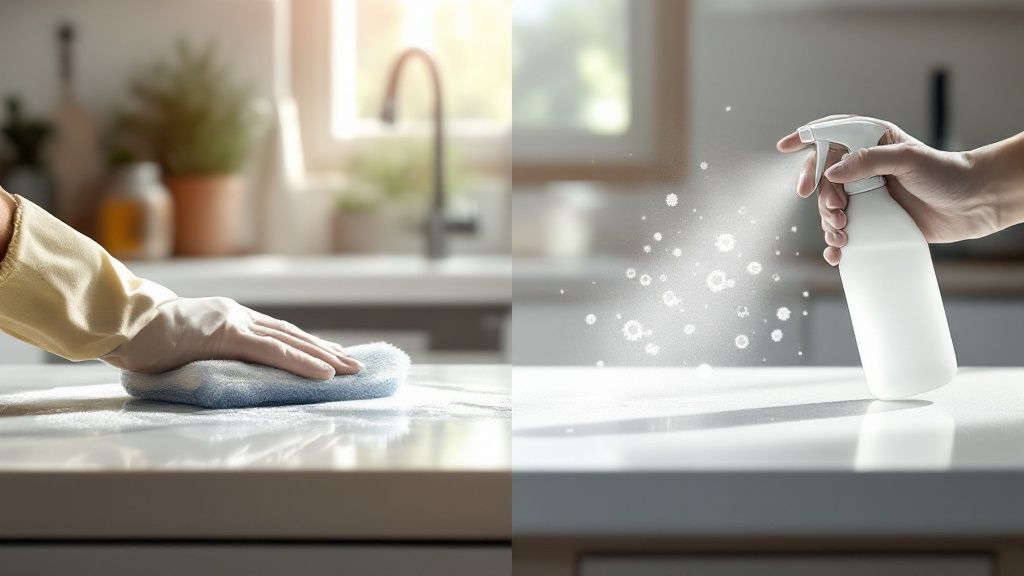
You've probably heard the words "cleaning" and "sanitizing" thrown around interchangeably, but they're not the same thing at all. Getting the distinction right is the first step toward actually protecting your space from viruses like Influenza A Virus (H1N1), Human Coronavirus, or even the more resilient Norovirus.
One is about what you can see, and the other is about the invisible threats you can't.
Understanding the Core Difference
Let’s get straight to it. Cleaning is the physical act of removing visible gunk—dirt, grime, crumbs, and other impurities—from a surface. Think of it as prep work. You're clearing the battlefield.
Sanitizing, on the other hand, is the chemical mission that happens next. Its goal is to drastically lower the number of germs to a safe level, as determined by public health standards. For a product to claim it "sanitizes," it must kill at least 99.9% of specific bacteria in a short amount of time. You can see how big the hygiene market is over at polarismarketresearch.com.
The simplest way to think about it is this: Cleaning is what you do for appearance, while sanitizing is what you do for health.
To make this even clearer, let's break it down side-by-side.
Cleaning vs Sanitizing At A Glance
This table cuts through the noise and gives you the core differences at a glance. It's the quick-and-dirty guide to understanding what you're really doing when you pick up a cloth or a spray bottle.
| Attribute | Cleaning | Sanitizing |
|---|---|---|
| Primary Goal | Remove visible dirt, grime, and debris | Reduce harmful germs to a safe level |
| Method | Physical (scrubbing, wiping) with soap/water | Chemical application (sanitizing agents) |
| Outcome | Visually clean surface, some germ removal | 99.9% reduction in specified pathogens |
| Key Function | Prepare a surface for sanitization | Lower the risk of spreading infection |
Ultimately, you can't have effective sanitizing without cleaning first. All that organic matter and dirt can act like a shield for viruses like SARS-CoV-2 and bacteria, preventing sanitizers from making direct contact.
So, always start by cleaning the surface. This crucial first step clears the way for your sanitizer to do its real job: knocking down the pathogen count and making the environment safer for everyone.
The Science of How Cleaning and Sanitizing Work

To really get the difference between cleaning and sanitizing, you have to zoom in—way in—to the microscopic level. One is all about physical removal, while the other is a targeted chemical assault.
Think of cleaning as a mechanical process powered by some clever chemistry. Soaps and detergents are packed with molecules called surfactants, and these things are pretty special. One end of a surfactant molecule loves water (hydrophilic), while the other end grabs onto oils and grease (hydrophobic).
So, when you scrub a surface, the hydrophobic ends latch onto all the greasy grime and the microbes hiding in it, breaking everything apart and lifting it off the surface. The water-loving ends then let you wash the whole mess—dirt, germs, and all—right down the drain.
The Chemical Assault of Sanitizing
Sanitizing is a whole different ballgame. It skips the lifting and removing and goes straight for the kill. It’s a direct chemical attack designed to destroy pathogens and dismantle viral structures on contact. This is where the distinction becomes critical for protecting public health.
The active ingredients in sanitizers are engineered to take out microscopic threats.
- Alcohols, like ethanol or isopropanol, work by denaturing proteins—the essential building blocks that bacteria and viruses need to function.
- Quaternary ammonium compounds, often called "quats," get to work by disrupting the cell membranes of bacteria, causing their insides to leak out and killing them.
These chemical weapons are especially brutal against enveloped viruses like Influenza A (H1N1), SARS-Related Coronavirus 2 (SARS-CoV-2), and Herpes Simplex Virus 1 (HSV-1). They tear apart the delicate fatty envelope that these viruses need to invade human cells, leaving them completely inert.
Sanitizing isn't just a good idea; it's a scientifically proven method for knocking down pathogen counts. Its success is measured against strict public health standards for how many microbes it can kill, and how fast.
This is exactly why agencies like the EPA have such specific benchmarks. A sanitizer has to reduce bacteria by 99.9% within a very short contact time—often just 30 to 60 seconds. It’s a guarantee that the product is actively neutralizing threats, not just smearing them around. You can see how these standards drive product development in the professional healthcare market.
Evaluating Efficacy Against Common Viruses

This is where the rubber meets the road. When you're looking at cleaning versus sanitizing, the real question is how well each one stands up against actual viral threats.
Cleaning with soap and water is great for physically lifting and removing some viral particles from a surface. It's an essential first step. But here's the catch: it doesn't actually neutralize them. You're just moving them around, leaving behind active viruses ready to infect someone.
Sanitizing, on the other hand, is a chemical assault designed to break down and inactivate viruses. How well it works, though, really depends on the virus you're trying to eliminate.
A virus's structure is its Achilles' heel. Understanding whether a virus is enveloped or non-enveloped is key to selecting a sanitizer that can effectively dismantle it and break the chain of transmission.
Enveloped vs. Non-Enveloped Viruses
The difference between these two types of viruses is everything when it comes to effective sanitization. Their unique structures make them either surprisingly fragile or incredibly tough to kill.
-
Enveloped Viruses: Think of viruses like SARS-CoV-2 (the virus that causes COVID-19), Influenza A Virus (H1N1), and Herpes Simplex Virus 1 (HSV-1). These are wrapped in a delicate, fatty outer layer called an envelope. Sanitizers with alcohol easily dissolve this lipid membrane, causing the virus to literally fall apart and become harmless. They're the low-hanging fruit of the virus world.
-
Non-Enveloped Viruses: These are the tough guys. Viruses like Norovirus (the infamous "stomach flu") and Rhinovirus Type 14 (the common cold) don't have that soft outer layer. Instead, they’re protected by a rugged protein shell called a capsid, which is much more resistant to chemical attacks. To beat them, you need more potent sanitizing formulas specifically designed to crack that durable shield.
This is exactly why knowing what is the difference between sanitizing and cleaning is so critical. A simple wipe-down of a surface contaminated with Norovirus might do next to nothing. You need to sanitize properly to slash the viral load to a safe level, especially when you consider how long do viruses live on surfaces. It's the only way to truly interrupt the path from a contaminated surface to a healthy person.
Applying Your Knowledge To Everyday Scenarios
Knowing the difference between cleaning and sanitizing is one thing, but putting that knowledge into practice is what really keeps your home healthy. It's not always cut and dry, but asking a couple of simple questions can point you in the right direction every time. Not every surface needs the same treatment, and figuring this out saves you a ton of effort while making sure you're protecting your family where it counts.
The decision really boils down to two things: how often a surface gets touched and if you can see any dirt on it. Take a dusty bookshelf or a floor in a room you rarely use—a simple cleaning to get rid of the grime is all you need. There’s no real benefit to sanitizing surfaces that people hardly ever touch.
When Sanitizing Becomes Essential
Sanitizing becomes a must for high-touch surfaces. Think of these spots as superhighways for germs like Rhinovirus and Influenza A Virus (H1N1). These are the areas that multiple people touch all day long, passing microbes back and forth without a second thought. Making a habit of sanitizing them is one of the single most effective ways to break that chain of infection, especially if someone at home is sick.
Here are the key hotspots that need regular sanitizing:
- Doorknobs and cabinet pulls
- Light switches
- Kitchen counters, especially where you prep food
- Bathroom faucets and toilet handles
- TV remotes and, of course, our phones
This simple decision tree can help you visualize whether a surface just needs a quick clean, a proper sanitization, or both.

The image highlights a critical rule of thumb: always clean a visibly dirty surface before you sanitize it. If you don't, the sanitizer can't get to the pathogens to do its job.
For these high-traffic areas, a good disinfecting wipe is often the easiest and most effective tool. They give you a pre-measured dose of chemicals designed to meet public health standards for killing germs, all without any extra steps. It's the simplest way to ensure you're effectively shutting down viruses and bacteria.
When to Clean, Sanitize, or Both
To make it even clearer, here’s a quick guide for common household items and areas. Use this table to decide on the best course of action to keep germs from spreading.
| Area or Item | Recommended Action | Rationale |
|---|---|---|
| Kitchen Countertops | Clean, then Sanitize | Food prep areas can harbor bacteria like E. coli and Salmonella. Cleaning removes spills, then sanitizing kills the germs. |
| Bathroom Sinks | Clean, then Sanitize | High-moisture, high-touch areas are breeding grounds for bacteria and viruses. |
| Doorknobs & Switches | Sanitize | These are the most frequently touched surfaces in any home, acting as major transfer points for germs. |
| Floors & Bookshelves | Clean | These are low-touch surfaces where dust and dirt are the primary concern, not germ transmission. |
| Children's Toys | Clean, then Sanitize | Especially important for plastic toys that go in a child's mouth. Regular sanitizing can prevent illness. |
| Remote Controls | Sanitize | Everyone touches them, often before or while eating. They're a classic germ hotspot. |
This targeted approach—cleaning what's dirty and sanitizing what's touched—is the most powerful strategy for maintaining a healthier household.
How to Choose the Right Cleaning and Sanitizing Products

Walking down the cleaning aisle can feel a bit overwhelming. But once you know what to look for, picking the right product is actually pretty simple. Your choice should always come down to two things: the germs you want to kill and the surface you need to treat.
The real power behind any sanitizer is its active ingredients. Common ones like ethanol and isopropyl alcohol are great against many enveloped viruses, including Influenza A, because they dissolve the virus's protective outer layer. Others, like quaternary ammonium compounds (or "quats"), go to work by busting up the cell membranes of bacteria and are also effective against certain viruses like Herpes Simplex Virus 2 (HSV-2).
The most important thing to find on any sanitizer label is the EPA registration number. This number is your proof that the product has been tested by the Environmental Protection Agency and actually does what it claims to do.
Making an Informed Purchase
Reading the label is your best tool for making a smart choice. Always look for that EPA registration number first to make sure the product is legit. After that, it’s all about what works best for your needs. Sprays are great for covering large areas, but you’ll still need a cloth to wipe them down.
For the high-touch spots we all deal with—doorknobs, light switches, and remote controls—nothing beats the sheer convenience of pre-measured disinfecting wipes. They deliver the right amount of sanitizer exactly where you need it, taking the guesswork out of the equation for a quick, targeted clean. That makes them a go-to tool for keeping your environment healthy and reducing the spread of viruses like Feline Calicivirus or Rhinovirus Type 39.
The demand for these products tells the whole story. The global disinfectant and cleaner market was valued at around USD 25 billion in 2023, largely because everyone is paying more attention to infection control.
By reading labels carefully and choosing the right format for the job, you can be confident you’re getting products that work. It's the most reliable way to protect your home.
Got Questions About Cleaning and Sanitizing? We’ve Got Answers.
When it comes to keeping viruses at bay, the details matter. People often get tripped up on the specifics of cleaning, sanitizing, and disinfecting. Let’s clear up some of the most common points of confusion so you can get it right every time.
Is Disinfecting The Same As Sanitizing?
Not quite, though people use the terms interchangeably all the time. The difference really comes down to the level of germ-killing power.
Sanitizing is all about reducing the number of bacteria on a surface to a safe level. The official standard is a 99.9% reduction. This is perfect for everyday surfaces, especially in kitchens and areas where you handle food.
Disinfecting is the next level up. It aims to kill nearly all microorganisms on a surface—we’re talking a 99.999% reduction. This is non-negotiable in healthcare settings where dangerous pathogens like Human Immunodeficiency Virus Type 1 (HIV-1) or Hepatitis B Virus (HBV) are a concern. For most homes, routine sanitizing is more than enough to keep things safe.
Do I Really Need To Clean Before I Sanitize?
Yes, absolutely. This is the one step you can't afford to skip, and here’s why: dirt, food crumbs, and general grime create a physical barrier. This gunk essentially acts as a shield, protecting germs from the sanitizer you’re about to use.
If you spray a sanitizer onto a dirty countertop, you’re just sanitizing the top layer of grime. The viruses and bacteria underneath remain untouched and ready to cause trouble. Cleaning first wipes away that barrier, allowing the sanitizer to make direct contact with the germs and do its job effectively.
Think of it this way: You can't paint a dirty wall and expect the paint to stick. Likewise, you can't sanitize a dirty surface and expect the germs to die. Cleaning clears the way for the sanitizer to do its job.
Can I Use Vinegar Or Other Natural Products To Sanitize?
Vinegar is a fantastic natural cleaner. Its acidity is great for cutting through grease and tackling mineral deposits from hard water. However, it is not an EPA-registered sanitizer.
There’s no scientific proof that vinegar can knock down 99.9% of germs, which is the benchmark required to meet public health standards. When you’re dealing with highly contagious pathogens like Norovirus or Human Rotavirus, you need a product that has been specifically formulated and tested to kill them. Always look for an EPA registration number on the label—that’s your proof that it actually works.
How Long Does A Surface Remain Sanitized?
This is a key point: sanitization is temporary. A surface is only considered sanitized for a fleeting moment—right up until it gets contaminated again. That can happen instantly from someone's touch, a nearby sneeze, or even just dust particles settling out of the air.
This is exactly why high-touch surfaces need to be sanitized so frequently. Things like doorknobs, light switches, and remote controls are constantly being re-contaminated. Using convenient products like disinfecting wipes makes it much easier to stay on top of this, allowing you to quickly re-sanitize these hotspots throughout the day and maintain a safer environment.
Leave a Reply