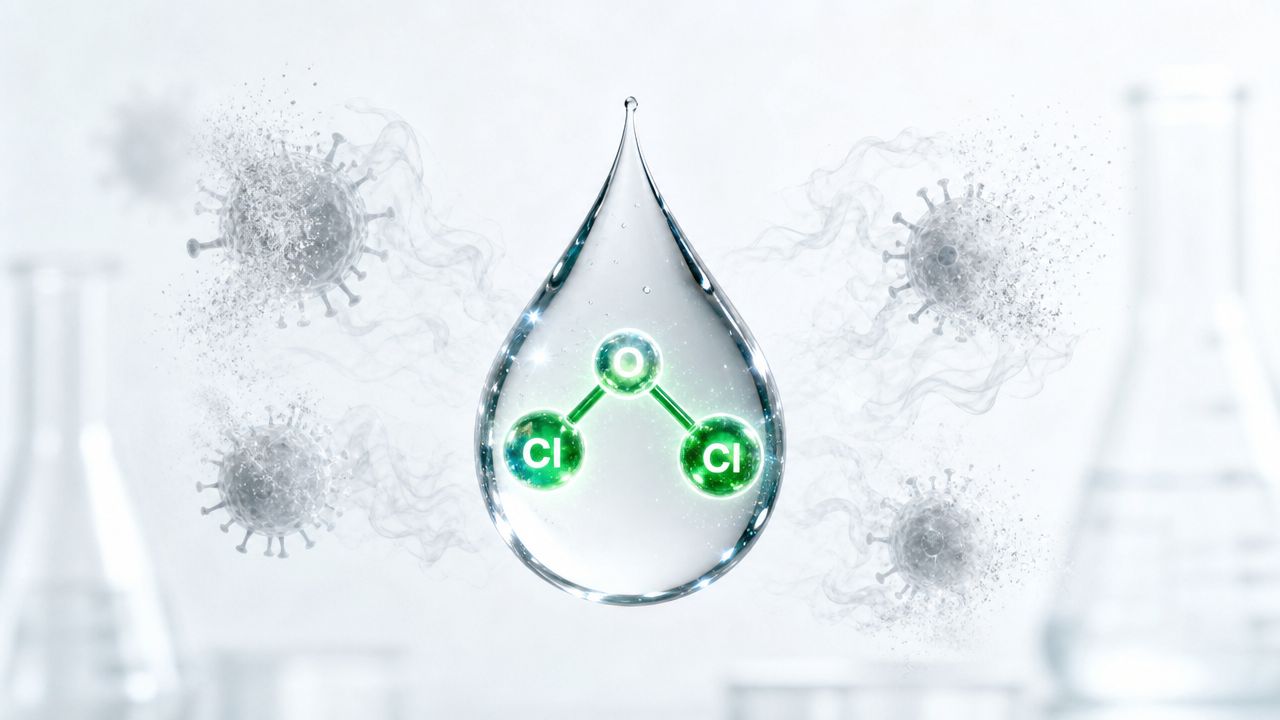
Chlorine dioxide can disinfect water without forming measurable trihalomethanes, while chlorine can produce 0.5 to 5 µMol per liter of those byproducts according to an EPA wastewater disinfection document. That single fact changes how many people think about this chemical.
The word “chlorine” often conjures images of bleach, pool smell, or a harsh cleaner. Chlorine dioxide disinfection isn't the same thing as pouring household bleach on a problem. It's a regulated, professional disinfection approach used where pathogen control matters and where unwanted byproducts matter too.
That distinction is especially important for readers who worry about viruses such as Influenza A, human coronavirus, SARS-CoV-2, and hardier gastrointestinal viruses like norovirus and rotavirus. It's also important because the internet has created dangerous confusion by mixing legitimate disinfection science with false and unsafe claims about drinking chlorine dioxide.
Healthcare workers need the technical basics. Curious readers need clear language. Both groups need the same bottom line. Chlorine dioxide has real value in professional disinfection, but that doesn't make it a wellness product, a supplement, or something to consume.
Understanding How Chlorine Dioxide Works
A useful analogy is this. Think of chlorine dioxide (ClO₂) as a highly selective chemical attacker. It doesn't work like a blunt cleaner that only coats a surface and hopes for the best. It works by oxidation, meaning it pulls electrons from critical parts of microorganisms and damages the structures they need to survive.
In plain language, it interferes with the machinery of life. If a virus or bacterium depends on certain proteins, membranes, or internal chemistry to stay intact and infect a host, chlorine dioxide can disrupt that system so the microbe can't keep functioning.

What it is and what it is not
Many readers often misunderstand this point. Chlorine dioxide is not the same chemical as household bleach. They both involve chlorine chemistry, but they behave differently.
One of the most important differences is stability across changing water conditions. EAI Water explains that chlorine dioxide operates as a selective oxidant that disrupts vital microorganism functions. Unlike traditional chlorine, it remains stable and effective across a broad pH range (6.5–9.5) because it does not hydrolyze in water, ensuring consistent biocidal activity in varying conditions. It is also non-reactive with ammonia, allowing it to maintain disinfection power in environments with high organic loads.
That matters because real-world disinfection isn't done in a chemistry classroom. Water systems, medical settings, and contaminated environments often contain organic material, variable pH, and interfering compounds. A disinfectant that keeps working under those conditions has a practical edge.
Practical rule: If you're comparing disinfectants, don't just ask whether they kill microbes. Ask whether they still work when pH shifts, organic material is present, and the target environment isn't perfectly clean.
Why selective oxidation matters
A selective oxidant is useful because it targets vulnerable chemical structures in microbes without behaving like the roughest possible option for every material it touches. That's one reason chlorine dioxide has been used for sensitive applications, including sterilization of delicate medical instruments.
It also helps explain why professionals separate disinfection from antisepsis. Disinfection targets contaminated water, equipment, or surfaces. Antisepsis is meant for living tissue. If you want a plain-language primer on that distinction, this guide on disinfection and antiseptic basics is a helpful companion.
Why people confuse it with bleach
The word “chlorine” is doing too much work in public conversations. People assume all chlorine-based chemistry acts alike. It doesn't.
A better mental model is this short comparison:
- Bleach thinking: strong, familiar, broad use, but often discussed as a general household cleaner.
- Chlorine dioxide thinking: controlled, application-specific, often generated for professional use, and chosen when consistency and byproduct profile matter.
That difference sets up the next question people usually ask. If it works this way chemically, what viruses and pathogens is it effective against?
Virucidal Efficacy Against Major Pathogens
Viruses spread fast in the settings people worry about most. A single norovirus incident can disrupt an entire school, ward, or care facility because the virus survives well on surfaces and needs only a small exposure to infect. That is why readers usually ask a practical question first. Does chlorine dioxide work against the viruses that cause outbreaks?
The short answer is yes, in professional disinfection settings, chlorine dioxide has documented virucidal activity against a wide range of pathogens, including both easier-to-inactivate enveloped viruses and tougher non-enveloped viruses. That distinction matters. Enveloped viruses such as coronaviruses are often more chemically fragile. Non-enveloped viruses such as norovirus are harder to inactivate, so they are a better stress test of a disinfectant's real-world usefulness.

What the evidence supports
A helpful way to read virucidal evidence is to sort viruses by how difficult they are to disable. If a disinfectant performs well against hardier viruses, confidence rises for easier targets too.
Research and product validation literature commonly describe chlorine dioxide as active against enteric viruses, influenza viruses, and coronaviruses under controlled conditions. A case study from Selective Micro Technologies on chlorine dioxide disinfection efficacy reports effectiveness against influenza A and H1N1 at low use concentrations. That does not mean every chlorine dioxide product performs the same way. It means the chemistry itself has credible virucidal potential when the formulation, dose, and contact time are properly validated.
This is also where confusion often starts. People see claims about virus inactivation and then assume the substance is broadly safe in any form. It is not. Surface disinfection, water treatment, and instrument reprocessing are controlled professional uses. Internet myths about drinking chlorine dioxide are a different issue entirely, and they are dangerous.
Which viruses matter most to readers
For a mixed audience, three groups matter most.
- Coronaviruses and other respiratory viruses: These are the viruses people associate with shared air, high-touch surfaces, and outbreaks in clinics, workplaces, and households.
- Norovirus and other enteric viruses: These drive vomiting and diarrhea outbreaks and are notorious for spreading in schools, cruise ships, long-term care, and family homes.
- Other resilient non-enveloped viruses: These are often the harder benchmark because they lack the lipid envelope that many common disinfectants damage more easily.
A useful analogy is a coat in bad weather. Enveloped viruses are like pathogens wearing a thin outer layer that certain disinfectants can disrupt fairly easily. Non-enveloped viruses are more like pathogens with a tougher shell. That is why norovirus keeps showing up in disinfection conversations. It forces products to prove themselves.
Alcohol-based products illustrate the difference. They can perform very well against many pathogens, but they are not equally reliable against every virus under every condition. Readers comparing options may find this guide to what kills viruses on surfaces useful for placing chlorine dioxide in the broader surface-disinfection picture.
Why professional context matters
The same chemical name can create a false sense of simplicity. In practice, virucidal performance depends on concentration, contact time, soil load, surface type, and delivery method. A hospital foam, a water-treatment application, and a consumer-adjacent surface product are not interchangeable.
That is one reason professional services matter in outbreak response and high-risk environments. Teams evaluating Toronto disinfecting solutions are usually not choosing a product based on a headline claim alone. They are choosing a protocol. The protocol determines whether a disinfectant reaches the right surface, stays wet for the right amount of time, and is used at the right strength.
For healthcare workers and curious readers, the practical takeaway is simple. Chlorine dioxide deserves attention because it has meaningful virucidal range, including relevance to viruses people fear most, such as coronaviruses and norovirus. It also requires discipline. The chemistry can be effective, but only when it is used as a disinfectant, not misused as a supposed health remedy.
Key Applications in Disinfection
Water systems, patient-care environments, and large buildings all use chlorine dioxide for a reason. Each setting poses a different infection-control problem, and the chemical is applied differently in each one.

At a water plant
Municipal and industrial water treatment is less like wiping a counter and more like managing a living system. Operators have to reduce microbial risk while also dealing with changing source water, organic matter, odor complaints, and treatment limits. Chlorine dioxide is often selected because it remains useful under conditions that can complicate traditional chlorine treatment, including the presence of ammonia.
A practical way to picture it is this. Surface disinfection is a spot treatment. Water treatment is population-scale risk control. One decision affects an entire distribution system, so the disinfectant has to perform predictably, not just powerfully.
That helps explain why utilities and industry continue to invest in chlorine dioxide technology, as noted earlier in the article. Adoption alone does not prove that one disinfectant is always best. It does show sustained professional use in settings where operators are judged by measured outcomes.
In hospitals and procedural settings
Clinical use is narrower and more controlled. Here, chlorine dioxide may appear in high-level disinfection workflows, certain equipment-reprocessing contexts, or targeted environmental protocols where staff need a product that matches a regulated procedure.
The distinction matters because readers often lump all disinfectants together. They are not interchangeable. A product suitable for a device workflow, a room decontamination process, or an environmental service protocol has to match contact-time requirements, material compatibility, and staff safety rules.
Healthcare workers also need a clear line between legitimate disinfection and internet misinformation. Chlorine dioxide is used on systems, surfaces, equipment, and water. It is not a wellness product to consume. That point becomes even more important when public concern centers on viruses such as norovirus and coronaviruses, because fear can push people toward unsafe shortcuts instead of evidence-based infection control.
For facilities trying to translate policy into real operations, outside support can be part of the plan. Teams reviewing Toronto disinfecting solutions are often deciding how to handle outbreak cleanup, high-touch surface disinfection, or post-contamination response in a way routine cleaning alone does not cover.
In buildings and air-handling environments
Large buildings present a different challenge. The concern may involve shared rooms, odor complaints tied to microbial growth, HVAC-adjacent spaces, or contamination after a specific event. In those cases, chlorine dioxide may be used by trained operators for targeted decontamination rather than casual day-to-day spraying.
This use can confuse readers because it sits between healthcare and janitorial work. The goal is not to turn every office into a hospital. The goal is to reduce microbial burden in areas where standard cleaning leaves gaps, especially when a building problem affects more than one surface or one room.
If you are comparing it with bleach-based options, this guide to disinfectant solution bleach for surfaces and viruses helps clarify where each approach fits.
Same chemical, different jobs
| Setting | Main goal | Why chlorine dioxide may be chosen |
|---|---|---|
| Water treatment | Reduce microbial contamination across a system | Performs well in variable water conditions and treatment scenarios |
| Healthcare | Support regulated disinfection or reprocessing tasks | Fits specific high-level disinfection uses when protocols call for it |
| Commercial buildings | Address contamination beyond routine cleaning | Useful for targeted treatment in shared or hard-to-manage spaces |
The pattern is straightforward. Chlorine dioxide is most useful where the environment is complicated, the protocol is defined, and trained people apply it for a specific purpose.
Comparing Chlorine Dioxide to Other Disinfectants
No single disinfectant leads every category. The better question is practical: which option matches the surface, the setting, the target organism, and the safety controls you can maintain?

That matters because readers often mix together very different jobs. A hand sanitizer, a hospital surface disinfectant, and a water treatment oxidant may all be called "disinfectants," but they solve different problems. Chlorine dioxide usually enters the conversation in the harder cases, especially where viruses, biofilms, water systems, or complex building conditions make routine products less reliable.
Chlorine dioxide versus traditional chlorine
This comparison matters most in water and industrial disinfection. Chlorine and chlorine dioxide can both reduce microbial contamination, but they do not leave behind the same chemical footprint.
A useful way to picture the difference is smoke from two fires. Both fires may burn the same pile, yet one leaves a dirtier cloud. In wastewater and water-treatment discussions, professionals often favor chlorine dioxide because it can produce fewer of the byproducts that make operators uneasy with traditional chlorine chemistry. Earlier in this article, we noted the wastewater data showing a cleaner trihalomethane profile for chlorine dioxide.
That advantage does not make chlorine dioxide "clean" in an absolute sense. It creates chlorite, so the trade-off shifts from one monitoring problem to another. Professionals accept that trade-off only when the application justifies the added control, testing, and equipment.
Cost also shapes the decision. Traditional chlorine is often the cheaper and simpler option to deploy. Chlorine dioxide tends to earn its place when byproduct concerns, water quality conditions, or system-specific performance matter more than lowest upfront cost.
Chlorine dioxide versus alcohol
Alcohol is the fast, convenient tool. It is easy to store, familiar to healthcare staff and the public, and useful for many routine tasks.
Its weakness is that convenience can be mistaken for universality. Alcohol works best on relatively clean surfaces and in use cases where rapid evaporation is an advantage, not a limitation. If contact time is too short or the surface is visibly dirty, performance can become less predictable.
Chlorine dioxide serves a different role. It is closer to a targeted engineering tool than a grab-and-go wipe. That distinction matters for readers worried about viruses such as norovirus or coronaviruses, because the pertinent question is not "Which chemical sounds stronger?" It is "Which product, at what concentration and contact time, is validated for this pathogen in this setting?"
Chlorine dioxide versus quats and bleach
Quats are popular because they are easy to formulate into wipes and sprays and are often compatible with finished surfaces. Bleach remains widely used because it is familiar, inexpensive, and broadly recognized in outbreak and environmental cleaning protocols.
Familiarity can create false confidence. Bleach is highly useful, but it is not the answer to every contamination problem, especially in porous materials or building-related moisture issues. For readers sorting out those broader claims, the truth about bleach and black mold gives a helpful reality check.
Bleach and chlorine dioxide also get confused online because both are "chlorine" chemicals in casual conversation. They are not interchangeable. If you want a clearer baseline on where bleach fits for virus control and surface disinfection, this guide to disinfectant solution bleach for surfaces and viruses is a useful companion.
Quats, bleach, alcohol, and chlorine dioxide each have a lane. The mistake is using one product's reputation as a shortcut for every other setting.
A practical pros and cons view
| Disinfectant | Pros | Limits |
|---|---|---|
| Chlorine dioxide | Useful in difficult water and environmental conditions, broad activity, attractive byproduct profile in some professional applications | Requires trained handling, generation or controlled preparation in many uses, chlorite monitoring burden, not a simple household default |
| Traditional chlorine | Familiar, widely available, often lower cost | Less favorable byproduct profile in some applications, can be harsher on materials and water quality |
| Alcohol | Fast-drying, convenient, accessible for routine use | Short contact time can be a weakness, less suited to dirty surfaces or specialized environmental jobs |
| Quats | User-friendly, common in wipes, often surface-compatible | Product choice matters, performance is not uniform across every pathogen and setting |
The clearest takeaway is straightforward. Chlorine dioxide is often the specialist's tool for difficult disinfection problems. Alcohol, quats, and bleach are often easier to use day to day. That gap between professional use and internet myth is worth keeping in view, especially because chlorine dioxide's real value comes from controlled external disinfection, not unsafe claims about consuming it.
Safety Protocols and Regulatory Standards
Millions of people drink water that has been disinfected under tightly controlled chemical limits. That fact matters here because chlorine dioxide is useful only when the dose, the setting, and the exposure route are managed with precision.
A good way to understand the safety side is to separate two very different situations. One is regulated external disinfection in water systems, healthcare, and industrial processes. The other is the internet myth that a disinfectant can be consumed for health benefits. Those are not neighboring ideas. They are different categories, with different risk profiles, different oversight, and different consequences.
What safe use looks like
Safe chlorine dioxide use follows the same logic as handling anesthesia gas or medical oxygen. The chemical itself is not the whole story. The system around it determines whether use stays controlled.
Professionals start with process design. That means choosing equipment that generates or delivers the chemical in a measured way, controlling airflow, confirming contact conditions, and preventing unintended exposure. Monitoring comes next. In water treatment, operators check residuals and related byproducts. In workplaces, safety programs focus on air exposure, ventilation, and task-specific risk. Personal protective equipment sits on top of those controls, not in place of them.
That sequence matters. Gloves and goggles help, but they do not fix a poorly ventilated room or an improvised mixing setup.
Standards in healthcare and water
Regulation treats chlorine dioxide as a chemistry that must be measured, documented, and verified. In healthcare, that means using products and systems according to validated instructions, with staff training, contact-time compliance, and compatibility checks for the devices or surfaces being treated. In water treatment, it means operating within formal limits for disinfectant residuals and byproducts, with routine testing and recordkeeping.
The practical message is simple. Chlorine dioxide belongs inside protocols, not guesswork.
That is one reason hospitals, dental clinics, and utilities build infection control around workflows rather than around a single product claim. For clinicians reworking patient-care spaces after the pandemic, this article on post-Covid dental practice setup shows the broader point well. Room layout, ventilation, equipment placement, and staff routines all shape whether a disinfectant program is safe in real use.
The message for nonprofessionals
Readers often hear that chlorine dioxide can inactivate serious pathogens such as norovirus or coronaviruses and then jump to the wrong conclusion. Effectiveness against hard-to-kill viruses does not make a chemical suitable for casual handling, homemade preparation, or consumption. A floor disinfectant can be excellent at its job and still be dangerous in the wrong route of exposure. Chlorine dioxide follows that rule.
For households and untrained users, the safest approach is to choose products labeled for the task, follow the label exactly, and leave chlorine dioxide generation or specialized use to trained personnel.
That boundary protects workers, patients, and the public. It also blocks the most harmful myth in this topic, the false claim that a regulated disinfectant should be swallowed because it works on microbes outside the body.
Essential FAQs About Chlorine Dioxide
People usually leave a technical discussion with practical questions. These are the ones that matter most.
Chlorine Dioxide FAQ
| Question | Answer |
|---|---|
| Is chlorine dioxide the same as bleach? | No. They're different chemicals with different behavior. People often lump them together because both involve chlorine chemistry, but professional use, byproducts, and performance characteristics differ. |
| Does chlorine dioxide work against viruses? | Yes, in regulated and professional applications it has documented virucidal value, including against viruses that matter in healthcare and public health settings. Its role is especially relevant when tougher pathogens or difficult environmental conditions are involved. |
| Is chlorine dioxide useful against norovirus and other hardier viruses? | It can be part of serious control strategies because chlorine dioxide is valued for broad-spectrum disinfection. For household decisions, though, you should choose products with clear labeling for the pathogens and surfaces you're dealing with. |
| Can I drink chlorine dioxide to prevent or treat infection? | No. The FDA explicitly states that oral chlorine dioxide products, often marketed as “Miracle Mineral Solution,” are illegal in the U.S. and can cause severe health problems, as summarized in this review article on chlorine dioxide and oral-use myths. |
| Why is there so much confusion online? | Because people mix up two completely different ideas: regulated disinfection use in water and healthcare, versus unapproved products sold with health claims. Those are not the same thing. |
| If it works in water treatment, why can't people just use it casually at home? | Because effective professional chemistry often depends on controlled generation, monitored concentrations, and compliance with exposure limits. Household use needs simpler, safer, clearly labeled products. |
| Does chlorine dioxide create byproducts? | Yes. One advantage discussed earlier is that it avoids measurable THMs in the cited wastewater comparison, but it does create chlorite, which has to be monitored in drinking-water systems. |
| Is it always the best disinfectant? | No. It's often an excellent choice for specific institutional problems, but “best” depends on the pathogen, the setting, the material, and who's applying it. |
The biggest myth to reject
The most dangerous misconception is also the easiest to answer. No, chlorine dioxide is not a remedy, tonic, cleanse, or immune booster.
The contrast is stark. In regulated settings, chlorine dioxide can inactivate pathogens in water and support high-level disinfection workflows. In oral-use scams, it becomes an illegal and dangerous product category. The review article discussing those myths notes that such products lack evidence of benefit and can cause severe health problems, including dehydration and kidney damage.
If a substance is valuable in water treatment, that tells you it can kill microbes. It does not tell you it belongs inside the human body.
Why it isn't sold like an ordinary cleaner
Readers sometimes assume that if chlorine dioxide is so effective, it should be as common as bleach wipes on every store shelf. That's not how this chemistry works.
Its use often depends on controlled preparation, trained handling, and context-specific deployment. That makes it less suitable as a casual, one-size-fits-all consumer product. The public usually needs products that are easier to store, easier to apply correctly, and less likely to be misused.
What should families and small workplaces use instead
For most homes, classrooms, and ordinary offices, the practical answer is straightforward. Use EPA-registered disinfectants that match the surface and the pathogen concern, and follow the label for contact time and safe use. In many situations, that means choosing disinfecting wipes or ready-to-use sprays rather than trying to replicate professional chlorine dioxide protocols.
Disinfecting wipes are often the better everyday choice because they solve several real-world problems at once:
- They simplify dosing. You're less likely to overmix or underapply than with a concentrated chemical system.
- They improve compliance. People are more likely to clean high-touch surfaces when the process is fast and familiar.
- They fit routine prevention. Door handles, phones, desks, counters, and bathroom touchpoints don't usually require an industrial disinfection setup.
What healthcare workers should remember
Clinicians and reprocessing staff need a slightly different takeaway.
- Match chemistry to protocol. Don't substitute one disinfectant category for another just because the names sound related.
- Respect standards. If a product is used for high-level disinfection, use it within validated workflows.
- Separate professional use from public messaging. Patients may hear internet myths. Staff should answer them clearly and without ambiguity.
Chlorine dioxide deserves respect because it works. It also deserves clear boundaries because misuse can harm people.
For more evidence-based guidance on viruses, transmission, and practical prevention, explore the educational resources at VirusFAQ.com.
Leave a Reply