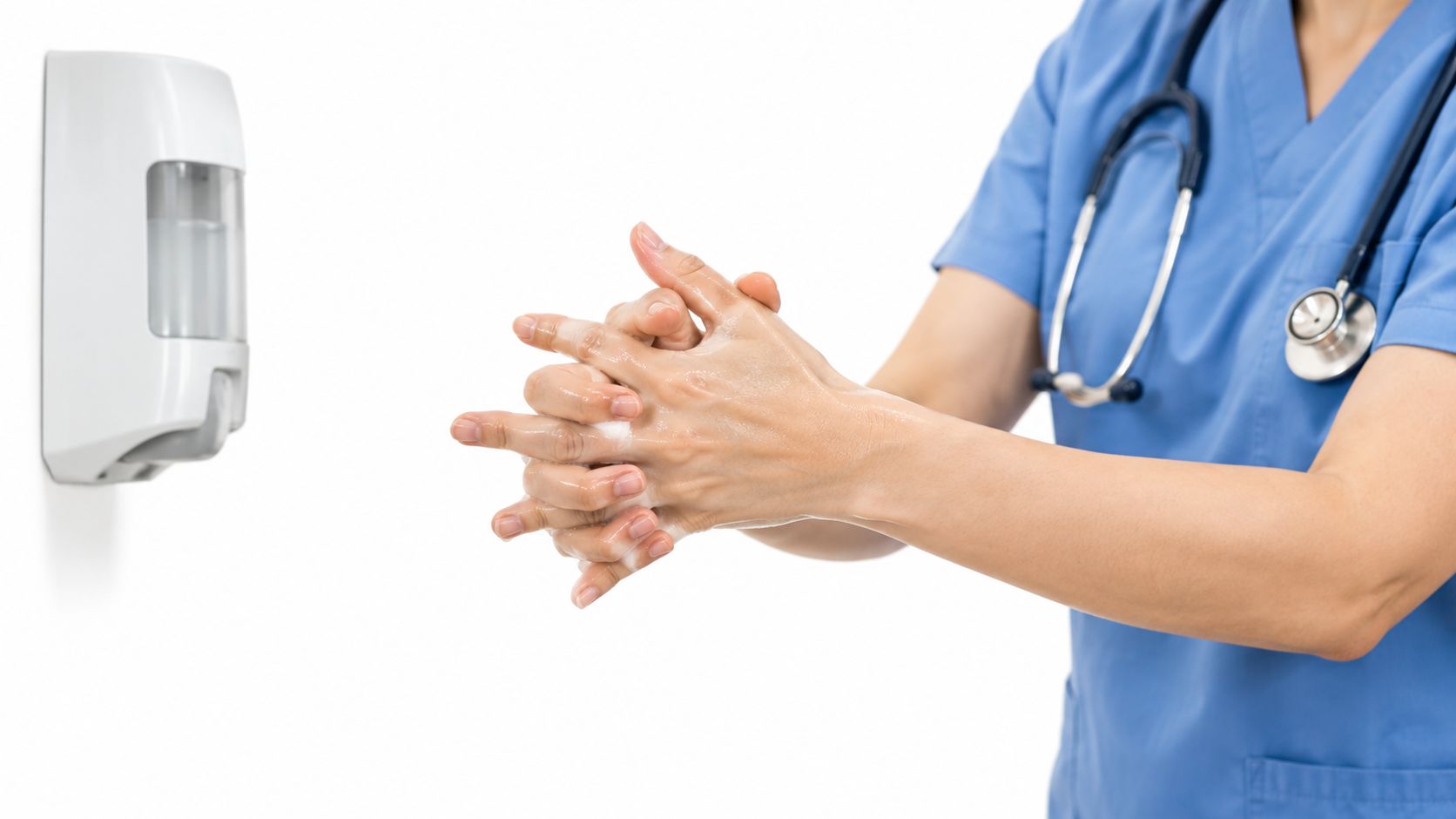
You're midway through a busy round, you've just adjusted a patient's pillow, and the dispenser by the next bed is empty. That small gap, repeated dozens of times a shift, is where hand hygiene in healthcare usually fails.
Five Moments That Decide When to Clean
WHO five moments for hand hygiene in patient care
| Moment | When it applies | Bedside example |
|---|---|---|
| Before touching a patient | Before any direct contact with the patient | Taking a pulse or adjusting a pillow |
| Before a clean or aseptic procedure | Immediately before inserting a line, catheter or dressing | Placing a urinary catheter |
| After body fluid exposure risk | After contact with blood, body fluids, secretions or excretions, even when gloved | Emptying a drain bag |
| After touching a patient | Before leaving the bedside after contact | Lifting the patient's arm to check a pulse |
| After touching patient surroundings | After touching anything near the patient, without touching the patient | Silencing a monitor alarm |
The table answers when, not how clean your hands look. A hand can appear clean after silencing a monitor or touching a bed rail, but you've still touched the patient's surroundings. That's a moment, because the next thing you touch may be another patient, a line, or your own face.
Timing before contact is what made the earliest evidence so striking. In an account of Ignaz Semmelweis at Vienna General Hospital, reported maternal mortality fell from approximately 16% to below 2% within months after doctors were required in 1847 to wash in chlorinated lime before examining maternity patients. When the practice stopped after he left in 1850, mortality rose again.
Turning moments into checkpoints
Don't treat the five moments as a poster to memorize. Treat each one as a checkpoint at the bedside before the next task, not a cleanup at the sink after the round. Before you take a pulse, clean your hands. Before a catheter, clean them again immediately beforehand, even if you cleaned them at the door two minutes earlier and then touched the trolley.
The confusing row for many new staff is the last one. You didn't touch the patient, so it feels unnecessary. But bed rails, monitors, charts, and call bells sit in the patient's zone and carry what the patient and previous staff left there, which is why hospital-acquired infection prevention treats surroundings as part of the contact chain.
Clean at the moment, at the bedside, before the next touch. If you have to leave the bed space to do it, the system is making the right action harder.
Choosing Between Rub, Soap, Gloves and Wipes
Hand hygiene options and their limits
| Option | Use when | Key limit |
|---|---|---|
| Alcohol-based hand rub, 60 to 95% alcohol | Routine care when hands are not visibly soiled | Does not remove visible soil; needs enough volume |
| Soap and water | Hands visibly dirty, after contact with blood or body fluids, during infectious diarrhea outbreaks | Needs sink access and 40 to 60 seconds |
| Alcohol product below 60% alcohol | Not an accepted substitute when soap and water are unavailable | Fails the CDC minimum |
| Gloves | Protect against contact with blood, body fluids or contaminated surfaces | Never replace hand hygiene; hands still need cleaning before and after |
| Surface disinfectant wipes | Shared equipment, bed rails, keyboards and tables | Not for skin; follow the label contact time |
Start with the condition of your hands. If they're not visibly soiled, alcohol-based hand rub is the routine choice because you can use it at the point of care without leaving the bedside. If they're visibly dirty, or you've had contact with blood or body fluids, soap and water does the physical removal that rub can't. During infectious diarrhea outbreaks, use soap and water as the table shows.
Product strength is a separate check. A pleasant scent or a pocket bottle doesn't make a product suitable for clinical care. Below the minimum in the table, it isn't an accepted substitute, however convenient it feels during a rushed round.
Where gloves mislead people
Say an ICU nurse puts on gloves for a dressing change, skips the rub before donning them, then keeps the same gloves on while answering the phone and touching the bed rail. The gloves now connect the dressing, the phone, and the rail. They've protected the nurse's skin during one task, but they've also become the surface that carries contamination to everything else.
Clean hands before donning gloves and after removing them. Change gloves between patients and between tasks with different contamination risk. Removal itself can contaminate your hands, and small defects go unnoticed, so what isolation precautions require never turns gloves into a hand hygiene replacement.
WHO's 2025 World Hand Hygiene Day materials, summarized in its World Hand Hygiene Day pages, highlighted the climate and waste consequences of gloves and called for appropriate glove use rather than treating gloves as a substitute for hand hygiene. The same source notes that ethanol and isopropanol products are safe when used appropriately, but alcohol-based products are potentially flammable and need local risk assessment and suitable storage.
Clear signage helps staff find the right product at the right place without hunting during care, and healthcare wayfinding advice from Evright Industrial is useful when you're placing dispensers, sinks, and waste points so people can spot them under pressure. Keep surface disinfectant wipes in that same workflow for shared equipment, bed rails, keyboards, and tables, follow the label contact time, and remember they're not for skin.
How to Clean Hands with Alcohol-Based Rub
For routine care when hands aren't visibly soiled, alcohol-based hand rub, or ABHR, is the default. The CDC hand hygiene FAQ states that products used when soap and water are unavailable should contain at least 60% alcohol, and that in healthcare settings personnel should rub over all hand surfaces until dry, typically about 20 seconds. The healthcare range you'll see on approved products is about 60% to 95% alcohol.
That concentration rule and the visibly soiled rule answer different questions. Concentration tells you whether the product qualifies. The condition of your hands tells you whether rub is the right method at all. A strong product on visibly dirty hands is still the wrong choice.

The sequence, step by step
- Check for visible soil. If you can see dirt, blood, or body fluids, switch to soap and water instead of starting the rub.
- Dispense enough product. Use the manufacturer's volume into a cupped palm, enough to wet every surface. Too little product can't cover thumbs, fingertips, and nail edges.
- Rub palm to palm. This spreads product across the largest contact surfaces first.
- Cover the backs of both hands. Put your right palm over your left dorsum with fingers interlaced, then reverse. The backs are easy to miss if you only work palm to palm.
- Rub palm to palm with fingers interlaced. This gets product into the interdigital spaces, the webs between fingers where moisture and contamination collect.
- Rub the backs of your fingers against the opposing palms. Bend your fingers so the knuckle side gets deliberate contact, not just incidental splashes.
- Rotate each thumb. Clasp each thumb in the opposite fist and rotate it. Thumbs grip bed rails, pens, and equipment, yet they're routinely left out of a quick rub.
- Finish with fingertips. Rub your fingertips into the opposite palm in a circular motion, including around the nails, then repeat on the other side. Fingertips are what you touch the patient with first.
Keep rubbing until completely dry. WHO guidance puts the whole handrub procedure at 20 to 30 seconds, and drying is your practical endpoint, not a timer you watch while walking to the next bed. Don't wipe off excess on your scrubs or shake your hands dry, because that cuts contact time and can recontaminate skin.
The dose check that catches most errors
Use drying time as feedback. If your hands feel dry within a few seconds, you almost certainly used too little product to wet every surface through all eight steps. Dispense more and repeat the missed areas while your hands are still at the bedside.
If your hands are still wet at about 20 seconds, don't assume you did a better job. Wet palms with dry thumbs usually mean the product stayed where it started. Slow down on steps 5 to 8, because thumbs, fingertips, interdigital spaces, and around the nails are the sites people miss most, a point also stressed in CDC clinical safety guidance for hand hygiene, which specifies rubbing those areas until dry and cleaning before donning and after removing gloves.
Dose check: Dry in a few seconds means too little. Still wet but thumbs missed means poor coverage. Both need a repeat, not a shrug.
Jewelry, long nails, and product trapped under rings make coverage harder, so follow your unit policy before clinical care. If a dispenser gives a weak, foamy half-dose, report it rather than adapting to it in silence. A technique that depends on two or three pumps from a failing dispenser will collapse on a night shift, and that's a supply problem to fix, not a personal failing to hide.
How to Wash Hands with Soap and Water
Use soap and water when hands are visibly dirty or contaminated with blood or body fluids, after caring for patients with infectious diarrhea during outbreaks, and before eating. This is a switch rule, not a preference. Rub can't rinse soil away, and visible contamination needs water, friction, rinsing, and drying.
The WHO hand hygiene brochure specifies washing with soap and water for 40 to 60 seconds when hands are visibly soiled, then rinsing and drying with a single-use towel, which can also be used to turn off the faucet. That duration covers the entire procedure, not just palm rubbing.

The washing sequence
- Wet your hands with water first. Wet skin lets soap spread evenly instead of clumping on dry palms.
- Apply enough soap to reach every surface. A smear that only covers your palms won't reach thumbs, fingertips, and nail folds.
- Rub palms together, then cover backs and between fingers. Work the backs of both hands, interlace your fingers, and clean around and under your nails. Water alone won't shift what's trapped at the nail edge.
- Rotate each thumb and work your fingertips into the opposite palm. These are the same high-contact sites people skip with rub, and they're just as easy to skip at a sink.
- Keep going for your unit's agreed duration. Don't stop when the lather looks good. Lather is not the endpoint.
- Rinse thoroughly under running water. Leftover soap irritates skin, and irritated skin makes staff avoid the next wash.
- Dry with a single-use towel. Wet hands pick up and transfer contamination more readily, and shared towels undo the wash.
- Use the towel to turn off the faucet. Touching a contaminated tap handle with clean, dry hands puts you back where you started.
Why you'll hear three different times
This confuses trainees, so name it directly. The CDC page on hand hygiene for healthcare settings specifies rubbing hands and fingers with soap for at least 15 seconds, while noting that other CDC handwashing guidance uses 20 seconds. WHO's 40 to 60 seconds describes the complete wash procedure. Pick one standard for your unit, teach it the same way on every shift, and audit against that standard.
The usual failure is stopping after a quick palm rub and never reaching thumbs, fingertips, and nails. Say a nurse leaving an outbreak ward has to walk to a sink at the far end of the corridor, past two other rooms and a keyboard she needs to update. A reminder poster won't fix that route. A working sink near the room, stocked with soap and towels, will.
Measuring Compliance and How Your Numbers Compare
Published hand hygiene compliance benchmarks
| Setting and year | Measure | Result |
|---|---|---|
| Global ICU observations through 2018 | Compliance with recommended opportunities | 59.6% overall; 64.5% high-income; 9.1% low-income |
| Clinical nurses, one tertiary hospital, China, 2025 | Observed opportunities met | 1,703 of 2,916 (58.40%) |
| Jiangsu Provincial Geriatric Hospital, China, 2017 to 2023 | Compliance trend | 49.25% rising to 86.67% |
| Healthcare workers, Hubei, China, 2024 | Self-reported practice | 94% effective practice; 84% washed 20+ seconds (self-reported, not observed) |
| WHO global hand hygiene day, 2024 | Staff not routinely following protocols | About 70% of healthcare workers; 50% of surgical teams |
The WHO hand hygiene page reports that approximately 59.6% of observed hand-hygiene opportunities in intensive-care units met recommendations through 2018, with about 64.5% in high-income countries compared with 9.1% in low-income countries. It also reports that without targeted improvement interventions, average compliance is around 40%.

Observed studies land close to that global picture. A 2025 study of clinical nurses in a tertiary hospital in China recorded hand hygiene during 1,703 of 2,916 observed opportunities, producing an overall compliance rate of 58.40%. A PubMed record for Jiangsu Provincial Geriatric Hospital reported compliance increasing from 49.25% in 2017 to 86.67% in 2023, which shows sustained measurement can accompany real change over years.
Now compare self-report. A 2024 cross-sectional study of 2,265 healthcare workers in Hubei, China found that 94% reported effective hand-hygiene practices, while 84% reported washing their hands for at least 20 seconds. Yet the WHO World Hand Hygiene Day 2024 speech page reported that approximately 70% of healthcare workers and 50% of surgical teams did not routinely follow hand-hygiene protocols. That gap is why you audit observed opportunities, not confidence.
A defensible audit method
- Choose units and cover several shifts, including nights. Day-shift-only data flatters units with more supervisors present.
- Record each opportunity by moment. A single yes or no for a whole patient visit hides which checkpoint failed.
- Calculate compliance plainly. Divide performed opportunities by total opportunities, then multiply by 100.
- Rotate observers and tell staff an audit period is running. People behave differently when watched, the Hawthorne effect, so rotating observers reduces one person's blind spots and keeps expectations transparent.
- Compare observed rates with self-reports. A large gap tells you training should target workflow and feedback, not just knowledge.
Report counts alongside percentages. Denominators matter because a unit with few opportunities can swing wildly on one busy shift, and leaders need to see whether 80% means 8 of 10 or 800 of 1,000. When you turn audit findings into staff education, VideoLearningAI's HIPAA training plan offers a useful model for structuring short, trackable training without pulling a whole unit off the floor at once.
Fixing the Gaps Audits Reveal
Barriers to hand hygiene and how to fix them
| Barrier | Check | Fix |
|---|---|---|
| No dispenser or sink within reach of the bed | Map dispenser locations against five-moment points | Place alcohol rub at each bed space |
| Stock-outs during shifts | Check stock levels at the start of each shift | Set par levels and a reorder trigger |
| Workflow congestion during rounds | Count interruptions per patient visit | Cluster tasks around one patient |
| Skin irritation from frequent rubbing | Ask staff about dryness and cracking | Approve an emollient and an alternative product |
| Gloves replacing hand hygiene | Check for hand cleaning after glove removal | Teach glove rules alongside the five moments |
| Observed compliance far below self-report | Compare observed and self-reported rates | Share unit-level feedback graphs monthly |
Before retraining staff, identify whether the barrier is a behavior or a system failure. A 2025 review of barriers to hand hygiene identified behavioral, organizational, physical, and interpersonal barriers. Across 22 included studies, unavailable, inconvenient, or insufficient supplies, including sinks, water, soap, and alcohol-based hand rub, were a leading obstacle. Weak supervision, monitoring, evaluation, and feedback also contributed to noncompliance.

Use the table during a unit walk. At each bed, check whether a nurse can clean hands at every moment without leaving the bed space. Check dispensers at the start of each shift and set a par level and reorder trigger. That gives someone responsibility for restocking before an empty dispenser interrupts care.
Look at the path staff take during rounds. If they must leave a patient to fetch charts, gloves, or equipment, returning creates another chance to miss a hand-hygiene opportunity. Cluster tasks around one patient, bring supplies to the bedside, and place alcohol rub where tasks end as well as where they begin.
Skin, gloves, and honest feedback
Ask staff about dryness and cracking. Sore hands can lead staff to shorten rubs, avoid the product, or rely too heavily on gloves. Approve an emollient and an alternative product within your standard, and involve occupational health early if dermatitis appears.
Keep routine environmental cleaning separate from clinical hand hygiene duties. Waiting rooms and office carpets have cleaning needs distinct from hand hygiene at the bedside. Facilities teams can refer to cleaning guidance for carpeted medical offices for carpet care, while clinical staff follow hand-hygiene procedures at the required moments. Clear roles help prevent environmental cleaning tasks from being improvised between patient-care steps.
Feedback turns audit findings into practical changes. Share unit-level graphs monthly, broken down by moment where possible, and pair them with infection control training for healthcare workers that covers glove rules alongside the five moments. The training should connect the expected action to the actual workflow: gloves do not replace hand hygiene, and a dispenser that is out of reach can make the right action harder to complete.
End each review by checking whether staff had the conditions needed to meet the standard. A sink without towels, an empty dispenser, or alcohol rub down the corridor can undermine compliance. Fix access barriers first, then hold staff to the hand-hygiene standard.
Start Your Audit on One Unit This Week
Pilot one unit for four weeks rather than launching a hospital-wide program that no one can staff properly. A small pilot gives you a baseline, one visible fix, and a repeat measurement using the same method. That sequence teaches the unit faster than a launch email.
- Pick the unit with the highest-risk patients or the lowest recent compliance.
- Observe at least two shifts, including one night shift, and record every opportunity by moment.
- Calculate the baseline and compare it with the WHO figure of about 40% average compliance without targeted improvement.
- Fix the single barrier from the diagnostic table that appears most often in your observations.
- Re-audit after four weeks with the same method and observers, then report counts and percentages together.
Give surfaces their own parallel plan. Shared equipment, bed rails, and keyboards need a disinfectant wipe used to the label's contact time, while hands rely on rub or soap and water. Stock wipes where shared equipment is returned, not in a locked cupboard, so cleaning the keyboard becomes part of handing it over.
Start this week by walking one bed space with a new nurse and applying the test that matters: can a new nurse clean hands at each moment without leaving the bedside? If the answer is no, move the dispenser, fix the stock trigger, and audit again, and keep VirusFAQ.com bookmarked for plain-language virus prevention explainers you can share with staff and patients.
Leave a Reply