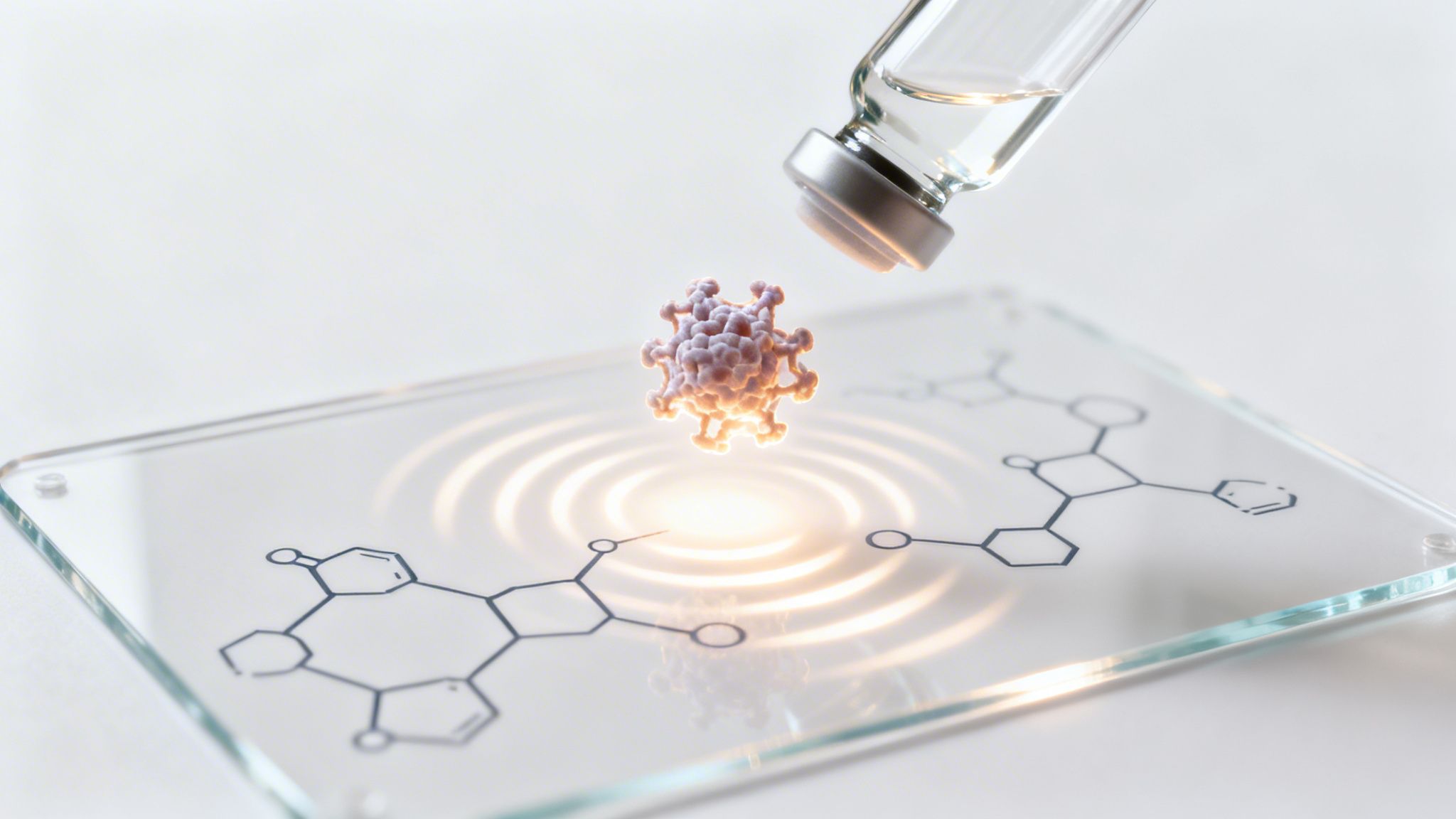
Subunit vaccines are one of the most clever and targeted ways we have to train the immune system. Instead of using a whole virus or bacterium, they introduce just a single, carefully chosen piece—or 'subunit'—of the germ.
This makes them incredibly safe.
A Blueprint for Immunity
Think of it like this: instead of letting a full-blown burglar into a house to teach a security system what to look for, you just show it a high-resolution photo of the burglar’s face. This targeted approach gives your immune system a precise blueprint of the enemy, allowing it to build a powerful defense without ever facing the danger of a live infection.
Because subunit vaccines contain only purified and harmless fragments of a pathogen—like a specific protein—they can’t cause the disease they’re designed to prevent. This outstanding safety profile makes them an ideal choice for many people, including those with weakened immune systems who might not be able to receive other types of vaccines.
The Power of Precision
This exact technology is the driving force behind some of modern medicine's biggest wins. For example, the vaccines for Hepatitis B Virus (HBV) and Human Papillomavirus (HPV) are both subunit vaccines. They work by training the immune system to recognize key viral proteins, a strategy that has drastically cut rates of liver cancer and cervical cancer worldwide. Viruses like these can persist on surfaces, making environmental hygiene a crucial part of a comprehensive prevention strategy.
To get a better sense of how these vaccines are produced, you can check out our guide on what recombinant vaccines are.
The entire principle boils down to identifying the one critical part of a virus that your immune system can spot and remember easily.
By isolating a single antigenic component, subunit vaccines create a highly specific immune response. This minimizes potential side effects while maximizing protective memory, representing a significant advancement over older, whole-organism vaccine technologies.
Subunit vaccines introduce these specific protein fragments, which then get presented to your immune cells. To understand how even small fragments can have such a big impact, it helps to look at naturally occurring peptides like Thymosin Alpha 1, which play a key role in modulating our immune responses. This method ensures your body learns to neutralize dangerous invaders like SARS-CoV-2 or Influenza A Virus (H1N1) without ever having to confront the whole virus.
How Your Body Learns to Fight a Virus It Has Never Met
So, how does a single, harmless piece of a virus get your entire immune system ready for a real fight? It’s a fascinating process, almost like a military training exercise happening inside your body. It all kicks off the moment a subunit vaccine is introduced.
Once inside, the first responders are specialized “scout” cells called antigen-presenting cells (APCs). Their job is to patrol for anything that looks foreign. They quickly find the harmless protein subunit from the vaccine and immediately recognize it as something that doesn’t belong.
This simple, elegant process is what makes subunit vaccines so effective. The vaccine uses a harmless piece to trigger a powerful, body-wide response without ever making you sick.

As you can see, the goal isn't to fight a live invader, but to teach your body what the invader looks like so it's prepared for the real thing.
Sounding the Immune Alarm
Here’s the thing: on its own, a purified viral protein is almost too clean. It doesn’t look particularly threatening to your immune system, so it might get ignored. This is where a crucial ingredient called an adjuvant comes in.
Think of an adjuvant as the vaccine's built-in megaphone. It gets the immune system’s attention and shouts, "Pay attention to this! This is important!"
Adjuvants create a small, localized inflammatory signal right at the injection site. This little bit of irritation acts like a flare, drawing more immune cells to the area and making sure they take the viral protein seriously. Without an adjuvant, the immune response might be too weak to create the lasting protection we need. You can get a deeper dive into this in our guide on how vaccines work against viruses.
Creating a Lasting Defense
Once an APC has engulfed the protein and heard the "danger!" signal from the adjuvant, it knows exactly where to go: the lymph nodes. Think of these as your immune system’s command centers.
Inside the lymph nodes, the APC presents the viral fragment to the two most important soldiers in your immune army: T-cells and B-cells.
This kicks off a chain reaction:
- T-cells are activated to help direct and coordinate the entire immune counter-attack.
- B-cells get the signal to start mass-producing highly specific antibodies—think of them as custom-built heat-seeking missiles designed to target that exact viral protein.
- Most importantly, the immune system creates memory cells. These are veteran cells that keep a permanent record of the enemy.
This immunological memory is the entire point of the vaccine. Now, if your body ever encounters the real virus—whether from an infected person or a contaminated surface—those memory cells will activate instantly. They’ll unleash a flood of targeted antibodies, neutralizing the virus long before it can gain a foothold and cause disease. Your body is now fully prepared to win the fight.
Building a Modern Vaccine From Lab to Jab

So, how do scientists actually build one of these targeted vaccines? It’s a fascinating process of molecular engineering that starts with a single, critical decision: choosing the perfect piece of the pathogen to copy.
For a virus like the Hepatitis B Virus (HBV), researchers zero in on the exact gene that creates a specific protein on its outer surface. This protein is the virus's "uniform"—the part our immune system can easily spot and remember. The gene is essentially the recipe for that uniform.
Turning Cells Into Factories
Once they have that genetic recipe, scientists use a game-changing method called recombinant DNA technology. They carefully snip out the viral gene and insert it into a completely harmless host, usually a common baker's yeast cell.
This simple step transforms the yeast into a microscopic production line. The yeast cell reads the new genetic instructions it's been given and starts churning out massive amounts of just the viral protein. No other part of the virus is ever made.
Think of it like this: you give a chef the recipe for only the sauce, not the entire dish. The chef can now produce vats and vats of that specific sauce without ever cooking the rest of the meal. The result is a pure, isolated ingredient.
This controlled manufacturing is a cornerstone of modern vaccine science. For a deeper dive into the full journey, you can get more details on how vaccines are developed in our guide. Understanding this process is key to seeing why subunit vaccines have such a strong safety profile.
Purification and Final Formulation
After the yeast "factories" have done their job, the next stage is an incredibly thorough purification process. Scientists need to separate the target viral protein from all the other bits and pieces of the yeast cell, leaving behind a highly concentrated batch of the antigen.
This step is absolutely critical for two main reasons:
- Safety: It ensures no leftover material from the yeast cell makes it into the final vaccine, which could cause an unnecessary reaction.
- Precision: It guarantees the immune system is shown only the exact protein it needs to learn from, making the training exercise clean and efficient.
Finally, this purified protein is mixed with an adjuvant—a trusted helper ingredient that signals the immune system to pay extra attention and mount a stronger, more durable response.
The finished product is a modern, highly targeted, and exceptionally safe vaccine, ready to protect people from diseases like whooping cough or those caused by viruses like HPV. It’s the final step in the journey from the lab to the jab.
Real-World Victories of Subunit Vaccines
The science behind subunit vaccines isn't just an interesting concept on a lab bench—it's one of the most powerful tools in modern public health, responsible for preventing millions of infections and saving countless lives. These highly specific vaccines are the heroes behind some of the biggest disease prevention wins in recent memory.
Take the Hepatitis B (HBV) vaccine, a true game-changer. Instead of using the whole virus, it cleverly uses just one key surface protein to train our immune system. This gives our bodies a "mugshot" of the intruder, allowing them to spot and neutralize HBV before it can ever establish a chronic, liver-damaging infection.
Before this vaccine became widespread, HBV was a primary cause of liver cancer and severe liver disease. Now, thanks to global vaccination programs, the impact is undeniable. Some countries have seen rates of chronic HBV infection in children plummet by over 90%.
Precision Against Cancer and Whooping Cough
The Human Papillomavirus (HPV) vaccine builds on that same smart design. Scientists create 'virus-like particles' (VLPs), which are essentially empty protein shells. They look exactly like the HPV virus to your immune system but have no genetic material inside, making them completely non-infectious.
This trick triggers a robust immune response, offering incredible protection.
The HPV vaccine is a perfect example of an anti-cancer vaccine. By blocking infections from the most dangerous HPV types, it has caused a massive drop in cervical cancer cases and could virtually wipe out the disease in vaccinated populations.
The acellular pertussis vaccine is another major success. It protects against whooping cough and replaced the older "whole-cell" vaccines, which used the entire killed bacterium and often came with more side effects like fever and soreness at the injection site.
The modern subunit version uses just a handful of purified proteins from the Bordetella pertussis bacterium. It provides fantastic protection with a much better safety record, which is why it’s a standard, trusted part of childhood immunizations today.
Adapting Proven Technology for New Threats
The beauty of this well-established vaccine platform is how quickly it can be adapted to fight new enemies. When SARS-CoV-2 appeared, researchers immediately got to work applying these exact principles. They pinpointed the virus’s all-important Spike protein as the perfect target for a subunit vaccine.
This work led to vaccines containing a lab-made version of that Spike protein, paired with a potent adjuvant to make sure the immune system paid attention. These vaccines became another vital weapon in the global arsenal against the pandemic, complementing hygiene measures like hand washing and surface disinfection that help reduce transmission.
It was a powerful reminder of how a reliable, proven technology can be deployed to protect public health from emerging threats. Today, that same platform is being explored to develop vaccines against some of our most stubborn viral foes, including Human Immunodeficiency Virus Type 1 (HIV-1) and Herpes Simplex Virus (HSV-1, HSV-2).
Subunit vs. mRNA vs. Traditional Vaccines

Not all vaccines work the same way. Think of it like training a security team—you could show them a picture of the intruder, give them a live (but harmless) drill, or just hand them the intruder's blueprints. Each method prepares the team differently. The same goes for vaccines, especially when you compare subunit, mRNA, and traditional platforms.
Let's break down the old-school approach first. Traditional vaccines are the original workhorses of immunology and come in two main flavors:
- Inactivated vaccines: These use the entire virus, but it's been "killed" with heat or chemicals. It can't cause disease, but the immune system gets to see the whole pathogen and learn what it looks like. Many of the viruses these target, such as Rhinovirus or Norovirus, are known to survive on everyday surfaces.
- Live-attenuated vaccines: This method uses a "weakened" version of the live virus. It’s strong enough to trigger a powerful, lasting immune response—much like a natural infection—but too feeble to make a healthy person sick.
Subunit vaccines were a huge leap forward. Instead of presenting the entire virus (dead or weakened), they take a more precise approach. They use just one specific, harmless piece—like a single protein—to train the immune system. This targeted method means there's zero risk of the vaccine causing the disease it’s designed to prevent.
A New Generation of Vaccine Tech
So, where do mRNA vaccines fit into all this? They follow a completely different playbook. Instead of giving your body a piece of the virus, an mRNA vaccine delivers a set of instructions (messenger RNA) that teaches your own cells how to make the viral protein.
Your cells become tiny, temporary factories, producing the exact antigen your immune system needs to recognize. Once the job is done, the instructions break down and disappear.
This difference has a massive impact on production speed. Making traditional and subunit vaccines often means growing viruses or proteins in giant vats, a process that can take weeks or months. But with mRNA technology, scientists can design and produce a vaccine almost as soon as a virus’s genetic code is known.
Vaccine Platform Comparison
To really see the differences, it helps to put them side-by-side. Each vaccine platform comes with its own set of strengths and trade-offs, which determines when and how it's used.
| Feature | Subunit Vaccines | mRNA Vaccines | Inactivated Vaccines |
|---|---|---|---|
| What it Contains | A single, purified piece of the pathogen (e.g., a protein). | A set of genetic instructions (mRNA) to build a viral protein. | The entire pathogen, but it's been killed or "inactivated." |
| Risk of Infection | Zero. Contains no live or whole pathogens. | Zero. Contains no part of the virus, only instructions. | Zero. The pathogen is non-infectious. |
| Production Speed | Moderate. Requires growing and purifying proteins. | Very fast. Can be designed and scaled up rapidly. | Slow. Requires growing and inactivating large batches of virus. |
| Adjuvant Needed? | Almost always. The single protein needs a boost to get the immune system’s attention. | No. The mRNA formulation itself is enough to trigger a strong response. | Sometimes. An adjuvant is often added to enhance the immune response. |
| Immune Response | Strong antibody response, but T-cell response can be weaker. | Generates a powerful combination of both antibodies and T-cells. | Good antibody response, but often less robust than a live vaccine. |
Ultimately, the choice of platform comes down to the specific threat. For a fast-moving pandemic, the speed of mRNA is a game-changer. For pathogens where safety is the absolute top priority and a specific protein is the key, subunit vaccines are an excellent and reliable choice.
The biggest trade-off is often between precision and power. Subunit vaccines offer an incredibly high safety profile thanks to their purified nature, while mRNA vaccines deliver remarkable speed and a potent, two-pronged immune attack.
This is why different vaccines exist for different diseases. A live-attenuated vaccine might provide a broad, durable response similar to getting sick and recovering. Subunit vaccines need an adjuvant to help kickstart a strong antibody response. And mRNA vaccines are fantastic at generating both antibodies and T-cells for a comprehensive defense. There's no single "best" platform—only the right tool for the job.
The Future of Targeted Vaccine Development
Subunit vaccines have been around for a while, but their story is far from over. Researchers are constantly refining the platform, pushing to see just how precise and powerful this technology can become.
A huge part of this work centers on creating better adjuvants. Think of these as the vital “megaphones” that get the immune system’s attention. The goal is to develop adjuvants that don’t just trigger a good response, but an incredibly strong and durable one that lasts for years.
This quest for more powerful tools is opening the door to tackling some of our most stubborn viral enemies—the ones that have eluded scientists for decades.
New Frontiers in Vaccine Research
The research pipeline for subunit vaccines is filled with some of the most sought-after breakthroughs in modern medicine. Scientists are now aiming at targets that were once considered nearly impossible:
- Human Immunodeficiency Virus Type 1 (HIV-1): The Human Immunodeficiency Virus is notoriously complex, making vaccine development a massive challenge. But subunit strategies that target specific, stable parts of the virus are a major focus of current research.
- Herpes Simplex Virus (HSV-1, HSV-2): Billions of people worldwide are affected by HSV. Work is now underway to develop subunit vaccines that could finally prevent or even treat these persistent infections. While vaccination is a future goal, preventing transmission today relies on good hygiene and avoiding direct contact.
- A ‘Universal’ Flu Vaccine: Imagine a single flu shot that protects you from multiple strains at once, including seasonal bugs like Influenza A Virus (H1N1) and potential pandemic threats like Avian Influenza Virus (H5N1). A subunit vaccine targeting a conserved, unchanging part of the influenza virus is one of the most promising paths toward this goal.
This ambitious work is getting a major boost from modern computing.
With the help of AI and advanced computational biology, researchers can now analyze viral structures and predict the most effective protein targets with incredible speed and accuracy. This significantly shortens the initial discovery phase of vaccine development.
By combining proven technology with these powerful new tools, scientists are ensuring that the principles behind what are subunit vaccines will remain a cornerstone of public health. This targeted, precise method of building immunity isn't just part of our past; it's a critical component of our future defense against infectious diseases.
Frequently Asked Questions About Subunit Vaccines
It's completely normal to have questions when you're trying to understand the science behind vaccines. Let's break down some of the most common ones about subunit vaccines with clear, straightforward answers.
Are Subunit Vaccines Safe?
Yes, subunit vaccines have an excellent safety record. Because they only contain a tiny, non-infectious piece of a germ—not the whole thing—they cannot cause the disease they’re designed to protect you from.
This high safety profile makes them a great choice for many people, including those with weakened immune systems who might not be able to get other types of vaccines, like live-attenuated ones.
Why Do Subunit Vaccines Need an Adjuvant?
Think of an adjuvant as an alarm bell for your immune system. The protein fragment used in a subunit vaccine is so pure and isolated that your body's defenses might not see it as a serious threat on its own. It's too clean.
The adjuvant creates a small, localized "danger signal" right at the injection site. This alert tells your immune cells, "Hey, pay attention to this!" It kicks them into gear to investigate the protein fragment and build a strong, lasting defense with antibodies and immune memory.
Can Any Virus Be Targeted With a Subunit Vaccine?
While the subunit approach is powerful, it doesn't work for every single virus out there. The biggest hurdle is finding the perfect piece of the virus—a specific protein that triggers a strong, protective immune response without causing any problems.
The success of a subunit vaccine really comes down to the virus's own biology. For incredibly complex viruses like Human Immunodeficiency Virus Type 1 (HIV-1) or Herpes Simplex Virus (HSV), researchers have spent decades searching for that ideal target with limited success.
That's why scientists need a whole toolbox of different vaccine strategies. But for viruses like Hepatitis B Virus (HBV) and Human Papillomavirus (HPV), the subunit method has been a massive success, preventing millions of infections and cancers worldwide. Viruses like these can also live on surfaces for hours or even days, making regular disinfection an important complementary step to reduce the risk of transmission in homes and public spaces.
Leave a Reply