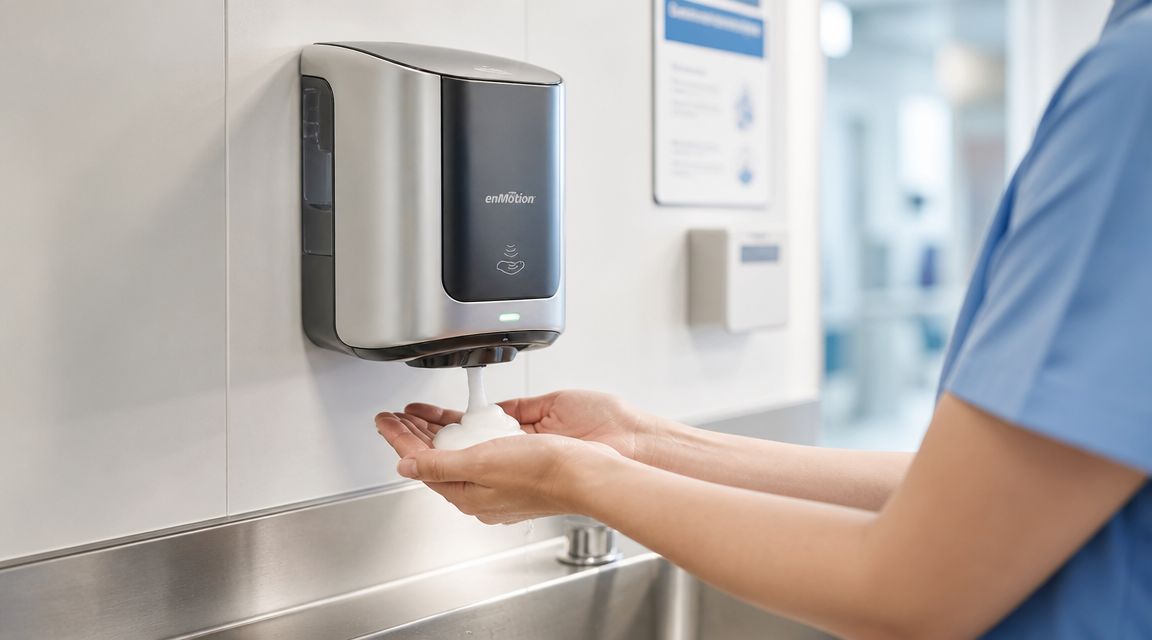
You're probably dealing with one of two complaints right now. Staff say the restroom soap dispenser is always empty, leaking, or jammed. Or nobody complains at all, and that's worse, because a dispenser can subtly become a weak point in your infection-control program long before anyone notices.
A commercial hand soap dispenser looks simple on the wall. In practice, it affects handwashing compliance, surface contamination, refill labor, and user confidence in the space. If the unit is awkward to use, poorly placed, contaminated inside, or constantly out of product, the sink stops functioning as a reliable hygiene station.
Why Your Hand Soap Dispenser Is a Critical Health Asset
Walk into any busy restroom after a peak-use period and you can see the whole problem at once. Wet counters. Fingerprints on fixtures. A dispenser nozzle with dried soap at the tip. People moving fast and touching only what they need to touch. In that setting, the soap dispenser isn't a minor accessory. It's part of the facility's frontline disease-control infrastructure.

Commercial dispensers have evolved a long way from basic hand pumps. Early dispenser patents appeared in the late 19th century, and the first automatic soap dispenser patent was filed in 1989 and granted in 1991 to Shiau Guey Chuan. That shift matters because it moved the dispenser from a convenience item to a control measure in shared environments. The same history also shows how established this category has become. The U.S. soap dispenser market was estimated at USD 347.92 million in 2022 and is projected to grow at a 7.7% CAGR from 2023 to 2030, according to this overview of automatic soap dispenser development.
That growth didn't happen because dispensers became stylish. It happened because operators need consistent handwashing tools that hold up under real use.
Why facility managers should treat dispensers like hygiene equipment
A dispenser influences more than soap delivery. It affects whether users can wash quickly, whether contact points accumulate contamination, and whether maintenance staff can keep stations stocked without creating new risks during refills.
In facilities that already invest in commercial cleaning in London or similar professional services elsewhere, soap dispensers deserve the same attention as faucets, door plates, and drying stations. They sit directly in the chain between contaminated hands and cleaner hands.
Practical rule: If a dispenser is hard to activate, often empty, or visibly dirty, users treat the whole handwashing station as unreliable.
What goes wrong when dispensers are treated as fixtures only
Teams often focus on finish, price, and mounting style first. Those details matter, but they don't answer the questions that affect health outcomes on the ground:
- Can users operate it without touching a shared surface?
- Does it deliver a consistent dose or encourage waste and mess?
- Will the refill method keep the soap protected?
- Can your staff maintain it without special workarounds?
A good commercial hand soap dispenser reduces friction. A bad one adds it. In public health terms, that difference is bigger than it looks.
Manual vs Touchless and Foam vs Liquid Dispensers
Most selection mistakes happen because buyers treat “soap dispenser” as one category. It isn't. You're making two separate decisions. First, how the unit activates. Second, what soap format it's built to dispense.

Manual and touchless operation
The clearest hygiene trade-off is between manual and touch-free activation. Touch-free units remove a hand-contact point from the wash sequence, which is especially useful in busy restrooms and food-service areas. Manual units are mechanically simpler, but every user touches the same pump, lever, or push surface. Stern Faucet notes that touch-free dispensing affects hygiene directly, because it eliminates a key hand-to-device contact point for pathogen transfer, while manual units remain a potential transfer surface in shared settings. The same source also notes that foaming dispensers are designed to reduce soap use per wash by improving coverage and lather at lower volumes. See Stern Faucet's commercial soap dispenser guide.
Manual models still have a place. In lower-complexity settings, they're easier to troubleshoot and don't depend on batteries or electrical connection. But “simpler” doesn't automatically mean “better” if the dispenser sits in a high-contact environment.
Foam and liquid chemistry
The second decision is soap format. Foam and liquid aren't interchangeable from a hardware standpoint. The pump and valve geometry must match the chemistry, or the dispenser won't perform reliably.
If you want a quick primer on foam systems specifically, this guide on hand-washing foam is useful background.
What matters operationally is this:
| Dispenser choice | Main advantage | Main drawback | Best fit |
|---|---|---|---|
| Manual liquid | Simple hardware, familiar use | Shared touch point, more mess if over-dispensed | Back-of-house or lower-risk areas |
| Manual foam | Lower soap use, simple mechanism | Shared touch point, must use foam-compatible refill | Moderate-traffic spaces |
| Touchless liquid | Reduced contact, controlled dosing | More components to maintain | Clinical and food-service sinks |
| Touchless foam | Reduced contact and lower soap use | Requires sensor reliability and foam-compatible product | High-traffic public restrooms |
What tends to work best in practice
In most public-facing restrooms, touchless foam is the most balanced setup. It reduces contact, keeps the station cleaner, and helps control product use without making the user think about dosage.
Manual dispensers usually work best where maintenance teams want straightforward hardware and can tolerate the contact surface. Liquid dispensers can also make sense where staff need a more traditional soap feel or already stock compatible liquid products across multiple stations.
The wrong combination usually fails in predictable ways. Liquid soap in a foam unit clogs performance. An underpowered automatic unit frustrates users. A manual pump in a crowded restroom turns into another shared touch surface.
Choose the activation method for the environment. Choose the soap format for the chemistry, maintenance routine, and cost control strategy. Don't mix those decisions together.
Preventing Cross-Contamination from Refill Systems
The most overlooked risk in a commercial hand soap dispenser isn't always the button on the front. It's the reservoir behind the cover.
Facilities often spend time debating manual versus touchless and ignore the refill system entirely. That's backwards. A dispenser can be touchless on the outside and still create hygiene problems if the refill method exposes the product to contamination.

Bulk-fill systems and hidden contamination risk
Bulk-fill dispensers use an open or reopenable reservoir. Staff top them off from a larger container. On paper, that looks economical and flexible. In reality, it creates several control problems at once. The reservoir is opened repeatedly, refill handling varies by employee, and old product may remain in the tank while new soap is added on top.
That's why refill-system contamination deserves much more attention. As discussed in Zogics' overview of hand soap dispensers, bulk-fill systems can harbor microbial growth, while sealed systems minimize that risk, making the refill method a critical issue in infection prevention. Here is the relevant Zogics discussion of dispenser refill-system contamination.
If you need a broader primer on transmission pathways, this explanation of what cross-contamination is helps frame why dispenser design matters so much.
Why topping off is a bad habit
In the field, one of the most common maintenance failures is topping off a partially used bulk reservoir. Staff do it to save time. The problem is that the dispenser never gets fully emptied, cleaned, and reset. Residue remains on interior surfaces, product ages in place, and the reservoir becomes harder to manage hygienically.
In these situations, a hygiene tool can become a contamination source.
A few warning signs usually show up before the problem becomes obvious:
- Residue around the opening that suggests repeated messy refill handling
- Stringy or inconsistent soap output, which can signal product age, clogging, or internal buildup
- Persistent nozzle contamination even after the exterior has been wiped
- Unclear refill accountability, where nobody knows who last opened and cleaned the tank
Why sealed cartridges are usually the safer choice
Sealed cartridge systems cost more upfront in many cases and may lock you into a manufacturer's refill format. Those are real drawbacks. But from an infection-control perspective, they solve a hard problem elegantly. The soap remains protected until dispensed, refills are faster, and staff don't have to expose the product during every service event.
Field advice: In healthcare, childcare, and food-handling spaces, sealed refills are usually worth the reduced contamination risk alone.
The key point is simple. A touchless sensor doesn't compensate for a poorly controlled refill process. If the reservoir can become contaminated, the dispenser can undermine the very handwashing behavior it's meant to support.
Proper Dispenser Placement and Maintenance Schedules
A well-designed dispenser still fails if people can't find it easily, reach it comfortably, or trust it to work every time. Placement and maintenance determine whether the unit helps hand hygiene or gets bypassed.

Place the dispenser where handwashing actually happens
The best location is usually obvious, but many installations still get it wrong. The dispenser should sit close enough to the sink that users move through washing in one motion, but not so close that drips pool onto awkward surfaces or interfere with faucet use.
A practical placement review should include:
- Visibility first: Users should see the dispenser as soon as they approach the sink.
- Clear reach: Nobody should have to lean around a partition, trash can, or hand dryer.
- Splash awareness: Avoid positions where constant water spray hits the housing or sensor.
- Cleaning access: Staff need room to wipe the body, nozzle, and wall area around the unit.
Poor placement creates avoidable friction. When that happens, users rush, skip steps, or leave soap residue on adjacent surfaces.
Build a maintenance routine around failure points
Chicago Faucets notes that commercial wall-mounted dispensers commonly use 1000 mL cartridges or tanks, and that automatic models may run on a plug-in transformer or four D-cell batteries. Those design choices directly affect maintenance intervals and uptime. Larger capacity can reduce refill frequency, while power architecture changes how your team plans service checks. The details are outlined in Chicago Faucets' guidance on choosing a commercial dispenser.
That should drive your maintenance routine. Don't use the same schedule for every dispenser in every restroom.
A workable schedule for most facilities
Use a simple checklist that staff can complete consistently.
Daily function check
Confirm the unit dispenses correctly, the nozzle is clean, and the station has product available. For touchless models, make sure the sensor responds without repeated hand waving.Exterior surface cleaning
Wipe the housing, push area, or sensor face, plus the wall immediately around it. In high-touch environments, disinfecting wipes are practical for the dispenser exterior, nearby faucet handles, and door hardware.Refill review
Replace sealed cartridges cleanly. If you still use bulk-fill systems, don't treat refilling as a simple top-up task. It needs a more controlled process.Periodic deeper inspection
Look for leaks, dried soap trails, loose mounting, cracked covers, and battery-related failures in automatic units.
| Maintenance area | What to look for | Why it matters |
|---|---|---|
| Nozzle and outlet | Dried soap, misfire, drips | A dirty outlet can contaminate hands and counters |
| Housing exterior | Smears, residue, fingerprints | Users judge the hygiene of the whole sink area by visible cleanliness |
| Power source | Battery weakness or transformer issue | A dead automatic dispenser is functionally the same as no dispenser |
| Mounting and seals | Movement, leaks, gaps | Mechanical instability leads to mess, damage, and service calls |
Clean-looking dispensers get used more confidently. Dirty-looking dispensers make users rush, hesitate, or avoid contact.
Maintenance doesn't need to be complicated. It needs to be disciplined.
Choosing the Right Dispenser for Your Environment
There isn't one best commercial hand soap dispenser for every building. The right unit depends on risk tolerance, cleaning capacity, user behavior, and how much abuse the hardware will take.
Healthcare and clinical settings
In clinics, treatment areas, and other care environments, infection control should drive the decision. That usually means prioritizing touchless activation and a sealed refill system over the lowest purchase price.
Stainless steel or high-quality sealed plastic housings both work if they can be cleaned easily and don't trap residue in awkward seams. The critical issue isn't appearance. It's whether the dispenser supports a controlled handwashing process with minimal avoidable contact and minimal refill contamination risk.
Schools, airports, stadiums, and other heavy-use public sites
These spaces punish weak hardware fast. Capacity matters. So does impact resistance.
Metal-bodied dispensers are often the safer choice where longevity and vandal resistance matter. Plastic units can still work well, but only if the environment is controlled and the maintenance team can replace damaged parts quickly. In very busy restrooms, it's often smarter to accept a slightly more industrial look in exchange for stronger housings, easier servicing, and fewer out-of-service periods.
A high-traffic venue usually benefits from this mix:
- Touchless operation to reduce shared-contact points
- Larger-capacity units to limit refill runs
- Lockable covers to reduce tampering
- Simple exterior geometry so staff can wipe them quickly
Offices, restaurants, and hospitality spaces
These settings need balance. A dispenser has to look presentable, work consistently, and fit the brand standard of the space, but it still can't compromise hygiene.
For offices, quiet reliability matters more than ruggedness. For restaurants, the question is whether the handwashing station supports staff workflow and customer confidence. For hospitality spaces, visible cleanliness carries extra weight because guests notice fixture condition immediately.
Material choice and what it really means
Material decisions are often framed as premium versus budget. That's too simplistic.
| Material | Strength | Limitation | Typical use case |
|---|---|---|---|
| Metal body | Better durability and vandal resistance | Higher upfront cost, can show smudges | Public venues, transport, schools |
| Plastic body | Lower initial cost, lighter weight | May wear faster in rough settings | Offices, lighter-duty restrooms |
Choose by environment, not by brochure appeal. A polished dispenser that leaks, clogs, or gets bypassed is the expensive option in the long run.
Ensuring ADA Compliance and Accessibility
A dispenser can be hygienic and still be a poor installation if people can't reach or use it safely. Accessibility isn't an optional upgrade. It's part of correct specification.
For public-facing restrooms, mount the dispenser so the operable parts are within reachable range. Keep wall projection under control so the unit doesn't become a hazard in circulation areas, especially for people with visual impairments. Manual dispensers also need to operate without excessive force.
The practical checkpoints are straightforward:
- Mounting height: Place operable parts no higher than 48 inches from the floor.
- Wall protrusion: Keep the unit within the 4-inch protrusion limit where applicable.
- Operating force: Manual units should require no more than 5 pounds of force.
These details are easy to miss during retrofits, especially when teams focus on plumbing and finishes first. They matter just as much as soap compatibility and refill access.
If you're reviewing the whole hand-hygiene station, this guide to a wall-mounted hand sanitizer dispenser is useful because many of the same placement and accessibility principles carry over.
A final point: touchless dispensers often make accessibility easier in everyday use, but they still need correct mounting height and clear approach space. Automation doesn't fix a bad installation.
Your Role in Breaking the Chain of Infection
A commercial hand soap dispenser does more than hold soap. It shapes whether handwashing happens smoothly, whether users touch a shared surface, whether maintenance introduces contamination during refills, and whether the sink station stays dependable under pressure.
The biggest mistake is treating the purchase as a simple fixture decision. The more important questions are practical. Is the dispenser easy to use? Is the refill method controlled? Can staff clean and service it consistently? Does the housing suit the environment it's in? Those are infection-control questions, not just procurement questions.
Touchless operation helps. Sealed refills help more than many buyers realize. Regular checks, disciplined cleaning, and correct placement make the difference between a dispenser that supports hygiene and one that only appears to.
Handwashing also isn't the last step in protection. Clean hands move on to faucet handles, door plates, counters, and dispenser surfaces. If those high-touch points stay contaminated, the benefit of handwashing drops fast. That's why facilities need a complete surface hygiene routine, including consistent disinfection of the dispenser exterior and nearby touchpoints with appropriate products.
For more practical guidance on interrupting transmission routes, surface hygiene, and virus prevention, visit VirusFAQ.com.
Leave a Reply