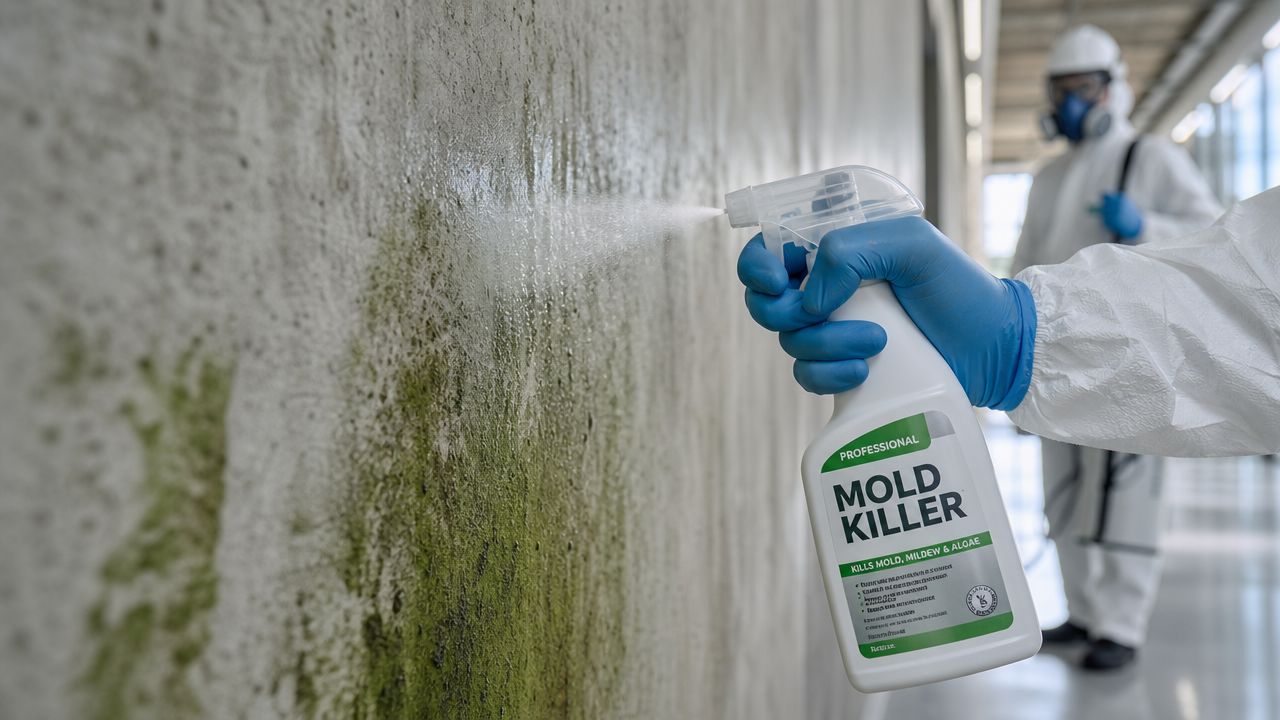
A facility manager usually finds mold in one of two ways. Someone reports a musty odor that won't go away, or someone notices staining on drywall, concrete, ceiling tile, or around an HVAC register. By the time that happens, the key question isn't whether to spray something. It's whether you're dealing with a surface-cleaning problem, a moisture problem, or a remediation problem.
That distinction matters because a commercial mold killer can be useful, but only when it matches the material, the exposure risk, and the actual source of growth. In practice, many products sold into this category do one job well and one job poorly. Some clean visible staining fast. Some offer defined disinfectant or mildewstat claims on hard, non-porous surfaces. Very few solve hidden growth inside porous building materials if the moisture source is still active.
Responding to Mold in Your Commercial Property
A common scenario looks small at first. A dark patch appears behind stored boxes in a receiving area. A basement corridor smells earthy after rain. A tenant mentions recurring odors near an exterior wall. Staff reaches for bleach or a household spray because the patch doesn't look serious.
That's where commercial buildings get into trouble. A visible patch is often only the part you can see. In occupied properties, mold isn't just a housekeeping issue. It affects complaints, downtime, vendor coordination, documentation, and sometimes insurance and lease obligations.
This is also a large, established category in the cleaning and maintenance market. Fact.MR estimated the mildew remover market at US$813.4 million in 2023, with the U.S. market at US$167.2 million in 2024 (Fact.MR mildew remover market analysis). That tells you something practical. Commercial operators deal with this often enough that specialized products and procurement channels are already built around it.
Start with the right question
The first question isn't “What spray should we use?”
It's this: Are we trying to remove a stain, kill growth on a cleanable surface, or remediate contamination in a building assembly?
Those are different scopes of work. If you skip that distinction, you can make a wall look cleaner while leaving the underlying conditions untouched.
Field rule: If the odor returns quickly after cleaning, don't assume the product failed. Assume the moisture source or hidden growth was never addressed.
For a local example of how commercial owners frame the issue from a response and restoration standpoint, this guide for Bradenton businesses on mold is useful because it treats mold as an operational building problem, not just a cleaning task.
Facility teams should also separate mold work from routine disinfection work. The chemistry, contact times, containment needs, and post-cleaning verification can differ. If your staff needs a refresher on ordinary hard-surface sanitation protocols, this surface disinfection guide is a helpful baseline, but mold response usually requires a tighter material and moisture assessment.
What usually works first
Before any product is chosen, do these three things:
- Find the water source: roof leak, plumbing issue, condensation, envelope failure, drain backup, or chronic humidity.
- Identify the material: non-porous surfaces can often be cleaned and treated. Porous materials may need removal, not spraying.
- Document the extent: photos, locations, occupant complaints, and any recurrence pattern.
That sequence prevents the most expensive mistake in mold response. Cleaning before diagnosis.
Understanding EPA Labels on Mold Killing Products
When you buy a commercial mold killer, the label matters more than the marketing copy. In professional settings, the label tells you what the product is allowed to claim, where it can be used, how to dilute it, and how long the surface must stay wet.
That last point gets ignored constantly. If the label requires a wet contact time and your crew mists, wipes, and walks away too soon, you didn't perform the labeled treatment.
What to read on the label
Look for terms that define the job:
- Disinfectant: intended for listed microorganisms on specified surfaces under stated conditions.
- Mildewstat: intended to inhibit mold or mildew growth on labeled surfaces.
- One-step claims: useful only when the actual application conditions match the label directions.
- Surface limitations: many stronger claims apply to hard, non-porous surfaces, not drywall, insulation, or unfinished wood.
A good commercial label reads like instructions for a controlled process, not a general suggestion.
A real example of why details matter
Moldstat 2 is a good example because its directions are specific. Its label information states a dilution of 0.5 oz per gallon of water, equivalent to 850 ppm active, in 400 ppm hard water, with 10 minutes of contact time for virucidal directions. The same product is labeled as a one-step disinfectant, deodorizer, and mildewstat for hard, non-porous surfaces, and it lists organisms including H1N1 influenza, human coronavirus, and RSV (Moldstat 2 label details).
That level of specificity is what separates a true commercial-grade product from a vague “mold remover” claim.
If the label gives a dilution and a contact time, treat both as non-negotiable. Too weak, too strong, or too short can all put you out of compliance with the product's own directions.
How facility managers should use label information
When reviewing a product, verify these points before approving it for staff use:
- Match the claim to the surface. A product may have strong claims on sealed tile or metal and weak relevance on porous materials.
- Confirm dilution control. If the label specifies a concentrate ratio, your team needs measuring tools and training.
- Plan for wet time. Ten minutes means ten full minutes of visible wetness, not a quick spray-and-dry pass.
- Check broader pathogen claims only when they matter. In healthcare-adjacent, high-touch, or shared environments, dual-use products can simplify inventory, but only if your team can execute the label correctly.
What labels do not tell you
A label doesn't tell you whether mold is inside the wall cavity. It doesn't tell you if insulation is contaminated. It doesn't tell you if a leak behind the facade is still feeding growth.
It tells you what the chemistry can do under the exact conditions listed. That's valuable, but it isn't a substitute for building investigation.
Comparing Commercial Mold Killer Ingredients
There's no single best active ingredient for every mold job. The right choice depends on the surface, the soil load, the need for residue control, worker safety, corrosion risk, odor tolerance, and whether you're trying to disinfect, inhibit regrowth, or remove visible staining.

What the main ingredient groups do
Quaternary ammonium compounds, often called quats, are common in institutional disinfectants. On the right labeled surfaces, they can be useful because they're often less aggressive toward finishes than bleach-based products. Their limitation is practical, not theoretical. Surface compatibility and organic load matter, and they are not a shortcut for porous material remediation.
Sodium hypochlorite, the active ingredient in bleach-based products, works as a strong oxidizer. It can change the appearance of mold staining quickly, which is exactly why crews over-trust it. But visible whitening doesn't prove deep kill in porous substrates.
Hydrogen peroxide products are also oxidizers. They're often chosen when teams want a different odor and handling profile than bleach, while still using chemistry that attacks biological material through oxidation.
Acid-based or specialty cleaners, including some stain-focused formulations, can be effective as cleaners or appearance-restoration products. That doesn't automatically make them remediation tools.
For teams weighing bleach products specifically, this guide to bleach disinfectant solutions is useful background because it helps separate disinfecting chemistry from the broader question of mold control.
Active Ingredient Comparison for Commercial Mold Killers
| Active Ingredient | Mode of Action | Best For | Key Considerations |
|---|---|---|---|
| Quaternary ammonium compounds | Disrupt cell membranes on labeled surfaces | Hard, non-porous surfaces where controlled disinfectant use matters | Follow label exactly. Surface limits and cleaning prep matter |
| Sodium hypochlorite | Oxidizes cellular components and bleaches staining | Fast surface stain reduction on appropriate materials | Corrosive potential, strong fumes, and poor fit for many porous-material problems |
| Hydrogen peroxide | Oxidative damage to biological material | Surface treatment where teams want an alternative oxidizer | Can affect some finishes or colors. Still not a substitute for moisture correction |
| Citric acid and similar mild acidic cleaners | Lowers pH and supports cleaning or inhibition in some uses | Light cleaning and maintenance situations | Usually a weaker choice for serious contamination and not a deep-remediation answer |
| Phenolic or specialty institutional actives | Targeted antimicrobial chemistry depending on formulation | Specific professional applications with label support | Requires close review of use instructions and compatibility |
How I'd choose in the field
If the surface is hard and non-porous, I want a product with a clear label, manageable dwell time, and a handling profile my staff can execute safely.
If the surface is porous, I stop asking which chemistry is strongest and start asking whether the material should be removed, isolated, or remediated by a specialist.
The product is only one part of the outcome. Surface type and moisture history usually decide whether cleaning will hold.
The Difference Between Mold Killing and Stain Removal
Often, buyers are misled in this situation. A wall can look clean and still contain viable growth in or behind the material. A product can remove discoloration and still fail to solve the contamination.

Why the clean look fools people
Some formulas are engineered to restore appearance very effectively. A mold-and-mildew remover patent describes a reactive concentrate using acetic acid, sodium metasilicate, sodium tripolyphosphate, sodium alkyl benzene sulfonate, and sodium-o-phenylphenolate, intended to be mixed with an oxidizer such as bleach. The patent describes removal of mold and mildew without scrubbing and with no noticeable residue, but it remains a surface-treatment approach rather than moisture-source elimination (mold and mildew remover patent description).
That's the important distinction. Engineering a product to clean a surface well is not the same as proving that it has remediated contamination inside a porous assembly.
What facility teams should assume
If mold is on painted drywall, insulation, ceiling tile, carpet backing, unfinished wood, or other absorbent materials, don't let appearance drive the decision. The growth may extend below the visible layer. In those cases, “no residue” and “no scrubbing” aren't the same thing as “problem solved.”
Use this practical filter:
- If the problem is only visible staining on a cleanable surface, a commercial mold killer or cleaner may be appropriate.
- If the material is porous or water-damaged, the safer assumption is that the contamination may extend past the surface.
- If growth keeps coming back, the building condition is still supporting it.
The costly mistake
The expensive error isn't buying the wrong bottle. It's using a stain-removal product as if it were a remediation strategy.
A facility can lose weeks that way. Staff cleans. The wall brightens. Occupants stop complaining for a short period. Then humidity rises, the leak continues, or hidden materials stay damp, and the odor returns.
A surface that looks better is not necessarily a surface that is safer.
Safe Application in Commercial Environments
Applying a commercial mold killer in an occupied building should be treated as controlled chemical work. Even when the mold area is limited, the job combines two hazards. Biological contamination and chemical exposure.

Why safety planning matters
A Safety Data Sheet for a commercial mold and mildew stain remover reports 2.15% sodium hypochlorite and warns that mixing with acid or ammonia releases chlorine gas. The same SDS classifies the product as very toxic to aquatic life, with aquatic toxicity values including 48 h EC50 0.071 mg/L and 96 h EC50 0.14 mg/L (sodium hypochlorite stain remover SDS).
Those details tell you exactly why untrained staff get into trouble. The same chemistry that strips staining fast can also create an inhalation hazard or an environmental disposal problem if handled poorly.
Core application controls
A sound procedure usually includes:
- Area isolation: keep spores and vapors from moving into occupied zones or HVAC returns.
- Ventilation planning: exhaust contaminated air where appropriate and avoid recirculating fumes.
- PPE selection: gloves, eye protection, and respiratory protection must match the product and the task.
- Controlled application: avoid unnecessary atomization. Fine misting can spread both spores and chemical droplets.
- Waste handling: rags, disposable PPE, absorbents, and removed materials need a defined disposal path.
If your team is considering sprayers for broader disinfection workflows, this overview of an electrostatic disinfection sprayer is worth reading, but those tools should not be treated as automatic mold-remediation equipment. Mold work often calls for more restraint, not more dispersion.
A practical sequence for in-house use
- Stop access to the area. Keep building occupants and unprotected staff out.
- Review the SDS and label before mixing anything. Never rely on memory.
- Use dedicated tools and containers. Cross-contamination and accidental mixing are common failure points.
- Apply enough product to meet the label without flooding building materials. Oversaturation can worsen a moisture problem.
- Allow the full contact time. Reapply if the surface dries too soon and the label requires continued wetness.
- Clean up residues and waste correctly. Don't wash everything into drains without checking disposal implications.
- Reassess after drying. If staining, odor, or moisture persists, the issue probably extends beyond surface treatment.
What not to do
Don't mix bleach products with other cleaners. Don't let crews improvise stronger concentrations. Don't spray aggressively into porous assemblies and assume penetration equals remediation. And don't reopen the area just because the discoloration is gone.
When to Call a Mold Remediation Professional
A facility team can handle some mold issues in-house. But there's a clear point where the right decision is to stop cleaning and bring in a remediation contractor.

Situations that usually justify outside help
The threshold gets crossed when the problem is larger, hidden, riskier, or recurring.
- Large affected area: If contamination covers more than 10 square feet, treat it as beyond routine spot cleaning.
- Porous or structural materials involved: Drywall, insulation, carpet, wood framing, and upholstered contents often require a remediation mindset, not janitorial treatment.
- HVAC contamination is suspected: Once growth involves ducts, air handlers, or insulation near airflow, the risk spreads beyond one room.
- Water source is unknown or ongoing: If you can't confidently stop the moisture, you can't confidently stop the mold.
- Sensitive occupants are involved: Complaints from employees, tenants, patients, or immunocompromised occupants change the risk calculation.
- Previous cleaning failed: Recurrence is evidence. It usually means the original scope was too narrow.
Why this isn't a defeat
Calling a specialist isn't an admission that your team missed something. It's good risk management. A remediation contractor should bring containment methods, removal protocols, project documentation, and material-level judgment that an in-house janitorial team typically doesn't have.
When mold moves from a visible surface issue to a building-system issue, the cheapest decision is often the wrong one.
A simple decision filter
Handle it in-house only when all of these are true:
- the area is limited
- the surface is cleanable and non-porous
- the moisture source is identified and corrected
- there's no sign of spread into assemblies or HVAC
- no one is reporting building-related symptoms tied to the area
If one of those conditions fails, a professional evaluation is usually the safer path.
Frequently Asked Questions About Mold Control
A few questions come up on almost every mold job. The answers are usually less about the product and more about matching the response to the material and the moisture source.
FAQ on Commercial Mold Control
| Question | Answer |
|---|---|
| Can bleach replace a commercial mold killer? | Sometimes for limited surface cleaning on appropriate non-porous materials, but it's not a universal substitute. Bleach-based products can remove visible staining quickly, yet that doesn't make them a complete answer for porous materials or hidden growth. |
| If I kill the mold, is the problem over? | Not always. Dead growth, residues, and contaminated porous materials can still require cleaning or removal. More importantly, if moisture remains, mold can return. |
| Why does mold come back after cleaning? | Because the building conditions that supported it are still present. Leaks, condensation, humidity, trapped moisture, and concealed wet materials are common reasons. |
| Are “no scrub” products enough? | They may be useful for appearance restoration on some surfaces. They should not be treated as proof of full remediation. |
| Should janitorial staff handle all mold complaints? | No. Routine staff can address some limited, surface-level issues if they're trained and equipped. Larger, recurring, porous-material, or HVAC-related issues need a different level of control. |
| What's the best long-term prevention strategy? | Moisture control. Fix leaks fast, correct condensation problems, dry wet materials promptly, maintain drainage and ventilation, and inspect recurrence points instead of only recleaning them. |
The best commercial mold killer is the one used in the right scope, on the right surface, with the right dwell time, by people who understand its limits. The best mold program is still a moisture-control program.
For more evidence-based guidance on disinfection, pathogens, and practical prevention strategies, visit VirusFAQ.com.
Leave a Reply