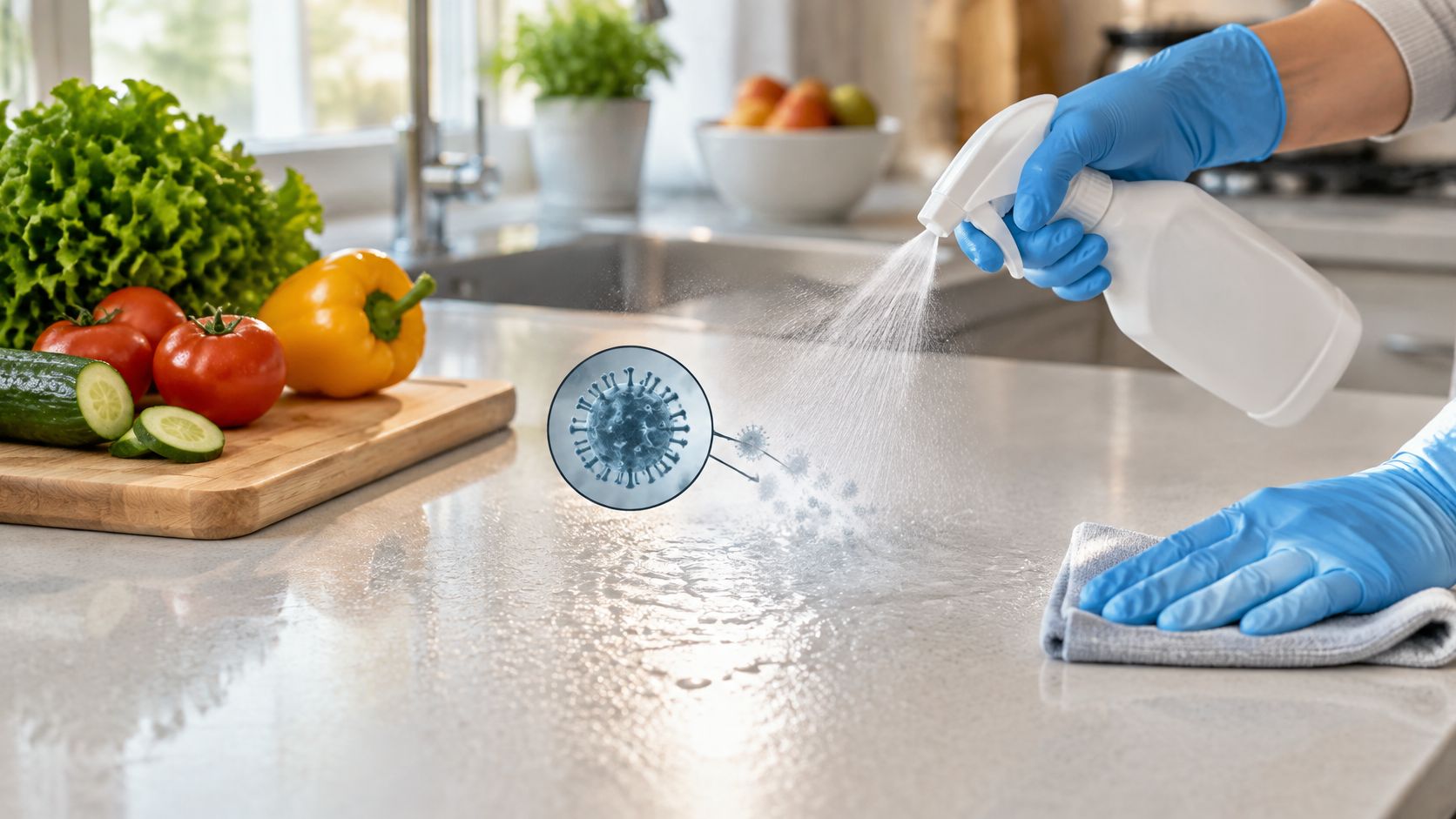
A child just got sick in the hallway, and the cutting board is still sitting next to the fruit bowl. You want the best disinfectant for kitchen work, but the bottle under the sink was bought for "germs," not for this exact mess. The same product can be right on a door handle and wrong on a board that will touch food.
The label is the decision rule. It names the microbes the product was tested against, the surfaces it may touch, how long the surface must stay wet, and whether you rinse before food comes back. Brand and scent do not settle those questions.
Norovirus is the hard case. It is a small non-enveloped virus, tougher than flu or SARS-CoV-2, and soap and water alone will not finish the job on a hard surface. What follows is a task-by-task way to read a label, mix bleach only when the job calls for it, and keep food-contact items inside safer limits.
Quick Picks for Each Kitchen Cleaning Job
The same bottle may suit a counter but not a cutting board. Match the product to the task, then follow its directions for contact time and rinsing.
| Kitchen task | Product to choose | Contact time | Rinse after? |
|---|---|---|---|
| Routine counter or handle wiping | EPA-registered kitchen disinfectant | The wet time printed on the label | Only if the label requires it |
| Food-contact sanitizing for cutting boards and utensils | Sanitizer labeled for food-contact surfaces | 2 minutes at 200 ppm bleach, when the label specifies this use | Check the label; often yes |
| Cleanup after raw meat juice | Detergent first, then a labeled sanitizer | The wet time printed on the sanitizer label | Follow the sanitizer label |
| Suspected norovirus after vomiting or diarrhea | EPA-registered norovirus product or bleach at 1,000-5,000 ppm | At least 5 minutes | Clean again with soap and hot water |
For routine counters and handles, choose an EPA-registered kitchen disinfectant whose label covers the surface and the germ you need to address. Keep the surface wet for the stated contact time. Rinse only when directed.
For cutting boards, knives, and utensils, use a sanitizer labeled for food-contact surfaces. A bleach solution at 200 ppm with a 2-minute contact time is a food-contact sanitizing option described by EPA guidance on sanitizing food-contact surfaces. Follow the product directions, including any rinse requirement, before food touches the item.
Raw meat juice calls for detergent first, followed by a labeled sanitizer. Removing food residue lets the sanitizer reach the surface. Use its stated wet time and rinse as directed.
After vomiting or diarrhea, use an EPA-registered product whose label names norovirus, or chlorine bleach at 1,000-5,000 ppm. The CDC norovirus prevention guidance maps that range to about 5-25 tablespoons of household bleach at 5%-8% sodium hypochlorite per gallon of water. Keep the surface wet for at least 5 minutes, follow the product label, then clean again with soap and hot water.
Alcohol wipes can address many everyday germs, but they do not reliably inactivate norovirus. Choose a product with a norovirus claim for that cleanup.
For ordinary crumbs, handles, and wipe-downs, everyday kitchen cleaning shortcuts can help keep routine cleaning manageable. A shortcut does not replace the product directions for sanitizing or disinfecting.
Cleaner, Sanitizer and Disinfectant Are Not the Same
Think of the three words as three different jobs in a sink, not three smells on a shelf.
A cleaner is the wash. A sanitizer is the step that reduces microbes to a safer level. A disinfectant is the stronger step that aims to inactivate specific pathogens, including viruses, when the label says it does. Judge the bottle by that claim, not by how it looks or smells.
Cleaners lift grease, starch, and food film. That film shields microbes and uses up active ingredient, so disinfectant on a dirty counter underperforms. The order is detergent first, a water rinse, then the disinfectant for its full wet time.

The label is the legal boundary. An EPA-registered product lists the organisms it was tested against, the surfaces it suits, the contact time, and whether food-contact use needs a potable-water rinse. A bottle marketed as antibacterial may have no norovirus claim at all.
The same reading habit helps on drinkware. HYDAWAY's guide to natural cleaning methods for hydration gear is a practical way to think about residue inside bottles. Bottle care is still not a virus claim for a counter.
A short companion on the difference between sanitizing and cleaning walks through that split without the chemistry jargon.
Three questions on any bottle
What does it claim to inactivate? Look for the organism name, not a vague "kills germs" line.
On which surfaces? Food-contact, hard nonporous, or a narrower list.
For how long must it stay wet? The wet time is part of the claim. Wipe sooner and you did not finish the step.
If one answer is missing, that bottle belongs to a different job.
How Active Ingredients Stack Up Against Norovirus
Enveloped viruses such as SARS-CoV-2 and influenza carry a lipid coat that is easier to disrupt. Non-enveloped viruses such as norovirus, rotavirus, feline calicivirus, and rhinoviruses do not. That is why alcohol products often fail on norovirus even when they work on flu.

| Active ingredient | How it works | Norovirus claim possible? | Food-contact note |
|---|---|---|---|
| Chlorine bleach (sodium hypochlorite) | Oxidizes viral proteins and genetic material | Yes, at 1,000-5,000 ppm for outbreaks | Sanitizing at 200 ppm, rinse rules per label |
| Ethyl or isopropyl alcohol | Disrupts proteins and the lipid envelope | No reliable norovirus claim | Set by that product's label |
| Quaternary ammonium | Disrupts microbial membranes | Some products only, check label | Read the rinse line |
| Hypochlorous acid | Oxidizes microbial components | Some products, per EPA listing | Some labeled food-contact only with post-rinse |
| Hydrogen peroxide | Oxidizes cell components | Only if that label lists norovirus | Follow that label's rinse line |
Chlorine bleach is the broad option with the clearest public backing when you dilute it for the job in front of you. It can pit some metals and fade fabrics, so it is a poor habit on every surface in the room.
Alcohol pulls apart proteins and that lipid envelope. Useful on many everyday germs. It is the wrong default once you suspect norovirus.
Quaternary ammonium, the quat in a lot of wipes, disrupts microbial membranes. Some formulas carry a norovirus claim and many do not. The rinse rule is formula-specific too. A wipe is only as relevant as those two lines.
Hypochlorous acid is often sold as the gentler oxidizer. EPA List N product records show that some hypochlorous-acid products have norovirus claims and are designated for food-contact surfaces only with a post-rinse. Gentler does not mean no-rinse, and it does not mean every bottle in that family has the same claim.
Hydrogen peroxide oxidizes as well. Whether a given peroxide spray or wipe lists norovirus, and whether food can touch the surface afterward, is not a single public recipe. The evidence for one kitchen-wide rule is thin. Trust that label and its contact time, or pick a product whose claim you can point to.
The ingredient predicts only part of the result. The label confirms the rest. Choosing bleach, alcohol, a quat, hypochlorous acid, or peroxide because the name sounds strong is less reliable than matching a registered claim to the virus and the surface.
Bleach Strength and Contact Times That Work
Three jobs, three mixes. Do not use the outbreak mix on a board that will hold bread.
| Job | Bleach per gallon (5-8% solution) | Chlorine level | Minimum contact time |
|---|---|---|---|
| Food-contact sanitizing (cutting boards, utensils) | 1 tablespoon | 200 ppm | 2 minutes, then air-dry |
| Basic household disinfecting | 5 tablespoons (one-third cup) | 1,000 ppm at the low end of the outbreak band | Visibly wet for label time; 1 minute without label directions |
| Norovirus cleanup on non-food surfaces | 5 to 25 tablespoons | 1,000-5,000 ppm | At least 5 minutes, then clean with soap and hot water |
Food-contact mix
An EPA bleach sanitizer label specifies 200 ppm available chlorine for food-contact surfaces: 1 tablespoon of bleach per gallon, on the surface for at least 2 minutes, then air-dry. Remove food and loose debris first, prewash with detergent, and rinse with potable water before the sanitizer goes on. Some food-safety practice also treats about 50-100 ppm as a routine range, so the label you are holding still wins.
Household mix and the outbreak band
The CDC bleach disinfection page sets a basic household mix at 5 tablespoons, or one-third cup, of bleach per gallon of room-temperature water, or 4 teaspoons per quart. Use unexpired bleach, ventilate, and never combine bleach with ammonia or another cleanser, because dangerous reactions can occur. Properly prepared solutions remain effective for disinfection for up to 24 hours. That 5-tablespoon count is the bottom of the 5-to-25-tablespoon outbreak band, so treat it as about 1,000 ppm, not as a food-contact sanitizer.
If no product directions are available, CDC facility cleaning guidance says the surface should stay visibly wet for at least 1 minute. Wiping early stops the product from doing the job the claim describes. A fuller walk-through of bleach for disinfection covers mixing habits without turning every spill into an outbreak mix.
The higher outbreak concentration belongs on non-food surfaces and in cleanup after illness. On a cutting board, stronger is not better.
These figures do not override a product label, and they do not make every bleach formula suitable for direct food contact. If the label demands a rinse, rinse.
How to Disinfect After Vomiting or Raw Meat
For kitchen surfaces that may hold norovirus, the CDC norovirus cleanup guidance recommends either chlorine bleach at 1,000-5,000 ppm or an EPA-registered disinfectant labeled as effective against norovirus. That bleach range is 5-25 tablespoons of 5%-8% household bleach per gallon. It must stay on the area for at least 5 minutes, and then you clean again with soap and hot water. Norovirus can persist in kitchens and spreads through food, hands, and surfaces, which is why counters, boards, and utensils get the same seriousness as the floor.

Our Education articles highlight practical tips for staying safe, cleaning effectively, and recognizing common risks. The sequence below is that kind of tip, written as steps you can follow while the room still smells like the spill.
Ventilate and glove up. Open a window and put on gloves before you mix anything. Bleach fumes and contamination both matter from the first minute. The slip is starting to wipe while the bottle is still closed and the air is still still.
Lift the visible mess. Use disposable towels for vomit, juice, or loose food, and bag them. Loose organic matter consumes disinfectant. A cloth you plan to rinse in the sink just moves the mess.
Wash with detergent. Strip grease and soil with detergent and water. Skipping this pass is why a later spray seems to "not work."
Mix for this job only. Use room-temperature water and bleach that is not expired, at the strength the task needs. Do not splash disinfectant onto food. Throw out a leftover mix rather than saving it for next week.
Keep it wet. Apply so the surface stays visibly wet for the full contact time, at least 5 minutes for norovirus. Set a timer. Wiping at the one-minute mark is the most common failed cleanup.
Wash again. Clean the area again with soap and hot water so residue does not stay where hands and food return.
Rinse food-contact items when the label says so, then air-dry. A board that is still damp is not ready for the fruit bowl. Cross-contact from a wet board back onto ready-to-eat food is a separate problem, and ways to prevent cross-contamination spell out how hands, boards, and utensils pass microbes along.
Laundry and hands. Wash dirty cloths in hot water. Wash your hands with soap and water after gloves come off.
A finished job looks ordinary. The surface was wet for the full time, rinsed where the label required it, and dry before food came back.
Food-Contact Surfaces and Troubleshooting Failures
Food-contact surfaces fail for boring, repeatable reasons. Each one has a single fix.
You skipped the detergent pass. On a greasy board the chemical meets soil, not microbes. Wash first, every time, even when the spill looks like a thin smear of juice.
You trusted "no rinse" without reading it. Some products need a potable-water rinse and some do not. Check that line before each use. Residue where you slice tomatoes is not a bonus.
You fogged the room. CDC public-health disinfection strategy warns that electrostatic sprayers or foggers can aerosolize disinfectant onto countertops, dishware, or food. Liquids, spray bottles, or wipes give you control over where the chemical lands. In food areas, use only products approved for food-contact surfaces and follow any wiping or rinsing the label requires.
You wiped before the clock finished. That is the usual reason a product "didn't work." Set a timer for the label time.
Fixes after a bad pass
If the surface dried early, reapply and restart the clock. Do not count the dry minutes.
If a board still smells strongly of bleach after air-drying, rinse it with potable water and dry it again before food returns.
If a metal knife or sink shows dull spots or pitting after repeated bleach, switch to a product labeled for that item and read its metal note. Bleach is not kind to every alloy.
If illness touched a porous board, a cloth, or a fabric seat, replace the cloth or use a product labeled for that material. Wiping alone is a weak plan on something that soaks.
Stone needs its own caution. Harsh chemistry and the wrong cloth can haze a finish even when the germ claim is correct. Varun Marbles' polished marble countertop maintenance tips are worth reading before you park a strong oxidizer on marble day after day.
If you would not put the next tomato on that surface, the job is not finished.
Choose Your Kitchen Disinfectant Before the Next Spill
Keep two products, not a crowded shelf. One is an EPA-registered disinfectant whose label names norovirus, saved for vomiting, diarrhea, and other outbreak cleanup. The other is a sanitizer labeled for food-contact surfaces, used on boards, utensils, and counters during ordinary cooking.
On the shelf, read in this order: the pathogen claim, the surface list, the contact time, and the rinse line. Buy only what those lines support. A pretty bottle with no norovirus line does not cover the hallway job.
Diluted bleach is the low-cost route if you will measure and mix it fresh. Ready-to-use sprays skip the measuring. Pre-moistened disinfecting wipes help a busy kitchen keep a hard surface wet for the full label time without a mixing cup, provided that wipe's label carries the claim the task needs. A wipe with no norovirus line stays in the everyday drawer.
Our Science articles cover mutation mechanisms, virus-host interactions, disinfection strategies, environmental factors, and real-world applications of virus control. The shopping choice is smaller than that list. You are matching a registered claim to a surface, not ranking brands by scent.
This week, pull out what is already under the sink. Move any product without a norovirus claim out of the outbreak job. Buy the missing item, whether that is a labeled food-contact sanitizer or a norovirus wipe you will keep wet for the full time.
Buy for the task, follow the label, and keep the contact time.
Tonight, set the two bottles side by side and read the four lines on each: pathogen, surface, wet time, rinse. If the outbreak job has no norovirus claim, put a pack of disinfecting wipes that lists it next to the gloves, and keep the food-contact sanitizer by the board. The next spill goes faster when the right product is already chosen.
Leave a Reply