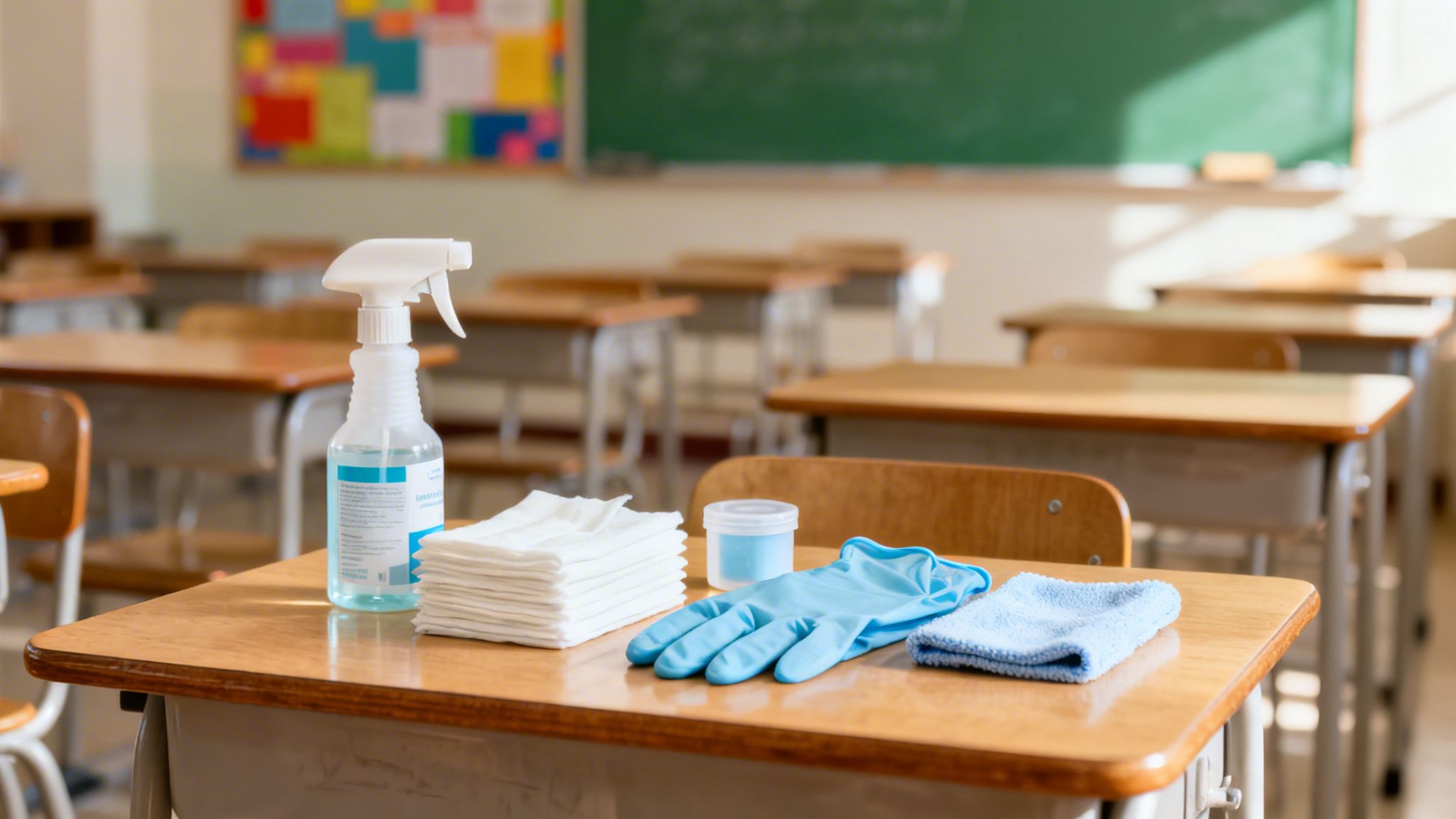
Keeping your classroom healthy is non-negotiable. It’s the foundation for everything else you do. This guide breaks down the essential classroom cleaning supplies you need to stop viruses from spreading and causing waves of student and staff absences.
Keeping Your Classroom Healthy and Ready for Learning

Every educator knows a healthy classroom is a learning classroom. But without a consistent hygiene strategy, common areas quickly become breeding grounds for germs that can derail an entire school week.
Think about it. High-touch surfaces like desks, doorknobs, and shared tablets are invisible highways for viruses. A single doorknob can be touched by dozens of hands in an hour, easily transmitting pathogens like the Influenza A Virus (H1N1), the highly contagious Norovirus, and SARS-CoV-2.
Protecting Instructional Time Through Proactive Cleaning
An effective cleaning protocol isn’t just another chore—it’s a core educational tool, as vital as any textbook or whiteboard. The real goal is to create an environment where learning can happen without the constant disruption of illness. When kids are healthy and in their seats, you maintain instructional momentum.
Interrupting the chain of infection isn't just about cleanliness—it's about protecting instructional time and ensuring every student has the chance to thrive. A simple act, like wiping down a shared tablet between uses, can prevent a virus from sidelining a student for a week.
This guide will show you how to build a smart, practical defense against the pathogens most common in schools. We’ll get into the specific supplies you need, the science behind why they work, and the strategies for building a healthier school year.
Here’s what we’ll cover:
- Understanding the Science: We'll look at how viruses like Rhinovirus Type 14 (the common cold) and Human Rotavirus survive on surfaces and spread through everyday contact.
- Choosing the Right Supplies: You'll learn the difference between cleaners, sanitizers, and disinfectants, with a focus on products proven to work against the toughest small non-enveloped viruses.
- Implementing Effective Strategies: We’ll map out simple, repeatable cleaning schedules that both custodial staff and educators can use to protect the entire school community.
Picture the journey of a single virus in your classroom. A student with a cold (Rhinovirus Type 39) touches their nose, then grabs a shared pencil. The next student who picks up that pencil can become infected. This simple chain of transmission happens thousands of times a day on countless surfaces.
By putting a strategic cleaning plan in place with the right supplies, you break those chains. A classroom equipped with effective disinfecting wipes, for example, allows for quick, targeted cleaning of hot spots throughout the day. This isn't just about reducing germs; it’s about building a culture of health and safety that reassures parents, protects staff, and keeps your students where they belong—in their seats, ready to learn.
The Science of a Cleaner Classroom and Healthier Students
A clean classroom is far more than just appearances—it’s one of the most practical investments you can make in student and staff health. The science is crystal clear: the connection between a well-cleaned classroom and a healthy school community is undeniable. When we understand this science, cleaning stops being just a chore. It becomes a frontline strategy for keeping everyone healthy and maximizing learning time.
It all boils down to a concept called fomite transmission. Think of a fomite as any object that gives a virus a free ride. When a sick student sneezes, coughs, or just touches their nose and then grabs a crayon, that crayon becomes a fomite. It’s now a little taxi, waiting to pass that virus along to the next person who picks it up.
Fomites: The Invisible Highway for Viruses
Viruses can linger on surfaces for hours, and some tough ones can survive for days, just waiting for a new host. This is especially true for stubborn, small non-enveloped viruses like Norovirus and Feline Calicivirus, which are notorious for causing widespread outbreaks in schools. A shared tablet, a doorknob, a light switch—these can all become hotspots for transmission. You can learn more about just how long different germs can stick around in our guide on how long viruses live on surfaces.
This is exactly why a consistent cleaning routine with the right supplies is non-negotiable. We're not just wiping away dust and grime. We're actively breaking the invisible chain of transmission that allows germs to spread silently from one person to the next.
A landmark study of over 15,000 students in K-8 schools proved this point loud and clear. Schools that followed a structured cleaning and disinfecting plan saw an 8.6% reduction in student absences from common viral illnesses. It’s a direct line from a better cleaning plan to fewer sick days.
This research puts real numbers behind what we know intuitively: effective cleaning delivers measurable results. It’s a direct investment in keeping students healthy, in their seats, and ready to learn.
Measuring Cleanliness: The Power of ATP
So, you’re cleaning regularly. But how do you know it’s actually working? This is where a bit of science comes in handy with a tool that acts like a "germ detector" by measuring adenosine triphosphate (ATP). ATP is an energy molecule found in all living things—including the bacteria, mold, and human cells that viruses love to cling to.
An ATP meter is surprisingly simple. You swab a surface, like a desktop or a water fountain button, and the device gives you a reading of the organic material present. A high ATP score is a clear sign that a surface isn't truly clean and could be a breeding ground for pathogens.
Here’s an easy way to think about it:
- A high ATP reading is like a flashing neon sign that says, “Germs Welcome Here!” It tells you that area needs a thorough cleaning, right now.
- A low ATP reading is the green light. It confirms your cleaning protocol successfully removed the gunk that viruses use to survive.
This technology gives you real, data-driven proof that your efforts are paying off. By using tools like ATP meters, schools can verify that their classroom cleaning supplies and procedures aren't just making things look clean—they're genuinely reducing the microbial load and creating a safer space for everyone. Of course, clean surfaces are just one piece of the puzzle; a truly healthy classroom also depends on understanding indoor air quality.
How to Choose the Right Classroom Cleaning Supplies
Walking down the cleaning aisle can feel like a pop quiz you didn't study for. Every bottle promises a germ-free classroom, but how do you know what actually works? It’s not about flashy marketing—it’s about understanding the science on the label to pick supplies that are both effective against viruses and safe for students and staff.
Before we even talk about products, we need to get our terms straight: cleaning, sanitizing, and disinfecting. These aren't just marketing words; they're distinct actions with very different outcomes.
- Cleaning is your first step. It’s the physical act of removing dirt, grime, and germs from surfaces using soap or detergent and water. You have to clean first because viruses and bacteria love to hide in all that gunk.
- Sanitizing is about lowering the number of bacteria on a surface to a level considered safe by public health standards. Notice I said bacteria—it doesn't guarantee it kills viruses.
- Disinfecting is the one that really matters for stopping illness. This process uses chemicals to kill germs, including tough viruses like Influenza A2/305/57 (H2N2), Norovirus, and SARS-CoV-2.
If you want to dig deeper into these differences, our guide on the distinction between sanitizing and cleaning is a great resource. For everyday upkeep, simple cleaning often does the job. But when you’re trying to stop an outbreak in its tracks, disinfection is non-negotiable.
Decoding Disinfectant Labels
So, how do you find a legitimate disinfectant? It's simpler than you think. Look for an EPA registration number on the label. This little number is your proof that the U.S. Environmental Protection Agency has vetted the product’s data and confirms it does what it says it does—kill the germs listed.
For specific threats, the EPA keeps special lists. The most famous is List N, which contains all the products proven to work against SARS-CoV-2. The EPA also maintains lists for other hard-to-kill pathogens, ensuring you can find a disinfectant proven effective against viruses like Human Coronavirus or Herpes Simplex Virus 2 (HSV-2).
Choosing Effective Disinfecting Active Ingredients
When you turn the bottle around, you'll see the "active ingredients." These are the chemical compounds doing the heavy lifting. While the list can be long and intimidating, a few common ones show up again and again in school settings. Each has its own strengths and weaknesses.
| Active Ingredient | Effective Against | Pros | Cons & Safety Notes |
|---|---|---|---|
| Quaternary Ammonium Compounds (Quats) | Broad-spectrum (bacteria, fungi, enveloped viruses like Herpes Simplex Virus 1 (HSV-1)) | Very common, good cleaning ability, low cost. | Less effective on some non-enveloped viruses (like Norovirus). Can cause skin or respiratory irritation. |
| Hydrogen Peroxide (Accelerated) | Broad-spectrum (viruses, bacteria, spores), including some large non-enveloped viruses. | Breaks down into harmless water and oxygen, making it a greener choice. | Can be more expensive. May lighten or damage certain fabrics and porous surfaces over time. |
| Hypochlorous Acid (HOCl) | Broad-spectrum (viruses, bacteria, fungi) including tough viruses like Avian Influenza Virus (H5N1). | Extremely effective yet gentle on skin and surfaces. Non-toxic and safe for food-contact areas. | Shorter shelf life than other disinfectants. Can be sensitive to light and air. |
| Alcohol (Ethanol or Isopropyl) | Most bacteria and enveloped viruses like Human Immunodeficiency Virus Type 1 (HIV-1). | Fast-acting and evaporates quickly without leaving a residue. | Requires high concentrations (60-90%). Flammable. Can damage plastics, rubber, and shellac finishes. |
The key takeaway here is there's no single "best" ingredient. The right choice depends on the specific viruses you're targeting, the surfaces in your classroom, and your school's safety protocols. Always, always read the label.
Understanding Contact Time: The Most Overlooked Step
Here’s the part where even the best intentions fall short: contact time. This is the non-negotiable amount of time a surface must stay visibly wet with a disinfectant to actually kill the germs.
If a product needs 3 minutes to kill Norovirus but the desk you just sprayed dries in 30 seconds, you haven't disinfected anything. You've just made the surface damp.
This is the classic failure point of the "spray-and-wipe" method. It creates a false sense of security while leaving active viruses right where they were—on desks, doorknobs, and shared crayons.
Getting the contact time right is tricky. It changes based on the product, the surface type, and even the humidity in the room. For a busy teacher juggling a dozen other tasks, trying to re-wet a surface for several minutes is practically impossible.
This is exactly why pre-saturated disinfecting wipes have become the gold standard in many schools. They are engineered to hold and release a consistent amount of disinfectant, which makes it far easier to keep a surface wet for the full required time. Plus, using a fresh wipe for each major surface prevents cross-contamination—the act of unintentionally spreading germs from a dirty area to a clean one. It's a simple switch that ensures your hard work is actually making the classroom a safer place.
The Hidden Cost of Classroom Hygiene on Teachers
When school budgets can’t cover all the bases, there's an unspoken reality in classrooms across the country: teachers step in to fill the gaps. It’s an issue that goes far beyond the logistics of keeping a room tidy. It’s the personal and financial weight that lands squarely on the shoulders of educators who simply refuse to let their students learn in an unhealthy environment.
This isn’t just about buying a few extra boxes of tissues. It’s a real, growing problem. Teachers have always dipped into their own pockets for supplies, but the need for effective cleaning products has pushed that spending to a whole new level. Driven by a deep-seated commitment to their students' well-being, they’re the ones making sure disinfectant wipes and hand sanitizer are available, even when the official supply closet is bare.
The Soaring Out-of-Pocket Expenses
The numbers tell a staggering story. During the 2020-2021 school year, teachers spent an average of $750 of their own money on classroom supplies. That’s a massive 25% jump from what they were spending before.
Think about that. A full 30% of these teachers spent $1,000 or more, many digging into their personal savings to make sure their classrooms had what they needed. A huge chunk of that increase—an average of $160 per teacher—went directly to PPE and cleaning products like disinfectants. You can dig deeper into the data in this detailed report on teacher spending.
What this really shows is a major disconnect. We know what it takes to keep a classroom healthy, but we’re often asking individuals to foot the bill.
Understanding the right process is key to seeing why having the right supplies is non-negotiable.

This chart makes it crystal clear: cleaning a surface to make it look clean is totally different from disinfecting it to actually kill germs. That last step requires specific products—the very ones teachers are so often forced to buy themselves.
A Plea for Institutional Support
Expecting teachers to fund classroom hygiene out-of-pocket just isn't a sustainable solution. It’s a flashing sign pointing to an urgent need for schools and districts to step up. Providing cleaning supplies should be just as fundamental as providing textbooks or laptops. When schools don't budget for these essentials, they're passing a hidden tax directly to their teachers.
When a teacher buys a container of disinfecting wipes, they're not just buying a product. They're buying peace of mind for themselves and for the parents who trust them with their children's well-being. It’s an investment in health that shouldn't come out of their own paycheck.
The story of teacher spending is a powerful call to action for everyone—parents, administrators, and policymakers. It’s a plea to see the very human side of this issue.
By properly funding and distributing effective supplies like EPA-registered disinfectants, schools can lift this unfair burden. It frees teachers to focus their time, energy, and their own money on what they do best: teaching. A well-supplied classroom is a direct reflection of a school’s commitment to the health of its entire community.
Your Practical Classroom Cleaning Checklist

Knowing what to clean is one thing, but knowing when and how is what really makes a difference in a busy school. An effective cleaning routine doesn’t have to be complicated, but it absolutely has to be consistent.
A great cleaning checklist isn’t about trying to do everything all at once. It’s about building a rhythm of daily, weekly, and monthly tasks that eventually become second nature. To keep things running smoothly, smart labels for storage and organization for all your supplies can be a real game-changer.
Daily Disinfection Priorities
Your daily tasks should be laser-focused on high-touch surfaces. These are the germ hotspots where viruses like Rhinovirus and Bovine Viral Diarrhea Virus (BVDV) spread most easily. The goal here is quick, targeted action to break the chain of transmission.
Your daily to-do list should always include:
- Entry and Exit Points: Doorknobs, push plates on doors, and light switches.
- Student Workspaces: The tops of desks and tables, plus the backs of chairs where students grab them.
- Shared Technology: Keyboards, computer mice, and tablet screens (use an electronics-safe wipe for these).
- Communal Supplies: Think pencil caddies, scissor holders, and crayon bins.
For these daily wipe-downs, convenience is key. To avoid just pushing germs around, use a fresh disinfecting wipe for each major surface area—for example, one wipe for a small cluster of desks. This makes the job fast, effective, and actually gets rid of the pathogens.
Weekly and Monthly Reset Tasks
Weekly and monthly cleanings go a bit deeper, tackling the grime that builds up over time but isn't as critical for day-to-day virus control. Think of these tasks as a way to maintain overall classroom hygiene and keep things from getting out of hand.
The responsibility for consistent cleaning is so critical that it often falls to teachers to fill the gaps. In the United States, an astonishing 94% of public school teachers use their own money for classroom supplies, spending between $500 to $750 on average each year. As you can read in this government report, that budget often includes essential cleaners and disinfectants to protect their students.
Here’s a sample schedule for those deeper cleans:
- Weekly Tasks:
- Wipe down less-trafficked surfaces like bookshelves, windowsills, and the fronts of cabinets.
- Give whiteboards and smartboards a thorough cleaning.
- Organize the classroom library and wipe down the covers of books.
- Monthly Tasks:
- Deep clean and organize shared supply bins, especially in art or science areas.
- Wipe down walls around high-traffic zones like light switches and trash cans.
- Inspect and clean out personal cubbies or student lockers.
Fostering Student Responsibility
Getting students involved in keeping their space clean is a powerful way to build community and personal accountability. While younger kids can help with simple tidying, older students can be safely taught to manage their own areas.
Giving each student a disinfecting wipe at the end of the day to clean their own desk and chair is a fantastic habit to build. It not only lightens your load but also teaches them a crucial life skill and reinforces that a healthy classroom is everyone’s job.
And for those who want to mix their own powerful cleaners, our guide on making a disinfectant bleach solution gives you clear, step-by-step instructions for doing it safely and effectively.
Building a School-Wide Strategy for Virus Prevention

While one dedicated teacher can certainly make their classroom a cleaner, safer space, true virus prevention can't happen in a silo. Real, lasting change requires a school-wide commitment. Stopping germs is a team effort, pulling together teachers, administrators, custodial staff, and even parents toward a single, critical goal.
Think of it this way: viruses like Hepatitis B Virus (HBV), Hepatitis C Virus (HCV), or Norovirus (Norwalk Virus) don't stop at the classroom door. A coordinated strategy is the only way to ensure the same high standard of safety is maintained everywhere—from the front office to the cafeteria and the gym. It shifts hygiene from a personal chore to a shared, school-wide value.
From Individual Effort to School-Wide Policy
To really protect a school community, we have to move past relying on individual teachers buying supplies with their own money. It’s time for smart, institution-wide policies. That means creating dedicated budgets for EPA-approved classroom cleaning supplies and, just as importantly, training all staff on how to use them correctly.
A well-executed, science-backed cleaning program is one of the smartest, most cost-effective moves a school can make. It’s a direct line to reducing the spread of viruses like Influenza A Virus (H1N1), which immediately cuts down on sick days for students and staff. Fewer absences mean more time for learning, better academic performance, and a healthier environment for everyone.
Investing in a unified, science-backed cleaning program isn't just about meeting a basic need—it's a strategic investment in student health and academic continuity. When the entire school community works together, the result is a safer, more resilient institution.
A Unified Call to Action
The final piece of the puzzle is equipping everyone with tools that are both effective and easy to use. Let’s be realistic—the school day is chaotic. Any effective plan has to work in the real world. This is where the right supplies are non-negotiable.
- Equip everyone with the right tools. Placing ready-to-use disinfecting wipes in every classroom, office, and common area makes it simple for anyone to tackle a high-touch surface on the spot.
- Keep it simple. The easier you make a task, the more likely it gets done right, every time. Pre-saturated wipes, for example, take the guesswork out of mixing chemicals or wondering about proper contact time. They just work.
- Build a culture of health. When students see every adult—from the principal to their teacher and the custodial team—using the same tools to keep the building clean, it sends a powerful message: we’re all in this together.
Ultimately, an effective school-wide strategy is about making smart, collective choices. When you frame proven tools like disinfecting wipes not as a small expense but as a critical investment in the health of your entire school, you're making the most powerful move possible. It's an investment that pays for itself with fewer illnesses, more learning, and a community that feels safe and cared for.
Frequently Asked Questions About Classroom Cleaning
When you're in charge of keeping a classroom safe, questions about cleaning supplies are bound to come up. It's one thing to wipe down a desk, but it’s another to know you’re truly protecting students from germs.
Let's tackle some of the most common questions we hear from educators and facilities staff. Getting the right answers is the first step toward building a cleaning plan that actually works.
Is It Safe to Use Disinfectants Around Children?
This is a huge—and completely valid—concern. The short answer is yes, but only if you choose the right products and use them correctly.
Many newer disinfectants, like those using accelerated hydrogen peroxide or hypochlorous acid, are designed to be tough on viruses but gentle enough for schools once they've had a chance to dry.
Always stick to these common-sense safety rules:
- Get the Air Moving: Whenever you’re spraying, open some windows or doors to get good ventilation.
- Clean After Hours: Save the major disinfection jobs for when the classroom is empty. This gives products time to work and surfaces time to dry completely.
- Read the Label: The product label is your most important tool. It tells you exactly how to apply it and whether you need to rinse the surface afterward.
For quick cleanups during the day, pre-saturated disinfecting wipes are a fantastic choice. They give you more control, cut down on airborne spray, and make it easy to hit a single doorknob or desk without a major production.
What Is the Real Difference Between Cleaning and Disinfecting?
People use these words interchangeably all the time, but in the world of infection control, they are two very different steps. Getting this right is fundamental to stopping viruses from spreading.
- Cleaning: This is all about removing the visible stuff—dirt, grime, and dust—from a surface. You use soap (or a cleaner) and water. Cleaning is always the first step because germs love to hide in grime.
- Disinfecting: This step uses chemicals to kill germs like viruses (Influenza, Norovirus) and bacteria that are left behind on the surface. Disinfecting will not work if you haven't cleaned first.
Think of it this way: cleaning is like sweeping the floor before you mop. You have to get rid of the loose dirt first. If you don't, you’re just pushing dirty water around. The same goes for disinfecting—you can't kill germs you can't reach.
How Often Should We Be Disinfecting High-Touch Surfaces?
Here, consistency beats intensity every time. For the surfaces that get touched the most, daily disinfection is the gold standard, especially once cold and flu season kicks into high gear.
Key Insight: A focused, daily routine on critical surfaces is far more effective than an occasional deep clean of the entire room. Prioritize your efforts where they will have the most impact.
Make these spots part of your daily closing routine:
- Doorknobs and light switches
- Desks, tables, and the tops of chair backs
- Shared supplies (like staplers or pencil sharpeners) and tech (keyboards, tablets)
- Water fountain buttons and bathroom fixtures
A quick wipe-down of these areas at the end of each day can dramatically lower the number of viruses like Rhinovirus and SARS-Related Coronavirus 2 (SARS-CoV-2) hanging around. In fact, one study found that when a school ramped up its cleaning and disinfection routine, it saw a 14% drop in student absences.
You can dive into the details of this impactful study on student health yourself. It’s powerful proof that these simple, consistent actions directly contribute to keeping kids in their seats and learning.
Leave a Reply